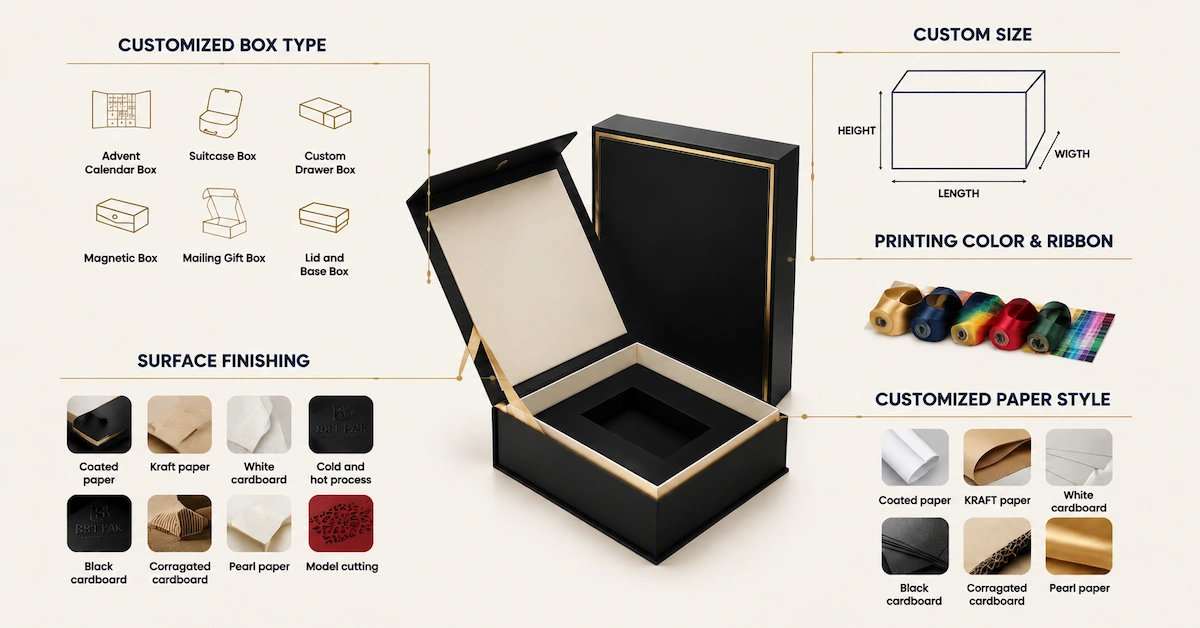

Ask five suppliers to quote the same custom jewelry packaging and you may get five numbers that differ by a factor, not by a percentage. Nothing dishonest is happening. They have priced five different objects. One assumed a folding board box with a printed lid. Another priced a rigid box with a wrapped shoulder. A third added a flocked vacuum-formed tray. A fourth quoted a wooden construction with a magnetic closure. The fifth priced the pouch as well, because you said "packaging" and it read that word literally.
That is the real problem with custom jewelry packaging cost. The number is not hard to find. The specification behind the number is. And a unit price is only comparable once the specification, the quantity basis, the one-time charges and the delivery terms all match.
So this article does something narrower than a price list. It shows you what moves a unit price, what changes at each order tier, which one-time costs buyers forget to budget for, and where the money you think you saved gets spent anyway. Who is it for? Small and mid-sized jewellery brands, private-label sellers, distributors, e-commerce brands and retail buyers who are about to send their first or third packaging brief.
If you are still choosing a supplier rather than costing a project, two existing guides cover that ground in detail — Custom Jewelry Packaging and the Custom Jewelry Packaging Manufacturer Guide. This page stays on money.

Publisher, conflict and research disclosure — reviewed September 27, 2026: BRTPAK publishes this article and manufactures custom jewellery packaging in Jinhua, China. We have a direct commercial interest in the subject, and we route readers from this page to our own product and contact pages. The cost logic, the relative weightings and every judgement about where buyers overspend are the publisher's editorial view. They are not an audit, a price survey, a market study or an identical request for quotation run across competitors. We did not obtain confidential price lists from other suppliers, and we did not compare the same brief side by side across a panel of factories.
Method limit: what follows is cost structure, not a quotation. Our cost positions come from our own manufacturing experience and from published sources where a source is cited. They do not describe your project, your market, your material choice or your quantity. Nothing here is an offer, a rate card, or a commitment on timing. Final cost is subject to actual specifications and a formal quotation.
One deliberate omission. You will not find unit prices, price bands or "from" figures in this article. Published numbers age badly, they vary with specification, and a rate that suits one buyer's volume misleads another. Ask three suppliers for a quotation against one brief instead. That takes a day and tells you more than any table on the internet.
✉ Request a Custom Packaging Quote
What "custom jewelry packaging cost" actually includes
The first mistake is treating the unit price as the cost. It is one line in a longer list, and on a first order it is rarely the largest line.
Unit price is not total cost
What you actually pay is the landed cost of goods that pass inspection on the date you need them. Build it up properly and you get: unit price, plus one-time charges, plus freight and duty, plus inspection and any third-party testing, plus the cost of the defects your inspection plan lets through, plus the cost of the delay if the goods arrive late. Strip out any of those and the comparison becomes fiction.
Here is the practical consequence. Two quotes can differ at the unit-price line and reverse their ranking once the other lines are added. A slightly higher unit price with an existing insert tool and a factory-run finish frequently beats a lower unit price that needs new tooling, a bespoke finish and a sample round you will pay for twice.
One-time costs
These are the charges that arrive once and then keep helping you. Sampling. Tooling and dies. Printing plates for foil or screen work. Artwork preparation and colour proofing. A first-article approval round. Some of them are recoverable against a bulk order if you negotiate that up front; some are simply the price of starting. They are all predictable, and they are all invisible if you only ask for a unit price.
Recurring costs
Then there are the costs that repeat quietly. Freight, priced on volume as often as on weight. Duty and clearance. Storage if you hold stock. Reorders at a small quantity, which carry a setup element every time. Replacement of damaged units. Re-printing if a colour drifts between batches. Individually these look small. Across a year of reorders they are usually the difference between a healthy margin and a thin one.
The honest framing is this: buy packaging as a system, price it as a system, and measure it after two reorders. The unit price is the worst single indicator you can optimise.
Quick reference: where costs land by packaging type
Different formats concentrate cost in different places. A folding carton concentrates it in printing and board. A rigid box concentrates it in hand assembly. A pouch concentrates it in fabric and stitching. Knowing where the weight sits tells you what to negotiate.
| Packaging format | Where the cost concentrates | Quantity sensitivity | Best fit |
|---|---|---|---|
| Folding board box with printed lid | Board grade, print method, die-cutting | High — press runs reward volume heavily | E-commerce shipping, lower price points, printed storytelling |
| Rigid box with wrapped shoulder | Hand assembly, wrapping, magnetic closure, lining | Moderate — labour falls with volume but never disappears | Retail presentation, unboxing-led brands, gifting |
| Wooden or MDF box | Material, cutting, finishing, hardware | Moderate, with a material floor | Premium and heirloom positioning, watch and high-value jewellery |
| Velvet or suede pouch | Fabric, cutting, stitching, drawstring or ribbon | High on fabric cutting, moderate on stitching | Add-on packaging, travel, in-store hand-off |
| Moulded or flocked insert | Tooling first, then material and cycle time | Very high — this is the most volume-sensitive item | Fixing a piece in place, protecting stones, presenting a set |
| Printed collateral inside the box | Setup, plate or screen charges, paper stock | High on setup, low on material | Brand story, care instructions, certificates |
Read that table against your own brief. If your cost is concentrated in inserts, your negotiating lever is the tooling and the cycle time. If it is concentrated in hand assembly, the lever is structure simplification. They are not the same conversation.
Send us your brief and we will send back a cost breakdown structured the same way, item by item, so you can put it next to any other quote without re-reading the specification twice.
✉ Get a Cost Breakdown for Your Project
The seven factors that move your unit price
Seven variables explain most of the difference between two quotes for the same brief. They are listed roughly in order of weight, though the order shifts with the format.
1. Material system
Material matters, but less than most buyers assume. Moving from a basic board to a heavier board, or from a paper wrap to a fabric wrap, changes cost in a steady, predictable way. What changes cost sharply is moving between material families — from board to wood, for example, or from a printed surface to a hand-finished lacquer. Those jumps are structural, not incremental.
2. Structural complexity
This is usually the single largest driver, and the one buyers underestimate most. Every extra moving part — a drawer, a hinged lid, a magnetic closure, a ribbon pull, an internal shelf — adds cutting, assembly and a quality checkpoint. A simple box with a beautiful finish almost always costs less than a complicated box with an ordinary one.
3. Surface finishing
Machine-applied finishes are cheap and repeatable. Hand-applied finishes are neither. Hot foil, screen print, embossing, debossing, spot UV and laser engraving each carry a different setup and a different per-unit behaviour. Foil and screen work bring plates or screens into the project; embossing can bring a die.
4. Insert design
The insert is where a box becomes a product. One insert shape for the whole range is economical. A different insert for every SKU multiplies tooling and inventory. The smart middle path is one box body with interchangeable pads — you get the presentation of a custom fit without paying for a new mould in every size.
5. Dimensions and material consumption
Bigger boxes use more material, more lining and more carton space. The second half of that sentence is the one buyers miss. A box that fits three millimetres better inside its shipping carton can move the landed cost more than a cheaper board.
6. Order quantity
Volume lowers unit cost because it spreads setup. It lowers it fastest on press work and moulded inserts, and slowest on hand assembly. There is also a point past which extra volume stops helping — the setup is already amortised, and what you are buying is throughput. More on that below.
7. Deadline pressure
Rush work is expensive in a specific way: air freight instead of sea, overtime instead of a planned schedule, and an inspection that happens under time pressure rather than properly. The cost of a rushed order is rarely the unit price. It is the freight line, and it is the defects you accept because you ran out of time to argue.
| Factor | Direction of effect on unit price | Relative magnitude | Room to optimise |
|---|---|---|---|
| Material system | Rises with grade; jumps between material families | Steady, moderate | Yes — standardise on one family across a range |
| Structural complexity | Rises with each additional moving part | Largest driver in most formats | Yes — simplify before you shop for price |
| Surface finishing | Rises sharply with hand-applied work | Large and often underestimated | Yes — pick finishes the factory runs routinely |
| Insert design | Rises with the number of distinct insert variants | Large on tooling, moderate per unit | Yes — one body, interchangeable pads |
| Dimensions | Rises with area, volume and carton footprint | Moderate, compounding through freight | Yes — design to a standard carton |
| Order quantity | Falls with volume, then flattens | Large at low volumes, small at high volumes | Partly — consolidate SKUs into one run |
| Deadline pressure | Raises freight, overtime and defect exposure | Volatile | Yes — move the date, not the money |
Order those seven for your own project before you send a brief. Then state each one explicitly. Suppliers cannot price what you have left open, so they price the most expensive plausible reading of your brief instead. That is how a "cheap" quote becomes an expensive order.

MOQ: what actually changes at each volume tier
Minimum order quantity gets treated as a single gate. It is really three gates standing in a row, and the one that stops you is usually not the one you asked about.
Why minimums exist
A production run has fixed costs: setting the machine, mixing or ordering the material, making the sample, preparing the artwork, running the first article past a quality check. Those costs are the same whether you order a hundred pieces or a hundred thousand. At low volume they sit on very few units. That is the whole explanation, and it means the conversation is always about which fixed costs can be spread or reused.
Where the savings actually come from
Four things shift as quantities grow, and not at the same speed. Setup charges spread over more pieces. Material terms improve, which shows up most on imported fabric and specialty board. A general line gives way to a dedicated run, so consistency improves and the schedule tightens. Then packing moves from hand work to a standard pack — usually the last visible saving to appear.
Where it stops helping is worth saying too. Past a certain point the setup is fully amortised, the material terms have flattened, and further volume buys throughput rather than savings. That point sits at a different quantity for a hand-assembled rigid box and a moulded insert. Ask your supplier where it is for your specific item — a good one will tell you, because it changes the whole shape of your buying plan.
How to run a small quantity without paying a small-quantity penalty
There are legitimate ways to start small. Use a standard box body and spend the customisation budget on the insert, the print or the wrap, where changes are cheaper. Choose a material and finish the factory already runs. Accept a slightly longer lead time so your order can share a production window. Consolidate several SKUs into one run instead of ordering them separately. Or run a pilot in a stock format to validate the retail reaction, then commit to a custom run once you know which SKU is worth it.
Two of our existing guides handle the small-volume supplier question directly, and this article deliberately does not repeat them: read Small Packaging Box Supplier and Choosing Your Ideal Small Packaging Box Supplier for how to select a supplier at that scale.
| Volume tier | How marginal cost behaves | Sensible buyer profile |
|---|---|---|
| Sample and prototype | Highest cost per piece by a wide margin; expect dedicated labour | Validating a shape, a finish or an insert before committing |
| Pilot run | Setup dominates; material terms still poor; per-piece cost falls quickly | Testing a first collection or a single flagship SKU |
| Standard production | Setup spreads across a real run; material improves; consistency improves | Brands with a known sell-through rate and a reorder plan |
| Consolidated multi-SKU run | Setup amortises across variants; packaging and freight improve together | Brands with several SKUs that can share one material and finish |
| Very high volume | Savings flatten; you are buying throughput, capacity and reliability | Established ranges with forecasted demand |
Small-brand buyers usually ask about minimums first. Ask about the tier structure instead. "What changes between these quantities, and where does it stop changing?" is a better question than "what is your MOQ", because it tells you how to plan the next two orders rather than only the first one.
Running a pilot or a first run at a modest quantity? Tell us the SKU count, the finish you want and the market you ship to, and ask specifically about small-batch options on that combination.
✉ Ask About Small-Batch Pricing
One-time costs buyers forget to budget for
These charges do not appear in a unit price, and on a first order they can genuinely surprise a buyer who planned around one number. None of them are unreasonable. All of them should be in the quotation.
Sampling
A sample is a small production job, and it is priced like one. You are paying for setup, for a material quantity too small to buy well, and for a craftsman's time on a single unit. That is why sample cost and bulk cost behave so differently. Ask what the sample includes: a mock-up in the intended material, a dimensional check, or a finished piece with the actual lining and logo. Those are three different things and three different prices.
Dies, moulds and cutting tools
Die-cutting tools, insert moulds and jigs are the capital items in a packaging project. The critical question is not the charge. It is ownership. If you pay for a mould, whose asset is it, where is it stored, and what happens to it if you move to another supplier? Get that in writing before the tool is made, not after. A tool you own but cannot retrieve has no value.
Printing plates, screens and engraved blocks
Foil stamping needs a plate or block. Screen printing needs a screen per colour. Embossing needs a die. Laser engraving usually needs a program rather than tooling, which is one reason it appeals to brands running many SKUs. These items are usually modest individually and add up when a design uses several colours or several decoration methods.
Artwork, proofing and approvals
Somebody has to turn your logo file into production artwork, set the tolerances, and prove the colour. If you supply a clean vector file, an approved colour reference and a clear position drawing, this step is short. If you supply a low-resolution file and a verbal description, it becomes a design job with extra rounds. Cheap here, expensive there — that trade runs both ways.
| One-time charge | Recoverable against a bulk order? | Triggered when |
|---|---|---|
| Sampling and mock-up | Sometimes, by prior agreement | Any new shape, material or insert |
| Die, mould or cutting tool | Sometimes, and often negotiable on a first order | New box footprint, new insert geometry, new cutting shape |
| Foil plate or engraved block | Rarely | Hot foil or embossed branding |
| Screen charges | Rarely | Screen printing, per colour |
| Artwork and proofing | Usually charged as work, not as a deposit | File preparation, colour proof, position drawing |
| First-article approval round | Usually absorbed into the run if no rework is needed | Pre-production sign-off on a custom item |
| Third-party testing | No | When a destination market or a retail customer demands it |
Budget these deliberately on the first order. On the second order of the same specification, most of them disappear — which is the practical reason a reorder costs less than a launch, and worth remembering when you compare two suppliers on a first-time brief.

How packaging volume changes your landed cost
Here is the part of the calculation that catches out good buyers. Freight is usually charged on the space your goods occupy, not only on what they weigh. Low-density packaging — boxes and inserts that are mostly air — is therefore priced largely on cardboard geometry.
Volumetric weight and carton efficiency
Carriers and forwarders apply a volumetric measure that converts volume into a chargeable figure, and apply whichever of the two measures is greater. So a carton that could have been shallower, or a box that could have nested, is paid for on every shipment. Multiply that across a year of reorders and it becomes a permanent line in your margin. Nothing about the box itself needs to change to fix it. Only the geometry.
What lightweighting and nesting actually save
Three design moves do most of the work. Nesting: structures that collapse or stack inside each other in the carton. Dimension discipline: sizing the box to a standard shipping carton rather than to a round number that wastes space. Material reduction where it costs nothing structurally: board thickness and lining weight that carry presentation without carrying freight. A fourth move is packing discipline — the master carton, the inner separation and the pallet pattern, which is where the third decimal place lives.
Work through this with the freight calculator open, not afterwards. Ask your supplier for the carton dimensions, the pieces per carton and the packed volume before you compare freight quotes. A supplier who can produce those numbers on request is telling you something useful about how they work.
| Landed-cost variable | How it behaves | Practical way to improve it |
|---|---|---|
| Volumetric weight | Set by packed volume, usually the binding constraint on packaging | Nest structures, remove void space inside the carton |
| Pieces per master carton | Falls when boxes are awkwardly sized | Fit the box to a standard carton footprint instead of a round number |
| Pallet pattern | Improves with squared cartons and consistent heights | Standardise carton height across the range |
| Duty and clearance | Follows declared value, classification and origin | Make sure origin and material statements match the goods |
| Damage in transit | Rises with unsupported structures and mixed cartons | Specify a transit test position for the packed product |
| Replacement and reprint | Recurs if a finish is not reproducible | Lock the finish method and keep an approved reference |
| Small-quantity reorders | Carry setup every time | Plan two or three reorders as one consolidated run |
Packaging that ships well is a design outcome, not a courier negotiation. That is why we look at carton efficiency in the structural design stage rather than at the quotation stage — it is one of the three things we do differently, and it is covered in Jewelry Box Packaging for Global Shipping.
Where buyers overspend, and where cutting cost backfires
Overspending in packaging almost never comes from a bad price. It comes from a decision taken early and paid for late. Five patterns show up again and again.
Common overspend points
The first is paying for a custom structure when a standard body would have carried the same design. The second is specifying a hand-finished surface for a market that will never see it — packaging that ships inside a mailer and gets thrown away does not need a lacquer finish. The third is tooling a separate insert for every SKU instead of one body with interchangeable pads. The fourth is discovering freight cost after the box is designed. The fifth is ordering a large first run to chase a better unit price, then sitting on stock you cannot sell through and reprinting the packaging when the design changes.
Two more that are less obvious
Buying packaging and display from suppliers who cannot match a colour reference, then re-buying one of them to fix the match. And approving a sample by eye without signing it, then discovering in bulk that "the same as the sample" was never defined.
Three places not to cut
Do not cut the approved sample process. It is the only control you have over bulk quality, and it is cheap relative to a rejected shipment. Do not cut the transit test position for goods that move as parcels or mixed pallets. Do not cut compliance documentation for a market that asks for it; retrofitting a material declaration onto goods already on the water is not a cost problem, it is a stopped-shipment problem.
| Overspend scenario | Root cause | How to avoid it |
|---|---|---|
| Custom structure where a standard body would do | The brief was never compared against what already exists | Ask for the stock or standard equivalent before approving tooling |
| Premium finish on packaging nobody opens twice | Positioning and channel were not matched | Match the finish to how the goods are actually delivered |
| A separate insert for every SKU | Customisation budget spent in the most expensive place | One box body, interchangeable pads |
| Freight discovered after the design is frozen | The carton was never part of the design brief | Design to a standard carton from the first drawing |
| A large first run to chase a better unit price | Volume was bought before sell-through was known | Pilot first, then consolidate the reorders |
| Re-buying one supplier to fix a colour mismatch | Display and box sourced with no shared reference | Fix one colour reference across all materials |
| A bulk dispute about "the same as the sample" | The sample was never signed or photographed | Golden sample, tolerances and defect definitions in writing |
Compliance is a cost question too, not only a design one. Take REACH, in force since 2007. Substances above one tonne per year per company must be registered with the European Chemicals Agency. Article 33 hands consumers a right to know about substances of very high concern in articles, and it gives companies 45 days to answer. Every one of those duties has a material consequence, and material consequences have a price.
Packaging changed shape as well. A directive became a regulation. Look at the Commission's own pages for Regulation (EU) 2025/40. In force since 11 February 2025. Applies from 12 August 2026. Broadly replaces the 1994 Packaging Directive. And by 2030? Recyclable in an economically viable way, for everything on the EU market. What does that do to your budget? It tilts the economics toward paper-based protection and away from mixed constructions a recycler has to pull apart first.
California wants a decision about warnings. Proposition 65 — formally the Safe Drinking Water and Toxic Enforcement Act of 1986 — obliges businesses to warn Californians whenever exposure to a listed chemical is possible. Your legal adviser owns that call. Your supplier owns the other half, and the other half is cheaper to settle. Paper sourcing claims deserve identical scepticism. FSC runs chain-of-custody certification and three label categories, those being 100%, Recycled and MIX. "FSC on request" tells you nothing at all about what sits in your carton.
Certificates cost money, which is the only reason they belong in a cost article. Take ISO 9001:2015 on iso.org. Withdrawn. Stage 95.99. Dated 16 September 2026. ISO 9001:2026 is the named replacement. Fair to ask a supplier to move to the current edition. Fairer still to ask who pays for the transition. Transit testing follows the same logic. Goods moving as parcels or mixed pallets? See ISTA, where procedures run from screening through to general simulation of the motions, forces and conditions of a distribution environment. How your goods move decides which one you need.
How BRTPAK prices this work
Claim boundary: this section is publisher self-description. It is not an independent verification of factory ownership, in-house control of every process, material composition, origin, certification, sample or bulk quality, capacity, price, timing or delivery. Nothing here is an offer, a rate or a commitment, and nothing here should be read as a price for your project. Legal seller, material supplier, production site, sample, quality control, packing, price and schedule all depend on the exact order, destination, contract and written confirmation. Final cost is subject to actual specifications and a formal quotation.
BRTPAK is Jinhua Better Industrial Co., Ltd., a packaging manufacturer in Jinhua, Zhejiang, producing jewellery boxes, watch boxes, watch rolls, watch winders, trays and displays. We quote each project against a written specification, and the quotation itemises the unit price, the one-time charges, the packing basis and the delivery terms separately so you can see which line you are negotiating.
Three things shape how we cost work, and they are the reasons buyers tell us our quotes read differently. We build a 3D concept before physical sampling, so a rejected shape costs you a screen review rather than a sample budget. We optimise structure for carton efficiency rather than chasing the lowest possible unit price, because on a reorder plan the freight line usually outweighs the unit line. And we prepare compliance documentation against the destination market rather than issuing one generic pack.
If you want to see how a specification is written before you send one, use our earring box OEM RFQ guide, then look at Jewelry Box Manufacturing Standards and Drawer vs Clamshell Jewelry Box for the structural and standard-setting detail. How to choose a prototype jewelry box factory covers sample expectations, and Jewelry Box Manufacturer Guide plus Top 20 Jewelry Box Manufacturers in China cover supplier comparison. To see a specification turned into a drawing, start at online custom design.
Questions buyers ask us
What does custom jewelry packaging cost per unit?
No single figure survives a real brief. The unit price is a function of structure, material, finish, insert, dimensions and quantity, and two buyers asking your question are often describing two different products. So take the structural answer instead: work out which of the seven drivers dominates your item, then ask for an itemised quotation against one written specification. Final cost is subject to actual specifications and a formal quotation.
What minimum order quantity should I expect?
Expect three minimums rather than one: per design, per material, and per colour or finish. Material and finish usually bind first, so a supplier quoting a low design minimum can still need more pieces for your chosen fabric or board. Ask what changes between tiers and where the savings stop, instead of only the entry quantity.
Are sampling fees refundable against a bulk order?
Sometimes, and only when it was written down before the sample was made. The common version credits the sample charge against the bulk invoice, or waives it after a second round. Tooling is a separate conversation from sampling, and more often recoverable. Both belong in the quotation as named lines, not folded into one lump.
Which one-time costs should I budget for?
Sampling. Die-cutting or mould tooling. Foil plates or screens. Artwork and colour proofing. A first-article approval round. Add third-party testing if your destination market or your retail customer asks for it. Most of these disappear on a reorder of the same specification, which is exactly why a second order usually costs less than a launch at an identical quantity.
What does custom logo printing or foil stamping add?
Method decides this more than logo size. Screen printing and hot foil each need a plate or screen per colour. Embossing needs a die. Laser engraving needs a program rather than physical tooling, which makes it the friendliest option for a brand running many SKUs at modest volumes. Multi-colour work multiplies the setup. Ask for logo cost as its own line so you can model what happens when a second colour arrives.
Does ordering more always lower the unit price?
No, and that surprises people. Volume lowers cost until the setup is fully spread and the material terms have stopped improving. Past that point you are buying throughput and capacity rather than savings. The turnaround arrives earlier on a moulded insert than on a hand-assembled box. Ask where it sits for your item, because the answer decides whether your next step is more pieces or more SKUs.
What payment terms can I expect on a first order?
Terms on a first order are negotiated rather than standard, and they tend to track how much work has to be paid for before goods exist. What matters more than the split is that the quotation states the basis, the currency, what triggers each stage, and which charges sit outside the terms. Confirm it in writing per order, and check how a change order or a rework moves the schedule.
How long should a packaging quote stay valid?
Ask for a stated validity period, because material and freight markets move and a supplier's exposure grows with the gap between quote and order. If you need a longer hold, say so when you request the quote rather than months later. A quotation with no validity date cannot legitimately be held to anything — which cuts both ways, and is worth remembering when you are the one holding it.
What should I send to get a reliable quote?
Send one specification, not several vague options. Finished dimensions. Material and finish system. Insert layout. Logo method with artwork. Quantity per SKU and per colour. Packing requirement. Destination market. Ask every supplier to price that brief exactly, and to put any deviation on a separate alternate line. Then compare the total cost of goods that pass inspection by the date you need them. Unit price alone will not get you there.
Next step: send your packaging brief
Ten exploratory emails get you ten answers to ten different questions. One written brief does not. Specification, quantity basis, packing requirement, destination market — all of it in a single document. Send that document everywhere, unchanged. Ask for the cost structure in the same order each time, every time, and the comparison stops being guesswork.
Then turn that cold eye on your own numbers. Unit price by itself tells you very little. Watch the one-time charges, the packed carton volume, and how often you reorder. Do that and packaging stops surprising you at quarter end.
Send your packaging brief. Include the destination market, the jewellery box format and dimensions, the insert layout, the exterior and lining materials, the logo method, the quantity by colour and SKU, the packing requirement and the date you need the goods. BRTPAK will return its own quotation, itemised so you can set it beside every other quote on the same basis. Final cost is subject to actual specifications and a formal quotation.
✉ Send Your Packaging Brief to BRT Pak
Supplier identity, production site, material composition, origin, environmental and certification evidence, samples, tests, inspection, capacity, minimum order, cost, packing, schedule and delivery terms remain subject to current source checks, destination requirements, contract, released specification and written confirmation. No figure in this article constitutes a price, an offer or a commitment.
Research basis: every standards and regulatory reference above was re-checked on 27 September 2026. One source let us down: EUR-Lex wanted JavaScript before it would load, so the EU packaging regulation is cited from the Commission's own page instead. Everything else comes from the organisations linked in the body. And where a number would normally sit, a relationship sits instead. Deliberately so.