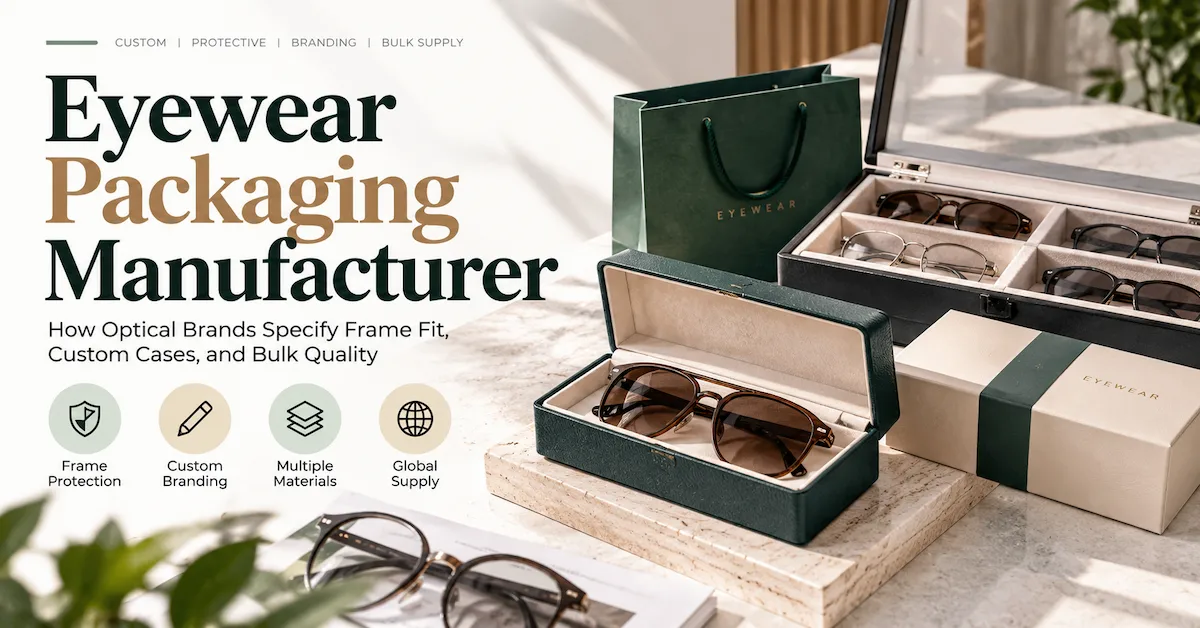

The purchasing challenge changes when an optical business grows from selling one eyewear collection to managing different frame types, colors, retail locations, and distribution channels. One store may require premium storage boxes for designer sunglasses, while another needs economical branded packaging for everyday optical accessories. A wholesale importer may need several variations in a single shipment, each with different inventory turnover.
Ordering these products without a clear purchasing system can create excess stock, inconsistent branding, incorrect carton assortments, and emergency replenishment costs.
This guide explains how to organize wholesale eyewear packaging programs, plan mixed-SKU orders, manage MOQ restrictions, maintain product consistency, and work with a supplier on repeat purchasing. It focuses specifically on long-term sourcing and inventory management, rather than repeating the frame-fit engineering and initial sample-testing topics covered in a separate eyewear packaging manufacturer guide.
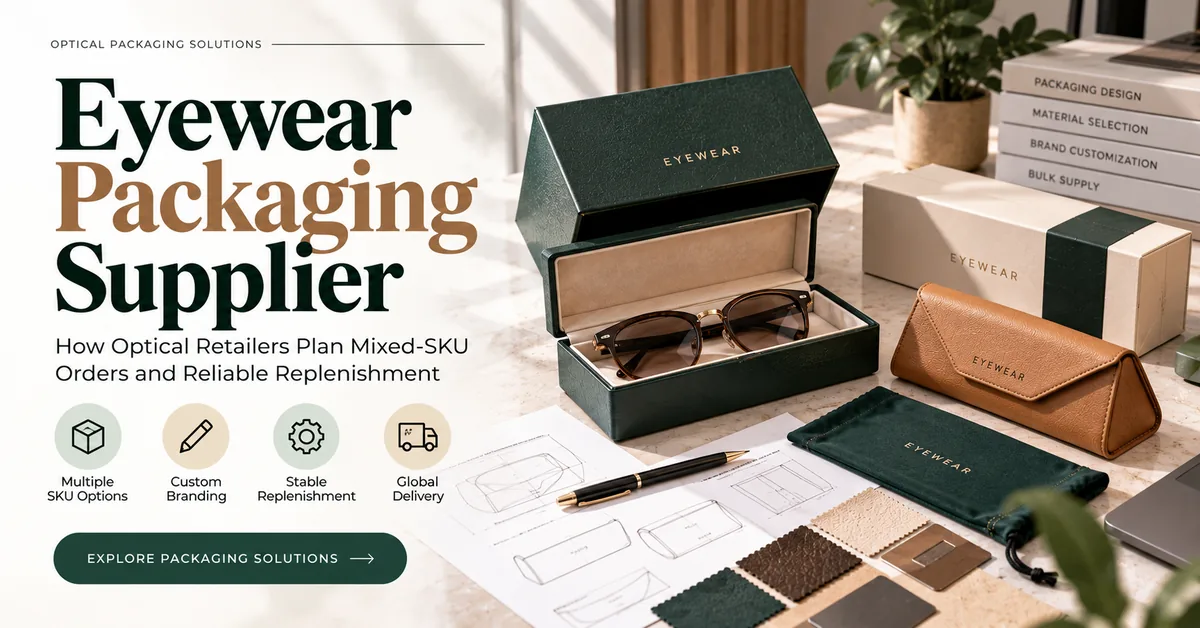
1. Why Does Eyewear Packaging Supply Become Difficult at Scale?
For businesses buying only one case design, procurement may appear relatively straightforward. Once the sample is approved, the buyer selects a quantity, confirms the price, and places the order.
However, optical brands and retailers often operate a much more complicated supply chain.
An expanding eyewear business may sell prescription glasses, premium sunglasses, sports eyewear, travel accessories, and multi-pair storage products. Each category may require different packaging dimensions, material choices, branding, and inventory quantities.
The difficulty is not necessarily manufacturing a single box. It is managing the growing number of packaging combinations without creating unnecessary cost or inconsistency.
Too Many SKUs Can Increase Inventory Pressure
Consider a brand that offers three packaging formats, four colors, and two logo variations.
If every combination must be stocked separately, the brand could theoretically manage 24 packaging SKUs.
Not every combination will sell equally well. Some may move quickly, while others occupy warehouse space for months.
When buyers place orders based only on a supplier's minimum quantities, they may purchase more slow-moving packaging than their sales forecasts justify.
The result can be excessive inventory, higher storage costs, obsolete branding materials, and additional working capital tied up in packaging.
A better approach is to reduce unnecessary variation before negotiating quantities.
Replenishment Delays Can Disrupt Product Availability
A business may have enough eyewear inventory to fulfill orders but lack the packaging required to ship or present those products.
For example, a premium sunglasses collection might be ready for distribution, but its matching branded cases may not arrive until several weeks later.
The delay affects the complete product offering, even if the sunglasses themselves are available.
This is why packaging replenishment should be coordinated with product launches, sales forecasts, and warehouse inventory rather than managed as an isolated purchasing task.
Inconsistent Packaging Can Weaken Brand Presentation
Customers may purchase the same eyewear collection from different stores or at different times.
If packaging materials, logo colors, surface textures, or box dimensions vary noticeably between batches, the brand's presentation can become inconsistent.
Such differences may arise from undocumented material substitutions, artwork revisions, different manufacturing arrangements, or incomplete reference samples.
A long-term supplier relationship should therefore include a documented specification and a defined approval process for changes.
Mixed-SKU Shipments Increase Receiving Complexity
A shipment containing several case types requires more careful identification than a shipment of one standard product.
If carton labels, packing lists, and product codes are unclear, warehouse teams may need to open and sort cases manually.
This creates additional labor and increases the possibility of sending the wrong item to a store or customer.
An effective supply plan should identify each configuration clearly and specify how products are separated, counted, labeled, and packed.
The central procurement objective is to balance packaging availability with controlled inventory investment. Buying more units is not always better, and ordering the lowest-cost option is not always the most economical decision.
2. Which Buyers Benefit Most From a Structured Packaging Supply Program?
Different eyewear businesses have different purchasing priorities. A supplier that is suitable for a small gift collection may not necessarily be the right partner for a large multi-store optical chain.
Optical Retail Chains
Retail chains need consistent packaging across locations.
Their purchasing departments may coordinate centralized procurement while individual stores distribute the packaging to customers.
Common priorities include standardized branding, reliable replenishment, consistent product identification, and packaging that can be allocated efficiently between stores.
The supplier should be able to work with a controlled specification and provide clear information about production schedules and order configurations.
Sunglasses Brands
Sunglasses brands often introduce seasonal colors, limited editions, and multiple product collections.
Their packaging may need to support different positioning levels, from standard retail accessories to premium branded presentation.
These businesses benefit from separating permanent packaging specifications from seasonal design elements.
For example, a standard case construction might remain unchanged while the exterior color or printed sleeve varies between campaigns, provided the proposed changes are technically and commercially suitable.
This can reduce unnecessary redevelopment while allowing the brand to maintain visual differentiation.
Eyewear Wholesalers and Importers
Wholesale buyers usually focus on assortment planning, purchasing quantities, import costs, and inventory turnover.
They may need several product styles within a single order, including storage boxes, individual cases, and other accessories.
Their biggest questions often concern whether different SKUs can be combined, how minimum order quantities are applied, and whether products can be supplied consistently across repeat orders.
A suitable supplier should explain the commercial implications of each configuration instead of providing only a general wholesale price.
Private-Label Accessory Brands
Private-label businesses need products that can be sold under their own branding.
Their requirements may include custom logos, coordinated colors, packaging inserts, product labeling, and presentation suitable for retail or online sales.
They also need clarity about ownership of artwork, customized components, and any exclusive design arrangements.
OEM and ODM services can support these needs, but each project's exact customization scope should be confirmed before development begins.
When a Long-Term Custom Program May Not Be Suitable
A fully customized purchasing arrangement may not be commercially appropriate for every buyer.
Businesses with very small or irregular demand may find an existing suitable packaging format more practical than maintaining several custom SKUs.
Likewise, customers with urgent, one-off requirements may be better served by available inventory where a suitable product exists.
The goal is to establish the most appropriate purchasing structure for actual demand, rather than automatically choosing the highest level of customization.
3. How to Build a Manageable Eyewear Packaging SKU Portfolio
Before asking an eyewear packaging supplier for bulk prices, buyers should decide which packaging variations they genuinely need.
This process is often called SKU rationalization.
It involves reviewing all planned packaging configurations and identifying opportunities to standardize dimensions, materials, colors, inserts, and artwork without compromising product suitability.
Organize Products Into Packaging Families
Rather than treating every eyewear model as a completely separate packaging project, create groups with similar functional and commercial requirements.
| Packaging family | Typical products | Primary purchasing considerations |
|---|---|---|
| Standard Optical Packaging | Everyday prescription glasses | Consistent format, brand presentation, replenishment |
| Premium Sunglasses Packaging | Fashion and designer sunglasses | Premium appearance, suitable internal dimensions, branding |
| Travel & Accessory Packaging | Portable eyewear storage accessories | Compact structure, handling suitability, assortment planning |
| Multi-Pair Storage Boxes | Eyewear organizers and collector products | Capacity, divider structure, larger carton volume |
| Gift & Promotional Packaging | Seasonal sets and corporate gifts | Artwork changes, campaign schedules, quantity planning |
| Custom Retail Display Packaging | Store presentation and merchandising | Display format, material consistency, store allocation |
These represent procurement planning categories, not a claim that BRT PAK currently supplies every listed format as an existing SKU.
Product availability, individual case development, and customization options must be confirmed for each project.
Identify Shared Components
Some packaging configurations may use the same exterior structure with different inserts or surface decoration.
Others may share materials or colors while requiring different dimensions.
Where technically appropriate, standardizing components can simplify material purchasing, artwork management, production planning, inventory identification, repeat-order specification control, and warehouse handling.
However, component standardization must not override actual eyewear compatibility.
A box designed for a narrow optical frame should not be assumed suitable for oversized sunglasses simply because the buyer wants fewer SKUs.
Separate Functional SKUs From Marketing Variations
Not every marketing variation requires a completely different structural product.
For instance, two collections might share the same case construction but use different exterior sleeves or logo decoration.
The buyer should compare the incremental cost of customization with the resulting inventory complexity.
If a seasonal design requires a separate MOQ, the business should evaluate whether projected sales justify carrying that packaging inventory.
Create a SKU Master Record
A packaging SKU master should include all information needed for purchasing, storage, and replenishment.
| Data field | Purpose |
|---|---|
| Internal SKU Code | Uniquely identifies the packaging configuration |
| Product Name | Provides a readable description |
| Packaging Family | Groups similar products |
| Revision Number | Identifies approved specifications |
| Material & Color | Defines the visible construction |
| Logo Version | Prevents outdated branding |
| MOQ | Records the confirmed purchasing minimum |
| Supplier Lead Time | Supports replenishment planning |
| Carton Quantity | Helps calculate warehouse and shipment needs |
| Approved Sample | Links the SKU to the accepted reference |
| Forecast Demand | Supports order quantity decisions |
| Reorder Point | Identifies when purchasing should begin |
| Supplier Contact | Supports procurement coordination |
This record should be updated whenever the approved configuration or commercial conditions change.
A good SKU structure makes it easier for the buyer and supplier to discuss the same product without confusion.
4. How to Compare Eyewear Packaging Formats for Wholesale Purchasing
Packaging format influences inventory costs, product positioning, storage requirements, and purchasing flexibility.
A multi-pair organizer has different commercial characteristics from a standard single-pair case. Even when two products use similar materials, they may require different manufacturing processes, carton arrangements, and minimum order quantities.
Standard Cases vs. Premium Cases vs. Multi-Pair Storage
| Evaluation factor | Standard Single-Pair Case | Premium Custom Case | Multi-Pair Storage Box |
|---|---|---|---|
| Primary purpose | Individual eyewear storage | Branded eyewear presentation | Multiple-pair organization |
| Typical buyer | Optical retailers | Sunglasses and fashion brands | Accessory retailers and wholesalers |
| Product capacity | One pair | Usually one pair, depending on design | Several pairs, depending on compartments |
| Custom branding | Depends on design and supplier | Often a central purchasing requirement | Depends on construction |
| Inventory complexity | Potentially simpler | Increases with custom finishes | Depends on capacity and product variations |
| Warehouse space | Relatively compact | Depends on dimensions | Generally larger per unit |
| Packing requirements | Individual and master-carton protection | Additional attention to decorative surfaces | Protection for larger structures and display panels |
| Purchasing priority | Availability and consistent quality | Brand appearance and customization | Construction, capacity, and retail presentation |
This comparison represents common packaging approaches, not confirmed specifications for every BRT PAK product.
When Are Multi-Pair Storage Boxes Commercially Suitable?
Multi-pair storage boxes serve a different market from everyday spectacle cases.
They may be sold as finished accessories to customers who own several pairs of eyewear. They may also be suitable for boutique display or gift programs where presentation is important.
For a wholesale importer, this format introduces additional considerations.
The product may occupy more warehouse space, require careful surface protection, and have a higher value per unit than simpler packaging accessories.
These differences affect inventory planning.
For example, a wholesaler that sells multi-pair storage boxes slowly but consistently may benefit from purchasing in planned batches rather than carrying excessive quantities throughout the year.
The correct approach depends on demand variability, MOQ, lead time, and the costs of replenishment.
BRT PAK's Eyewear Storage Product Reference
BRT PAK lists an Eyewear Box with a black faux-leather exterior, contrasting stitching, a transparent hinged lid, a soft light-colored interior, and six individual compartments.
The product is presented as an eyewear storage and display organizer for multiple pairs of spectacles or sunglasses.
This makes it a relevant reference for wholesalers evaluating multi-pair eyewear storage products.
However, its published description should not be treated as proof that every frame size will fit, that particular materials can be substituted without development, or that a specific MOQ is currently available.
Buyers should request the actual dimensions, carton configuration, customization options, and current commercial conditions for their intended order.
For broader product exploration, review BRT PAK's Eyewear & Watch Boxes collection.
When Is a Standardized Format Better Than a New Design?
A standardized format can be attractive when it already satisfies the required product dimensions and appearance.
It may reduce the amount of structural development needed and simplify repeat orders.
However, a standard format is not automatically available from stock, and it does not guarantee a lower MOQ. Availability must be confirmed.
A custom design becomes more appropriate when the target product cannot be accommodated by an existing structure, when the brand requires a distinctive appearance, or when the commercial value of differentiation justifies additional development.
The purchasing decision should be based on suitability and total cost rather than the assumption that either standard or custom packaging is always superior.
5. What Technical Specifications Must Remain Consistent Between Orders?
When buying packaging repeatedly, consistency depends on documented specifications.
The goal is to ensure that every production batch follows the same approved requirements unless the buyer authorizes a change.
For mixed-SKU optical packaging, specifications should describe the complete product configuration rather than only the outside appearance.
Essential Technical Specification Table
| Specification | Required information | Importance for repeat orders |
|---|---|---|
| Exterior dimensions | Length, width, height, measurement points | Maintains carton compatibility |
| Interior dimensions | Usable cavity size after materials and inserts | Supports product compatibility |
| Structural material | Actual shell construction | Prevents unauthorized material changes |
| Exterior covering | Material type, texture, color | Maintains brand appearance |
| Interior lining | Material, color, surface requirements | Supports consistent presentation |
| Compartments | Number, layout, divider construction | Maintains storage capacity |
| Closure | Hinges, locks, magnets, or other components as applicable | Controls function and usability |
| Logo decoration | Artwork, process, placement, size | Maintains branding consistency |
| Surface finish | Reference color and acceptable appearance | Supports batch-to-batch comparisons |
| Individual packing | Wrapping, sleeves, separators | Maintains transport preparation |
| Carton configuration | Quantity, dimensions, weights, labels | Supports freight and warehouse planning |
| Inspection criteria | Functional and cosmetic acceptance rules | Supports consistent quality decisions |
These are recommended purchasing fields. They do not imply every packaging format uses all the listed components.
Why Internal Dimensions Need Special Attention
A packaging supplier may maintain the same exterior dimensions while changing an interior divider or lining material.
Although the change appears small, it can alter the usable space.
For eyewear storage boxes, this may affect whether the intended spectacles or sunglasses fit comfortably.
Therefore, a repeat-order specification should include both external and internal dimensions where they are important to product function.
If the packaging is expected to accommodate several types of frames, the buyer should establish a representative product range during initial approval.
How to Control Logo and Color Consistency
Brand consistency depends on more than specifying a general color name.
For example, “dark green” may be interpreted differently when applied to PU covering, fabric, or printed paper.
Buyers should use a defined material reference, approved color sample, or other agreed method appropriate to the production process.
Logo specifications should identify the artwork revision, placement, size, and decoration method.
A change in material may affect how the same artwork appears, so replacement materials should be reviewed before production.
What Is a Golden Sample?
A golden sample is an approved physical reference used to guide production and inspection.
For a custom eyewear box, it may demonstrate the accepted construction, materials, finish, logo placement, and assembly quality.
The sample should be linked to a written specification and a revision identifier.
A physical sample alone is not enough to describe every requirement. Measurements, inspection criteria, and approved variations should also be recorded.
For repeat orders, ask the supplier to confirm whether the same approved specification can be reproduced or whether any materials, components, or processes have changed.
6. How to Plan MOQ, Inventory, and Replenishment for Multiple SKUs
Managing minimum order quantities is one of the most important challenges for wholesale eyewear packaging buyers.
A supplier's MOQ may reflect material purchasing, equipment setup, decoration processes, or other production requirements.
For the buyer, however, the commercially appropriate order quantity depends on demand, inventory investment, and replenishment risk.
These two perspectives must be balanced.
Understand What the MOQ Applies To
When a supplier quotes a minimum order quantity, ask whether it applies to the overall purchase order or to each separate configuration.
For example, different exterior colors may require separate material purchasing arrangements. Different logos may require separate decoration setup. Distinct box dimensions may involve different structural components.
The supplier should explain how these factors affect the quotation.
| Purchasing question | Why it matters |
|---|---|
| Is MOQ calculated per design? | Determines whether multiple structures can be combined |
| Is MOQ calculated per color? | Affects color assortment flexibility |
| Can different inserts share an order? | Influences mixed-SKU purchasing |
| Does custom artwork have a separate setup requirement? | Affects initial cost |
| Can existing materials be used? | May influence production arrangements |
| Are repeat orders subject to the same MOQ? | Supports future inventory planning |
| Can shipments be divided? | Affects storage and cash-flow requirements |
Do not assume suppliers will permit mixed quantities or split shipments without confirming the conditions.
What Is a Reorder Point?
A reorder point is the inventory level at which the buyer should initiate replenishment under an agreed planning model.
A basic calculation is:
Reorder Point = (Average Demand × Lead Time) + Safety Stock
Demand and lead time must use compatible units.
For example, consider a hypothetical packaging SKU with average usage of 60 units per week and an assumed replenishment lead time of eight weeks.
Expected usage during lead time would be 480 units.
If the buyer has separately determined that 120 additional units are an appropriate safety-stock allowance, the planning reorder point would be 600 units.
This is only an illustrative calculation, not a recommended safety-stock level for all optical businesses. Actual safety stock depends on demand variation, supplier performance, order timing, and the acceptable risk of running out.
Reorder Points Are Not the Same as Order Quantities
A reorder point tells the buyer when to consider ordering. It does not automatically determine how many units to purchase.
Order quantities also need to account for supplier MOQ, carton multiples, available warehouse space, forecast demand, storage costs, and cash flow.
A buyer may reach a reorder point but still need to combine orders across several SKUs to satisfy purchasing conditions.
The important distinction is that the replenishment trigger and the order quantity solve different problems.
Use SKU-Level Demand Data
Packaging demand is often linked to the sale of the eyewear product.
However, the relationship is not always one-to-one.
Retailers may consume additional packaging for displays, replacements, promotions, and customer-service situations.
Wholesale importers may also sell packaging independently from eyewear.
Each business should therefore estimate demand from the appropriate source.
Where historical data exists, compare forecast demand with actual consumption.
Where a new product is launching, document the assumptions and revise them as real sales information becomes available.
Prevent Slow-Moving Inventory From Growing Unnecessarily
When an assortment contains many designs, identify which SKUs move frequently and which are ordered only occasionally.
High-volume products may justify a predictable replenishment schedule.
Lower-volume products may require smaller assortment commitments, more conservative forecasts, or a review of whether continued customization remains economical.
Consider whether seasonal branding can be applied to a shared base construction, provided the supplier confirms technical feasibility and commercial conditions.
This approach may reduce unnecessary variants without removing meaningful product differentiation.
Create a Rolling Purchasing Forecast
A rolling forecast is updated as new demand and inventory information becomes available.
It can help buyers communicate upcoming needs to suppliers without representing an unconfirmed forecast as a guaranteed purchase order.
A useful forecast identifies expected demand by SKU, likely order timing, important promotional periods, and products that may be discontinued.
The buyer and supplier should distinguish forecast quantities from binding purchase commitments.
For customized packaging, material preparation or production reservations may require additional agreement.
Plan for Exceptional Demand
Sales promotions, new product launches, and unexpected retail demand can temporarily increase packaging consumption.
Rather than relying on emergency orders, identify which products are most likely to experience sudden demand changes.
Discuss available options with the supplier before a shortage occurs.
Possible arrangements might include a planned additional production batch, adjusted ordering dates, or a suitable existing design where technically and commercially possible.
Any special production, storage, or shipment arrangement must be confirmed for the actual project.
7. How to Compare Packaging Costs and Supplier Quotations
When selecting an eyewear packaging supplier, unit price is important, but it should not be the only purchasing criterion.
Packaging costs can be affected by material selection, dimensions, construction, decoration processes, order quantities, individual wrapping, export cartons, and transportation.
A reliable comparison requires suppliers to quote equivalent products under clearly defined conditions.
Understand the Complete Cost Structure
| Cost component | What buyers should confirm | Potential financial impact |
|---|---|---|
| Product unit price | Included materials and construction | Direct purchasing cost |
| Artwork setup | Printing, embossing, or other decoration setup | One-time or recurring setup expenses |
| Custom development | Drawings, prototypes, tooling if applicable | Initial product development investment |
| Material changes | Special covering, lining, or components | Unit cost and material procurement |
| Individual packing | Protective wrapping and labeling | Packing cost and handling efficiency |
| Export cartons | Carton construction, protection, packing quantity | Transportation preparation |
| Quality inspection | Inspection responsibility and agreed scope | Quality-assurance expense |
| International freight | Shipping mode, volume, weight, and destination | Landed cost |
| Import charges | Applicable duties, taxes, and clearance fees | Destination expenses |
| Inventory storage | Warehouse space and handling requirements | Ongoing operating cost |
Why the Lowest Quotation May Not Be the Best Option
Imagine two suppliers offering the same general eyewear storage format.
Supplier A provides a lower unit price, but individual protective wrapping is excluded.
Supplier B offers a higher unit price that includes the specified protection and carton labeling.
Without reviewing the complete scope, it is impossible to determine which quotation provides better overall value.
The buyer should compare both proposals using the same packaging specification and commercial assumptions.
The evaluation should also include how nonconforming goods will be handled and whether additional inspection, sorting, or replacement could create costs.
Calculate Landed Cost per Usable Unit
A practical internal purchasing metric is:
Landed Cost per Usable Unit = Total Applicable Purchasing and Delivery Costs ÷ Accepted Usable Units
This calculation helps buyers understand the relationship between purchasing expenses and the quantity of packaging actually available for use.
The numerator should include only costs borne by the buyer under the agreed transaction and should not double-count expenses already included in the quotation.
Consider Inventory Carrying Costs
For frequently reordered packaging, a larger order may reduce the quoted unit price but increase the amount of inventory held.
The buyer should evaluate whether the cost reduction justifies the additional storage and working-capital commitment.
This becomes particularly important for seasonal packaging or items with changing branding.
A large quantity of outdated branded cases may have little commercial value even if the original purchase price was attractive.
Compare Price Breaks Against Expected Demand
Ask suppliers for pricing at several realistic order quantities.
The selected quantities should reflect forecast demand and warehouse capacity rather than arbitrary large numbers chosen to obtain a lower unit price.
For each quantity tier, calculate expected inventory coverage and financial exposure.
A purchasing decision should balance unit cost, supply reliability, stock availability, and the risk of obsolete packaging.
8. How to Maintain Quality Consistency Between Production Batches
Long-term purchasing requires the ability to reproduce an approved packaging configuration.
This does not mean every component will always be visually identical under every viewing condition. It means that the supplier and buyer agree on acceptable variation and use a controlled process to manage changes.
Establish a Documented Quality Reference
The buyer should maintain an approved sample, technical specification, artwork record, and acceptance criteria for each relevant SKU.
These records create a reference for production and inspection.
If a product is modified, the revision should identify the changes and the person who authorized them.
For repeat orders, the supplier should confirm whether the approved materials and manufacturing methods remain available.
Apply Quality Control at Different Stages
A practical quality-control plan can include the following stages.
- Incoming Material Verification. Confirm that the proposed materials match the approved specification, including relevant colors, textures, structural components, and lining.
- First-Article Production Review. Inspect early production units to identify recurring problems with assembly, logo decoration, dimensions, or finishing.
- In-Process Quality Checks. Review important characteristics during production rather than relying exclusively on final inspection.
- Finished Product Inspection. Check the agreed functional, dimensional, and cosmetic acceptance criteria using an appropriate inspection method.
- Packing and Shipment Verification. Confirm SKU quantities, protective packing, master-carton identification, and required shipment documents.
The exact checks, sampling plan, and acceptance limits should be agreed for the product and order. They should not be presented as guaranteed BRT PAK inspection procedures without project confirmation.
Control Material Substitutions
Material substitutions can occur when an approved covering, lining, or structural component becomes unavailable.
A replacement may be commercially reasonable, but it should not be introduced without evaluating its impact.
Ask the supplier to identify the proposed change and explain whether it affects appearance, dimensions, durability, branding, or compliance claims.
When necessary, request a revised sample or supporting evidence.
The change should be recorded before production begins.
Quality Control for Multi-Pair Eyewear Storage Boxes
Multi-pair storage products may require additional checks because they contain several compartments and potentially larger structural components.
Relevant inspection points can include divider alignment, interior cleanliness, lid operation, transparent-panel condition, surface finish, and compartment consistency.
Where a supplier proposes changes to an existing organizer design, the buyer should review the entire assembled product rather than approving individual components in isolation.
Verify Certifications and Supporting Documents
Buyers should request documentation relevant to their destination market, materials, and product claims.
Depending on the project, this may include material specifications, applicable test reports, sourcing declarations, or other supporting records.
A supplier's general company certification does not automatically establish that every product carries the same certification or complies with every destination-market requirement.
Always confirm the scope, validity, and relevance of the document before relying on it in purchasing decisions.
9. How to Plan Export Packing, Warehousing, and Delivery
Reliable replenishment depends not only on manufacturing but also on the movement and identification of finished products.
For businesses purchasing several packaging configurations, export and warehouse planning should be incorporated into the ordering process.
Define Carton Specifications by SKU
Each packaging configuration should have a confirmed packing arrangement.
Important information includes unit dimensions, individual protective materials, quantity per carton, master-carton dimensions, gross weight, and labeling requirements.
The buyer should also establish how mixed-SKU shipments will be organized.
Where different products share a shipment, carton labels and packing lists should allow warehouse staff to identify the contents without unnecessary opening and sorting.
Protect the Finished Presentation
Premium packaging is often itself a finished retail product.
Scratches, pressure marks, stains, or deformed corners may make a box unsuitable for sale even if its structural function remains intact.
Therefore, export packing should consider protection of the packaging exterior as well as the structure.
The correct arrangement depends on the product's materials, shape, weight, and expected distribution conditions.
A six-compartment eyewear organizer with a transparent lid may require a different protective arrangement from a compact individual eyewear case.
Coordinate Shipping Terms
International quotations should clearly identify the agreed trade terms and named locations.
Buyers should understand which party is responsible for the specified transportation arrangements, costs, and risks.
Incoterms 2020 terminology can help structure these responsibilities, but the complete agreement should also address documents, packaging specifications, inspection arrangements, and other contractual matters.
Do not assume that customs clearance, import duties, insurance, or delivery to the final warehouse are included unless expressly agreed.
Use Delivery Milestones
Rather than relying on a single estimated lead time, define a project schedule with identifiable milestones.
| Milestone | Buyer or supplier confirmation |
|---|---|
| Order specification approved | Final drawings and SKU configurations confirmed |
| Materials ready | Required material availability confirmed |
| Production scheduled | Agreed production arrangements established |
| Production completed | Finished quantity available for inspection |
| Inspection accepted | Agreed acceptance criteria satisfied |
| Shipment prepared | Cartons, labels, packing list, and documentation checked |
| Goods dispatched | Shipping information communicated |
| Goods received | Warehouse quantities and condition reviewed |
For repeat orders, compare actual milestone performance with the original schedule.
This helps identify where delays occur and whether adjustments are needed in future purchasing plans.
Coordinate Warehouse Receiving
The buyer's warehouse should receive a clear packing list showing quantities by SKU.
If a shipment contains several configurations, the receiving team should know how those products are identified.
After receiving, record accepted quantities, shortages, damaged cartons, and other discrepancies.
This information can support the supplier's corrective-action process and improve the next order.
10. What OEM/ODM Capabilities Matter for Long-Term Eyewear Packaging Supply?
OEM and ODM cooperation can be useful when an eyewear brand needs distinctive packaging, consistent branding, or a coordinated product range.
However, customization should support a defined commercial purpose.
Adding more materials, finishes, and structural variations without a clear need can increase purchasing complexity.
What OEM Packaging Support Should Include
For an OEM project, the buyer normally provides established design requirements or technical specifications.
The supplier evaluates how those requirements can be manufactured and identifies any necessary adjustments.
The process may involve material selection, sample development, branded decoration, quality planning, and production.
The buyer should retain a controlled record of approved drawings, artwork, materials, and packaging requirements.
What ODM Development Can Offer
ODM cooperation is relevant when a buyer has a concept but has not completed the product design.
For example, an eyewear accessories brand may want a premium multi-pair storage organizer but require assistance choosing the compartment arrangement, exterior finish, and construction.
A development supplier may help translate those requirements into a manufacturable proposal.
However, the design scope, project charges, approval process, and intellectual-property arrangements should be confirmed in writing.
BRT PAK's Relevant Packaging Capabilities
BRT PAK, operating as Jinhua Better Industrial Co., Ltd., presents itself as a provider of packaging design, development, production, and global logistics services.
Its official product portfolio includes eyewear and watch boxes, jewelry boxes, gift boxes, display products, and other packaging accessories.
The company's published service workflow covers requirement confirmation, design sketches, prototype development, material selection, sample confirmation, and logistics preparation.
These capabilities make BRT PAK relevant to buyers exploring coordinated eyewear storage and premium packaging projects.
However, the published service descriptions do not establish a universal MOQ, lead time, or customization specification for all eyewear products.
Those details must be confirmed during quotation.
What Buyers Should Ask BRT PAK
For an eyewear packaging project, buyers can request a review of their intended product format, dimensions, materials, branding, estimated quantity, and destination market.
A useful supplier response should explain which existing products may be relevant, what would require additional development, and which specifications need sample verification.
For mixed-SKU purchasing, ask how separate configurations would be quoted and whether any common construction or material arrangements are technically and commercially feasible.
For repeat orders, discuss how approved samples and product specifications will be maintained.
11. How to Evaluate Suppliers for a Long-Term Purchasing Relationship
A supplier that performs well on a first sample may still face challenges with larger quantities, changing assortments, and repeat orders.
A long-term evaluation should therefore consider operational performance as well as product appearance.
Recommended Supplier Evaluation Matrix
| Evaluation area | What to examine | Evidence to request |
|---|---|---|
| Product suitability | Ability to supply the required packaging formats | Relevant product samples and specifications |
| Customization capability | Ability to implement approved designs | Sample development and artwork process |
| MOQ flexibility | Practicality of proposed order quantities | Itemized quotation by configuration |
| Production planning | Ability to support expected ordering patterns | Project-specific production schedule |
| Quality consistency | Controls for materials, assembly, and finished products | Quality records and approved references |
| Change management | Procedures for substitutions and revisions | Written approval process |
| Export preparation | Packing, labeling, and shipment coordination | Carton specifications and documentation plan |
| Communication | Clarity and responsiveness | Technical and commercial correspondence |
| Commercial transparency | Clear costs and responsibilities | Itemized quotations and agreed terms |
| Repeat-order support | Ability to maintain approved specifications | Revision records and replenishment process |
Evaluate Communication Quality
Good communication means more than responding quickly.
A useful supplier should identify missing information, explain technical limitations, and clarify commercial assumptions.
For example, if a buyer requests three colors but provides no quantity breakdown, the supplier should establish how those colors affect minimum orders and pricing.
Likewise, if a proposed organizer cannot accommodate the intended frames, the supplier should explain the limitation rather than promising compatibility without verification.
Review Performance After Each Order
Track operational performance over time.
Relevant indicators can include delivery against agreed milestones, accepted quantities, specification conformity, and the frequency of approved changes.
Review actual problems and the effectiveness of corrective actions rather than relying solely on supplier promises.
If a recurring issue appears, identify its cause and agree on preventive steps before the next production cycle.
Avoid Excessive Dependence on One Assumption
A long-term purchasing program should not rely on an unverified assumption that materials, prices, or production capacity will remain unchanged indefinitely.
Review important commercial conditions periodically.
Ask suppliers to communicate material discontinuations, relevant process changes, and scheduling constraints early enough for the buyer to make decisions.
A reliable relationship depends on transparency and documented agreements, not on assuming that nothing will ever change.
12. How to Prepare a Mixed-SKU Eyewear Packaging RFQ
A well-prepared request for quotation helps suppliers understand what must be produced and how the order will be managed.
For mixed-SKU purchasing, buyers should separate overall project information from configuration-specific details.
RFQ Information Checklist
| Information | What to include |
|---|---|
| Buyer profile | Optical retailer, sunglasses brand, distributor, or importer |
| Target market | Destination country and distribution channel |
| Product family | Single-pair packaging, storage organizer, or another defined format |
| SKU breakdown | Quantity by design, size, color, and artwork |
| Product specifications | Dimensions, materials, lining, and construction |
| Customization | Logo files, color references, decoration methods |
| Sample requirements | Type of sample and approval process |
| Quality requirements | Inspection points and acceptance criteria |
| Packaging requirements | Individual protection, master cartons, and labels |
| Commercial requirements | MOQ, quantity tiers, costs, and payment conditions |
| Delivery requirements | Requested milestones, shipping terms, and destination |
| Replenishment expectations | Forecast quantities and expected ordering frequency |
Example of a Professional RFQ
We are sourcing eyewear packaging for our retail and wholesale distribution program. Our planned assortment includes several packaging configurations with different colors and branding requirements.
Please review the attached specifications and quantity breakdown. We would like to understand which existing products are suitable, what customization options can be offered, and whether any shared materials or structures could simplify purchasing.
Please provide MOQ requirements for each configuration, pricing at our proposed order quantities, sample development arrangements, estimated production milestones, individual packing specifications, and export carton information.
We would also appreciate details of the process used to maintain approved product specifications across repeat orders.
This request gives the supplier enough information to prepare a commercially meaningful response.
How to Move From RFQ to an Approved Order
After receiving the quotation, compare the proposed product with the original requirements.
Identify any differences in materials, design, MOQ, packing, or delivery assumptions.
Confirm the final specification before approving samples or bulk production.
For custom packaging, maintain a clear record of revisions and approvals.
Before the supplier begins manufacturing, make sure both parties agree on the ordered configuration, quantity, price, acceptance criteria, and delivery responsibilities.
For long-term purchasing, establish how repeat orders will be identified and whether the supplier needs to reconfirm materials or other important details.
13. Frequently Asked Questions
1. What should I look for in an eyewear packaging supplier for repeat orders?
Look for consistent product specifications, clear MOQ conditions, documented sample approval, production planning, quality controls, and transparent commercial terms.
For long-term purchasing, ask how the supplier manages material changes and artwork revisions.
A supplier should be evaluated on its ability to reproduce the approved packaging and support your required delivery schedule, rather than only on the appearance of its initial sample.
2. Can different eyewear packaging designs be combined into one wholesale order?
This depends on the supplier's production arrangements and the specifications of each design.
Different sizes, materials, colors, and logos may have separate minimum order requirements.
Ask for a quotation showing the MOQ and price for each configuration, together with any confirmed opportunities to combine quantities or shipments.
Do not assume a combined shipment automatically qualifies every SKU for the same minimum quantity.
3. How can optical retailers reduce packaging inventory costs?
Start by identifying slow-moving packaging SKUs and unnecessary design variations.
Where appropriate, consider using common structures or materials across several product collections.
Improve demand forecasting, establish realistic reorder points, and compare the cost of holding inventory with the cost of more frequent purchasing.
Any proposed standardization should preserve product compatibility and brand requirements.
4. What is the difference between MOQ and a reorder point?
MOQ is the minimum quantity a supplier agrees to sell or produce under specific conditions.
A reorder point is an inventory planning threshold that indicates when the buyer should begin replenishment.
The two figures serve different purposes.
A business may need to place an order larger than the quantity suggested by its short-term demand because of MOQ or carton-multiple requirements.
5. How often should eyewear packaging inventory be reviewed?
Review frequency should reflect demand variation, lead time, product value, and the consequences of stockouts.
Fast-moving products and important seasonal packaging may require more frequent monitoring.
Slower-moving accessories can often be reviewed using a different planning schedule.
The key is to update forecasts using actual demand and current supplier information rather than relying indefinitely on the initial purchasing assumptions.
6. Can private label eyewear cases be reordered with the same design?
They can be reordered against an approved specification, subject to the supplier's current production capabilities and material availability.
Keep a record of dimensions, materials, artwork, finishes, and packing requirements.
Before confirming a new order, ask the supplier to identify any proposed differences.
If changes are necessary, review and approve them before production rather than assuming the previous design will be reproduced without modification.
7. What influences the lead time for customized eyewear packaging?
Lead time can depend on the selected construction, material availability, customization processes, sampling requirements, order quantity, current production schedule, inspection arrangements, and shipping method.
Request a project-specific timeline that distinguishes sampling from bulk production and transport.
A supplier's general lead-time statement should not be treated as a guaranteed delivery date for every custom design.
8. Are multi-pair eyewear storage boxes suitable for wholesale distribution?
They can be appropriate when the buyer's customers need eyewear organization, display, or gift products.
However, larger storage boxes may require more warehouse space and protective packing than compact single-pair cases.
Evaluate the product's actual dimensions, compartment capacity, materials, demand forecast, and landed cost.
BRT PAK's published six-compartment Eyewear Box can be used as a reference when discussing this category.
9. What quality documents should buyers request for eyewear packaging?
Request documentation relevant to the ordered product and contractual requirements.
This may include material specifications, approved samples, inspection records, packing specifications, and applicable compliance evidence.
If a certification or test report is important, confirm that it covers the specific materials or product configuration involved.
Do not assume that a company-level certification proves compliance for every packaging item.
10. How do I request a wholesale eyewear packaging quotation from BRT PAK?
Prepare information about your required product formats, dimensions, materials, colors, artwork, estimated quantity by SKU, target market, and delivery schedule.
Explain whether you need an existing design, OEM customization, or broader ODM development support.
You can review the Eyewear & Watch Boxes collection and contact BRT PAK to discuss available options, sample development, commercial conditions, and a quotation tailored to your project.
14. Conclusion
Choosing the right eyewear packaging supplier requires a long-term purchasing strategy, not merely a comparison of product prices.
For optical retailers, sunglasses brands, private-label businesses, and wholesale importers, the most important considerations are product suitability, SKU management, MOQ, inventory turnover, quality consistency, replenishment planning, and total delivered cost.
A successful supply program begins with a manageable product assortment and clearly documented specifications. It continues through realistic demand forecasting, appropriate order quantities, sample approval, controlled production, and reliable export preparation.
Buyers should prioritize suppliers that communicate clearly, define their responsibilities, and can explain how approved packaging configurations will be maintained across repeat orders.
BRT PAK / Better Industrial provides a relevant starting point for businesses exploring eyewear storage products and customized packaging development. Its published product portfolio and company information can help buyers identify suitable product directions, while specific quantities, materials, designs, and delivery arrangements should be confirmed through a project quotation.
Ready to plan your next eyewear packaging order? Explore BRT PAK's Eyewear & Watch Boxes and submit your purchasing requirements, including your SKU breakdown, target quantities, branding files, desired delivery schedule, and expected reorder frequency.
A well-structured inquiry can help establish a more efficient packaging supply program—one that supports consistent brand presentation, reduces avoidable inventory problems, and creates a practical foundation for long-term business cooperation.