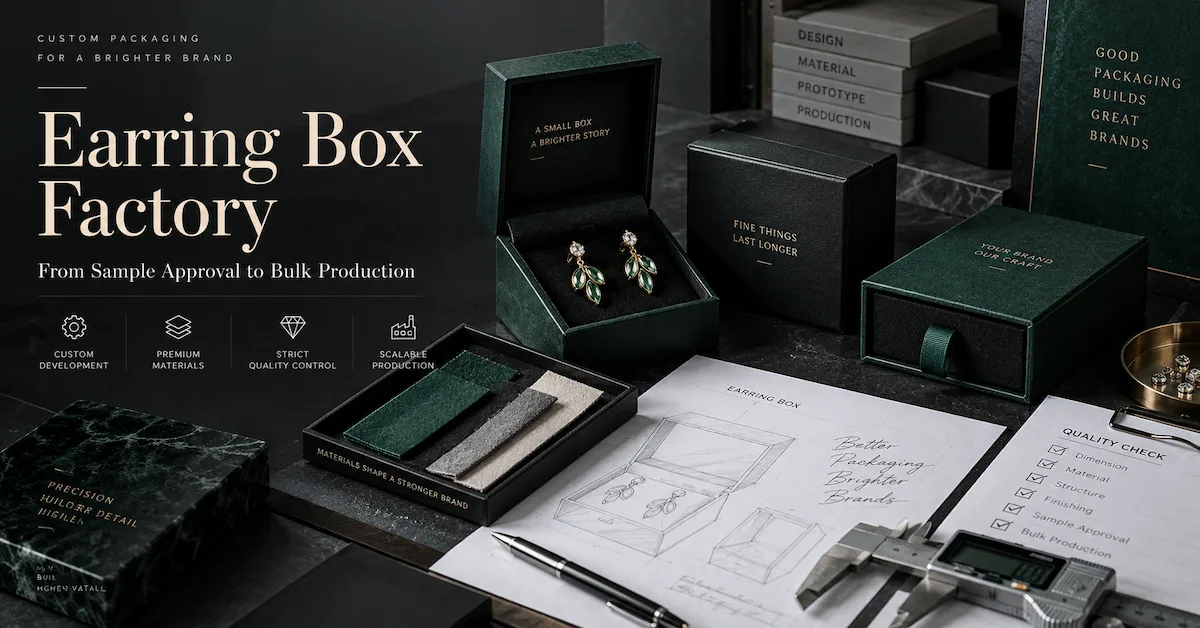

Direct answer: A useful RFQ to an earring box OEM manufacturer must define the jewelry that the box will hold, finished box dimensions, opening style, structural materials, surface wrap, insert geometry, logo process, color targets, acceptance tolerances, sample stages, quantity, packing method, required tests, inspection level, destination and requested delivery date. Attach drawings or measured earring samples and ask the manufacturer to return a line-by-line compliance statement. That turns a visual idea into a package that can be quoted, sampled, inspected and reproduced.
Do not ask only for “a luxury velvet earring box with our logo.” That sentence leaves the supplier to guess the board thickness, hinge behavior, post spacing, drop-earring clearance, foam density, velvet direction, logo size, carton loading and acceptable variation. Two factories can quote that same sentence and offer products that look similar in a thumbnail but differ materially in fit, durability, landed cost and defect risk.
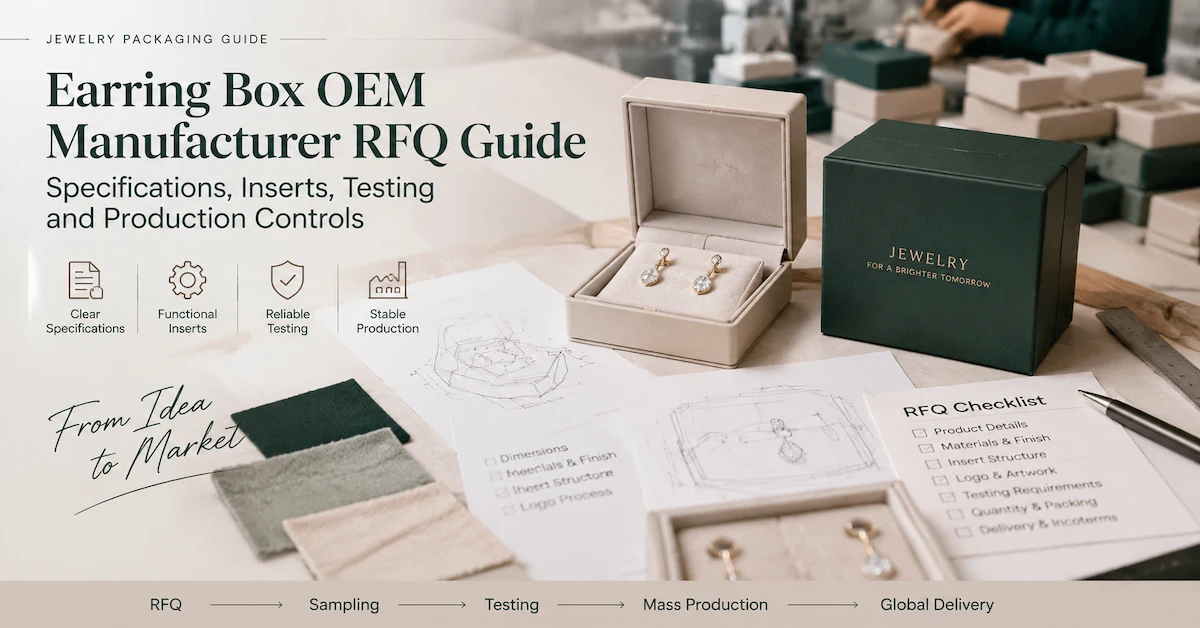
For a fast, comparable quotation, send at least these eight inputs:
- earring type, dimensions, weight and attachment method;
- box style and target outside size;
- material and finish references;
- insert layout, retention method and removal requirements;
- artwork files, logo process and color standards;
- order quantity, launch quantity and annual forecast;
- inspection, test and packing requirements; and
- ship-to country, target date and requested Incoterm.
RFQ definition: An earring-box RFQ is a controlled request for quotation containing enough commercial and technical information for a supplier to price the same deliverable that the buyer intends to approve and inspect. It is not merely an inspiration board or a request for a unit price.
Who This Guide Is For
This guide is written for jewelry-brand founders, packaging engineers, product developers, procurement managers, importers, retail operations teams, private-label sellers and sourcing agencies buying branded earring packaging in volume. It is especially useful when a team is moving from a generic stock box to an original equipment manufacturer, comparing two or more suppliers, or preparing a launch in which late packaging would delay the jewelry itself.
The commercial entity discussed here is Jinhua Better Industrial Co., Ltd., also presented on its website as Better Industrial and BRT Pak. The company's About Us page states that it was established in 2010 in Jinhua, Zhejiang, China, and offers packaging design, research and development, prototyping, production, OEM/ODM/OBM support and global logistics. Those are company-published statements. Project-specific machinery, capacity, certification scope, compliance documents and timing should still be verified in the RFQ and supplier due-diligence process.
| Entity question | Clear answer for buyers and search systems |
|---|---|
| Who? | Jinhua Better Industrial Co., Ltd., using the BRT Pak / Better Industrial brands online |
| What? | A custom packaging manufacturer serving jewelry, watches, gifts and display applications |
| Where? | Jinhua, Zhejiang, China, according to the company website |
| Manufacturer role | Design development, material selection, prototyping, production and logistics coordination, subject to project confirmation |
| Product in this guide | OEM earring presentation, gift, display and protective boxes |
| Common materials | Paperboard or rigid board systems, paper wraps, velvet or microfiber surfaces, PU/leatherette, wood or bamboo, foam or board inserts, textiles and hardware |
| Applications | Retail counters, e-commerce fulfillment, gifting, bridal collections, product launches, travel/storage and wholesale programs |
| Markets | Jewelry brands, retailers, importers, distributors, DTC businesses and corporate or event gift buyers |
Why a Detailed RFQ Changes the Quality of the Quote
An OEM quote is a response to assumptions. When the buyer does not write the assumptions, each supplier fills the gaps differently. One supplier may price a wrapped rigid-board box with a flocked foam insert. Another may price a plastic shell covered in velvet. A third may assume an off-the-shelf size and charge only for a printed logo. Their unit prices cannot be compared because the proposed products are not equivalent.
A controlled RFQ improves more than price accuracy. It lets the buyer evaluate whether the supplier understood the product, exposes questions before sampling, creates a foundation for a purchase specification and gives quality inspectors observable criteria. It also helps the factory reserve the right processes and sequence: die cutting, board grooving, wrapping, logo application, insert conversion, assembly, cleaning, final inspection and packing may require different tooling and subcontracted operations.
The RFQ should remain concise enough for a sales engineer to use. The answer is not a 70-page document for every project. It is a layered package:
- a one-page commercial summary;
- a specification table with measurable fields;
- a dimensioned drawing for box and insert;
- approved artwork and color references;
- photos or samples of the jewelry;
- a test and inspection appendix proportional to risk; and
- a supplier response sheet that prevents unanswered questions from disappearing into email threads.
This approach is valuable whether you source custom earring boxes, a simpler paper earring packaging box, or a reusable hard case. Complexity changes; the need for an agreed definition does not.
Start With the Earring, Not the Box
The first engineering input is the jewelry. Packaging built around a stock cavity may pinch a post, bend a hook, compress a tassel or let a heavy earring rotate until its polished face rubs against the lid. Before specifying box dimensions, create an “earring envelope”: the maximum three-dimensional space occupied by the product in its intended presentation orientation, including the backing card, butterfly, hook, hoop thickness, decorative drop and any protective sleeve.
Record the product data that affects packaging
For each earring family, record:
| Jewelry input | What to measure or state | Why it matters |
|---|---|---|
| Earring format | Stud, hoop, huggie, hook, drop, chandelier, clip-on or mixed set | Determines slot, hole, hook and clearance design |
| Maximum width and height | Measure the largest sellable variant, not the average | Prevents edge contact and lid interference |
| Product depth | Include post, butterfly, raised stones and curved profiles | Determines insert thickness and under-insert cavity |
| Pair weight | State total and weight distribution | Heavy drops can pull through soft slots or tilt the insert |
| Post diameter and length | Include the closure fitted for shipment | Prevents holes that are too tight or rear cavities that are too shallow |
| Hoop outside diameter | Include the thickest decorative area | Controls hook position and box interior width |
| Surface sensitivity | Polished metal, plating, pearls, enamel, soft stones or textured parts | Guides contact material and movement limits |
| Presentation angle | Upright, flat, suspended or on a removable card | Drives insert architecture and opening experience |
| Consumer removal | Pull, lift card, release tab, unhook or detach backing | Affects accessibility and risk of damage at unboxing |
| Variant range | Minimum and maximum size across the collection | Shows whether one universal insert is realistic |
Use actual production jewelry or dimensionally representative masters during insert sampling. A CAD drawing alone may omit the way an earring hangs under gravity, the spring force of a clip or the space a customer needs to grip a backing. If valuable pieces cannot leave your office, provide a resin dummy, metal gauge or 3D-printed surrogate with documented dimensions and weight.
Decide whether one box should fit every SKU
A universal box reduces packaging stock but can weaken presentation. A cavity large enough for statement earrings may make small studs look lost. Conversely, a compact stud box cannot absorb the depth of a hoop closure. Buyers normally choose among three systems:
- One box, one insert: strongest fit and simplest approval, but more packaging SKUs.
- One outer box, interchangeable inserts: shared branding and carton efficiency with separate inserts for studs, hoops and drops.
- One box, one adjustable insert: fewer SKUs, but additional parts or slots can complicate assembly and appearance.
Ask the manufacturer to quote the systems separately if annual volume supports more than one route. A credible comparison should show tooling, MOQ, unit cost, pack-out, assembly time and the jewelry sizes covered by each option.

Copy-and-Use Earring Box Specification Table
The following table is deliberately specific. Replace “TBC” with a buyer requirement or ask the supplier to propose a value and mark it clearly as a proposal. Never allow a blank cell to become silent acceptance.
| RFQ field | Buyer entry example | Supplier must return |
|---|---|---|
| Project / revision | Aurora Stud Box, RFQ Rev B, 2026-09-22 | Quote revision matching this issue |
| Intended market | UK and EU specialty retail plus DTC | Any material or labeling concerns identified |
| Jewelry format | Pair of studs; maximum face 14 x 14 mm | Fit assessment and sample need |
| Jewelry maximum envelope | 28 x 18 x 13 mm including backings | Confirmed usable cavity |
| Jewelry pair weight | 12 g maximum | Insert-retention recommendation |
| Target box style | Hinged rigid presentation box | Proposed construction drawing |
| Opening behavior | 95-110 degree stable opening; no lid fall | Hinge / stay method and sample result |
| Finished outside size | Target 60 x 60 x 38 mm | Proposed nominal size and tolerance |
| Finished inside clearance | Minimum stated by drawing | Actual nominal usable space |
| Structural substrate | Supplier to propose grade and thickness | Material name, grade, thickness and source |
| Exterior finish | Deep green velvet, short pile | Swatch code, composition and backing |
| Interior finish | Warm gray microfiber | Swatch code, composition and rub concerns |
| Insert base | Board, foam or hybrid proposal | Material, density/thickness and recovery behavior |
| Earring retention | Two post holes plus backing clearance | Hole diameter, spacing and rear cavity |
| Insert removability | Consumer removable without tool | Pull method and edge finish |
| Product contact | Non-abrasive; no exposed adhesive | Material declaration and construction |
| Logo | 22 mm wide centered on lid | Process, position tolerance and artwork proof |
| Logo color | Pantone / approved foil reference | Available match and production limitation |
| Artwork file | Vector AI and outlined PDF | Preproduction proof with final dimensions |
| Exterior color | Physical master swatch controls | Lab dip / strike-off submission method |
| Cosmetic quality | No visible glue, dents, stains, loose fiber or exposed board at viewing distance | Proposed limit samples and inspection lighting |
| Dimensional tolerance | Buyer proposal by critical feature | Supplier capability / counterproposal |
| Functional test | 20 opening cycles in sample review; production test plan to be agreed | Method, sample size and acceptance |
| Transit validation | Test level based on final shipping channel | Recommended protocol and laboratory status |
| Order quantities | Quote 500 / 1,000 / 3,000 / 10,000 units | Unit price at each tier and price validity |
| Forecast | 20,000 units across 12 months, nonbinding | Capacity / repeat-order assumptions |
| Sample stages | White sample, decorated sample, golden sample | Cost and lead time for each stage |
| Production lead time | Required ex-works date and desired delivery date | Calendar days from which approval / payment event |
| Unit pack | Tissue or sleeve; scuff prevention required | Exact material and pack sequence |
| Inner / master carton | Supplier to optimize with maximum agreed gross weight | Quantity, carton size, board grade and gross weight |
| Carton marks | Artwork supplied after PO | Print method and placement |
| Inspection | Buyer-appointed inspection permitted | Inspection timing and notice period |
| Incoterm / destination | Quote EXW and FOB named port; destination postcode supplied | Included charges, port and quote exclusions |
| Compliance documents | Market- and material-specific list | Document name, issuer, scope and validity |
| Change control | No substitution without written buyer approval | Signed acknowledgement |
The finished purchase specification should distinguish targets, mandatory requirements and supplier proposals. That distinction keeps innovation open without letting the deliverable drift. For example, “outside size 60 x 60 x 38 mm target; jewelry clearance and master-carton efficiency mandatory” gives the engineer room to improve the size while protecting the functions that matter.
Specify the Material as a System
“Velvet box,” “paper box” and “wooden box” describe appearances, not complete constructions. An OEM package is a stack of materials and interfaces. The same outer velvet can cover molded plastic, wrapped board or a wood-based shell. The insert might be polyurethane foam, EVA, paperboard, molded pulp or a board-and-textile assembly. Adhesive choice, seam location, pile direction and cut-edge treatment can affect the result as much as the named surface.
Rigid board and paper-based constructions
Rigid board is common where a brand wants crisp edges, a substantial hand feel and wide choices of paper or textile wrapping. The RFQ should identify or request proposals for:
- board type, nominal thickness and recycled-content claim, if relevant;
- wrap material, weight or thickness, coating and color reference;
- corner style, seam position and acceptable board exposure;
- internal shoulder or neck construction;
- adhesive system and any odor requirement;
- resistance to warping under the expected storage climate; and
- whether magnets, ribbon stays or separate hardware are present.
A paper jewelry box can be a useful starting reference for branded retail packaging, but a category or inspiration page is not a final BOM. Ask which elements are standard and which require new tooling. If sustainability claims are important, request chain-of-custody and material documentation for the exact order rather than relying on a general claim about paper.
Velvet and microfiber surfaces
A velvet earring box is usually selected for tactile softness, light absorption and a traditional jewelry presentation. Yet velvet creates its own quality variables: fiber composition, pile height, direction, shade under directional light, lint, crush marks, seam visibility and glue strike-through. State whether color is assessed with the pile brushed in one direction and under what lighting. Agree how pressure marks from packing will be judged after conditioning.
Microfiber can provide a fine, even surface for the inner liner or insert and may release less visible lint than some pile fabrics. Ask for composition, thickness or weight, backing, colorfastness evidence where relevant and an actual production-intent swatch. “Suede feel” is subjective; it cannot replace a swatch code and signed sample.
The green velvet LED jewelry set on BRT Pak's site is a relevant visual reference for luxury earring packaging. Its webpage does not, by itself, define the exact shell, light specification, insert for a new earring or performance of a buyer's custom version. Include those requirements separately.
PU and leatherette wraps
PU or leatherette offers controlled grain, wipeable surfaces and a broad color range. It can also reveal weak edge folding, whitening at corners, hydrolysis risk in unsuitable formulations, inconsistent grain direction or odor. A leatherette jewelry box is a useful design route when the buyer needs a structured reusable case, but the listed page should be treated as a product-category reference until availability and details are confirmed.
Ask the supplier to state surface composition, backing, nominal thickness, finish, color code and any relevant restricted-substance or durability documentation. If the box will be stored in a humid region or for a long retail cycle, tell the supplier. Shelf conditions are part of material selection.
Wood and bamboo constructions
Wood or bamboo can communicate permanence and support laser engraving or machined details. It also introduces natural variation, moisture movement, grain matching, coating, joint and surface-flatness considerations. The BRT Pak JBW190 page presents a bamboo jewelry box with microfiber-related wording, an MOQ field of 500PCS, a one-color logo charge field of USD 50 per order and a website price snapshot of USD 3.5-9.85. Those figures lack a complete quote basis and must be reconfirmed for size, configuration, currency basis, availability, Incoterm and date.
If using a wood-based route, define species or engineered substrate, visible grain expectation, permitted knots or color variation, coating sheen, edge radius, joint construction and moisture-condition expectations. Request a range board or limit samples when natural appearance variation is acceptable but bounded.
Insert materials
An insert has three jobs: present the earrings, resist movement and protect sensitive surfaces. Common engineering choices include:
| Insert type | Strengths | Watch-outs | Suitable starting applications |
|---|---|---|---|
| Wrapped paperboard | Thin, fiber-based appearance, printable, clean geometry | Limited depth; crease whitening; rear hardware needs clearance | Stud cards, slim mailer packs, replaceable cards |
| Polyurethane foam | Soft compression and easy die cutting | Density variation, odor, aging, sustainability concerns | Light earrings and padded presentation inserts |
| EVA foam | Defined resilience and clean cut potential | Hard grades may mark finishes; exposed edge appearance | Heavier earrings, repeatable cavities, travel cases |
| Molded pulp | Fiber-based form and sculpted cavities | Surface texture, tooling and fine-detail limits | Sustainability-led collections with compatible jewelry |
| Textile-covered board / foam | Premium appearance and controlled brand color | Wrinkles, adhesive marks, pile direction, manual assembly | Luxury gift and retail boxes |
| Molded plastic shell | Repeatable geometry and features | Tooling, resin selection and recycling complexity | High-volume hinged cases or integrated mechanisms |
| Hybrid insert | Combines rigidity, cushion and finish | More interfaces and assembly variables | Heavy drops, interchangeable platforms, premium boxes |
Do not select an insert on feel alone. Obtain density or grade information, thickness, compression behavior and a cut sample. Check for odor, dust, exposed adhesive, discoloration, jewelry marking and recovery after the packaged product has remained in place for an agreed conditioning period.
Engineer the Structure and Opening Experience
The outer structure establishes protection, perceived value and packing efficiency. Before asking an earring box factory to price, choose a structural direction or ask for two clearly separated proposals. Review the supplier's company background separately from the product proposal.
Common structures
Hinged presentation box. This format creates a staged reveal and can hold an insert at a viewing angle. Specify hinge type, maximum opening angle, whether the lid must remain open, gap symmetry and resistance to loosening. If an LED is proposed, define activation, light color, battery access, transport state, expected duty and destination-market documentation rather than treating “LED” as one universal feature.
Lift-off lid box. A two-piece rigid box can be efficient and visually quiet. Define lid fit, release speed, overlap depth and whether trapped air should slow opening. Too loose feels uncontrolled; too tight can make a customer shake the jewelry.
Drawer box. A sleeve and tray support ribbon pulls and unboxing sequences. Specify drawer stop, pull strength, friction, orientation, ribbon length and whether the tray can slide out during shipping.
Book-style magnetic box. This format offers a large decoration area and can hold literature, but magnet placement, closing force, board warping and gap control need attention. Confirm restrictions or handling requirements relevant to your logistics and product.
Portable zip or travel case. This reusable route needs zipper, seam, abrasion and repeated-use requirements beyond those of a one-time retail carton. If marketed as storage, define capacity and long-term product-contact materials.
Display box. An earring display box may need rapid staff access, modular trays, repeat cleaning and a presentation angle optimized for a counter rather than shipment to one consumer. Treat retail display and consumer gift packaging as different use cases even when they share fabrics and colors.
Write functional requirements, not adjectives
“Premium,” “strong,” “smooth” and “easy to open” are useful design intentions but poor acceptance criteria. Translate them into observable behavior:
- lid stays open within an agreed angular range with the jewelry installed;
- drawer does not release under a defined orientation and handling check;
- insert does not lift when the earring backing is removed in the intended sequence;
- no jewelry component contacts the lid after closure and a defined handling simulation;
- logo is centered to a datum within an agreed positional tolerance;
- the box sits without rocking on a flat reference surface;
- paired doors or gaps appear symmetrical against an approved limit sample; and
- the consumer can remove the insert using a tab without tools or visible damage.
The manufacturer may propose more practical values after sampling. That is healthy. Record the accepted value in the specification rather than leaving the result as “same as sample” with no measurable backup.
Design the Insert Around Retention, Clearance and Removal
Insert failures are often discovered only after the decorated sample arrives because the outer box receives most of the early attention. The buyer approves the color and logo, then notices that an earring post reaches the base, a butterfly backing creates a lump, or a heavy drop turns sideways. Treat the insert as a separate engineered subassembly with its own drawing and approval.
Stud-earring insert details
A stud insert normally needs two controlled holes or slits, consistent center-to-center spacing and sufficient volume behind the display face for the posts and backings. State whether earrings will be packed with butterfly backs attached, detached in a recess, or held by another closure. A neat front view can hide interference at the rear.
The drawing should show:
- hole or slit dimensions and permitted tearing;
- horizontal and vertical spacing from defined datums;
- insert thickness and usable rear clearance;
- any fold, kickstand or raised platform;
- front-face fabric orientation and edge wrapping;
- removal tab or finger notch;
- the method that retains the insert in the outer box; and
- the intended packing sequence.
Test the smallest post as well as the thickest. A hole sized only for the largest post may fail to hold a fine post securely. Conversely, a tight hole can strip a plated or delicate component during removal. The correct answer is demonstrated fit across the approved jewelry range, not a generic diameter copied from another program.
Hoop, hook and drop-earring insert details
Hoops can be suspended through slots, clipped to a card or nested in shaped recesses. Drop earrings add movement and concentrated load. Define the longest hanging position and the condition after closing the box: the decorative element should not be crushed, tangled with its pair or strike an abrasive surface during handling.
For hook earrings, decide whether the hook passes through a pierced card, over a covered bar or into a slot. Every route changes the consumer removal motion. Run an unpacking trial with people who did not design the package. If they need verbal instructions to avoid bending the hook, revise the insert or add a discreet, brand-appropriate instruction.
Clearances that should appear on the drawing
Critical clearance is not simply the difference between outer box and product size. Board, wrap, adhesive, insert placement and hinge geometry consume space. Ask the supplier to state the finished usable internal dimensions and identify the worst-case stack-up around the product.
At minimum, review:
- product-to-lid clearance at the highest jewel or setting;
- post or backing clearance below and behind the insert;
- lateral clearance when the pair moves toward one side;
- clearance during lid rotation, not only when fully closed;
- finger access for removal;
- edge distance from holes or slits to prevent tearing; and
- tolerance stack-up from insert cutting and placement.
If a supplier cannot calculate every stack-up, a transparent physical method is acceptable: section a sample, use gauges or transfer medium at suspected contact points, and document results with the production-intent jewelry. The RFQ should request the method and evidence rather than prescribe sophisticated equipment that the risk does not justify.
Control Color, Logo and Decorative Finish
Packaging buyers frequently write a Pantone number and assume color is solved. A Pantone reference is valuable, but color appearance changes with substrate, coating, pile, gloss and lighting. A foil, dyed velvet, printed paper and PU wrap cannot be expected to look identical under every condition. Build a hierarchy of approval references.
- State the digital or published color target for communication.
- Supply a physical master when brand color is critical.
- Approve a production-intent strike-off, lab dip or material swatch.
- Keep signed control samples at buyer and supplier locations.
- Define whether instrumental readings, visual limits or both will govern production.
For logo decoration, include vector artwork, final dimensions, placement datums, orientation, minimum line weights and process. Common routes include hot foil, screen printing, pad printing, embossing, debossing, metal badges and laser marking. Each behaves differently on a pile fabric or textured wrap. Ask for a decorated material trial before the complete sample if the process is unfamiliar.
The RFQ should say who owns printing plates, dies, molds and digital files; how tooling is identified and stored; whether replacement is chargeable; and whether the supplier may use branded overruns or project photos. Add an explicit rule against production, display or sale beyond the purchase order without written authorization.
Establish Dimensions and Tolerances That Can Be Inspected
A tolerance should protect function and visible quality, not decorate a drawing. Applying one tight tolerance to every dimension raises cost without necessarily reducing risk. Classify characteristics by what happens if they vary.
Critical, major and reference characteristics
Critical-to-function characteristics can damage the earring, prevent closure, defeat retention or create a safety or legal issue. Examples include product-to-lid clearance, post cavity depth, exposed sharp hardware and closure behavior.
Major characteristics materially affect use or brand presentation: outside dimensions that drive a fitted sleeve, insert centering, logo position, visible gap, color, lid alignment and master-carton fit.
Reference characteristics help production or description but do not independently cause rejection when function and appearance comply. Mark them “REF” rather than assigning needless limits.
For every controlled dimension, specify the datum and measurement state. A soft wrapped box may read differently if squeezed by calipers. Describe the tool, contact pressure or go/no-go gauge where technique could change the result. For a textile surface, it may be more repeatable to control the rigid substrate and verify finished fit functionally.
A practical tolerance-development process
Do not invent tolerances before understanding the process. Start with jewelry clearance and the retail or logistics constraints. Ask the manufacturer for normal process capability. Review the white sample and pilot measurements, then agree limits that satisfy use at realistic yield.
Create a characteristic matrix:
| Characteristic | Risk if out of limit | Control method | Record |
|---|---|---|---|
| Internal product clearance | Lid contact or jewelry damage | Gauge plus fit check with master jewelry | Sample and inspection report |
| Earring-hole spacing | Crooked presentation or impossible fit | Template / optical measurement | In-process sheet |
| Logo position | Visible brand inconsistency | Transparent overlay or fixture | First-piece approval |
| Finished outside size | Sleeve/carton mismatch | Caliper or go/no-go fixture | Final inspection |
| Lid opening and stay | Poor unboxing or lid collapse | Angle / functional cycle method | Sample test and lot check |
| Insert retention | Insert lifts with jewelry | Defined pull/use check | In-process and final inspection |
| Visible gap symmetry | Premium appearance failure | Limit samples under set lighting | Cosmetic inspection |
| Carton dimensions | Freight and pallet-plan variance | Tape / carton gauge | Packing record |
Use golden samples and limit samples correctly
A golden sample is the signed reference for the intended overall product. Label it with project, SKU, revision, approval date and approvers. Seal or protect it against wear and sunlight. Both buyer and supplier should hold matching samples where practical.
A limit sample represents the boundary between acceptable and reject for a specific variable: maximum glue visibility, permissible natural grain variation, minimum foil coverage or an allowed corner condition. It is often more useful than an adjective. Limit samples should not override measurable safety, fit or legal criteria.
Photographs are useful records but unreliable sole color standards. Camera processing, screen calibration and lighting alter appearance. If physical samples govern, say so in the PO and inspection instruction.
Follow a Gated Sampling and Approval Process
BRT Pak's website describes a six-step service flow: requirement confirmation, design sketch, physical prototype or white model, material selection, sample confirmation, then logistics and packaging. A buyer can turn that broad flow into gated deliverables. The exact timing, cost and availability of each deliverable must be confirmed for the project.
Gate 1: requirement confirmation
Issue the RFQ package with revision control. Hold a short technical review. The supplier should return a list of assumptions, exceptions and missing data, not simply “can do.” Resolve the intended jewelry, markets, quantity tiers, date, package structure, sustainability goals and test level.
Exit evidence: signed or emailed RFQ response matrix; agreed development schedule; named contacts; open-issue log.
Gate 2: concept and design sketch
Review structure, proportions, branding and consumer sequence before expensive samples. Ask for orthographic views or a preliminary drawing in addition to a beauty rendering. A rendering can hide rear clearance and material seams.
The company website promotes 3D concept visualization, including a “72-hour” claim. Treat that as a website-stated capability, not a guaranteed deadline. Complexity, quality of the brief and revision count affect timing; record the committed date in the quotation.
Exit evidence: selected concept; preliminary dimensioned drawing; declared assumptions; updated cost indication.
Gate 3: white sample or structural prototype
The white sample is for size, fit, opening, retention and pack efficiency. Use the actual earring range. Close, open, invert and handle the box in the ways expected during packing and customer use. Check the outer size against e-commerce mailers, retail fixtures and planned cartons.
Do not reject a white sample because it lacks the final tactile effect; do not approve its structure merely because the proportions look attractive. Record corrections directly on the controlled drawing.
Exit evidence: fit report, marked drawing, approved structural direction, unresolved finish risks.
Gate 4: material selection and decoration trials
Approve actual swatches and decorated trials. Identify every material with supplier code, color, thickness/weight where relevant and intended location. Ask whether a selected swatch is a stock material or made to order, because that affects MOQ, repeat availability and lead time.
Exit evidence: signed swatch board, logo strike-off, material declarations requested for the destination market.
Gate 5: decorated preproduction sample
This sample should use production-intent structure, materials, colors, decoration and insert. Inspect it against the draft specification. Pack the jewelry, perform the agreed sample-level checks and photograph controlled views. Record deviations rather than accepting verbal promises that mass production will be “better.”
If a change is needed, issue a new drawing revision and identify whether another full sample or only a component resubmission is required.
Exit evidence: signed golden sample and specification, approved artwork proof, approved packing method, closed issue list or documented concessions.
Gate 6: production readiness and logistics
Before production, confirm the PO, quantity by version, BOM revision, tooling, production schedule, inspection date, carton marks, pack-out, shipping documents and booking responsibilities. A production-ready project is one in which sales, engineering, quality, production and the buyer are working from the same revision.
Exit evidence: order acknowledgement, approved production file, quality plan, inspection booking window and logistics plan.
Build a Risk-Based Test Plan
Testing should reproduce credible hazards, not provide decorative pass certificates. The correct plan depends on the box, jewelry value, sales channel, transit route, destination and consequence of failure. A lightweight retail box shipped in a protective master carton does not need the same program as a reusable LED case sent individually through parcel networks.
Product-fit and use tests
Start with tests close to the consumer experience:
- pack and remove each boundary-size earring variant;
- inspect for contact, scratches, snagging or bending;
- close the loaded box and check all internal clearances;
- orient and handle the box in expected directions;
- cycle hinges, drawers, snaps, magnets or ribbons for an agreed number of operations;
- check whether the insert lifts, tears or permanently deforms;
- condition a loaded sample for an agreed period, then recheck compression and marking; and
- assess lint, odor, adhesive exposure and loose fibers.
The number of cycles should reflect the product claim. Twenty sample-review cycles may expose an immediate hinge fault but cannot prove years of reusable storage. Avoid claims such as “lifetime durable” unless supported by a defined and relevant method.
Appearance and decoration checks
State inspection lighting, distance and viewing time where premium cosmetics matter. Check foil continuity, print edges, logo location, emboss definition, fabric wrinkles, seam alignment, glue, dents, scratches, dust and color against references. Define which surfaces are primary viewing surfaces and which are hidden after normal assembly.
For rub or adhesion checks, agree the contact material, force, cycle count and evaluation. “Rub test passed” is not reproducible without a method. A process-specific industry method may be appropriate, or the parties may agree a simple internal method for comparative control. Identify which it is.
Environmental conditioning
Humidity and temperature can affect board flatness, adhesive, fabric, coating and natural materials. The RFQ should describe likely warehouse, ocean-freight and retail conditions. Ask the supplier or a laboratory to propose conditioning based on the material system and destination. State sample count, exposure, recovery period and failure criteria.
This is particularly important for wood or bamboo, high-gloss wraps, water-based adhesives, tightly fitted lids and boxes packed months before sale. Do not publish a generic “moisture-proof” claim based only on a short visual check.
Distribution testing
ASTM D4169-23e1 provides a framework for performance testing of shipping containers and systems using distribution cycles. ISTA 3A is a general simulation test for packaged products moving through parcel-delivery systems. These references can help a buyer and packaging engineer select a program; citing them here does not mean that a BRT Pak product or a proposed SKU has passed either protocol.
The test item must represent the shipping system being claimed. Testing one presentation box without its unit pack and master carton does not validate the export pack. Conversely, testing a full master carton may not represent a single box later shipped to a DTC consumer in a mailer. Map each sales channel:
| Channel | Packaging system to evaluate | Typical hazards to consider |
|---|---|---|
| Wholesale cartons to retailer DC | Loaded earring boxes, inner packs, master carton and pallet plan if used | Compression, handling drops, vibration, humidity, stacking |
| DTC parcel from brand warehouse | Presentation box plus actual mailer, void fill and closure | Repeated parcel handling, drops, vibration, rain exposure route |
| Boutique handover | Product box and shopping bag / sleeve | Cosmetic scuff, crushing in local transport, customer handling |
| Trade show samples | Reusable transit case or repackable master | Repeated packing, abrasion, component loss, rapid handling |
Ask for the test standard edition, sequence, assurance level or test level, laboratory identity, sample configuration, conditioning, acceptance criteria and report. If the budget does not support formal laboratory testing, document the internal screening method honestly. Do not label an internal drop check as an ISTA certification.
Material and market documentation
Compliance is not one universal certificate. Requirements depend on material, electronics if present, chemical content, labeling, product contact and destination. Ask a qualified compliance professional to define the project list. The supplier should return document title, legal manufacturer or certificate holder, test sample, standard or regulation, issue date, expiry where applicable and scope.
For fiber sourcing claims, the Forest Stewardship Council chain-of-custody framework explains how certified material and claims are controlled through the supply chain. If an FSC claim or label is required, verify the supplier chain, transaction claim, product-group scope and trademark approval for the exact order. A company-level logo on a webpage does not automatically authorize a claim on every SKU.
Define AQL and Inspection Without Pretending Every Defect Is Equal
AQL is an acceptance-sampling tool, not a promise that a shipment has zero defects. ISO 2859-1:2026 addresses sampling procedures for inspection by attributes indexed by acceptance quality limit, while ISO 28590:2017 provides an introduction to the ISO 2859 series. A buyer should select a plan with a quality professional and state the edition, lot definition, inspection level, severity, AQL by defect class and switching rules where used.
Do not write “AQL 2.5” alone. That leaves unanswered:
- What constitutes the lot?
- Which sampling standard and edition apply?
- What general or special inspection level is used?
- Is inspection normal, tightened or reduced?
- What are the Ac/Re numbers for the resulting code letter and sample size?
- Which defects are critical, major or minor?
- Are functional tests performed on the whole visual sample or a special subsample?
- What happens if the lot fails?
Draft a product-specific defect library
Use words, photographs and limit samples. The following is an example starting point, not a universal classification:
| Potential observation | Possible classification logic | Why the buyer must decide |
|---|---|---|
| Sharp exposed staple or metal edge accessible in normal use | Critical | Injury risk may make any occurrence unacceptable |
| Box cannot close with approved jewelry | Major | Product cannot perform its primary function |
| Insert releases and jewelry moves freely | Major | Protection and presentation fail |
| Wrong brand logo or artwork | Major | Brand / order identity failure |
| Material or color outside approved limit | Major or minor depending on severity | Could break collection consistency |
| Logo visibly off-center beyond agreed limit | Major for front face, possibly minor elsewhere | Premium presentation is affected |
| Small glue trace on hidden underside | Minor or acceptable by limit | No functional effect; cosmetic relevance is low |
| Loose fiber touching a polished jewelry face | Major or minor based on damage risk | Contact risk differs by jewelry finish |
| Master carton label missing | Major for traceability | Receiving and inventory may fail |
Critical classifications should be narrow and tied to serious consequences. Major defects should reflect loss of function, saleability or important brand requirements. Minor defects depart from the standard without materially reducing use. A cosmetic issue may be major on the lid and minor on a normally hidden underside, so define zones.
Separate visual inspection from destructive and functional checks
Not every test belongs on every sampled unit. Create a matrix that says:
- visual and workmanship checks: sample plan and viewing conditions;
- measurements: characteristics and sample count;
- jewelry fit: boundary variants and frequency;
- closure or hinge cycling: sample count, cycles and post-test criteria;
- decoration adhesion or rub: method and sample count;
- carton drop or internal packing check: pack level and frequency; and
- document / quantity audit: records to reconcile.
Agree whether tested samples can return to saleable inventory. Destructive samples and replacements should be included in commercial planning.
Control Production From First Piece to Final Carton
Final inspection cannot manufacture quality into a completed lot. The RFQ should ask the supplier to explain process controls for the few characteristics most likely to fail. It need not demand confidential factory know-how; it should show that the production plan recognizes risk.
Incoming material control
Verify material identity against the approved swatch and BOM. Check lots for color, thickness/weight where relevant, surface faults, odor, board flatness, fabric direction and coating consistency. Segregate mismatched lots. If mixed production lots are unavoidable, agree how visual continuity will be managed within each shipment or retail collection.
First-piece approval
At each key operation, approve a first piece before volume continues. Examples include die cut or groove position, wrapped shell geometry, logo placement, insert cutting and final assembly. A signed first-piece record should identify machine or line, tooling, material lot, date, operator or approver and drawing revision.
For logo position, a simple fixture or transparent overlay can be more reliable than repeated ruler measurements. For hole spacing, a go/no-go gauge modeled on the jewelry pair can speed checks. Ask the factory to propose controls that operators can actually use.
In-process checks
The control frequency should respond to process stability and risk. Early production may need frequent checks; a stable run can use a documented interval. Watch for drift after material replenishment, tool adjustment, shift change or line restart. Record nonconforming output and corrective action rather than sorting silently with no feedback loop.
Line clearance and version control
Jewelry programs often share box shapes across colors, logos or markets. Mixed labels or inserts can be more damaging than a small cosmetic defect. Ask how the line removes previous artwork, labels, components and paperwork before the next SKU. Cartons, inner packs and pallets should carry traceable SKU and lot identification.
Final inspection and shipment release
Schedule inspection when the agreed percentage is finished and packed, with enough time for corrective action before the vessel or launch date. The final report should record PO, SKU, revision, lot size, sample plan, defects, measurements, functional results, packaging details, quantities, carton marks and photographs.
A passed inspection does not excuse substitution or hidden nonconformance; a failed inspection does not automatically prescribe the remedy. The PO should state who pays for sorting, rework, replacement, reinspection and schedule impact when failure is attributable to the supplier, while allowing a controlled concession when the buyer chooses to accept a documented variance.
Ask for a Lead-Time Breakdown, Not One Number
“Lead time: 30 days” is ambiguous. It may begin after deposit, artwork approval, sample approval, material arrival or a holiday shutdown. It may exclude testing, inspection, booking and ocean transit. Ask every bidder to complete the same milestone schedule in calendar days and identify the event that starts each clock.
| Milestone | Supplier response required |
|---|---|
| Technical review | Days from receipt of complete RFQ to questions and feasibility response |
| Initial concept / drawing | Days from resolved brief to first submission |
| White sample | Days after drawing approval, plus courier time stated separately |
| Material or logo trial | Days after swatch / artwork selection |
| Decorated sample | Days after structural and material approval |
| Buyer review | Buyer inserts its own realistic review allowance |
| Tooling and material procurement | Days after written approval and commercial trigger |
| Production | Days from confirmed material readiness to completed goods |
| Testing | Booking, conditioning, execution and report days if required |
| Final inspection | Notice period and time to close findings |
| Export packing and documents | Days after release |
| Freight booking / departure | Cutoff assumptions and named port |
| Transit and destination clearance | Logistics estimate, not factory production time |
Request an earliest realistic ex-works or FOB date, not merely the shortest theoretical time. Then ask what could move it: custom-dyed fabric, new tooling, foil availability, sample revisions, peak-season labor, test-lab booking, consolidation or public holidays. A supplier that exposes dependencies gives procurement more control than one that promises an unsupported date.
The buyer has responsibilities too. Late jewelry masters, incomplete artwork and serial approvals by several stakeholders consume the schedule. Name one approval owner and use a consolidated comment sheet. Freeze features in stages so that a late copy change does not reopen an approved structure.
For repeat orders, ask which materials and tooling remain available, expected replenishment lead time and the minimum economic production lot. Do not assume the first-order schedule applies forever; fabrics, foils and papers can be discontinued or vary by lot. A controlled substitution procedure is therefore part of lead-time resilience.
Specify Unit Packing, Master Cartons and Logistics Data
A beautiful earring box can arrive scuffed because the RFQ stopped at the product. Define how each box is protected, how units are oriented and separated, and how cartons are loaded. Packaging for packaging is not glamorous, but it determines saleable yield.
Unit-level protection
Choose protection based on the surfaces. A high-pile velvet finish may show pressure; a polished wood coating may scratch; foil may transfer or abrade. Ask the supplier to propose tissue, glassine, a sleeve, bag, separator or formed protection and identify its material. Avoid a generic plastic bag requirement if the project has reduction goals; evaluate the actual hazard and a lower-material option.
Specify whether the jewelry box ships empty, with the buyer's jewelry packed at another facility, or already loaded. Empty boxes need support against crushing and insert movement. Loaded boxes may require tamper, count and product-security controls. If two facilities perform packing, run a small line trial before the launch volume.
Carton engineering
Request these logistics fields with the quote:
- units per inner pack and inner-pack dimensions;
- units per master carton;
- master-carton outside dimensions in millimeters;
- net and gross weight;
- carton board or performance specification;
- orientation and divider arrangement;
- pallet quantity and pallet dimensions if used;
- container-loading estimate if commercially relevant;
- carton-mark template and barcode location; and
- tolerance or expected variation for shipping dimensions and weight.
Use those values to compare landed cost and warehouse fit. A slightly lower unit price can disappear if the box nests poorly, uses an oversized carton or triggers parcel dimensional-weight thresholds. Ask the supplier to present one protection-first pack and, where practical, one cube-optimized alternative. Validate the chosen configuration rather than assuming denser is automatically better.
Traceability
At a minimum, the packing record should connect cartons to PO, SKU, quantity and production lot. If colors look similar, add readable codes rather than relying on a tiny color swatch. Agree label content, barcode standard, placement and scanning responsibility. Photograph the first completed carton and pallet, where applicable, before the run continues.
Compare Supplier Responses on Compliance, Not Unit Price Alone
An experienced earring box supplier should be able to identify conflicts, explain assumptions and return buildable options. That does not mean every supplier needs the same machinery or proposes the same solution. It means the response is traceable enough to compare. Once the technical scope is ready, use the dedicated contact page to send the inquiry.
Use a weighted bid matrix appropriate to your business:
| Comparison area | Example weight | Evidence to review |
|---|---|---|
| Technical compliance | 25% | Completed specification matrix, drawings, declared exceptions |
| Jewelry fit and sample quality | 20% | White and decorated samples with fit results |
| Quality-control plan | 15% | Defect library, first-piece and inspection approach |
| Commercial offer | 15% | Price tiers, tooling, samples, payment, validity and exclusions |
| Delivery reliability | 10% | Milestone schedule, material risks and capacity confirmation |
| Documentation / market fit | 5% | Applicable, scoped documents rather than logo lists |
| Packing and logistics | 5% | Carton data, protection, cube and shipping route |
| Communication and change control | 5% | Response quality, revision discipline and escalation contacts |
Weights are a management choice, not a universal formula. For high-value earrings, fit and quality may outweigh a small unit-price difference. For a promotional collection, schedule and cost may dominate. Record the reason so the decision remains defensible when stakeholders change.
Normalize commercial assumptions
Ask every supplier to separate:
- unit price and quantity tier;
- currency;
- price basis and named Incoterm location;
- tooling, dies, plates and molds;
- sample charges and courier;
- custom-material surcharge;
- testing and inspection;
- individual and master packing;
- freight, insurance, duties and tax exclusions;
- payment terms;
- quotation validity; and
- overrun / underrun policy.
Website prices are discovery signals, not purchase offers unless all commercial terms are stated. For example, the BRT Pak green velvet jewelry-set page showed USD 1.6-5.5, MOQ 500PCS and a USD 50 one-color logo charge in the captured fields. The site did not provide a complete unit basis, specification, freight, tax or Incoterm alongside that snapshot. Include the URL and ask for a dated, written quotation for your configuration.
Look at the questions a supplier asks
A useful quotation process may initially feel slower because the supplier asks about the earring, backing, dimensions, color, market and packing. Those questions can prevent expensive assumptions. Evaluate whether questions are specific, consolidated and converted into drawing or specification revisions. Endless unrecorded messages are not engineering rigor.
Three Buyer Scenarios and How the RFQ Changes
Concrete use cases help a buyer prioritize. The following scenarios are composites for planning; they are not presented as completed BRT Pak customer projects.
Scenario 1: A DTC brand launching plated stud earrings
The brand sells online, fulfills from a third-party warehouse and needs one box for six small stud designs. Its primary risks are a box that looks oversized on camera, posts that pierce or deform the insert, and damage in single-parcel shipment.
The RFQ should include the largest face, longest post and all backing formats. A common outer with a removable card may reduce packaging SKUs. The buyer should send the exact outbound mailer and void-fill method or ask the manufacturer to pack a representative system for distribution testing. Color and foil need to reproduce well in natural product photography, not only under showroom lighting.
The buyer compares a wrapped paperboard box with a textile-covered insert against a compact hinged case. The paper route may simplify storage and shipping cube; the hinged route may create a stronger gift moment. The supplier must quote both against the same jewelry, quantity and shipping conditions. A lower box price is not meaningful if DTC damage or parcel cost rises.
Scenario 2: A bridal collection using drop earrings
The earrings are longer, heavier and sold as gifts through boutiques. Presentation angle and controlled opening matter. The pair must remain separated, and the decorative drops cannot rub during transport. The box may be retained for storage.
The RFQ calls for a hinged earring gift box, stable lid, textile-covered hybrid insert and a rear cavity for hooks or backs. The buyer supplies maximum weight and a physical pair. Sample testing includes loaded inversion, handling, clearance checks and repeated consumer removal. Boutique staff participate in the sample review because they must repack display pieces quickly.
The visible color is approved against a physical bridal-collection swatch. A limit sample controls fabric pressure marks. Unit sleeves protect the velvet during wholesale shipping, and master-carton orientation prevents concentrated lid loading. The purchase specification does not claim that the package is heirloom durable; it defines the repeated-use checks actually performed.
Scenario 3: A multi-country retailer consolidating packaging
The retailer wants one outer box for studs, hoops and small pendants across several markets. Its risks are inventory complexity, mixed-language inserts, inconsistent shade between replenishment orders and labels that do not scan at distribution centers.
The RFQ requests one outer shell and three coded inserts. Each insert has a separate drawing and color-neutral identifier on a hidden face. The supplier quotes consolidated outer volume and insert-specific MOQs. The quality plan adds line-clearance and version checks. Carton labels identify both outer and insert combination.
The retailer asks for market-specific documentation by material and intended claim, and it prohibits unapproved substitutions. It also requests retained material swatches and a repeat-order color process. This is where a disciplined custom jewelry packaging program creates more value than simply buying three unrelated boxes.
Copyable RFQ Template for an Earring Box OEM Manufacturer
Use this template in the email body or convert it into your procurement form. Attach drawings and artwork rather than pasting critical geometry only into an image.
SUBJECT: RFQ - [Brand / Project] Custom Earring Box - Revision [X]

1. BUYER AND PROJECT
Buyer legal entity:
Brand:
Buyer contact / time zone:
Project name and RFQ revision:
Target market(s):
Sales channel(s): retail / wholesale / DTC / gifting / other
Target launch date:

2. JEWELRY TO BE PACKED
Earring type(s): stud / hoop / hook / drop / clip-on / mixed
Maximum product envelope (W x H x D, mm):
Pair weight (g):
Post / hook / closure details:
Surface-sensitive materials:
Jewelry drawings attached: yes / no
Physical master available: yes / no

3. BOX AND INSERT
Preferred structure or request for proposal:
Target outside dimensions (mm):
Minimum usable internal clearance (mm):
Opening / closure requirement:
Insert retention method:
Insert removal requirement:
Product-to-lid and rear-post clearance:
Reference product link or image:

4. MATERIAL AND APPEARANCE
Structural substrate:
Exterior wrap / finish:
Interior liner:
Insert material, grade / density and thickness:
Brand color reference and physical master availability:
Permitted natural variation:
Prohibited exposed materials / adhesives:

5. BRANDING
Logo process:
Logo finished dimensions and placement datum:
Artwork files attached:
Foil / ink / engraving reference:
Artwork proof required: yes
Branded overrun and photography restriction:

6. QUANTITY AND COMMERCIAL RESPONSE
Quote quantities: [500 / 1,000 / 3,000 / 10,000]
Annual forecast (nonbinding):
Requested currency:
Requested Incoterms and named location:
Ship-to country and postcode:
Separate unit, tooling, sample, testing and packing charges:
Quotation validity:
Payment terms:

7. SAMPLE AND APPROVAL GATES
White structural sample:
Material / logo strike-off:
Decorated preproduction sample:
Golden sample retained by both parties:
Required cost and calendar days for each:

8. QUALITY AND TESTING
Critical dimensions / functions:
Cosmetic zones and defect references:
Requested sampling standard and plan:
Required fit / cycle / rub / conditioning checks:
Distribution test requirement or proposal request:
Destination-specific document list:
Third-party inspection access:

9. PACKING AND LOGISTICS
Individual protection requirement:
Units per inner and master carton proposal:
Maximum master-carton gross weight:
Required carton / barcode marks:
Pallet requirement:
Return carton dimensions, net / gross weight and loading quantity:

10. SUPPLIER RESPONSE
Complete compliance matrix: comply / exception / proposal
Dimensioned construction drawing:
Full material description and material codes:
MOQ by box, insert, color and custom material:
Milestone lead-time breakdown:
Subcontracted critical processes disclosed:
Quality plan and traceability proposal:
Assumptions, exclusions and open questions:
Authorized quotation name, date and revision:
Do not delete an unanswered field when a supplier returns the form. Mark it “open,” assign an owner and close it before sample or PO approval. The resulting record becomes the spine of the production specification.
Have the jewelry dimensions but not the packaging drawing?
Send the earring format, maximum size, quantity tiers, destination and launch date for a feasibility review.
✉ Request an OEM Earring Box Quote
What to Send BRT Pak for a Faster Feasibility Review
Jinhua Better Industrial Co., Ltd. describes a “From Sketch to Shelf” service covering requirement review, design, prototype, materials, sample confirmation and logistics. To evaluate an earring-box project without guessing, send:
- the jewelry drawing, measurements or a clear scale photo;
- a link to the desired structural reference, such as the green velvet jewelry set;
- preferred material and physical color reference;
- logo artwork in vector format;
- quantity tiers and annual estimate;
- sales channel and destination;
- required delivery date;
- expected unit packing and master-carton constraints; and
- any test, inspection or document requirement already defined by your compliance team.
If you reference the green velvet set, use the full URL rather than a model alone because its webpage title and API item number differ. Ask the sales contact to confirm which identifier appears on the quotation, sample label and future PO. This small step prevents version confusion.
Buyers can also compare related constructions: jewelry earring boxes in bamboo/wood styling, earring packaging boxes with a paper-based direction, and a jewelry pouch as a soft secondary or travel format. These links are design starting points. Final availability, dimensions, BOM, MOQ, price and lead time require a written project quotation.
Frequently Asked Questions
What information does an earring box OEM manufacturer need to quote?
At minimum, provide earring type and maximum dimensions, pair weight, post or hook details, box structure, target size, materials, insert method, logo artwork, color reference, order quantities, destination and required date. Add test, inspection and packing requirements if they are known. Ask the supplier to state assumptions and exceptions rather than hiding them in a generic quote.
What is the usual MOQ for custom earring boxes?
There is no reliable universal MOQ. It changes with structure, material purchase lot, custom color, decoration, tooling and production route. One BRT Pak jewelry-set page displayed MOQ 500PCS, and the JBW190 bamboo jewelry-box page also displayed 500PCS, but those fields apply only to the referenced webpage configuration at the time captured. Confirm MOQ separately for each box, insert, color and logo version.
Can I use the website price as my final wholesale price?
No. Treat a website figure as a snapshot until the supplier issues a dated quotation. The public figure may omit the exact unit basis, material version, quantity tier, tooling, logo, sample, test, packing, freight, insurance, duty, tax and Incoterm. A quote for wholesale earring boxes should itemize those assumptions so competing offers can be normalized.
How should I specify an insert for stud earrings?
Provide post diameter and length, backing type, face dimensions, total pair weight and preferred presentation spacing. The drawing should control holes or slits, center spacing, rear clearance, insert thickness, fabric, edge wrapping, removal method and retention in the box. Fit-test the smallest and largest approved jewelry, not only one average pair.
How do I stop drop earrings from tangling in the box?
Separate the pair, control suspension points and limit free movement. The insert may need slots, hooks, channels or shaped recesses plus enough length and lid clearance. Test a fully loaded sample in multiple orientations and after the intended transit simulation. Soft lining alone will not prevent tangling if the geometry permits the earrings to cross.
Is velvet always the best material for luxury packaging?
Velvet offers a soft, light-absorbing presentation associated with jewelry, but it can show lint, pile-direction shade, pressure marks and adhesive faults. Microfiber, coated paper, PU, wood or combinations may better fit a brand, shipping channel or budget. Evaluate actual swatches and a production-intent decorated sample rather than choosing from an adjective.
What should a golden sample include?
It should represent the approved structure, dimensions, materials, colors, logo, insert, function and packing, and it should be labeled with project, SKU, revision, approval date and approvers. Pair it with the signed drawing, BOM or material list, artwork proof and defect limits. A sample without revision control can create conflict when later changes occur.
Should I ask for AQL inspection?
For volume orders, attribute sampling can provide a structured shipment-acceptance method. State the standard and edition, lot, inspection level, severity and AQL by defect class, then define defects for this product. Do not assume AQL means zero defects or use one number without the sampling plan. Engage a quality professional when consequences are high.
Which shipping test should I request?
Choose from the actual distribution route and package system. ASTM D4169-23e1 can inform distribution-cycle testing, while ISTA 3A addresses packaged products for parcel-delivery systems. A laboratory or packaging engineer should select the applicable sequence and level. Referencing either framework does not establish that a proposed BRT Pak box has passed it.
Can an earring gift box use an LED light?
It can be considered where the reveal supports the product, and BRT Pak displays an LED jewelry-box set online. The RFQ must still define activation, light appearance, power source, battery handling, accessibility, expected operation, transport state and destination-market documentation. Confirm the exact model and configuration; do not infer electrical compliance from a gallery image.
How do I compare custom earring box suppliers fairly?
Give each supplier the same RFQ revision and require a compliance matrix. Compare the full BOM proposal, jewelry fit, samples, quality plan, milestone schedule, packing, documentation, Incoterm and exclusions in addition to unit price. Score exceptions openly. A low quote based on a thinner structure or missing unit protection is not equivalent.
Who owns the earring-box tooling and artwork?
Ownership is commercial, not automatic. State who pays for and owns dies, plates, molds, fixtures and digital files; where they are stored; how long they are retained; and what happens when they wear out or the relationship ends. Prohibit unauthorized branded overruns, display, photography and sale in the purchase terms.
Can one box fit studs, hoops and drop earrings?
Often, one outer shell can accept interchangeable inserts, but one universal cavity may compromise fit and appearance. Ask for a coverage matrix showing the smallest and largest jewelry validated with each insert. Compare inventory savings against extra insert tooling, picking complexity and risk of packing the wrong version.
What is the difference between an earring display box and a gift box?
A display box prioritizes staff access, viewing angle, repeated handling and coordination with trays or counters. A gift box prioritizes the recipient's reveal, protection and take-home presentation. One structure can serve both only if both workflows are tested. State the primary use and any secondary use in the RFQ.
How far in advance should I begin development?
Work backward from the delivery date through transit, export preparation, final inspection, production, material procurement, golden-sample approval, decorated sampling, white sampling and design. Add buyer review and contingency. Ask for calendar-day durations and start triggers for every stage. A single “production lead time” does not represent the full development path.
What sustainability evidence should I ask for?
Define the claim first: certified fiber, recycled content, reduced plastic, reusable design, recyclability in a named market or something else. Then request evidence tied to the exact material, supplier chain and order. For FSC claims, verify chain of custody, scope, transaction evidence and trademark use. Avoid broad “eco-friendly” copy that cannot be substantiated.
What if the manufacturer proposes a different material or dimension?
Treat it as a controlled proposal. Ask for the reason, effect on jewelry fit, appearance, testing, unit cost, MOQ, packing and schedule. Approve it in writing by revising the drawing, specification, sample and quotation as necessary. Never allow an email suggestion to become an undocumented production substitution.
How can I reduce sample rounds?
Send a complete brief, actual jewelry, vector artwork and physical color references; review structure in a white sample before decoration; consolidate stakeholder comments; and freeze decisions by gate. A 3D view can expose layout issues, but a new material, sensitive color or critical fit may still need a physical sample. Sample reduction should remove repeated uncertainty, not evidence.
Final RFQ Checklist
Before clicking send, confirm that your package answers each question:
- Is the earring defined by maximum envelope, weight and closure?
- Is the presentation orientation shown?
- Are box and insert drawings dimensioned from clear datums?
- Are materials described by layer and supplier code or requested proposal?
- Are colors controlled by an appropriate physical reference?
- Are logo process, size, position and artwork fixed?
- Are critical clearances, functions and cosmetic zones identified?
- Are sample stages and approval records defined?
- Is the test plan tied to use and distribution?
- Is the inspection plan complete rather than just “AQL 2.5”?
- Are unit packing, carton dimensions, weights and labels requested?
- Are quantity tiers, forecast, destination and Incoterm stated?
- Are lead-time milestones and their start triggers requested?
- Must the supplier disclose assumptions, exceptions and substitutions?
- Does the final quote separate unit, tooling, sample, test and logistics costs?
The goal is not to tell the manufacturer how to operate every machine. The goal is to define the result, invite a technically sound proposal and preserve enough evidence to approve, reproduce and inspect it. A disciplined RFQ makes supplier expertise visible. It also gives both parties a calmer way to handle inevitable choices about cost, appearance, schedule and risk.
Request a Project-Specific Earring Box Quotation
Send the jewelry dimensions or sample details, preferred construction, material references, logo file, quantity tiers, destination and required delivery date. BRT Pak can then review the brief against its stated design-to-production service and identify what still needs confirmation. Any quotation should state the exact SKU or drawing revision, material system, MOQ, costs, timing, test responsibilities and trade terms.