
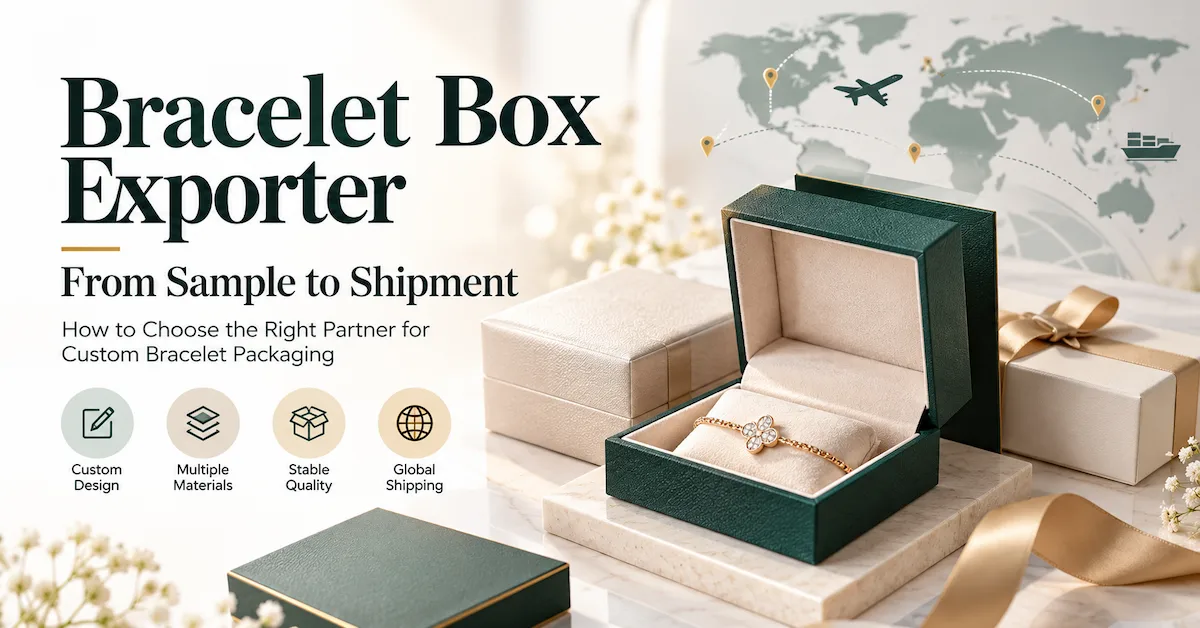
A reliable bracelet box exporter should connect the approved sample to a written specification, production checks, and a confirmed packing plan. Choose a partner that can verify bracelet fit, material and logo consistency, carton configuration, and delivery responsibilities. Before authorizing a bulk order, agree on acceptance criteria, change-control rules, and total purchasing costs rather than comparing the box price alone.
For an international buyer, the decisive question is not simply, “Can this supplier make an attractive sample?” It is, “What will make the shipment match the product we approved?” This guide provides a practical purchasing framework for answering that question. Its checklists are recommended buyer controls, not published performance guarantees or standard commercial terms for every product.
Why an Attractive Sample Is Not Enough
An approved sample records what a buyer has seen. It does not, by itself, explain which materials must be purchased, how assembly should be controlled, or what an inspector must reject. Those decisions need their own written references.
Consider a hypothetical bracelet launch. The sample has an elegant exterior and the correct logo, but the order confirmation only describes a “luxury bracelet box.” The insert material, usable cavity, protective wrapping, and carton quantity are left unspecified. If the delivered boxes differ in any of these areas, the parties have no shared reference for deciding whether the differences were permitted.
The solution is not a longer promotional description. It is a clearer definition of the ordered product.
Separate appearance approval from functional approval
A brand manager may approve color and branding while overlooking whether a larger clasp fits beneath the lid. A procurement manager may approve price without checking whether the quote includes the same insert as the sample. A warehouse team may accept the carton count without opening enough cartons to confirm the assortment.
Assign each approval to a named person. Appearance, product fit, commercial scope, and shipment release are separate decisions, even when one person handles several of them. Record unresolved issues before moving forward.
BRT PAK’s prototype development guide discusses physical samples as a way to examine structure, materials, branding, and jewelry fit before production. Use that development stage to produce an approval record, not merely a favorable photograph. Jinhua Better Industrial Co., Ltd.
Identify where a defect would create the greatest cost
A slightly different interior shade and a bracelet that cannot be removed easily are not equivalent problems. Likewise, a damaged presentation box may be commercially unacceptable even when the bracelet itself remains intact.
Before sampling, define the conditions that would make the package unusable for your sales channel. Ask whether the problem would require repacking, delay fulfillment, undermine a gift presentation, or prevent a retailer from accepting the delivery. These consequences should shape inspection priorities.
For wholesale bracelet gift boxes, also define assortment errors. A shipment containing the correct total quantity can still be wrong if the colors, sizes, or inserts are distributed incorrectly.
How the Box, Insert, and Shipping Package Work Together
For specification purposes, treat the package as three connected layers: the product-contact insert, the presentation box, and the shipping arrangement. Approve each layer separately and then review the assembled package.
The insert determines usable fit
Measure the bracelet in its intended presentation position, including the clasp, charms, hinges, or raised decoration. Do not size the cavity from wrist circumference alone. A rigid bangle, flexible chain, and open cuff can occupy different shapes even when sold for similar wrist sizes.
Check the usable space after the lining and insert have been installed. External box dimensions are not a substitute for internal clearance: walls, covering, cushions, and lid construction occupy part of the available space.
During the fit review, place and remove the actual bracelet. Check whether the support holds the intended position without requiring an operator to force the clasp, bend a rigid section, or press a decorative element against the lid. Treat an unfamiliar material combination as something to evaluate, not as automatically compatible.
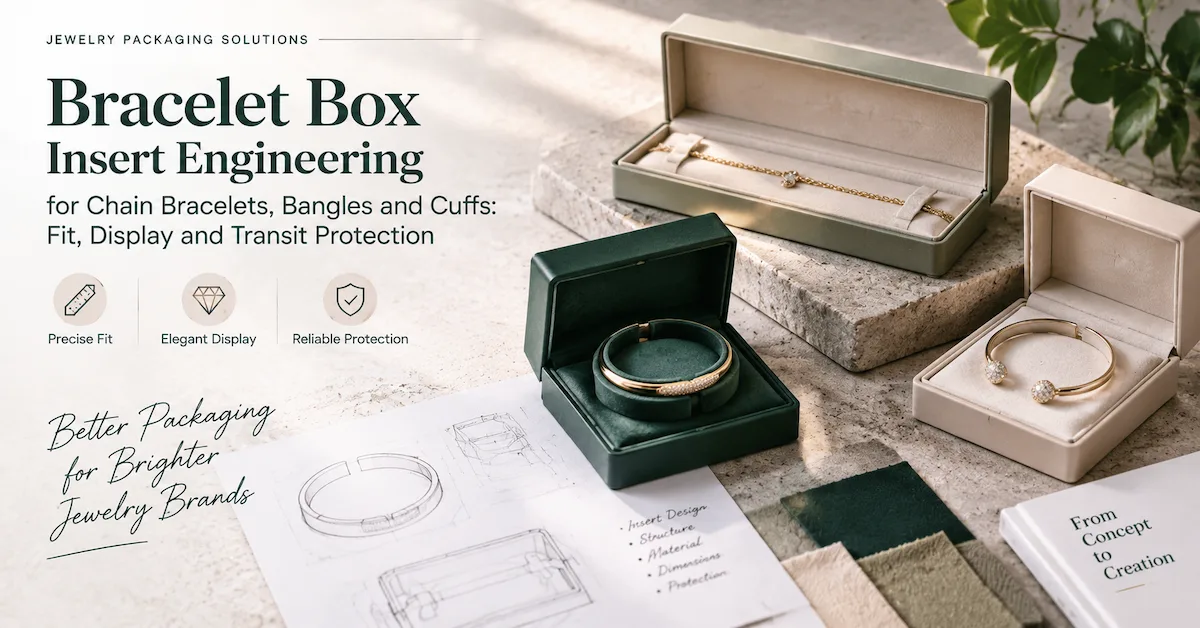
For a deeper discussion of retention geometry, use the bracelet box insert engineering guide. The purchasing task here is to make the approved fit reproducible in the order specification. Jinhua Better Industrial Co., Ltd.
The exterior determines construction and finish requirements
“Velvet box” or “leatherette box” describes only part of the package. Ask what forms the structural shell, how it is covered, how the lid closes, and what material contacts the bracelet.
Record these as separate specification fields. This allows a buyer to distinguish a change in decorative covering from a change in the underlying structure. It also prevents a supplier and buyer from using the same product name for different assemblies.
For surface review, specify the viewing conditions and use an approved physical reference where appearance matters. Check corners, exposed edges, seams, adhesive marks, and logo placement on the assembled box rather than approving isolated material swatches alone.
The shipping package has a different job
Do not use successful countertop presentation as evidence of transport protection. Request a packed sample showing how each box is protected, grouped, labeled, and placed inside the master carton.
If transport testing is required, agree on the package configuration, contents, method, and acceptance criteria before testing. A report should identify what was actually evaluated. Avoid extending a result from one packing arrangement to a different carton, quantity, or product without further review.
For e-commerce, inspect the package the customer will receive. For bulk exports, inspect the master-carton arrangement. These are different distribution configurations and should not share an approval simply because the presentation box is identical.
Compare Packaging Options by Their Approval Requirements
Start with the bracelet and sales channel, then compare constructions. The following table is a purchasing comparison, not a ranking of tested performance or a statement that every option is available in every catalog model.
| Packaging direction | Potential purchasing advantage | What to validate | Best-fit buying situation |
|---|---|---|---|
| Paper-based presentation box | A starting point for coordinated printed branding | Shell specification, corners, surface finish, insert, and packed dimensions | Branded retail collections and repeat-order programs |
| PU or leatherette-covered box | A leather-look visual direction | Actual covering, base structure, edge wrapping, seams, and logo result | Brands seeking a particular texture and presentation |
| Velvet-covered or lined box | A soft-textured presentation direction | Fabric reference, cleanliness, visible marks, covering consistency, and fit | Premium gift and occasion-led collections |
| Bamboo presentation box | A visibly different material direction | Construction, finish, variation limits, insert, and packed weight | Collections that intentionally use a bamboo appearance |
| Existing standard construction with branding | A way to avoid unnecessary structural redevelopment | Available dimensions, customization limits, stock status, and current quotation | Buyers whose bracelet already fits an established format |
Use real catalog references without assuming universal fit
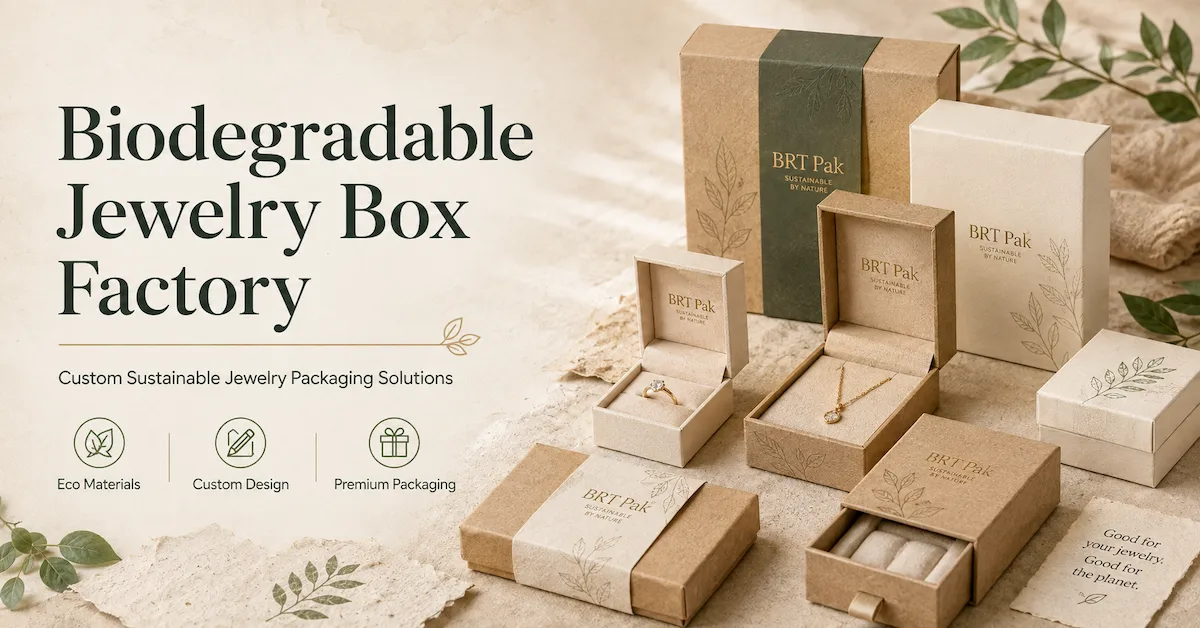
The Paper Jewelry Box provides a paper-based visual reference; its published description includes matte styling. Treat it as a design starting point and request confirmation of the orderable size, insert, branding options, and current supply conditions. Jinhua Better Industrial Co., Ltd.
The Leatherette Jewelry Box provides a leather-look reference. Confirm the covering and full construction in the quotation rather than describing it as genuine leather or assuming that every interior configuration is suitable for bracelets. Jinhua Better Industrial Co., Ltd.
The JBW190 Bamboo Jewelry Box provides a named bamboo packaging reference. Its product page also uses microfiber-related descriptions. The selected bracelet configuration still needs a dimensioned specification and physical fit approval. Jinhua Better Industrial Co., Ltd.
These references help buyers communicate an intended direction. They do not replace model-specific confirmation, and no universal MOQ, lead time, or protective performance is implied.
Choose customization only where it solves a defined problem
For custom bracelet boxes for jewelry brands, separate required changes from optional decoration. A revised insert may solve a genuine fit problem; a new box shape may not be necessary if an existing construction already works.
Ask the supplier to distinguish the baseline configuration from each proposed upgrade. This makes it easier to see whether extra development is improving fit, presentation, packing efficiency, or only adding visual complexity.
Explore jewelry packaging options →
What Should a Bracelet Box Exporter Prove Before Production?
Ask for a clear chain of evidence: the specification defines the target, the approved sample demonstrates it, and inspection records show how the production order was checked. The following checkpoints are a recommended procurement method, not a claim that every supplier follows the same procedure.
Checkpoint 1: A quotation-ready technical specification
Use one controlled sheet for each distinct packaging configuration. Do not let the product name carry information that belongs in a measurable field.
| Specification field | What the buyer should record | Approval evidence |
|---|---|---|
| Bracelet reference | Product identifier, presentation position, dimensions, and protruding features | Actual sample or dimensioned product reference |
| Usable interior | Cavity and lid clearance with the final insert installed | Measurements and assembled fit review |
| Exterior dimensions | Finished length, width, and height | Approved drawing and measured sample |
| Structural shell | Named material and agreed construction | Supplier specification and sample |
| Covering and lining | Material references, color, texture, and placement | Approved material and assembled finish |
| Insert | Shape, material, support points, and orientation | Product placement and removal review |
| Logo | Artwork revision, process, size, position, and color | Approved decorated sample |
| Closure | Opening method, alignment, and agreed functional checks | Recorded sample review |
| Unit protection | Sleeve, bag, wrapping, or other agreed arrangement | Packed unit sample |
| Master carton | Assortment, quantity, dimensions, labels, and protection | Approved packing plan |
| Acceptance rules | Defect examples, measurement methods, and decision authority | Signed inspection instructions |
Set tolerances around the actual function and manufacturing proposal. Do not copy an arbitrary numerical tolerance from another box. Identify the measurements that determine fit and agree how those measurements will be taken.
Checkpoint 2: An approved sample with a revision identity
Give the approved sample a reference number, date, and specification revision. Identify any features that remain provisional. If the sample uses a temporary lining or unfinished logo, state that clearly; it is not yet a complete production reference.
Keep equivalent references with the buyer and supplier where practical. Photographs support the record, but the written specification should explain what the photographs cannot establish.
The bracelet packaging sample approval should also name the person authorized to approve changes. Otherwise, a casual message about a preferred color can be mistaken for permission to change the production order.
Checkpoint 3: Written control over substitutions
Ask the supplier to obtain approval before changing a specified material, insert construction, decoration process, or packing arrangement. The change request should identify the original requirement, proposed replacement, reason, and expected effect on price or schedule.
Decide whether the change requires a new swatch, decorated sample, assembled prototype, or further testing. Not every change needs the same response, but it should receive a deliberate response.
A useful rule is that silence does not count as approval. The order should record the accepted revision before the changed configuration enters production.
Checkpoint 4: Production checks tied to buyer priorities
Define which characteristics should be checked before covering, after assembly, and before packing. For example, insert geometry should not first be considered after every box has been sealed into a carton.
For final inspection, agree on sample selection, measurements, visual criteria, and how failures will be handled. Ask for evidence from the actual order rather than a set of unrelated showroom photographs.
Check assortments as well as workmanship. Verify that box size, color, insert, artwork version, and carton label correspond to the same item code. A well-made box with the wrong branding is still the wrong product.
Checkpoint 5: A shipment-release decision
Before shipment, review the agreed inspection result, carton count, packing list, and any required supporting documentation. If defects require correction, identify which goods were affected and how the corrected quantity will be checked.
Do not let a freight booking silently become approval to ship unresolved goods. Name the person who can release the shipment and record any accepted exceptions.
This makes the final purchasing decision explicit: the order is released against agreed evidence, not merely because production has reached its planned completion date.
Compare Purchasing Cost and Lead Time Without Hiding Risk
When comparing a bracelet box exporter with another candidate, put both offers on the same specification and delivery basis. A price difference is useful only when you understand what changed between the offers.
BRT PAK’s custom jewelry packaging cost guide separates specification decisions from one-time charges and packing assumptions. Use that distinction when building a comparison rather than treating every displayed product price as a complete project quotation. Jinhua Better Industrial Co., Ltd.
Compare the cost of usable packaging, not just ordered units
For your internal model, consider:
Cost per accepted usable box = total relevant project cost ÷ accepted usable quantity.
Include only the cost categories relevant to your transaction, and avoid counting charges twice. Separate the product price from development, decoration, inspection, protective packing, transport, and destination expenses that your business actually bears.
Also compare what would happen if goods required correction. Agree on how additional inspection, rework, replacement, and associated handling would be addressed. Do not invent a defect allowance or assume a supplier has accepted unlimited liability.
Evaluate dimensions before negotiating away protection
Consider an illustrative design calculation, not a BRT PAK product specification. A box measuring 120 × 120 × 45 mm occupies 648 cubic centimeters. At 120 × 120 × 35 mm, its external volume would be 504 cubic centimeters: approximately 22.2% less.
That arithmetic does not establish a freight saving. The shorter box must still accommodate the bracelet, insert, and lid clearance; carton layout and the carrier’s charging basis must also be checked. The example shows why reviewing unnecessary dimensions can be more useful than simply demanding a lower material cost.
Request confirmed packed dimensions before comparing transport options. Do not remove protective components solely because the outer box becomes smaller.
Build the schedule around approvals
Ask for separate estimates for development, material preparation, sample review, production, inspection, corrective work if needed, and shipment preparation. Identify the event that starts each period.
A production estimate that begins after final approval cannot be treated as a complete concept-to-delivery schedule. Likewise, changes to artwork or materials should trigger a schedule review rather than an automatic assumption that the original date remains valid.
For capacity evaluation, ask when your specific configuration could be scheduled and which operations could constrain it. A general factory-capacity claim is not the same as a confirmed slot for your order.
For an urgent launch, compare a suitable existing construction with a newly developed design. Rejecting an unnecessary customization can be a better decision than rushing an unapproved sample.
Where BRT PAK Fits Into an OEM or ODM Project
BRT PAK / Better Industrial, identified on its website as Jinhua Better Industrial Co., Ltd., presents packaging design, development, production, and logistics services. Its company information describes a workflow covering requirement review, sketches, prototypes, material selection, sample confirmation, and packing coordination. Jinhua Better Industrial Co., Ltd.
For a buyer, the useful next step is to connect those published services to the exact project. Confirm who prepares the drawing, who sources the proposed material, who authorizes sample changes, and what evidence accompanies the shipment.
Define the development responsibilities
Under a buyer-led OEM bracelet packaging brief, provide the approved product geometry, artwork, and performance requirements, then ask the supplier to confirm manufacturability and propose any necessary adjustments.
For supplier-assisted development, describe the bracelet, intended presentation, and commercial limits before choosing a structure. Agree on the development deliverables and the approval process rather than relying on the OEM or ODM label alone. Discuss the permitted use of custom artwork, drawings, and tooling as part of that scope.
BRT PAK’s OEM jewelry packaging guide describes structure development, branding, sampling, and quality-control activities. Confirm which options apply to the selected construction and order quantity. Jinhua Better Industrial Co., Ltd.
Look for operational advantages that can be demonstrated
A coordinated development process is valuable when it gives the buyer fewer unresolved handoffs. Ask for a consolidated specification, a clear revision history, one agreed sample status, and an identified contact for inspection questions.
Judge the advantage by the documents and decisions produced. Avoid assigning value to promises of “perfect quality” that do not define acceptance. A useful supplier relationship makes it easier to know what is approved, what has changed, and what must happen before shipment.
Discuss specifications and sample development →
Match the Packaging Brief to the Sales Channel
The appropriate acceptance criteria depend on how the box will be used. Establish the application before choosing the most decorative option.
| Buyer or channel | Priority to define | Selection advice |
|---|---|---|
| Premium jewelry retailer | Presentation under store lighting and repeated customer handling | Approve the assembled finish, opening action, and product removal |
| Direct-to-consumer brand | Compatibility with its fulfillment package | Review the presentation box inside the actual mailer or shipping carton |
| Wholesaler or importer | Correct assortment and straightforward receiving | Use separate item codes, packing instructions, and carton identifiers |
| Seasonal gift program | A usable launch quantity by the required date | Approve the design early and document any split-shipment arrangement |
| Multi-collection brand | Consistent identity without forcing every bracelet into one interior | Share suitable exterior elements while validating each insert separately |
Build environmental conditions into the review
Tell the supplier whether the boxes will remain in storage, sit in illuminated display cabinets, travel between trade shows, or be dispatched individually. Describe known handling conditions instead of using the undefined phrase “export quality.”
For a moisture-sensitive or high-contact application, agree on the relevant evaluation with your packaging or quality specialist. Do not assume a premium-looking covering makes the assembled package suitable for every storage condition.
Prepare an RFQ that supports a useful response
Send the bracelet reference, intended presentation, quantity by configuration, preferred material direction, logo artwork, destination, and required arrival window. Add your approval requirements and clarify whether you need only presentation boxes or a reviewed shipping arrangement as well.
Ask the supplier to return a proposed construction, inclusions and exclusions, sample plan, minimum quantities, production assumptions, and packing basis. This turns the request for quotation into the beginning of a controlled purchasing process.
For very small quantities or immediate replacement needs, a confirmed standard product may be more appropriate than a new custom development. The right solution should fit the order’s economics as well as the bracelet.
Frequently Asked Questions
1. Must we send valuable bracelets to develop the packaging?
Not necessarily for the first design discussion. Measurements, photographs, and a dimensionally representative sample may support an initial proposal. However, agree how final fit will be checked with the actual product before approval. A substitute cannot automatically establish compatibility with delicate finishes, flexible parts, or a complex clasp.
2. Can different bracelet box colors count toward one MOQ?
Ask for written confirmation by configuration. Clarify whether the minimum applies to the overall order, each color, each insert, or each branding version. Do not assume that combining several small quantities creates one production minimum. Request a quotation that shows the permitted assortment clearly.
3. Can one exterior box serve several bracelet collections?
Treat that as a design proposal to validate. A shared exterior may work with different inserts, but each combination needs its own fit review and item code. Confirm that the common box does not introduce unnecessary size or compromise presentation for the smaller bracelet designs.
4. Can we approve samples remotely?
Use remote review to approve drawings, artwork placement, or identified visual details, but state what remains unverified. For decisions involving material feel, removal force, usable clearance, or handling, arrange a physical review by your team or an appointed representative. Do not record unperformed checks as completed.
5. How should natural material variation be handled?
Agree on acceptable appearance boundaries using representative samples and clear defect examples. Separate permitted variation from damage, poor finishing, or incorrect construction. The word “natural” should not become an unlimited exception to the visual standard approved by the buyer.
6. What changes require another sample?
Use the effect of the change to decide. A different lining, insert shape, structural material, or decoration process may affect previously approved characteristics. Ask the supplier to identify those effects and propose the appropriate reapproval. Record the decision even when both parties agree that a full new prototype is unnecessary.
7. What evidence should support a compliance claim?
Request documentation that identifies its issuer, scope, covered material or product, and relevant version or date. Have the appropriate reviewer assess whether it covers the ordered configuration and destination requirements. A general company credential should not be substituted for evidence concerning a particular product claim.
8. Can part of the order ship before the remainder?
Only under an agreed arrangement. Define which configurations and quantities belong to each shipment, how each batch will be inspected, and how extra packing or transport costs will be allocated. Make sure the first delivery contains a usable assortment rather than an incomplete set of packaging components.
9. What should we do if packaging arrives damaged or incorrect?
Preserve the carton identifiers, packing records, photographs, quantities, and affected samples. Compare the issue against the approved specification and notify the responsible parties within the agreed reporting period. Before ordering, establish the investigation process and available remedies; do not assume a standard warranty covers every situation.
10. How do we prevent repeat orders from drifting away from the original design?
Reorder against a controlled specification and reference sample, not the previous invoice description alone. Ask the supplier to confirm material availability and disclose proposed changes before production. Keep the review proportional to the change: an unchanged repeat order and a substituted construction should not receive identical approval treatment.
Conclusion
The right bracelet box exporter should help make approval a repeatable purchasing process: define the package, validate the sample, control changes, inspect the order, and confirm shipment readiness. Attractive materials matter, but they are only part of a decision that also involves bracelet fit, usable quantities, commercial scope, and delivery planning.
Start with the product and sales channel. Compare packaging directions against those requirements, then approve the construction and packing arrangement together. Keep one clear reference for each configuration so that production, inspection, and future replenishment use the same definition of an acceptable box.
To begin a BRT PAK project, review the jewelry box collection and send your bracelet dimensions, quantity by configuration, preferred finish, logo artwork, destination, and timing through the project inquiry page. Request a proposed specification, sample plan, packing basis, and itemized quotation before authorizing your order.