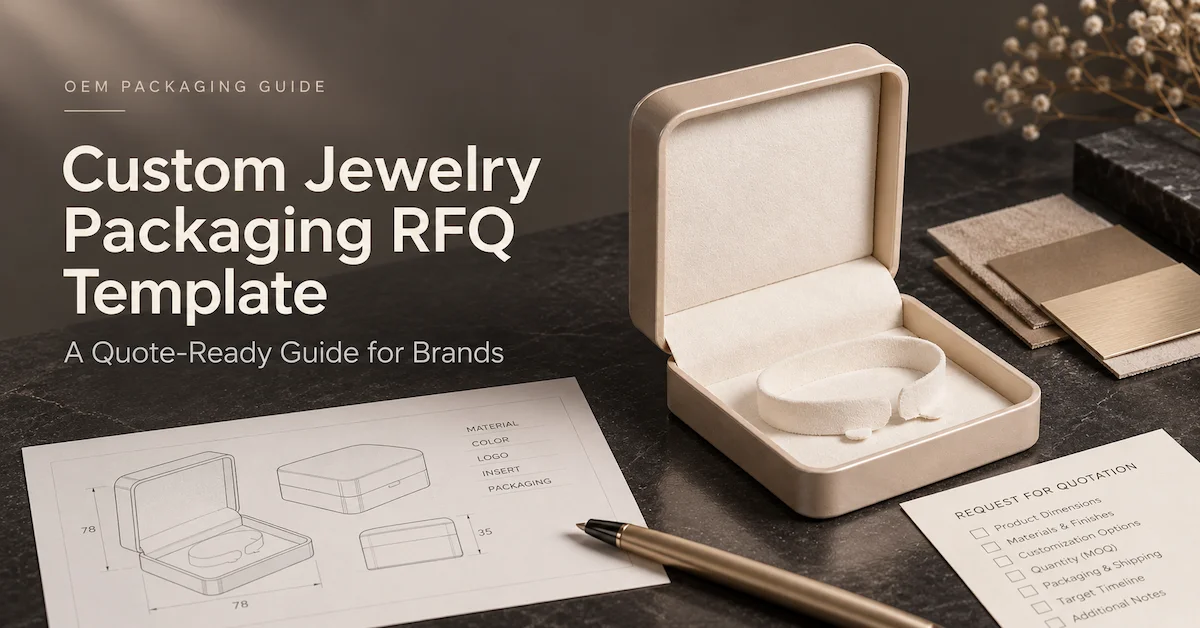

For jewelry brands, watch companies, gift retailers, and private-label businesses, packaging is both a commercial product and an essential part of brand presentation. Poorly managed sourcing can lead to inconsistent materials, incorrect inserts, unexpected charges, delayed launches, or finished boxes that differ from the approved sample.
A structured purchasing process helps buyers reduce these risks while improving communication with manufacturers.
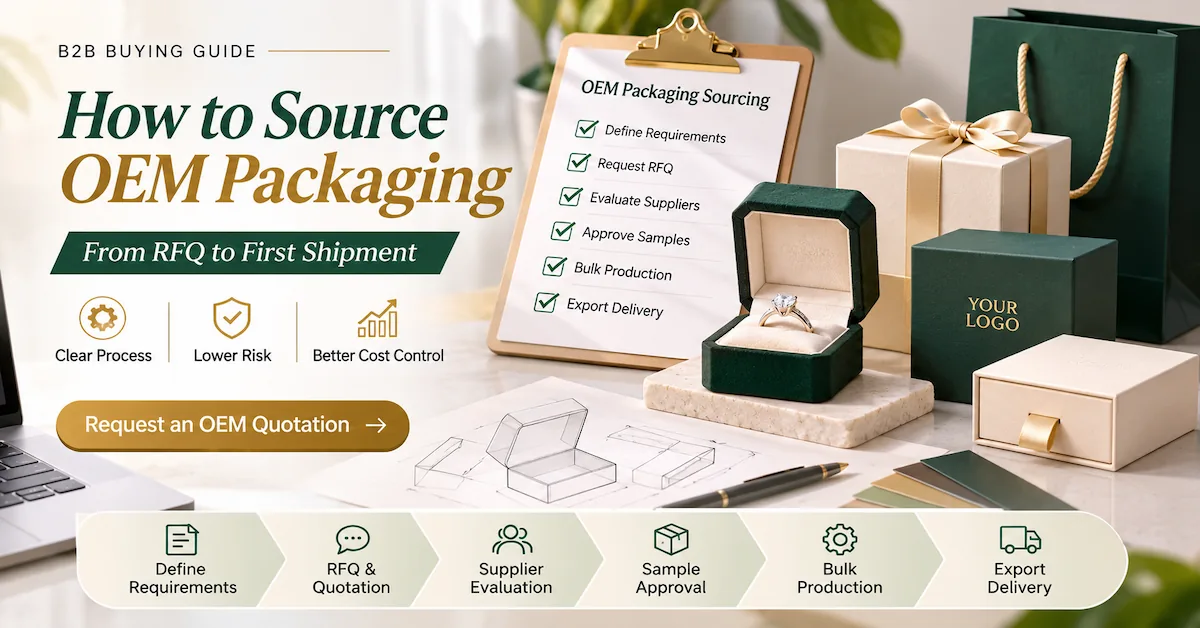
This guide explains the practical stages of OEM packaging procurement, including technical requirements, supplier verification, quotations, sample approval, quality control, and export delivery.
OEM Packaging Sourcing: Key Steps at a Glance
| Sourcing Stage | Main Buyer Action | Required Outcome |
|---|---|---|
| 1. Define requirements | Identify products, market, materials, quantity, and budget | Clear purchasing brief |
| 2. Prepare an RFQ | Specify dimensions, structure, inserts, and branding | Comparable supplier quotations |
| 3. Shortlist suppliers | Review capabilities, product experience, and responsibilities | Qualified supplier shortlist |
| 4. Compare solutions | Evaluate materials, structures, customization, and cost | Preferred packaging proposal |
| 5. Approve samples | Verify product fit, workmanship, and brand appearance | Approved production reference |
| 6. Confirm commercial terms | Agree on MOQ, pricing, lead time, and responsibilities | Confirmed purchase order |
| 7. Monitor production | Check materials and production conformity | Documented quality controls |
| 8. Prepare export delivery | Verify packing, inspection, and documents | Shipment-ready goods |
| 9. Evaluate the order | Review receiving results and corrective actions | Reliable repeat-order reference |
Key takeaway: Successful OEM sourcing is not completed when a supplier provides a low quotation. It requires a controlled process connecting technical specifications, commercial commitments, production approval, and final delivery.
1. What Should You Define Before Sourcing OEM Packaging?
The first step is understanding what the packaging must accomplish.
A supplier cannot recommend a suitable structure based only on a reference image or a request for “luxury packaging.”
The buyer should explain the product, its intended presentation, distribution environment, branding requirements, and commercial constraints.
Identify the Product and Intended Application
Different products require different packaging designs.
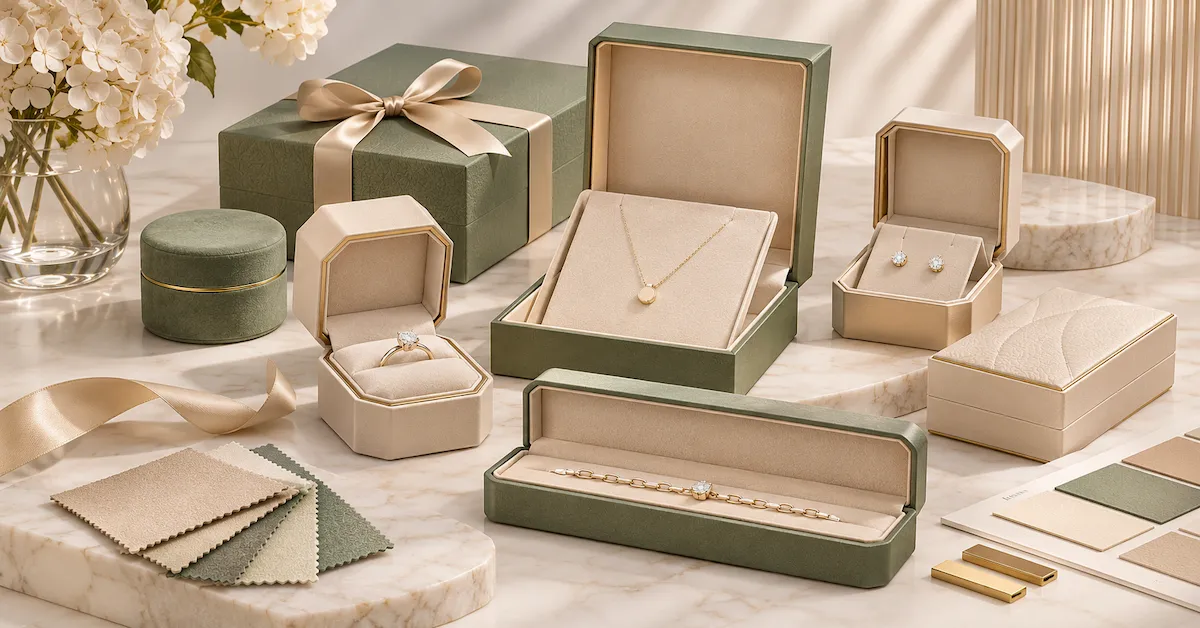
Ring boxes must accommodate the ring band and any raised gemstone settings. Necklace packaging must control chain positioning and pendant presentation. Watch packaging requires suitable support for the watch and its strap or bracelet.
Gift boxes may need compartments for several products, while eyewear storage boxes require appropriate clearance for frames and lenses.
The product should determine the packaging structure rather than being forced into an attractive but unsuitable box.
Define Your Target Customer and Sales Channel
A premium jewelry boutique may prioritize material texture and opening experience.
An e-commerce brand must consider the relationship between its presentation box and outer shipping package.
A wholesale importer may prioritize SKU identification, carton quantities, and repeat-order consistency.
These differences influence material selection, structural complexity, and acceptable purchasing costs.
Determine Whether OEM Customization Is Necessary
OEM packaging is appropriate when an existing packaging format cannot fully meet the buyer's specifications or brand requirements.
However, not every project requires a new structure.
If an available box already accommodates the product, customization might focus on the logo, color, lining, or insert.
This approach can reduce unnecessary development work, although actual MOQ and pricing must still be confirmed.
A fully customized construction becomes more relevant when dimensions, product support, opening style, or presentation requirements cannot be met by existing designs.
2. How Do You Prepare an Effective OEM Packaging RFQ?
An RFQ, or request for quotation, allows suppliers to evaluate the project and prepare a commercial offer.
The quality of the RFQ directly affects how accurately suppliers can interpret the buyer's requirements.
A vague RFQ often produces quotations that cannot be compared fairly.
Essential OEM Packaging Specification Checklist
| RFQ Item | Information to Provide | Why It Matters |
|---|---|---|
| Product category | Jewelry, watches, eyewear, gifts, or accessories | Determines packaging requirements |
| Product dimensions | Length, width, height, weight, and relevant projections | Establishes fit requirements |
| Packaging structure | Drawer, hinged, lid-and-base, or proposed design | Defines manufacturing complexity |
| Structural material | Paperboard, wood-based material, bamboo, or another option | Affects construction and cost |
| Exterior finish | Color, texture, covering, or coating | Controls brand appearance |
| Interior construction | Lining, foam, cushions, dividers, or other inserts | Supports the product |
| Branding | Logo artwork, dimensions, placement, and decoration | Defines customization |
| Order quantity | Quantity by design, size, and color | Supports MOQ and pricing |
| Quality requirements | Measurements, visual criteria, and testing needs | Establishes acceptance |
| Packing requirements | Individual protection, cartons, and labels | Supports delivery preparation |
| Target market | Destination country and sales channel | Supports logistics and applicable requirements |
| Required schedule | Sample approval, production, and delivery milestones | Supports project planning |
Separate Mandatory Requirements From Preferences
A buyer may require specific product dimensions and logo artwork but remain flexible about the box construction.
The RFQ should make this distinction clear.
For example, a jewelry brand might require a cream exterior, gold logo, and insert compatible with a defined necklace size, while allowing the supplier to recommend a suitable paperboard structure.
This gives the supplier room to propose a practical solution without changing essential requirements.
Avoid Quotation Ambiguity
Ask suppliers to identify all assumptions and exclusions.
A quotation should specify whether inserts, logo decoration, individual wrapping, export cartons, sample development, and other requested services are included.
The purpose is to compare complete packaging solutions rather than unrelated unit prices.
For buyers needing a detailed technical handoff, BRT PAK's custom jewelry box design guide provides related information about developing production-ready specifications.
3. How Should You Shortlist and Verify OEM Packaging Suppliers?
A supplier's website can demonstrate its product positioning, but it should not be the only basis for a purchasing decision.
Buyers should evaluate whether the supplier can support the specific packaging type, development scope, order quantity, and delivery requirements.
Manufacturer vs. Trading Company vs. OEM Development Partner
| Supplier Model | Typical Responsibility | Main Buyer Consideration |
|---|---|---|
| Direct manufacturer | Manufactures or manages the production of packaging | Production controls and actual capabilities |
| Trading company | Sources products and coordinates purchasing | Supplier transparency and accountability |
| OEM development partner | Produces packaging against buyer specifications | Technical interpretation and sample conformity |
| ODM development partner | Supports design and product development | Design scope, ownership, and approval process |
These roles may overlap.
A manufacturer may also export directly, and an OEM supplier may provide design-development services.
The most important requirement is understanding who is responsible for each part of the order.
Verify Relevant Production Experience
Ask whether the supplier has experience with the required construction and materials.
For example, a company producing ordinary paper cartons may not necessarily have the same experience with velvet-covered jewelry boxes, high-gloss watch boxes, or illuminated presentation packaging.
Relevant samples and technical explanations can provide useful evidence.
Review Quality and Compliance Documentation
Buyers should request documents relevant to the actual product and destination market.
These may include material specifications, applicable certifications, inspection records, or testing information.
If a supplier provides ISO, FSC, or other documentation, confirm its validity and scope.
A company-level certificate does not automatically mean every finished packaging product has the same certification.
Check Communication and Accountability
An effective supplier should identify unclear requirements, explain manufacturing limitations, and document important changes.
Ask who manages design approval, material procurement, production inspection, and shipment release.
Clear responsibilities can reduce problems when several departments or subcontractors are involved.
4. How Do You Compare OEM Packaging Materials and Structures?
Material selection should balance product protection, brand presentation, manufacturing feasibility, and total cost.
No single material or packaging structure is best for every application.
Comparing Common Packaging Materials
| Material | Potential Advantages | Limitations to Evaluate | Typical Applications |
|---|---|---|---|
| Rigid paperboard | Printable, structured, flexible decoration | Board quality, corner finishing, moisture exposure | Jewelry and retail gift boxes |
| PU leatherette | Leather-like texture and color options | Wrapping, seams, surface wear | Premium presentation packaging |
| Velvet | Soft visual and tactile appearance | Lint, pressure marks, cleanliness | Luxury jewelry packaging |
| Wood-based construction | Substantial feel and distinctive finish | Weight, joints, coating consistency | Watch and jewelry boxes |
| Bamboo | Natural appearance and texture | Material variation, finishing | Specialty jewelry packaging |
| Microfiber | Soft interior contact surface | Cleanliness and product compatibility | Inserts, linings, and pouches |
These characteristics are general selection considerations. Actual material performance depends on its grade and finished construction.
Compare the Complete Structure
A box described as “velvet packaging” may still contain a paperboard or other structural body beneath the covering.
Similarly, a leather-look finish does not identify the material used for the supporting shell.
Buyers should request a complete construction description.
Important information includes the box body, exterior covering, lining, insert, closure, and individual protective packing.
Review Real Product References
BRT PAK offers several published packaging directions that can help buyers define their preferences.
Its Paper Jewelry Box illustrates a drawer-style design with a ribbon pull and soft interior lining.
Buyers can also explore the Jewelry Boxes collection, Gift Box collection, and Bags collection for related product categories.
These pages provide starting points for selecting packaging styles.
Actual materials, available configurations, MOQ, customization options, and prices must be confirmed for each project.
5. How to Source OEM Packaging With Clear MOQ and Cost Controls
A reliable purchasing comparison considers what the supplier is actually offering.
Two quotations may use the same product name but describe different structures, materials, inserts, or packing arrangements.
Normalize Quotations Before Comparing Prices
Ask each shortlisted supplier to quote against the same approved RFQ.
If a supplier proposes an alternative material or construction, identify it as a separate option.
This allows buyers to understand whether the lower price results from production efficiency or a different product specification.
Understand MOQ by Configuration
MOQ may depend on material procurement, dimensions, colors, logo processes, and manufacturing arrangements.
For mixed-product orders, the total shipment quantity may not satisfy the minimum for each configuration.
Request MOQ and price breaks by SKU, color, and design where relevant.
Consider Total Landed Cost
The complete purchasing cost may include production, sampling, tooling or setup, inspection, protective packing, freight, customs charges, and warehouse handling.
An internal comparison can use:
Total landed cost per usable unit = Applicable purchasing and delivery costs ÷ Accepted usable quantity
Include only costs actually borne by the buyer and avoid counting charges twice.
A low unit price may not offer the best value if the packaging requires additional sorting, repacking, or correction.
Clarify Tooling and Artwork Ownership
When a custom project requires molds, cutting tools, original designs, or brand artwork, agree on the ownership and permitted use of those assets.
Also clarify whether tooling charges are one-time costs, whether repeat orders require additional setup, and what happens if the supplier relationship ends.
These details should be resolved before making significant development commitments.
6. How Does OEM Packaging Sample Approval Work?
Sample approval connects the design concept with the intended manufactured product.
It is one of the most important stages of OEM sourcing because the buyer needs to confirm that the proposed packaging meets both visual and functional requirements.
Stage 1: Structural Prototype
A structural prototype can verify dimensions, box geometry, opening style, and internal product fit.
At this stage, the materials or decoration may not fully represent the final product.
The buyer should record which characteristics have been approved.
Stage 2: Material and Decoration Review
Review exterior materials, lining, color references, logo placement, and finishing methods.
A digital rendering cannot fully demonstrate texture, opening resistance, or the appearance of decoration on an actual material.
Approve representative physical materials where those characteristics matter.
Stage 3: Production-Intent Sample
A production-intent sample should represent the proposed finished packaging closely enough to support manufacturing approval.
Check product fit, materials, dimensions, decoration, closure, and individual packing.
Stage 4: Golden Sample Confirmation
Keep an approved reference sample linked to a written specification, artwork revision, and material information.
If the supplier proposes substitutions after approval, review the changes before production.
Sample approval establishes what should be manufactured. It does not automatically prove that the entire production lot conforms to that sample.
7. How Can Buyers Control Quality During Bulk OEM Production?
Quality control should be planned before production begins.
The required inspection method depends on the packaging structure, materials, order quantity, and consequences of defects.
Important Quality-Control Checkpoints
| Production Stage | Main Inspection Focus |
|---|---|
| Incoming materials | Material identity, color, texture, and specifications |
| Initial production | Dimensions, assembly, insert positioning |
| In-process production | Workmanship, covering, decoration, consistency |
| Finished products | Function, appearance, quantity, approved specification |
| Export packing | Individual protection, carton contents, labels |
Define Acceptable and Unacceptable Defects
A functional defect may prevent a box from opening correctly or accommodating the intended product.
A cosmetic defect may affect visible surfaces, logo appearance, or presentation.
Buyers and suppliers should agree on how these issues will be classified and assessed.
If sampled inspection is used, the sampling plan and acceptance criteria should be defined in advance.
Manage Production Changes
An approved material should not be substituted without appropriate review.
A different lining, covering, structural component, or decoration process may affect appearance or functionality.
Request written confirmation of changes and determine whether another sample or inspection is required.
Establish Corrective-Action Responsibilities
Before shipment, agree on how nonconforming goods will be identified, corrected, replaced, or otherwise handled.
This should include responsibilities for additional inspection or related costs where applicable.
Clear procedures are more useful than general promises of perfect quality.
8. How Should You Plan OEM Packaging Production and Export Delivery?
Production and shipment planning should begin before the purchase order is finalized.
Custom packaging schedules can include several activities that are not reflected in a general production lead-time estimate.
Confirm Project Milestones
Ask the supplier to separate design development, sampling, material preparation, bulk manufacturing, final inspection, and shipment preparation.
Also confirm what triggers each stage.
A production estimate that begins after final sample approval should not be interpreted as the complete concept-to-delivery period.
Verify Capacity for the Actual Order
General factory-capacity claims do not establish that a particular order can be completed within a requested schedule.
Ask the supplier to confirm the proposed quantity, configuration, production window, and dependencies.
For orders containing several packaging SKUs, clarify whether different products will be manufactured or shipped together.
Check Export Packing Requirements
Finished presentation boxes may require protective wrapping, separators, and suitable master cartons.
Confirm carton quantity, dimensions, weight, labeling, and the packing-list format.
The packaging used to export empty boxes may differ from the shipping package later used to deliver jewelry to consumers.
Agree on Delivery Responsibilities
International quotations should specify the agreed trade terms and named delivery location.
Incoterms 2020 can help define certain transport responsibilities, but buyers should also confirm relevant documents, packing requirements, inspection arrangements, and commercial obligations.
Do not assume insurance, destination customs clearance, import duties, or final delivery services are included unless agreed.
9. Why Consider BRT PAK for OEM Jewelry and Gift Packaging?
BRT PAK / Better Industrial, operated by Jinhua Better Industrial Co., Ltd., describes itself as a provider of packaging design, research and development, production, and international logistics services.
Its published development process covers requirement confirmation, design sketches, physical prototypes, material selection, sample confirmation, and logistics preparation.
The company's product portfolio includes jewelry boxes, gift boxes, bags, displays, and watch-related packaging.
These categories are relevant to jewelry brands, gift companies, importers, and private-label businesses planning coordinated packaging projects.
Match the Supplier's Capabilities to Your Project
BRT PAK's published service scope provides a starting point for OEM/ODM discussions, but buyers should confirm which services are available for their specific product.
For example, a brand sourcing jewelry boxes and matching pouches should identify the required materials, quantities, artwork, and delivery conditions for each product.
A buyer developing an entirely new packaging structure should also agree on design responsibilities, sample stages, and technical approval.
Request a Project-Specific Proposal
Rather than relying on general claims about quality, capacity, or pricing, request a proposal based on your actual RFQ.
The response should clarify suitable product options, customization requirements, sample development, MOQ, quality expectations, and commercial terms.
10. Frequently Asked Questions
1. What Is OEM Packaging?
OEM packaging is packaging produced according to a buyer's specified requirements. It may involve custom dimensions, structures, materials, inserts, colors, or branding. The degree of customization depends on the supplier's capabilities and the agreed project scope.
2. How Do I Find a Reliable OEM Packaging Supplier?
Begin with suppliers experienced in your product category. Compare technical capabilities, representative samples, manufacturing responsibilities, quality controls, and commercial terms. Ask for evidence relevant to your actual packaging project rather than relying only on promotional claims.
3. What Information Is Required for an OEM Packaging RFQ?
Provide product dimensions, packaging type, structural preferences, materials, logo artwork, estimated quantities, target market, quality requirements, and schedule. Clearly distinguish mandatory requirements from preferences that the supplier may recommend.
4. What Is the MOQ for OEM Packaging?
MOQ varies according to materials, design, decoration, configuration, and production arrangements. Different colors or product sizes may require separate minimum quantities. Request a project-specific quotation instead of assuming one universal MOQ.
5. How Much Does Custom OEM Packaging Cost?
Cost depends on structure, material selection, dimensions, inserts, decoration, quantity, sampling, packing, and delivery terms. Compare complete quotations on identical specifications and calculate total delivered cost rather than using unit price alone.
6. What Is the Difference Between OEM and ODM Packaging?
OEM generally involves manufacturing to buyer-defined specifications. ODM involves additional supplier-supported design or development. The distinction can overlap in practice, so buyers should define the actual responsibilities, deliverables, ownership terms, and approvals.
7. Should I Request a Physical Sample Before Bulk Production?
For customized packaging, a representative physical sample is strongly recommended. It allows buyers to check product fit, materials, workmanship, branding, and opening behavior. Digital images alone cannot verify every physical requirement.
8. How Can I Verify OEM Packaging Quality?
Use an approved specification, representative sample, documented material references, and agreed inspection criteria. Evaluate important characteristics during production and before shipment. Confirm how nonconforming products will be managed.
9. Can OEM Packaging Include Sustainable Materials?
A project may specify materials with particular environmental attributes, subject to availability and suitability. Buyers should request evidence for recycled content, certified sourcing, or other claims. Environmental terminology should not be used without relevant supporting documentation.
10. How Can I Start an OEM Packaging Project With BRT PAK?
Review BRT PAK's jewelry packaging products and prepare your product specifications, reference images, artwork, expected quantities, and target market. Then contact BRT PAK to discuss design options, sampling, MOQ, and quotation requirements.
Conclusion
TURN YOUR PACKAGING BRIEF INTO A QUOTE-READY PROJECT
Knowing how to source OEM packaging helps jewelry brands, gift companies, and private-label buyers reduce purchasing risks, control product quality, and build more reliable supplier relationships.
Successful sourcing begins with a clear product brief and measurable specifications. Buyers should then verify supplier capabilities, compare equivalent quotations, approve representative samples, and establish quality-control and delivery requirements before authorizing bulk production.
The most suitable OEM packaging partner is not necessarily the supplier offering the lowest price. It is the one whose verified capabilities, communication, product quality, and commercial arrangements match the buyer's actual requirements.
BRT PAK / Better Industrial offers jewelry packaging, gift boxes, bags, and related product categories, together with published design-development and international service capabilities relevant to customized projects.
To begin your sourcing process, explore the BRT PAK Jewelry Boxes collection and submit your OEM packaging requirements, including product dimensions, preferred materials, logo artwork, expected order quantity, and target delivery schedule.
A detailed RFQ can help establish suitable packaging options, clearer commercial quotations, and a practical foundation for consistent long-term cooperation.