
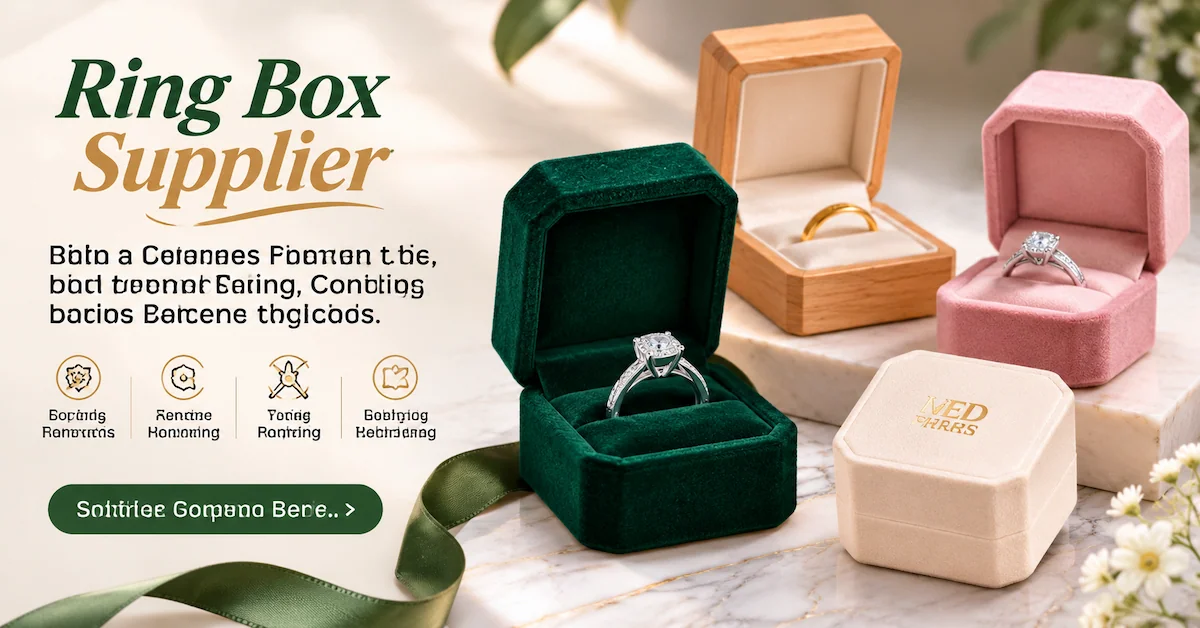
A reliable ring box supplier should provide packaging that fits the ring, accommodates raised gemstone settings, supports brand presentation, and maintains consistent quality across bulk orders. Jewelry buyers should compare usable interior dimensions, insert construction, materials, opening mechanisms, logo customization, MOQ, and inspection requirements. Engagement rings, wedding bands, and everyday retail rings may require different packaging solutions.
For jewelry brands and retailers, packaging affects more than product appearance. It influences the customer's first impression, the way the ring is presented, and the efficiency of purchasing, stocking, and distributing finished products.
Choosing an unsuitable box can create preventable problems, including gemstone contact with the lid, unstable ring positioning, inconsistent branding, and unexpected bulk-order expenses.
This guide provides a structured method for selecting ring packaging, comparing technical specifications, evaluating supplier capabilities, and preparing commercial orders.
Ring Box Selection: Quick Reference Guide
| Purchasing Requirement | Recommended Packaging Direction | Main Technical Concern | What Buyers Should Verify |
|---|---|---|---|
| Engagement rings | Premium velvet or rigid presentation box | Raised gemstone clearance | Internal height and ring stability |
| Wedding bands | Compact standardized ring box | Different band widths and sizes | Insert compatibility |
| Luxury jewelry retail | Wood-based, bamboo, or premium covered box | Surface appearance and opening quality | Material finish and closure |
| Private-label collections | Customized box with approved branding | Logo consistency | Artwork and decoration samples |
| Premium gift presentation | LED or decorative presentation box | Lighting and functional reliability | Electrical configuration and product fit |
| Wholesale jewelry distribution | Standardized or selectively customized boxes | MOQ and replenishment | Quantity requirements and carton configuration |
Key conclusion: Select the box structure according to ring geometry and intended use before deciding on decorative materials. A visually attractive box that cannot hold the product correctly is not an appropriate packaging solution.
Key Takeaways
-
Ring compatibility comes first. Band width, setting height, and ring orientation determine the required insert and usable interior dimensions.
-
Engagement and wedding ring packaging have different priorities. Engagement packaging may emphasize the opening experience, while wedding band collections often benefit from consistent inserts and efficient replenishment.
-
Materials affect both presentation and cost. Velvet, paperboard, wood, bamboo, and leatherette provide different aesthetic and construction options.
-
Sample approval reduces purchasing uncertainty. Buyers should confirm ring fit, surface finishing, logo application, and closure behavior before bulk production.
-
MOQ must be checked by configuration. Different sizes, colors, materials, or decoration methods may have separate production requirements.
-
Supplier evaluation should include production and delivery controls. An approved sample alone does not establish that the finished shipment will meet the same requirements.
Why Trust This Guide? Product Knowledge and BRT PAK Packaging Experience
This guide combines practical jewelry packaging selection principles with product information published by BRT PAK / Better Industrial.
BRT PAK, operated by Jinhua Better Industrial Co., Ltd., provides jewelry packaging products and describes capabilities involving packaging design, development, manufacturing, material selection, sample confirmation, and international logistics coordination.
Its catalog includes bamboo jewelry boxes, velvet presentation packaging, leatherette designs, and other jewelry packaging products.
Buyers can review the company's Jewelry Boxes collection when comparing design directions.
However, published products are reference points rather than proof that every ring size, material combination, or decoration method is available.
The following recommendations are purchasing and quality-control guidance. They do not imply independently verified factory defect rates, universal lead times, or guaranteed performance for every BRT PAK product.
How Do Engagement Rings and Wedding Bands Require Different Packaging?
The main difference lies in ring geometry, presentation requirements, and how the jewelry is handled.
Engagement Rings: Protecting Raised Gemstone Settings
Engagement rings frequently feature a prominent central gemstone, decorative setting, or raised profile.
These elements affect the space required inside the box.
A supplier should evaluate more than the ring's band diameter. The maximum height of the setting and its position relative to the lid are equally important.
During sample approval, place the actual ring in the intended orientation and close the box.
Confirm that the gemstone and setting do not experience unwanted contact or pressure.
The box should also allow customers to remove the ring without forcing the band out of the insert.
For premium engagement collections, presentation quality can be especially important because the box is part of the proposal or gifting experience.
Wedding Bands: Consistency Across Ring Sizes
Wedding bands often require simpler presentation, but they vary in width, thickness, material, and decorative features.
A narrow band may sit loosely in an insert designed for a wider ring.
Conversely, forcing a wide band into an undersized slot may create unnecessary pressure or make removal difficult.
For jewelry brands carrying several ring sizes, a standardized exterior box can be useful when the insert is suitable for the approved product range.
A representative sample should be evaluated with the smallest and largest relevant bands.
Fashion and Statement Rings
Fashion rings may have irregular shapes, wide decorative sections, or projecting elements.
These designs may require more specialized inserts or additional clearance.
Buyers should provide representative product dimensions and, where practical, actual samples.
For collections containing highly varied designs, multiple insert configurations may be more practical than forcing every ring into one universal support.
Which Ring Box Material Offers the Best Balance of Appearance and Cost?
Material selection influences presentation, construction, weight, customization, and procurement expenses.
The appropriate choice depends on the jewelry's market positioning, intended use, and purchasing requirements.
Material Comparison for Wholesale Ring Packaging
| Material | Potential Advantages | Limitations to Evaluate | Suitable Applications |
|---|---|---|---|
| Rigid paperboard | Flexible printed decoration and coordinated design | Corner quality, surface durability, structural consistency | Everyday retail and branded collections |
| Velvet | Soft texture and premium visual appearance | Lint, pressure marks, cleanliness, color variation | Engagement and luxury gift packaging |
| Wood-based construction | Substantial feel and distinctive surface finish | Weight, coating, joints, transport protection | Premium retail and presentation |
| Bamboo | Natural texture and differentiated appearance | Material variation, finish quality, construction | Nature-inspired jewelry collections |
| PU leatherette | Leather-like textures and color choices | Edge wrapping, seams, surface wear | Private-label and premium-style boxes |
| Microfiber lining | Soft interior contact surface | Cleanliness and compatibility with jewelry finishes | Interior lining and inserts |
These characteristics describe general material options. Actual product performance depends on construction and should be verified using representative samples.
Paperboard vs. Velvet Ring Boxes
Paperboard may be appropriate for brands seeking coordinated printed packaging and efficient product ranges.
Velvet can provide a different tactile and visual impression, particularly for engagement and gift collections.
However, a velvet covering does not necessarily describe the underlying structural body.
Buyers should request the complete construction specification, including shell material, exterior covering, interior lining, and insert.
Wooden and Bamboo Ring Boxes
Wood-based and bamboo designs may suit brands seeking a more substantial or distinctive presentation.
When evaluating these products, inspect surface finishing, material variation, edges, joints, and overall dimensions.
If the brand intends to make environmental claims, request relevant documentation for the actual product and transaction.
The use of a natural-looking material alone does not establish a particular certification or sustainability performance.
Leatherette Ring Boxes
PU leatherette can provide a range of textures and colors.
For bulk production, corner wrapping, seam alignment, adhesives, and surface consistency are important inspection considerations.
The buyer should approve the actual material and finish rather than relying solely on a digital image.
What Technical Specifications Should a Ring Box Supplier Confirm?
A technical specification should describe the complete finished packaging, not merely its exterior dimensions.
The most important requirements involve jewelry fit, insert positioning, closure behavior, materials, and branding.
Technical Specification Checklist
| Specification | What to Define | Recommended Verification |
|---|---|---|
| External dimensions | Length, width, and height | Approved drawing and sample |
| Usable internal dimensions | Space after lining and insert installation | Measured assembled sample |
| Ring-slot size | Width, depth, and support geometry | Actual ring placement |
| Gemstone clearance | Space around raised settings | Closed-box fit inspection |
| Structural material | Shell composition and construction | Material specification |
| Exterior finish | Color, texture, and coating | Approved physical reference |
| Interior lining | Material, color, and contact surface | Sample examination |
| Closure mechanism | Opening method and alignment | Functional inspection |
| Logo application | Artwork, position, size, and process | Decorated sample approval |
| Individual packing | Protective wrapping and identification | Packed-unit sample |
| Export carton | Quantity, protection, dimensions, and labels | Approved packing plan |
Why the Insert Matters More Than Its Appearance
A ring insert should support the jewelry in the intended presentation position.
Its function is not simply to fill empty space.
An insert may look attractive but fail to accommodate a ring's width or setting.
During sample review, buyers should check whether the ring sits securely, remains accessible, and avoids unwanted pressure.
The correct design may vary between an engagement ring, a wide wedding band, and a statement ring.
How to Check Ring Clearance
A practical ring-clearance check involves placing the approved ring into the insert and closing the finished box.
The buyer should verify that the ring and setting remain free of unwanted contact with the lid or other components.
The test should reflect the intended packed position.
If several ring designs share one box, evaluate representative products from the required range.
How to Evaluate the Closure
Hinged, lid-and-base, drawer-style, and other constructions offer different opening experiences.
For any selected structure, verify alignment, smooth operation, and product stability during normal use.
The closure should not interfere with the jewelry.
For premium presentation packaging, repeated opening and closing may justify additional functional evaluation agreed with the supplier.
How Do LED Ring Boxes Compare With Conventional Packaging?
LED presentation boxes introduce lighting as an additional feature.
They can create a distinctive visual effect, particularly when displaying gemstones.
However, lighting adds technical and commercial requirements that ordinary passive boxes do not have.
| Evaluation Factor | Conventional Ring Box | LED Ring Box |
|---|---|---|
| Primary function | Presentation and storage | Presentation with integrated lighting |
| Power requirement | None for passive construction | Depends on the lighting system |
| Technical evaluation | Fit, materials, closure, finish | Fit, materials, closure, electrical function |
| Inspection scope | Structural and cosmetic checks | Structural, cosmetic, and lighting checks |
| Applicable documentation | Depends on materials and claims | Also depends on electrical design and target market |
| Purchasing considerations | Structure, materials, MOQ, packing | Additional components, testing, and power arrangement |
BRT PAK's LED Velvet Packaging Reference
BRT PAK lists a Green Velvet LED Jewelry Box that illustrates a velvet-covered, illuminated jewelry presentation direction.
This is a useful reference for buyers interested in premium engagement packaging.
However, buyers should confirm the exact orderable variant, ring compatibility, electrical configuration, applicable documentation, and current commercial terms.
An LED feature should be selected because it serves the intended presentation—not simply because it adds complexity.
How Can Jewelry Buyers Verify Ring Box Quality Before Bulk Production?
Quality control should begin with the specification and continue through sample approval, production, and shipment preparation.
Step 1: Approve the Product Specification
Confirm dimensions, insert geometry, materials, colors, logo artwork, and packing requirements.
Assign a revision identifier to the final specification.
Any unresolved requirements should be addressed before production approval.
Step 2: Review a Physical Sample
Test actual ring fit, opening behavior, exterior finish, and product presentation.
A digital rendering can support early design discussions but cannot establish material texture or physical compatibility.
If the intended collection contains different ring sizes or settings, review representative samples.
Step 3: Confirm Branding
Approve the actual decoration on the selected production material.
Check logo placement, size, alignment, and visible quality.
A change in artwork or material may require additional review.
Step 4: Establish Inspection Criteria
Agree on functional, dimensional, and cosmetic acceptance requirements.
The inspection process should identify how samples are selected, how defects are classified, and how nonconforming products will be handled.
Sampled inspection does not guarantee every unit is defect-free.
Step 5: Verify Export Packing
Confirm individual protection, master-carton quantities, carton identification, and shipment documentation.
Premium presentation boxes may require protection against rubbing, pressure, or damage to decorative surfaces.
If transport testing is required, select a procedure appropriate for the actual packaged configuration and distribution route.
What Determines MOQ and Wholesale Ring Box Costs?
MOQ and unit pricing depend on the selected construction, materials, customization requirements, order quantity, and production arrangements.
Buyers should compare quotations based on the same complete specification.
Typical Cost Drivers
| Cost Factor | Purchasing Impact |
|---|---|
| Structural material | Influences construction and material costs |
| Exterior covering | Affects material purchasing and finishing |
| Insert customization | May require development or special components |
| Logo decoration | May introduce setup and processing charges |
| Order quantity | Influences production economics |
| Product variations | Different colors or designs may require separate quantities |
| Individual protection | Affects packing expenses |
| Export-carton configuration | Influences transport preparation |
| Sampling and inspection | Depends on the agreed project scope |
Why a Lower Unit Price May Not Reduce Total Cost
A quotation may exclude customized inserts, branding, protective packing, or inspection.
Therefore, buyers should compare the total cost of receiving usable packaging.
A useful internal metric is:
Cost per accepted box = Total applicable purchasing and delivery costs ÷ Accepted usable quantity
The calculation should include only costs relevant to the agreed transaction.
Ask for Quantity-Based Quotations
Request prices for realistic order quantities rather than arbitrary large volumes.
Confirm whether the minimum applies to each size, color, or design.
When purchasing several ring box configurations, ask whether quantities can be combined under the supplier's actual production arrangements.
Do not assume a universal MOQ for all BRT PAK products.
Practical Buying Example: Selecting Boxes for Three Ring Collections
Consider a hypothetical jewelry retailer preparing three collections:
| Collection | Packaging Requirement | Main Concern | Suggested Selection Approach |
|---|---|---|---|
| Engagement rings | Premium presentation with gemstone clearance | Raised setting contacting the lid | Validate insert and internal height |
| Wedding bands | Consistent branded boxes across sizes | Band-width variation | Test representative band sizes |
| Fashion rings | Flexible packaging for decorative shapes | Irregular product geometry | Review specialized inserts where needed |
This is an illustrative purchasing scenario, not a verified BRT PAK customer project.
The retailer wants one recognizable brand identity across all three collections.
Step 1: Identify Shared Elements
The business may standardize exterior color, logo artwork, and selected material references.
This can support visual consistency across the range.
Step 2: Separate Functional Requirements
Engagement rings may require additional setting clearance.
Wedding bands may need inserts suitable for different widths.
Fashion rings may require more specialized support.
The buyer should approve each functional configuration independently.
Step 3: Compare Manufacturing Options
Request quotations for existing suitable designs and any proposed custom alternatives.
Evaluate whether the commercial value of customization justifies development and production complexity.
Step 4: Confirm Samples and Quantities
Approve representative samples and request MOQ information for each configuration.
The supplier should clarify which materials or components can be shared and which require separate production arrangements.
Step 5: Prepare Replenishment Records
Retain approved specifications, artwork revisions, material references, and packing instructions.
For future orders, confirm that the same requirements remain available or review any proposed changes.
Practical conclusion: Coordinated branding can improve presentation, but successful purchasing depends on maintaining product-specific fit and documented commercial requirements.
How Can BRT PAK Support Ring Box Customization?
BRT PAK / Better Industrial describes packaging design, development, manufacturing, and international coordination services.
Its product portfolio includes jewelry boxes and related packaging categories that may provide reference designs for different jewelry collections.
The JBW190 Bamboo Jewelry Box is one example.
The published JBW190 product family includes different size variants, including a ring-oriented configuration.
Buyers should confirm actual usable dimensions, insert suitability, material specifications, and current order conditions before selecting a variant.
For OEM/ODM inquiries, BRT PAK's published development workflow provides a starting point for discussing design requirements, prototypes, materials, sample confirmation, and production.
What Should You Send for a Quotation?
Prepare the ring dimensions, setting height, desired exterior design, insert requirements, material preferences, logo artwork, estimated quantities, and target market.
If the design is not finalized, identify which features are mandatory and which can be proposed by the supplier.
A useful inquiry should request:
-
Confirmation of suitable existing formats or custom development requirements.
-
Material and insert recommendations.
-
MOQ and pricing by configuration.
-
Sample-development arrangements.
-
Quality and packing requirements.
-
Project-specific production and shipping milestones.
Request Custom Ring Box Samples and Quotation
Frequently Asked Questions
1. What Should I Look for in a Ring Box Supplier?
Evaluate product compatibility, available constructions, customization scope, sample quality, inspection arrangements, MOQ, and commercial transparency. The supplier should explain how the finished boxes will be produced and checked against approved requirements.
2. What Is the Best Box for an Engagement Ring?
Choose a design that supports the ring's presentation while providing sufficient clearance for its gemstone setting. Velvet, rigid covered, wooden, bamboo, and LED designs may be suitable depending on the jewelry and brand requirements. Test actual ring fit before ordering.
3. Can One Ring Box Fit Several Ring Sizes?
Possibly, but compatibility depends on the band width, setting height, support geometry, and usable interior space. Evaluate representative rings from the collection rather than assuming one insert fits every design.
4. Are Velvet Ring Boxes Better Than Paperboard Boxes?
Neither is universally better. Velvet can offer a soft-textured appearance, while paperboard provides different structural and decoration possibilities. Compare actual construction, workmanship, cost, and intended use before deciding.
5. Can Ring Boxes Be Customized With a Brand Logo?
Customization may be available through printing, foil stamping, embossing, or other suitable methods. Confirm the available processes for the selected material and approve a representative decorated sample before production.
6. What Is the MOQ for Wholesale Ring Boxes?
MOQ varies by construction, material, size, color, branding process, and supplier production requirements. Request a project-specific quotation rather than relying on a minimum advertised for another product.
7. What Should Be Checked on an LED Ring Box?
Verify ring fit, lighting function, power arrangement, construction, and applicable product documentation. The necessary checks depend on the actual electrical configuration and destination-market requirements.
8. How Can Buyers Verify Ring Box Quality?
Use approved samples, written specifications, material references, and agreed inspection criteria. Check product fit, dimensions, surface finish, decoration, closure function, and packing before shipment release.
9. Can Engagement and Wedding Ring Boxes Use the Same Exterior Design?
They may share exterior materials, colors, and branding where technically feasible. However, the inserts and internal dimensions should be evaluated separately for the intended jewelry products.
10. How Can I Request Ring Box Packaging From BRT PAK?
Review the Jewelry Boxes collection, prepare ring dimensions and packaging references, and contact BRT PAK with your preferred materials, artwork, quantities, and delivery requirements. The team can then discuss suitable product options and project-specific quotation conditions.
Conclusion
Choosing the right ring box supplier requires more than comparing product photographs or unit prices. For engagement jewelry brands, wedding ring retailers, private-label businesses, and wholesalers, packaging must combine suitable ring support, sufficient gemstone clearance, consistent materials, reliable branding, and clearly defined purchasing requirements.
The most effective approach is to evaluate the jewelry first, compare packaging structures and materials, approve representative samples, and establish quality-control criteria before bulk production.
Buyers should also confirm MOQ, customization scope, export packing, and delivery arrangements for the selected product rather than relying on general supplier claims.
BRT PAK / Better Industrial provides jewelry packaging products and published customization capabilities relevant to these requirements.
Explore the BRT PAK Jewelry Boxes collection and contact BRT PAK with your ring dimensions, preferred box style, logo artwork, and estimated order quantity.
A clear purchasing brief makes it easier to identify suitable packaging options, evaluate quotations, and build a consistent supply program for future jewelry collections.