
QUICK ANSWER
To source ODM packaging, begin by identifying supplier-developed packaging designs that meet your product and branding requirements. Confirm which structural elements, materials, inserts, and decorations can be customized, then clarify design ownership and exclusivity in writing. Before ordering, approve a physical sample and verify MOQ, development charges, quality criteria, production responsibilities, and repeat-order conditions.
Can the supplier sell the same box to competitors? Who owns the modified design? Will the buyer receive editable design files? Can the approved materials be reproduced in future orders?
Understanding how to source ODM packaging means evaluating both the physical product and the commercial rights associated with its design.
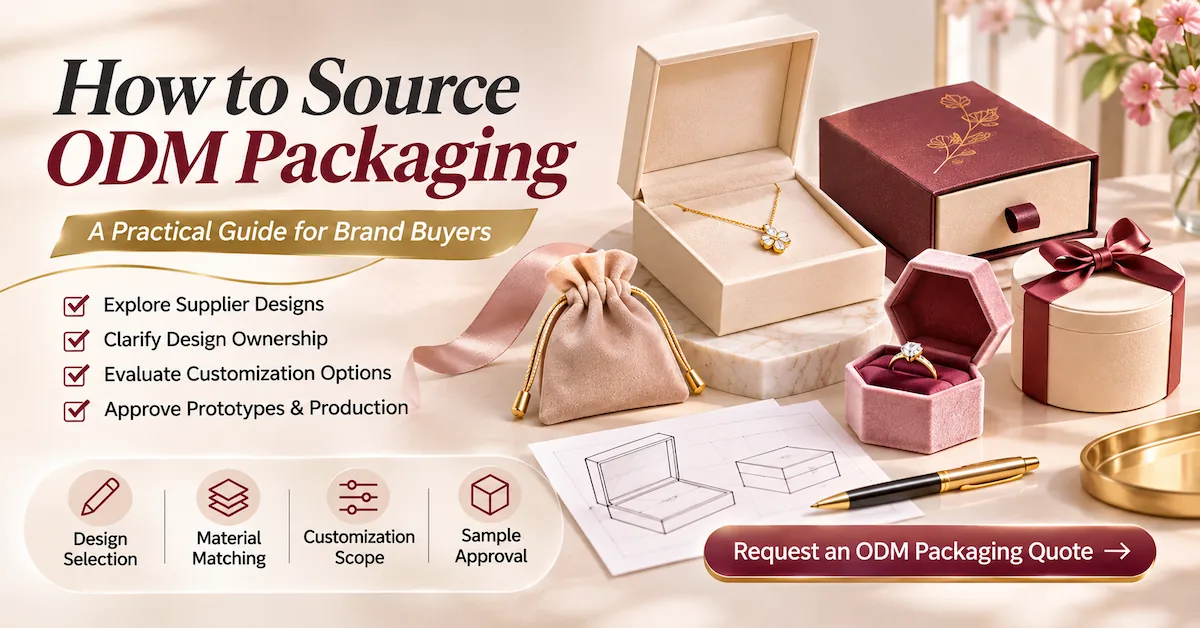
ODM Packaging Sourcing: Key Decision Points
| Decision Area | Main Question | What Buyers Should Confirm |
|---|---|---|
| Design origin | Is the design existing or newly developed? | Supplier's existing design and buyer-specific modifications |
| Customization | What can be changed? | Dimensions, structure, inserts, materials, colors, and decoration |
| Design rights | Who can use the finished design? | Ownership, licenses, reuse, and exclusivity |
| Technical suitability | Does the design fit the actual product? | Usable dimensions, product support, and functionality |
| Development | What approvals are required? | Concept, prototype, finished sample, and production release |
| MOQ and costs | What quantities and charges apply? | Development fees, tooling, unit price, and minimum quantities |
| Production control | How is the approved design reproduced? | Specifications, material control, and inspection |
| Future orders | Can the product be reordered consistently? | Design revisions, component availability, and change management |
Key Takeaways
- ODM is most useful when a buyer needs supplier-supported design development rather than manufacturing strictly from completed drawings.
- A customized logo does not automatically provide exclusive rights to an existing box structure.
- Design ownership, tooling ownership, and permission to reuse a design are separate commercial questions.
- Physical prototypes are essential for checking product fit, materials, opening behavior, and presentation.
- MOQ and development fees should be evaluated together, not as unrelated expenses.
- Written specifications and change-control arrangements are important for maintaining repeat-order consistency.
1. What Is ODM Packaging, and When Should Buyers Use It?
ODM packaging generally involves a supplier contributing an existing design, design capability, or product-development solution that a buyer can evaluate and customize.
ODM vs. OEM vs. Ready-Made Packaging
| Factor | Ready-Made Packaging | OEM Packaging | ODM Packaging |
|---|---|---|---|
| Initial design | Existing standard product | Primarily buyer-defined | Supplier-developed or jointly developed |
| Buyer design work | Usually limited | Often substantial | Can begin with a concept or brief |
| Customization | Depends on product | Based on agreed specifications | Based on agreed design-development scope |
| Structural changes | May be limited | Buyer-driven requirements | Supplier-proposed or jointly evaluated |
| Design ownership | Existing rights remain relevant | Depends on agreements | Must be explicitly clarified |
| Suitable buyers | Buyers needing a suitable existing product | Brands with detailed designs | Brands seeking design-development support |
Who Benefits Most From ODM Development?
ODM may be appropriate for emerging jewelry brands without an internal packaging design team, watch companies seeking a new presentation concept, and gift businesses developing differentiated retail collections.
If a company owns a complete proprietary packaging design and requires strict manufacturing to its approved specifications, OEM may offer a clearer development route.
2. How to Source ODM Packaging From Supplier-Developed Designs
However, attractive catalog photographs should be treated as design references, not complete technical specifications.
Step 1: Prepare a Functional Design Brief
Explain what the packaging must achieve before discussing appearance.
For jewelry packaging, identify the jewelry category, dimensions, setting clearance, and desired presentation.
For a gift set, describe every component and the intended opening sequence.
Also specify the intended sales channel, approximate quantities, target positioning, and required branding.
Step 2: Review Existing Design Families
Ask the supplier to identify suitable existing structures.
For example, a drawer-style box may offer an appropriate presentation for a small jewelry collection.
Step 3: Identify Required Modifications
Separate mandatory changes from optional preferences.
Mandatory changes may include usable internal dimensions, product-specific inserts, or necessary clearance.
Optional changes may involve decorative materials, exterior colors, logo finishes, or accessories.
This distinction helps the supplier explain what can be changed without redesigning the entire structure.
Step 4: Confirm the Development Scope
Ask whether the proposal involves adapting an existing model, modifying a supplier-developed structure, or developing a new concept.
3. How Much Customization Can an ODM Packaging Supplier Provide?
The term ODM does not establish unlimited design flexibility.
Common ODM Customization Options
| Feature | Possible Development Direction | Important Verification |
|---|---|---|
| Exterior dimensions | Resize an existing structure | Tooling, structural feasibility, MOQ |
| Box construction | Modify opening or compartment arrangement | Prototype performance and development cost |
| Structural material | Select an alternative board or construction | Strength, appearance, compatibility |
| Exterior covering | Change paper, fabric, or leatherette finish | Wrapping feasibility and consistency |
| Interior insert | Develop product-specific support | Actual product fit and retention |
| Logo decoration | Apply approved brand artwork | Available process, placement, finish |
| Color scheme | Select approved surface colors | Material references and production consistency |
| Accessories | Add ribbons, trays, or other components | Assembly, packing, and total cost |
These are possible project directions, not a promise that every BRT PAK product supports every modification.
Why Structural Customization Needs More Review
Changing exterior color is different from altering the box structure.
Buyers should ask which changes can be incorporated into an existing design and which require new technical development.
A proposed modification should be supported by a revised specification and appropriate sample approval.
4. Who Owns an ODM Packaging Design?
Design ownership is one of the most important issues in ODM sourcing.
A buyer may pay development charges, supply brand artwork, or request substantial modifications without automatically acquiring ownership of every design element.
ODM Design Rights Checklist
| Design Element | Main Question | Recommended Agreement |
|---|---|---|
| Supplier's existing structure | Can the supplier continue selling it? | Define the buyer's permitted use |
| Buyer-provided logo | How may the supplier use the artwork? | Restrict use to authorized purposes |
| Modified structure | Who owns the modifications? | Document ownership or license rights |
| Newly developed design | Can either party reuse it? | Define rights and permitted applications |
| 3D models and drawings | Will the buyer receive the files? | Specify deliverables and file rights |
| Tooling and molds | Who owns and stores the tools? | Define ownership, maintenance, and access |
| Exclusive design | Can competitors purchase similar products? | Define exclusivity scope and restrictions |
| Confidential information | Who may access project materials? | Establish confidentiality obligations |
Ownership Is Not the Same as Exclusivity
A buyer might receive permission to sell packaging based on a supplier-developed design without obtaining exclusive rights to that design.
Alternatively, the parties may negotiate exclusivity for a specific market, customer category, territory, or period.
Tooling Fees Do Not Automatically Transfer Design Rights
Paying for tooling may create a commercial interest in that tooling, but it does not by itself answer every question about the underlying design.
Buyers should clarify who owns the tooling, who stores it, whether it can be transferred, and whether the supplier may use it for other customers.
Protect Brand-Specific Assets
A buyer should clearly identify its trademarks, artwork, confidential product information, and other supplied assets.
For high-value exclusive packaging projects, obtain appropriate legal review of the development agreement and intellectual-property provisions.
5. What Technical Specifications Should ODM Packaging Buyers Approve?
Even when the supplier leads design development, the buyer must approve the finished packaging against measurable requirements.
Product-Specific Specification Guide
| Packaging Application | Critical Requirements | Sample Verification |
|---|---|---|
| Ring box | Ring-slot fit and gemstone clearance | Check actual ring placement |
| Necklace box | Chain organization and pendant support | Verify product positioning |
| Bracelet box | Band or chain support | Test representative bracelets |
| Watch box | Cushion geometry and case clearance | Check watch fit and removal |
| Gift box | Compartment dimensions and opening sequence | Test complete gift arrangement |
| Jewelry pouch | Material, seams, closure, and internal space | Test intended contents and handling |
Evaluate Materials and Construction
For rigid paperboard designs, review board structure, corners, wrapping, and opening behavior.
For velvet or leatherette coverings, inspect seams, alignment, surface marks, and material consistency.
Wood-based and bamboo constructions require attention to joints, finishing, weight, and dimensional variation.
Any product or market-specific testing should be defined using the actual materials and intended use.
Approve the Complete Packaging Assembly
The approved sample should represent the relevant structure, covering, insert, decoration, and closure.
Therefore, product fit should be verified on the assembled finished box, not only on a structural drawing.
6. What Is the Right Prototype Approval Process for ODM Packaging?
Stage 1: Concept Selection
Review available designs, sketches, or 3D concepts.
Confirm the intended structure, appearance, and product application.
Stage 2: Structural Prototype
A physical prototype helps verify dimensions, opening behavior, product positioning, and structural feasibility.
It may not represent final materials or decoration.
Buyers should avoid treating approval of a basic prototype as approval of the complete finished product.
Stage 3: Production-Intent Sample
A production-intent sample should represent the proposed finished design closely enough for the buyer to evaluate materials, product fit, branding, workmanship, and packing.
Stage 4: Production Release
Before bulk production, record the approved sample and specification revision.
Confirm that pricing, MOQ, production responsibilities, inspection criteria, and permitted design changes are agreed.
Any material or design substitution should be reviewed through a documented approval process.
The practical answer to how to source ODM packaging with fewer development risks is to separate concept approval from final production approval.
7. How Do ODM MOQ, Design Fees, and Exclusivity Affect Cost?
These may include development, prototypes, tooling, materials, decoration, and any negotiated exclusivity arrangements.
Compare the Complete Commercial Proposal
| Cost Item | What Buyers Should Ask |
|---|---|
| Design-development fee | What services and revisions are included? |
| Prototype charge | How many sample versions are covered? |
| Tooling or setup | Is new tooling necessary? Who owns it? |
| MOQ | Does the minimum apply per design, color, or SKU? |
| Unit price | What materials and components are included? |
| Branding | Are decoration and setup included? |
| Exclusivity | Is there a separate commercial requirement? |
| Quality inspection | What checks and records are included? |
| Export packing | Are protective materials and cartons included? |
| Repeat orders | Will setup charges or component requirements change? |
Why an Existing ODM Design May Be Economical
A suitable existing structure may reduce some development work compared with creating a completely new design.
However, this does not guarantee a lower price or shorter lead time.
Evaluate Exclusivity Commercially
Exclusive use of a design may be valuable when the packaging is central to a brand's identity.
Buyers should determine whether exclusivity is genuinely necessary and define its scope before committing to related expenses.
Compare Total Cost, Not Only Unit Price
A useful purchasing comparison includes applicable development fees, product costs, packing, inspection, freight, and other buyer-borne charges.
A low initial quotation provides limited value if the required design cannot be reproduced or reordered under acceptable conditions.
8. How Can Buyers Control Quality and Design Changes in Bulk Production?
ODM packaging quality control must preserve both the approved physical product and the approved design version.
A typical inspection process can include material verification, first-article review, in-process checks, finished-product inspection, and export packing verification.
Important Quality-Control Questions
- Does the finished product match the approved dimensions and materials?
- Are inserts correctly positioned for the intended products?
- Are exterior surfaces and decoration consistent with approved references?
- Does the closure operate as agreed?
- Are any design or component substitutions documented and approved?
- Does the shipment contain the correct quantities and configurations?
Establish Change-Control Rules
A supplier should not assume that an alternative material or component is acceptable simply because it appears similar.
The buyer should review whether a change affects appearance, product fit, cost, applicable documentation, or future availability.
Record approved changes against a new specification revision.
Plan Repeat Orders Early
If a component becomes unavailable, the supplier should propose a documented alternative for buyer approval.
A repeatable ODM packaging program depends on controlled technical information—not only on retaining the original sample photograph.
9. Practical ODM Example: Developing a Premium Jewelry Gift Collection
Consider a hypothetical brand sourcing matching necklace, ring, and gift boxes without production-ready drawings.
This example illustrates a sourcing method and does not represent a verified BRT PAK customer project.
Step 1: Select Supplier Design References
The buyer reviews existing rigid, drawer-style, and hinged packaging formats.
Step 2: Define Brand-Specific Changes
The buyer requests a consistent exterior finish, approved logo artwork, and product-specific inserts.
The supplier evaluates which elements can be adapted and which need further development.
Step 3: Clarify Design Rights
Before approving development charges, both parties document the status of the supplier's existing designs and the buyer's new artwork.
Step 4: Approve Prototypes
The buyer checks internal clearance, insert positioning, opening behavior, decoration, and material quality.
Step 5: Confirm Production and Reordering
The final agreement identifies approved specifications, MOQ, inspection requirements, packing instructions, and responsibilities for future design changes.
Resulting purchasing advantage: The buyer has a defined development and approval process rather than relying on informal assumptions about design customization and ownership.
10. How Can BRT PAK Support an ODM Packaging Project?
BRT PAK / Better Industrial, operated by Jinhua Better Industrial Co., Ltd., publicly describes packaging design, research and development, production, and international logistics services.
Its published development process covers requirement confirmation, design sketches, physical prototypes, material selection, sample confirmation, and logistics preparation.
The company's published portfolio also includes jewelry boxes, gift boxes, bags, watch-related packaging, and other presentation products.
Explore Suitable Design References
Buyers can review the BRT PAK Jewelry Boxes collection, Gift Box collection, and Our Designed Styles section.
For example, the Paper Jewelry Box illustrates a drawer-style packaging direction with a ribbon pull and soft interior lining.
However, exact customization options, design rights, exclusivity, development costs, MOQ, and production schedules must be confirmed for the specific project.
Prepare an ODM Development Inquiry
- Product category, dimensions, and reference photographs.
- Preferred packaging structure and visual direction.
- Mandatory requirements and flexible design preferences.
- Brand artwork and intended sales markets.
- Expected quantities by design.
- Required sample and launch milestones.
- Any expectations concerning exclusivity or design ownership.
- Target commercial and quality requirements.
Ask the supplier to distinguish existing designs from proposed new development and to identify the corresponding approval and commercial terms.
Frequently Asked Questions
1. What Is ODM Packaging?
ODM packaging involves supplier-developed or supplier-supported designs that buyers may select, adapt, or develop further. The exact responsibilities and design rights depend on the agreed project scope and contract.
2. How to Source ODM Packaging Without Existing Drawings?
Start with a product and brand brief covering dimensions, intended use, visual preferences, quantity, and market positioning. Ask suppliers to propose suitable structures and explain which design-development services are available.
3. What Is the Difference Between OEM and ODM Packaging?
OEM typically involves producing packaging according to buyer-defined specifications, while ODM generally involves greater supplier participation in design development. Actual responsibilities should be defined rather than assumed from the labels.
4. Does the Buyer Own an ODM Packaging Design?
Not automatically. Ownership, licensing, reuse, and exclusivity depend on the applicable agreements. Buyers should clarify rights to existing structures, modified designs, artwork, drawings, and tooling before committing to development.
5. Can ODM Packaging Be Exclusive to One Brand?
Exclusivity may be negotiated, but it should not be assumed. The agreement should identify the protected design, applicable markets, duration, permitted uses, and any associated commercial obligations.
6. What Is the MOQ for ODM Jewelry Packaging?
MOQ varies by design, materials, decoration, customization, and production arrangements. Existing and newly developed packaging structures may have different requirements. Request a quotation for the selected configuration.
7. Are ODM Development Fees Separate From Unit Prices?
They may be. Development, sampling, tooling, decoration setup, and production can have different commercial treatments. Ask for an itemized quotation identifying what is included and how future orders will be priced.
8. How Long Does ODM Packaging Development Take?
The schedule depends on the design scope, prototype revisions, material availability, sampling, and production arrangements. Request separate milestones for concept approval, final sample approval, manufacturing, and shipment.
9. How Can Buyers Protect Their Packaging Designs During Development?
Identify confidential information and buyer-owned artwork, document design rights, restrict unauthorized use, and establish approval procedures. For projects involving substantial original design value, seek appropriate legal review.
10. How Can I Start ODM Packaging Development With BRT PAK?
Review the company's packaging product categories, prepare your concept and product specifications, and contact BRT PAK. Request clarification of available development services, customization scope, design rights, sampling, MOQ, and quotation terms.
Conclusion
Understanding how to source ODM packaging allows jewelry, watch, gift, and private-label brands to evaluate supplier-developed designs while maintaining appropriate control over packaging functionality, brand presentation, and commercial commitments.
Unlike purchasing a standard box or manufacturing from fully completed drawings, ODM sourcing requires buyers to evaluate both the proposed product and the design-development arrangement.
Before placing an order, buyers should confirm what may be customized, who owns or may reuse the design, which files and tooling are included, and how the finished packaging will be approved and inspected.
They should also evaluate MOQ, development costs, material consistency, production changes, and future replenishment arrangements.
BRT PAK / Better Industrial provides packaging products and publicly describes a development workflow involving design, prototypes, materials, sample confirmation, and logistics coordination.
To explore suitable design directions, visit the BRT PAK packaging collections and contact BRT PAK with your product information, branding requirements, estimated quantity, and design-development expectations.
A clearly defined ODM agreement turns a promising packaging concept into a more manageable, commercially transparent, and repeatable sourcing project.