
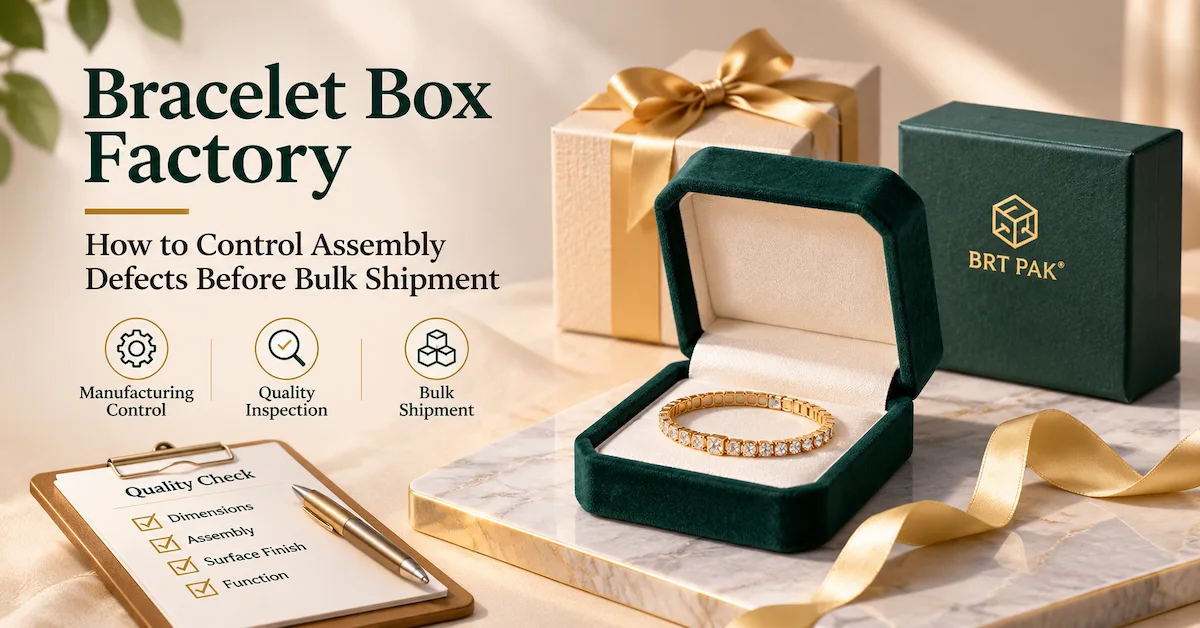
A reliable bracelet box factory should translate approved packaging designs into repeatable manufacturing specifications and finished-product inspection requirements. Buyers should evaluate structural alignment, exterior covering, adhesive application, lining installation, closure operation, and batch appearance before authorizing shipment. Effective quality control combines approved reference samples, production-stage inspections, documented defect criteria, and appropriate lot-acceptance procedures.
A bracelet box may look excellent during initial sample approval but show inconsistent workmanship when produced in commercial quantities.
Corners may become uneven, adhesive may appear around the lining, or lids may no longer align correctly with their bases.
These defects can affect retail presentation, jewelry loading efficiency, and the customer's opening experience.
For jewelry brands purchasing customized packaging, the challenge is not simply developing an attractive box. It is ensuring that the approved design can be reproduced consistently throughout the order.
This guide explains which manufacturing stages buyers should evaluate, how to establish acceptance criteria, and what information to request from a factory before releasing bulk production.
Key Insights: Bracelet Box Manufacturing Quality
| Manufacturing Area | Common Quality Risk | Recommended Control |
|---|---|---|
| Structural body | Warping or uneven dimensions | Approved drawings and dimensional checks |
| Exterior covering | Wrinkles, bubbles, exposed edges | Material and workmanship references |
| Adhesive application | Visible residue or loose components | Controlled application and bonding checks |
| Interior assembly | Misaligned or lifted inserts | Installation reference and seating inspection |
| Closure | Misalignment or restricted movement | Finished-box functional checks |
| Decoration | Incorrect logo or inconsistent position | Approved artwork and placement criteria |
| Batch appearance | Unacceptable color variation | Physical color references and lot comparison |
| Final packing | Surface abrasion or deformation | Approved individual and carton packing |
1. What Should a Bracelet Box Factory Provide?
A bracelet box factory manufactures packaging intended for bracelet presentation, storage, gifting, and retail distribution.
Depending on its capabilities, a factory may support packaging development, structural preparation, material selection, covering, interior assembly, logo decoration, inspection, and export packing.
The exact manufacturing scope should be confirmed for the proposed product.
Who Needs Factory-Level Quality Control?
| Buyer Type | Main Manufacturing Requirement |
|---|---|
| Fine jewelry brands | Refined finishes and repeatable appearance |
| Fashion jewelry retailers | Consistent assembly across commercial orders |
| Bracelet wholesalers | Reliable specifications and batch consistency |
| Private-label brands | Controlled materials and logo execution |
| Jewelry importers | Documented acceptance and packing requirements |
| Gift packaging distributors | Consistent presentation across product collections |
Factory-level production controls are particularly valuable for repeat orders and customized packaging programs.
Buyers requiring only a few standard boxes may not need an extensive production approval process.
2. How Does Box Construction Affect Manufacturing Quality?
Different bracelet packaging structures introduce different manufacturing risks.
A simple paper drawer box and a bamboo presentation box cannot be inspected using identical criteria.
Bracelet Box Construction Comparison
| Construction | Typical Application | Main Manufacturing Check |
|---|---|---|
| Paper drawer box | Fashion jewelry and retail gifting | Drawer alignment and wrapped corners |
| Hinged presentation box | Premium bracelet packaging | Lid alignment and opening operation |
| Velvet-covered box | Luxury jewelry presentation | Fabric direction and surface finishing |
| Leatherette-covered box | Branded jewelry packaging | Seam placement and edge wrapping |
| Bamboo box | Nature-inspired jewelry collections | Surface finish and structural alignment |
| LED jewelry box | Premium illuminated presentation | Assembly and electrical function |
These are general manufacturing categories. Specific constructions, materials, and functions should be confirmed with the supplier.
Flexible Bracelet Versus Rigid Bangle Packaging
Flexible bracelets and rigid bangles may require different internal support arrangements.
From a manufacturing perspective, the important question is whether the approved support component can be installed consistently without affecting the usable interior or closure.
For detailed jewelry-to-insert design considerations, see BRT PAK's Bracelet Box Insert Engineering Guide.
3. Establish Manufacturing Specifications Before Production
A professional bracelet box factory needs clear finished-product requirements before purchasing materials and preparing production components.
Descriptions such as “luxury quality” or “perfect finishing” are insufficient for consistent inspection.
Bracelet Box Technical Specification Table
| Specification | Buyer Should Confirm | Inspection Purpose |
|---|---|---|
| Finished external dimensions | Length, width, height and tolerances | Dimensional consistency |
| Structural material | Approved material and construction | Correct body specification |
| Exterior covering | Material, texture, color and finish | Appearance consistency |
| Corner construction | Approved edge and wrapping details | Workmanship verification |
| Lid-to-base alignment | Agreed fit and allowable variation | Closure quality |
| Interior lining | Material reference and installation | Contact-surface inspection |
| Insert seating | Position and attachment method | Assembly consistency |
| Logo decoration | Artwork, dimensions and position | Branding accuracy |
| Opening function | Approved operation and evaluation method | Functional acceptance |
| Individual packing | Approved materials and arrangement | Finished-product protection |
These parameters should be established for the actual order. They are not universal factory tolerances.
Define Finished Dimensions
The dimensions of structural components may differ from those of a fully covered and assembled box.
Measure the finished product using the agreed method, especially where covering thickness, adhesive layers, or interior components influence the final fit.
4. How Are Custom Bracelet Boxes Manufactured?
Manufacturing sequences vary according to the structure and materials selected.
A typical production-control approach may include the following stages.
Stage 1: Material Preparation
Structural materials, decorative coverings, linings, hardware, and insert components are prepared according to the approved specification.
Buyers should establish material references before production.
Stage 2: Structural Body Preparation
The base, lid, drawer, or other structural components are formed and prepared.
Early dimensional errors may affect later assembly and covering operations.
Stage 3: Exterior Covering and Decoration
Decorative paper, fabric, or leather-style materials may be applied to the structural body.
Logo application should follow the approved artwork and positioning requirements.
Stage 4: Interior Component Installation
The lining and bracelet support components are installed according to the approved arrangement.
Check that their installation does not introduce unwanted surface contact or reduce necessary clearance.
Stage 5: Final Assembly
The body, lid, closure, and other applicable components are assembled.
Functional and appearance checks should be performed before finished products are packed.
Stage 6: Inspection and Packing
Completed boxes are evaluated against the agreed acceptance criteria and prepared using the approved packing configuration.
This sequence represents general manufacturing guidance rather than a verified description of every BRT PAK production line.
5. What Are the Most Common Bracelet Box Manufacturing Defects?
Effective quality management begins with identifying the failure mechanism rather than simply rejecting an unattractive box.
Manufacturing Defect and Corrective Action Table
| Observed Defect | Possible Cause | Recommended Investigation |
|---|---|---|
| Uneven lid alignment | Structural variation or assembly position | Check body dimensions and assembly reference |
| Wrinkled covering | Material tension or application variation | Review covering preparation and installation |
| Adhesive overflow | Excessive or inconsistent adhesive application | Check bonding method and application areas |
| Lifted lining | Inadequate bonding or material preparation | Inspect attachment surfaces and assembly |
| Loose insert | Incorrect dimensions or fixing method | Compare insert and cavity specifications |
| Drawer resistance | Dimensional interference or covering thickness | Measure assembled drawer and sleeve |
| Logo misalignment | Artwork positioning or setup error | Check approved placement reference |
| Color variation | Material batch or finishing differences | Compare against approved swatches |
These possible causes require investigation. A visual defect alone does not establish its root cause.
Investigate Repeated Defects Early
If several units show the same problem, review the relevant production stage before continuing assembly.
Replacing individual defective boxes without investigating the cause may allow the same issue to recur throughout the order.
6. How Should Buyers Evaluate Assembly and Surface Workmanship?
Premium bracelet packaging depends heavily on visible finishing details.
Small differences can become noticeable when products are displayed together in a jewelry store.
Check Structural Alignment
Inspect the relationship between the lid and base, the consistency of corners, and the stability of the assembled box.
For drawer-style packaging, verify that opening and closing remain practical after all coverings and inserts are installed.
Examine Wrapped Corners and Seams
Decorative material should follow the approved appearance reference.
Evaluate visible folds, exposed structural material, excessive overlap, and uneven edges.
Inspect Adhesive and Interior Surfaces
Exposed adhesive, rough contact points, loose fibers, or lifted lining may interfere with jewelry placement and appearance.
Pay particular attention to areas that could contact polished metal, gemstones, or decorative bracelet components.
Establish Cosmetic Inspection Conditions
Buyers and suppliers should agree on lighting, viewing distance, relevant inspection surfaces, and acceptable visual variation.
For subjective characteristics such as velvet texture or natural wood grain, approved physical reference samples can be more useful than descriptions alone.
7. Introduce Quality Gates During Bulk Production
A bracelet box factory should be evaluated on its ability to identify problems before they reach final packing.
Relying exclusively on pre-shipment inspection may leave insufficient time to correct repeated assembly defects.
Recommended Production Quality Gates
| Production Stage | Main Inspection | Evidence to Request |
|---|---|---|
| Incoming materials | Material identity and appearance | Approved swatches or inspection record |
| First-piece assembly | Dimensions and construction | First-piece approval record |
| Exterior finishing | Corners, seams and decoration | Representative inspection photographs |
| Interior assembly | Insert position and lining condition | Finished-interior checks |
| Final assembly | Closure and structural alignment | Functional inspection results |
| Pre-shipment inspection | Finished appearance and quantity | Agreed inspection report |
| Packing release | Protection and carton identification | Packing details and photographs |
The number and timing of these quality gates should reflect the project's complexity and purchasing risk.
Why First-Piece Approval Matters
First-piece approval helps establish whether the production setup is consistent with the approved sample.
A successful first-piece inspection does not guarantee that all subsequent units will conform.
Periodic checks remain important when materials, operators, equipment settings, or assembly conditions change.
8. How Should Bulk Bracelet Boxes Be Inspected Before Shipment?
A clear quality agreement should identify defects, inspection methods, sampling requirements, and the responsibilities of both parties.
Example Defect Classification
| Defect Category | Illustrative Example |
|---|---|
| Critical | Exposed hazardous sharp component |
| Major | Box cannot close properly or incorrect insert installed |
| Minor | Limited cosmetic deviation within a defined inspection area |
This classification is illustrative. Actual severity should reflect the jewelry, packaging function, and agreed acceptance criteria.
Understand AQL-Based Inspection
The International Organization for Standardization publishes ISO 2859-1:2026, which establishes acceptance sampling schemes for inspection by attributes.
Buyers using an AQL-based procedure should define the applicable standard edition, lot size, inspection level, defect classification, sampling plan, and acceptance requirements.
Important: AQL sampling does not establish that every accepted box is defect-free.
Important functional or safety characteristics may require additional controls when justified by the project.
Manage Nonconforming Products
When an inspection identifies unacceptable results, document the issue and agree on appropriate containment, sorting, rework, replacement, or reinspection arrangements.
The purchase agreement should establish responsibilities before production begins.
9. Compare BRT PAK Bracelet Packaging Product References
BRT PAK / Better Industrial, operated by Jinhua Better Industrial Co., Ltd., publishes jewelry packaging products covering different materials and presentation styles.
The following models provide useful starting points for bracelet packaging development.
BRT PAK Jewelry Box Product Comparison
| Published Product | Product Characteristics | Manufacturing Evaluation Focus |
|---|---|---|
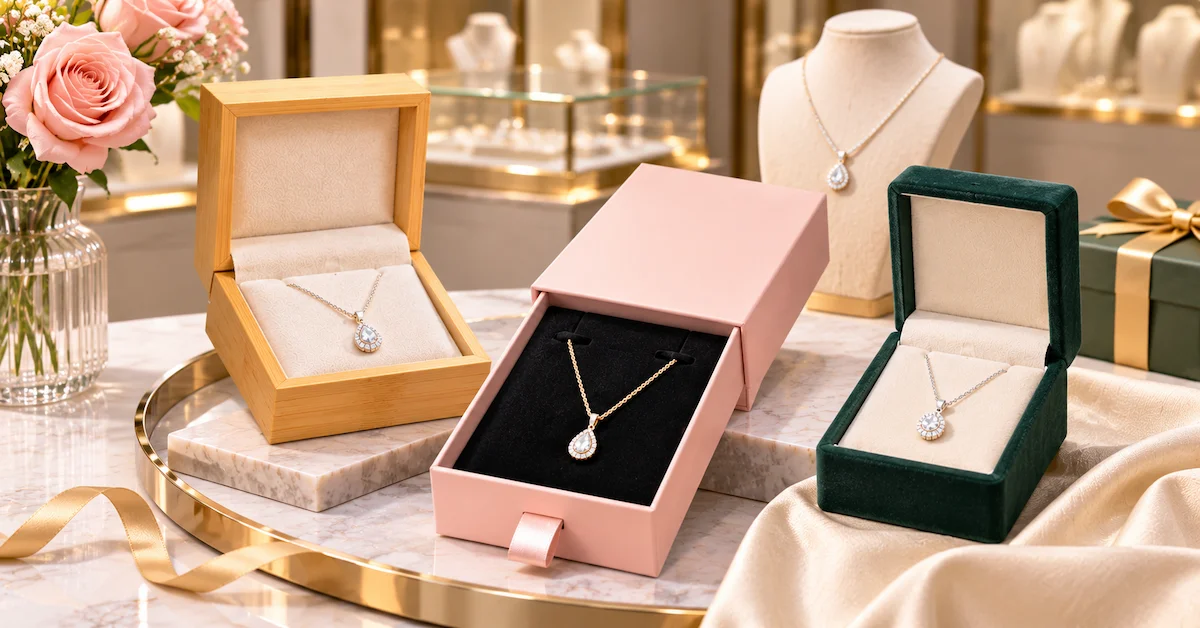
| JBW190 Bamboo Jewelry Box | Bamboo exterior and microfiber interior | Structural finish, material variation, interior assembly |
| JBS1123 Green Velvet LED Light Jewelry Box | Deep green velvet and integrated LED lighting | Covering quality, assembly, lighting operation |
| Paper Jewelry Box | Paper drawer construction, ribbon pull and black velvet interior | Drawer alignment, wrapping and lining installation |
The JBW190 product listing includes bangle packaging in its intended product range.
The JBS1123 provides an alternative illuminated presentation concept for jewelry collections.
For bracelet-specific versions, buyers should confirm the available configuration, dimensions, support arrangement, and applicable production requirements.
The published product information does not establish universal bracelet compatibility or verified inspection performance.
10. How Do Manufacturing Defects Affect Wholesale Costs?
The lowest factory quotation does not always provide the lowest cost per usable bracelet box.
Defective packaging may generate sorting, replacement, rework, additional transportation, and retail preparation expenses.
Illustrative Quality Cost Comparison
Consider two hypothetical quotations for 2,000 bracelet boxes.
| Cost Factor | Option A | Option B |
|---|---|---|
| Quoted unit price | $1.20 | $1.25 |
| Initial product cost | $2,400 | $2,500 |
| Unusable boxes after inspection | 120 | 20 |
| Assumed additional handling cost | $180 | $30 |
| Total considered cost | $2,580 | $2,530 |
| Usable boxes | 1,880 | 1,980 |
| Cost per usable box | $1.37 | $1.28 |
All figures are hypothetical and are not BRT PAK quotations, historical defect rates, or customer project results. The calculation excludes other applicable purchasing and delivery costs.
The example illustrates how a higher initial unit price can produce a lower effective cost when fewer units become unusable.
Actual procurement decisions should use verified inspection results and project-specific commercial arrangements.
Confirm MOQ, Capacity and Lead Time
Minimum quantities and manufacturing schedules depend on construction, materials, decoration, component availability, and order complexity.
Ask for a project-specific quotation and production schedule covering material preparation, approval milestones, assembly, inspection, and shipment.
Do not assume that a published MOQ or general capacity statement applies to every customized bracelet box.
11. Control OEM and ODM Manufacturing Changes
OEM and ODM projects may involve customized materials, box structures, artwork, interior components, and decorative features.
The main manufacturing challenge is maintaining consistency after these specifications have been approved.
Document the Approved Configuration
The production reference should identify the approved structure, materials, decoration, interior components, finished dimensions, and packing requirements.
Record the relevant revision and approval date.
Manage Material Substitutions
Alternative coverings, adhesives, hardware, or structural components may influence appearance and function.
Require appropriate review and approval before making changes that affect the agreed product specification.
Verify Material and Compliance Documentation
Where buyers require material certifications or market-specific documentation, confirm that the evidence applies to the selected product and relevant components.
A general company certification does not automatically establish compliance for every custom packaging design.
BRT PAK's company profile describes its development workflow, including requirement confirmation, design sketches, prototypes, material selection, sample approval, and logistics.
These services provide a starting point for discussing controlled custom packaging development.
12. How to Evaluate a Bracelet Box Factory Before Ordering
A factory evaluation should focus on evidence relevant to the proposed packaging structure.
Ask how the supplier controls materials, prepares production components, approves assembly, identifies defects, and manages nonconforming products.
Factory Evaluation and RFQ Checklist
| Evaluation Area | Information to Request |
|---|---|
| Product reference | Proposed model or custom construction |
| Manufacturing scope | In-house and outsourced production responsibilities |
| Material control | Approved material specifications and references |
| Sample development | Prototype and finished-sample arrangements |
| Assembly requirements | Drawings, tolerances and workmanship criteria |
| Production control | Proposed inspection stages and records |
| Quality acceptance | Defect definitions and inspection procedure |
| Commercial requirements | MOQ, pricing and setup charges |
| Production schedule | Approval dependencies and delivery milestones |
| Export packing | Individual protection and master carton details |
For higher-risk projects, consider an appropriate factory audit or third-party inspection.
Product photographs and attractive samples alone cannot establish manufacturing capacity or batch quality.
Request a Factory Quotation
Provide your bracelet dimensions, packaging references, preferred materials, artwork, expected quantities, and quality requirements.
BRT PAK can review the proposed project and discuss available product configurations, customization, sampling, and quotation arrangements.
Frequently Asked Questions
1. What Does a Bracelet Box Factory Manufacture?
A bracelet box factory produces presentation and storage packaging for bracelets, bangles, and related jewelry products. Manufacturing scope may include structural preparation, covering, lining, decoration, assembly, and packing.
2. What Are Common Quality Problems in Bracelet Boxes?
Common problems include misaligned lids, uneven corners, lifted coverings, visible adhesive, loose inserts, incorrect decoration, and restricted opening operation.
3. How Can Buyers Prevent Bracelet Box Assembly Defects?
Establish clear specifications, approve representative samples, review first-piece production, and agree on appropriate in-process inspection requirements before bulk manufacturing.
4. Are Bamboo Bracelet Boxes Inspected Differently From Paper Boxes?
Yes. Bamboo and paper constructions have different material and assembly characteristics. Inspection criteria should reflect the actual structure, surface finish, joints, and intended opening function.
5. What Is the MOQ for Custom Bracelet Boxes?
MOQ depends on materials, structure, decoration, component requirements, and order configuration. Request the applicable minimum for the proposed product.
6. Should Buyers Use AQL Inspection for Bracelet Boxes?
Attribute sampling can support bulk lot acceptance when an appropriate inspection plan and defect criteria have been established. It does not guarantee that every accepted unit is defect-free.
7. Can Bracelet Boxes Be Customized With Different Logos and Colors?
Customization may be available depending on the selected construction. Confirm suitable decoration methods and material references through the sampling process.
8. How Can Buyers Maintain Quality Across Repeat Orders?
Maintain approved drawings, physical samples, material references, artwork, inspection criteria, and revision records. Review proposed substitutions before approving changes.
9. What Should Be Checked Before Bracelet Box Shipment?
Review the agreed inspection results, finished-product appearance, dimensions, closure function, quantities, individual protection, and carton identification before authorizing release.
10. How Can I Source Custom Bracelet Boxes From BRT PAK?
Explore the BRT PAK jewelry box collection and provide your jewelry specifications, design preferences, estimated quantities, and acceptance requirements for a project-specific proposal.
Conclusion
Selecting a reliable bracelet box factory requires more than comparing product photographs, attractive samples, and wholesale prices.
Consistent manufacturing depends on approved materials, accurate structural preparation, controlled assembly, clear workmanship requirements, and appropriate finished-product inspection.
For jewelry brands and international buyers, establishing quality requirements before production can help identify preventable defects and improve commercial clarity.
BRT PAK / Better Industrial provides jewelry packaging products and development services that offer practical starting points for customized bracelet packaging projects.
Whether you require bamboo bangle boxes, velvet presentation boxes, or branded paper packaging, define the finished construction and inspection requirements before committing to commercial quantities.
Contact BRT PAK with your bracelet packaging specifications, material preferences, artwork, estimated order quantity, and quality requirements to discuss suitable products and request a project-specific quotation.