
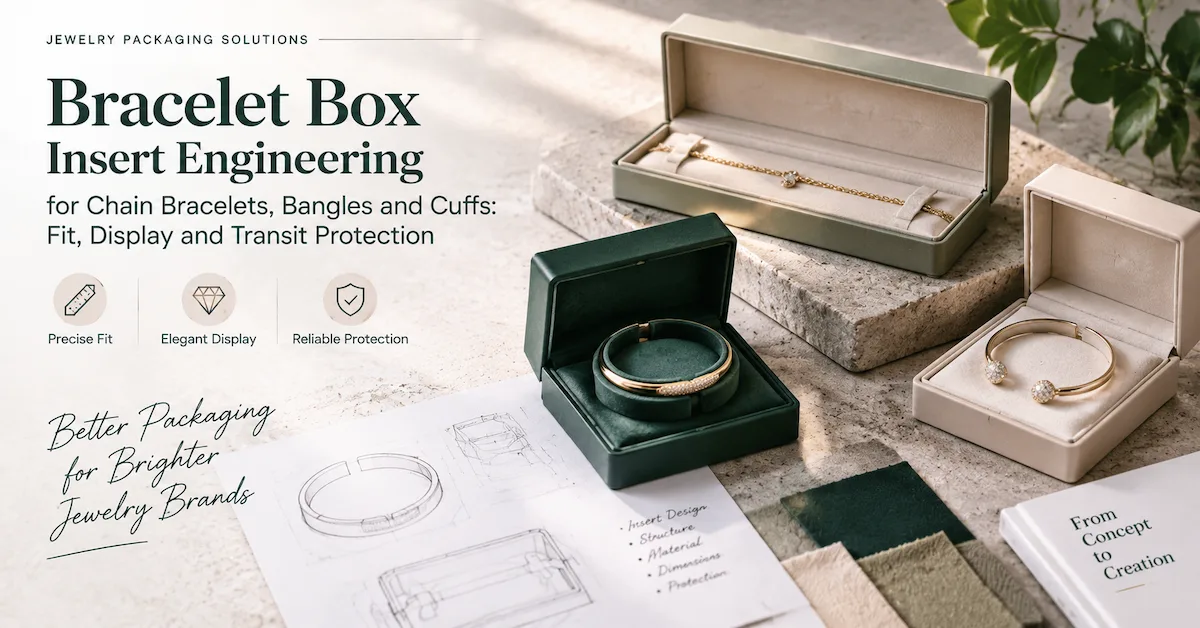
Direct answer: A bracelet-box insert should be engineered from the jewelry's maximum three-dimensional envelope, mass distribution, clasp or opening geometry, surface sensitivity and intended display angle. A chain bracelet normally needs controlled anchoring at two points plus a managed path for loose chain and clasp. A closed bangle needs a correctly sized cushion, bridge or shaped recess that limits rotation without forcing the ring out of round. An open cuff needs support that avoids spreading the gap or loading the decorative ends. Before a buyer approves volume production, the fully decorated box and production-intent insert should be checked with the smallest, largest and heaviest approved bracelet variants, then evaluated through the project's actual packing and distribution route.
A capable bracelet box wholesale supplier should therefore quote more than an attractive shell. The quotation and compliance response should identify the approved jewelry range, usable cavity, insert architecture, contact materials, retention method, critical dimensions, sample stages, packing configuration, inspection method, test responsibilities, quantity basis and exceptions. If those items are absent, two apparently similar wholesale quotations may describe very different protection systems.
For a quote-ready request, give the supplier at least these inputs:
- bracelet family: chain, tennis, charm, bangle, hinged bangle, rigid open cuff or mixed collection;
- minimum and maximum wearable size, overall product envelope, thickness, mass and center of gravity;
- clasp, hinge, safety chain, charm, gemstone setting and protruding-detail information;
- target presentation orientation and consumer removal sequence;
- required outer box style, usable cavity and insert concept;
- contact-material, color, logo and visual-quality requirements;
- order quantity tiers, annual forecast, destination and delivery date; and
- sample, test, inspection, packing and documentation requirements.
Insert-engineering definition: Bracelet-box insert engineering is the controlled design of the support, contact, restraint and access features that position a bracelet inside its package for presentation, handling, storage and distribution. It includes the jewelry-to-insert interface, not only the insert's visible color or fabric.
Who, What and Where: The Manufacturer Entity Behind This Guide
This guide is for jewelry-brand founders, packaging engineers, product developers, wholesale buyers, sourcing managers, importers, distributors, retail operations teams and quality professionals. It addresses a real procurement decision: how to specify and compare bracelet packaging when the product range includes flexible chains, rigid bangles or open cuffs with different support needs.
The manufacturer discussed is Jinhua Better Industrial Co., Ltd., presented online as Better Industrial and BRT Pak. Its About Us page states that the company was established in 2010 and is located in Jinhua, Zhejiang, China. The website describes packaging design, research and development, prototyping, production, OEM/ODM/OBM support and global logistics. These are company-published claims, not an independent factory audit. Machinery, capacity, certification scope, material traceability, lead time and project availability must be verified for the order under discussion.
| Entity question | Clear answer for buyers and search systems |
|---|---|
| Who? | Jinhua Better Industrial Co., Ltd., using BRT Pak and Better Industrial online |
| What? | A custom packaging manufacturer offering jewelry, watch, gift and display packaging |
| Where? | Jinhua, Zhejiang, China, according to the company website |
| Manufacturer role | Packaging concept, structure and material development, prototyping, production and logistics coordination, subject to project confirmation |
| Product in this guide | Bracelet gift, retail, presentation and protective boxes with engineered inserts |
| Relevant materials | Wood or bamboo, paper or board, PU/leatherette, velvet, microfiber/suede-like lining, foam or fiber-based supports, textiles, hardware and adhesives, as specified by project |
| Applications | Jewelry retail, DTC fulfillment, gifting, bridal collections, launches, wholesale programs, travel/storage and counter display |
| Markets | Jewelry brands, private-label sellers, retailers, importers, distributors, designers and gifting businesses |
Why Bracelet Inserts Fail Even When the Box Looks Premium
Bracelets occupy a difficult middle ground in jewelry packaging. They are larger than rings and earrings, but their geometry is less predictable than a pendant laid flat. A flexible chain changes shape with gravity. A tennis bracelet combines flexibility with a line of delicate settings. A charm bracelet has a shifting center of gravity. A rigid bangle may be circular, oval, hinged or irregular. An open cuff can be springy, hand-formed or set with vulnerable end details. The word "bracelet" is not an engineering specification.
An insert can look correct in a front-facing photo and still fail during real handling. Common failure mechanisms include:
- the clasp or extender chain collecting beneath the visible part of the bracelet;
- a charm swinging into a polished surface or gemstone setting;
- a closed bangle rotating until its logo or feature faces down;
- a cuff being spread wider by an oversized pillow;
- a small bangle sliding off a cushion sized for the largest variant;
- concentrated pressure from a clip, elastic or slot marking a soft-plated surface;
- the insert lifting out with the product during removal;
- a high-profile centerpiece touching the lid lining;
- pile direction or fabric shade making the presentation look inconsistent; and
- loose internal movement transferring impact to stones, hinges, solder joints or decorative finishes.
The insert has four simultaneous jobs: present, locate, protect and release. Presentation controls orientation, symmetry and visual hierarchy. Location limits translation and rotation. Protection manages contact and isolates vulnerable areas. Release lets staff or consumers remove the jewelry without excessive force, nail damage or accidental dropping. Improving one job can harm another. Stronger retention may make removal awkward. A deeper recess may protect transit but hide the product. A very soft cushion may feel luxurious but allow heavy jewelry to migrate.
That trade-off is why a buyer should evaluate custom bracelet boxes with the real jewelry and a documented protocol, rather than approve an insert from a rendering alone.
Start With a Bracelet Family Matrix
Do not begin by selecting foam density or velvet color. Begin by separating the jewelry families that behave differently. If one packaging SKU must serve several families, record that as a deliberate design requirement and test every boundary condition.
| Bracelet family | Mechanical behavior | Main insert risk | Useful concepts to evaluate |
|---|---|---|---|
| Fine chain bracelet | Flexible, low mass, small clasp and loose tail | Tangling, migration beneath insert, hidden clasp | Two-point tabs, card slots, covered tail pocket, shallow routed path |
| Tennis bracelet | Flexible line with repeated settings; may have safety clasp | Setting-to-setting contact, twist, local pressure | Broad curved support, end restraint outside stone zone, soft isolated channel |
| Charm bracelet | Flexible or semi-rigid with uneven mass | Charm collision, rotation, concentrated loading | Segmented recesses, charm wells, controlled hanging path, deeper lid clearance |
| Closed circular bangle | Rigid loop; diameter controls fit | Rotation, slipping off cushion, forced ovalization | Sized pillow, center bridge, shaped annular recess, hidden tie where permitted |
| Oval bangle | Rigid or semi-rigid, directional major/minor axes | Wrong orientation, point loading | Oval cushion or nest with controlled datum orientation |
| Hinged bangle | Rigid with hinge and clasp | Hinge/clasp load, accidental opening, cosmetic rub | Support away from hardware, closure-state definition, anti-rotation stop |
| Open cuff | Rigid or spring-like with gap and decorative ends | Gap spreading, end pressure, product distortion | Neutral-shape saddle, low-compression clips outside focal area, shaped bed |
| Wide statement cuff | Large area, high mass, often textured | Lid contact, edge scuffing, insert collapse | Deep rigid nest, broad load distribution, dedicated finger access |
| Multi-wrap bracelet | Long flexible construction wrapping multiple times | Tangling, variable circumference, bulky overlap | Controlled winding mandrel, removable card, compartmented tail management |
| Bracelet set | Several pieces with shared presentation | Piece-to-piece contact and packing error | Separate lanes, count-visible layout, removable modules, SKU-specific diagram |
Define the packaging SKU strategy
There are four common strategies:
- Dedicated box and insert for each bracelet SKU. This provides the closest fit and clearest presentation, but increases packaging inventory, artwork control and minimum-order exposure.
- One box shell with interchangeable inserts. The outer branding remains common while insert modules serve chains, bangles and cuffs. This can reduce shell SKUs, but the buyer must prevent the wrong insert from being packed.
- One adjustable or universal insert. Multiple slots, tabs or cushion positions cover a range. It can simplify purchasing, but visible unused features may weaken the premium appearance and the claimed coverage must be tested.
- One collection box for multiple pieces. A set may hold bracelet, ring, earrings and necklace. The insert must separate products and control the loading sequence; a generic open cavity is rarely sufficient.
Ask the supplier to quote alternatives against the same annual volume, not only the same launch quantity. A shared shell may lower inventory risk even if its unit price is slightly higher. A dedicated insert may justify its extra tooling if it prevents high-value returns or lets a flagship piece present correctly. The correct decision is total program cost and risk, not the lowest line-item price.
Build a Bracelet Fit Envelope From Real Measurements
The fit envelope is the space the bracelet and all attached features occupy in the approved presentation and foreseeable displaced positions. It is not simply wrist circumference. Measure the largest and smallest production variants, including hardware and decoration.
Chain-bracelet measurements
Record:
- total laid-flat length, including clasp and extender;
- decorated or stone-set section length and width;
- chain diameter or maximum link thickness;
- clasp dimensions and opening action;
- extender length and terminal charm;
- maximum hanging depth if suspended;
- total mass and unusually heavy charms;
- minimum bend radius that should not be exceeded; and
- areas where tabs, ties or slots may contact the product.
A chain laid flat may be longer than the box. That does not automatically require a longer box: the chain can follow a controlled curve or route beneath a card, provided it is not sharply folded, trapped in adhesive or allowed to knot. The drawing should show the intended chain path and the location of every retention feature.
Closed-bangle measurements
Record:
- internal major and minor dimensions for an oval bangle, or internal diameter for a circular bangle;
- outside major/minor dimensions or diameter;
- section width and thickness at several locations;
- hinge and clasp envelope when closed;
- decorative feature height and angular position;
- mass and center-of-gravity bias; and
- permissible presentation orientation.
Do not derive pillow size from nominal wrist size alone. Two bangles with the same internal circumference can have different ovality, cross-section or hinge protrusion. Use the smallest internal opening to assess insertion force and the largest external envelope to assess cavity and lid clearance.
Open-cuff measurements
Record:
- neutral, unloaded internal major/minor dimensions;
- gap width at defined datums;
- end-detail envelope and fragility;
- band width and thickness around the arc;
- permitted elastic movement, if the jewelry engineer provides it;
- mass and focal-feature orientation; and
- prohibited contact or clamp areas.
Packaging approval is not authorization to reshape a cuff. If the supplier does not know the allowable deflection, the safe requirement is that the insert support the product in its neutral approved geometry without using the cuff's spring force as the primary retention mechanism.

Establish a measurement record
Use a table that identifies sample count and measuring method rather than one unlabeled set of dimensions:
| Field | Buyer entry |
|---|---|
| Jewelry SKU and revision | TBC |
| Bracelet family | Chain / tennis / charm / closed bangle / hinged / cuff / other |
| Samples measured | TBC; state whether prototypes or production pieces |
| Minimum measured product | Dimensions and sample ID |
| Maximum measured product | Dimensions and sample ID |
| Heaviest measured product | Mass and sample ID |
| Focal feature envelope | Length x width x height and orientation |
| Hardware envelope | Clasp, hinge, safety chain, extender or end details |
| Sensitive surfaces | Plating, polish, stones, enamel, pearls or other |
| Prohibited contact zones | Marked drawing or annotated photographs |
| Allowed contact zones | Marked drawing or annotated photographs |
| Approved display orientation | Front/top/angle plus datum illustration |
| Retention/release target | Functional description and agreed method |
Where a collection is still in development, state that dimensions are preliminary. The supplier can make a concept sample, but the production insert should not be released until the final jewelry envelope is frozen or a documented allowance is approved.
Select an Insert Architecture Before Selecting the Fabric
The visible fabric does not define the insert. The architecture beneath it controls load paths, retention and dimensional stability. Buyers comparing wholesale bracelet boxes should ask for a section drawing or exploded description of the support layers, not merely "velvet insert."
1. Wrapped cushion or pillow
A cushion presents a closed bangle around a raised form. It can look full and familiar, and a removable pillow may support later storage. Critical inputs include compressed and uncompressed size, recovery, seam position, cover material, bangle installation method and how the pillow locates in the box.
The pillow must not depend on excessive compression. An undersized cushion may let the bangle rotate or drop. An oversized cushion can load the inner surface, hinge or clasp and may permanently deform a soft bangle. If several bangle sizes share the box, test both ends of the range and define whether alternate cushion sizes are needed.
2. Center bridge or saddle
A bridge supports the bangle across a raised central feature, leaving visual space around it. A saddle can also support a cuff in its neutral curve. The design needs sufficient bearing area to avoid point pressure and enough anti-rotation geometry to hold the focal face in position. Finger access must be deliberate; otherwise users pull on the jewelry rather than the insert.
3. Shaped recess or nest
A die-cut, routed, thermoformed or otherwise shaped nest can closely follow the product envelope. It is suitable for statement pieces and precise orientations. Risks include tolerance sensitivity, visible gaps, abrasive cut edges, difficult removal and excess SKU specificity. The nest should be lined or finished so the jewelry never contacts a rough structural edge.
4. Flat card with tabs, slots or ties
This approach is common for flexible chains. The card provides a graphic plane while two or more features locate the bracelet. The loose tail can be routed behind the card or into a covered compartment. Control tab width, edge finish, slot length, back clearance, assembly direction and removal. A thin slit can become a hard contact edge after wrapping; inspect the finished feature, not only the CAD line.
5. Channel or perimeter path
A shallow channel guides a tennis bracelet or chain around a controlled curve. End pockets or hidden tabs can retain the clasp. The channel width and depth must tolerate production variation without allowing the jewelry to twist. Curvature should respect the product's minimum bend behavior.
6. Low-compression clips or elastic retainers
Clips can hold a cuff or bangle in a defined orientation, while elastic can accommodate a modest size range. Both introduce concentrated force and material-aging risk. Specify contact area, location, accessible release motion, replacement or durability expectation and appearance after repeated use. Test the decorated jewelry surface for marking under the project's conditioning and dwell time.
7. Removable presentation module
A removable insert lets retail staff lift the bracelet from a box or move it to a display. It can also allow one shell to use multiple modules. The module needs positive orientation and sufficient retention in the box so it does not fall out unexpectedly. Specify whether the customer is intended to remove it and how the module is marked to prevent SKU mix-ups.
Architecture selection matrix
| Requirement | Cushion | Bridge/saddle | Shaped nest | Tabbed card | Channel | Clip/elastic |
|---|---|---|---|---|---|---|
| Fine chain control | Low | Low | Medium | High | High | Medium |
| Closed bangle presentation | High | High | High | Low | Medium | High |
| Open cuff neutral support | Medium | High | High | Low | Medium | Medium-High |
| Broad size flexibility | Medium | Low-Medium | Low | Medium | Low-Medium | Medium-High |
| Premium sculpted appearance | High | High | High | Medium | High | Medium |
| Low visible hardware | High | High | High | Medium | High | Low-Medium |
| Easy consumer removal | Medium-High | High | Depends on finger access | Medium | Medium | Depends on release force |
| SKU-specific fit | Medium | Medium | Very high | Medium | High | Medium |
These are design tendencies, not pass/fail data. The actual result depends on dimensions, layer construction, material behavior, jewelry finish, assembly and box geometry.
Engineer Contact Materials as a Layered System
A supplier's material description should distinguish the surface that touches the jewelry from the load-bearing core and attachment method. "Microfiber insert" or "velvet lining" is incomplete because the same face fabric can be wrapped over different foams, cards or molded forms.
Use a layer-by-layer bill of materials or approved material schedule:
| Layer or component | What the RFQ should identify | Why it matters |
|---|---|---|
| Jewelry-contact face | Supplier code, composition if known, color, texture/pile, weight or thickness reference | Controls appearance, friction, lint and direct contact |
| Soft support | Foam/fiber type, nominal thickness, density or firmness reference, color | Controls compression, recovery and pressure distribution |
| Structural carrier | Board, molded part, wood/bamboo, plastic or fiber component; thickness and grade | Controls shape, flatness and retention-feature stability |
| Wrap or edge treatment | Wrapped edge, skived fold, sealed edge, stitched cover or molded finish | Prevents exposed rough edges and inconsistent appearance |
| Adhesive or fixing method | Supplier/code or performance requirement; application zones | Affects odor, staining, lifting and environmental durability |
| Mechanical retainers | Tab, ribbon, clip, elastic, tie or hidden fastener; dimensions and material | Controls movement and removal force |
| Insert-to-box location | Friction fit, recess, magnet, tabs, adhesive or removable module | Prevents insert lift and rotation |
Velvet, microfiber and other presentation surfaces
A velvet bracelet box can deliver a soft, light-absorbing presentation, but velvet is not one universal specification. Pile direction can change perceived shade. Pressure and handling can leave tracks. Loose fibers may be visible on polished metal or dark surfaces. Adhesive bleed or uneven tension can telegraph through the face.
Microfiber or suede-like surfaces can provide a fine, controlled appearance and are identified as a material direction on BRT Pak's JBW190 listing. Paper wraps, woven textiles, PU/leatherette and molded surfaces may also be appropriate depending on positioning, cost, cleanability and construction. None should be described as non-abrasive, colorfast, archival, anti-tarnish or chemically compatible unless the relevant evidence and use conditions support that claim.
Ask for production-intent swatches and test them against the actual jewelry finish. A buyer-side contact review can include:
- dry rub observation with a defined clean witness cloth;
- visual check for lint, fiber transfer and surface marking;
- dwell contact after agreed temperature/humidity conditioning;
- odor review after sealed storage;
- color-transfer observation on a representative light surface;
- adhesive migration or staining inspection; and
- repeated insertion/removal observation.
The exact method, duration, sample count and acceptance limit must be written for the project. This article does not claim that any BRT Pak material or SKU has passed these checks.
Foam and resilient supports
Density alone does not predict how a cushion will behave. Compression force, thickness, cell structure, recovery, surface lamination and aging all matter. Instead of asking only for "high-density foam," define the functional outcome: the smallest bangle must remain located; the largest must install without unacceptable force; the cushion must recover after the agreed dwell; and no permanent marking may appear on the jewelry or visible fabric under the agreed test conditions.
Where a buyer wants plastic-free or lower-plastic packaging, ask the supplier to propose formed fiber, folded board, paper honeycomb, textile-filled cushions or other structures and disclose their limitations. A material substitution changes stiffness, recovery, tolerances, moisture response, appearance and often tooling. It must be sampled and approved, not treated as an invisible purchasing change.
Control the Dimensional Stack, Not Just the Outer Box Size
Bracelet fit depends on a chain of dimensions: the outer shell creates an internal cavity; lining and wrapped walls reduce that cavity; the insert carrier and face fabric consume more space; retention features displace the jewelry; and the jewelry itself has production variation. A box can match the nominal drawing and still touch the lid if the designer has not accounted for the complete stack.
At minimum, the controlled drawing should define:
- finished outside length, width and height;
- usable internal cavity at the narrowest points;
- lid-lining or hinge intrusion into the cavity;
- insert finished length, width, height and seating depth;
- exposed gap between insert and box wall;
- bracelet support datum and presentation angle;
- maximum jewelry envelope in its retained position;
- clearance above the highest feature;
- finger-access recesses and removal path;
- clasp, hinge, charm and loose-chain storage zones; and
- location and size of tabs, slots, clips or ties.
Use datums and inspection points
A dimension is useful only when both parties measure it from the same place. Identify datums on the drawing: for example, the finished rear internal wall, insert top plane and box centerline. Show whether a fabric-wrapped dimension is measured lightly, under a defined contact force or on the underlying carrier. Rounded, padded surfaces are particularly prone to operator-to-operator variation.
Classify dimensions by function rather than applying one arbitrary tolerance everywhere:
| Dimension class | Example | Control logic |
|---|---|---|
| Critical jewelry-fit | Cushion circumference, cuff saddle width, channel width, lid clearance | Tighter control and fit verification because failure can damage or release jewelry |
| Assembly interface | Insert-to-cavity length/width, locating tab position | Must support repeatable assembly without buckling or gaps |
| Presentation | Centering, reveal, logo-to-product alignment, visible border | Controlled by drawing and approved sample/limit examples |
| General construction | Hidden carrier size or non-interface wall dimension | Tolerance can reflect process capability and functional risk |
| Reference only | Nominal jewelry dimension repeated from buyer file | Clearly marked; not inspected as packaging output |
Do not copy a metal-machining tolerance onto a wrapped soft-good insert. Ask the supplier what its proposed construction can hold, then decide whether the resulting range protects the jewelry and appearance. If it cannot, change the architecture, measurement method or process rather than hiding uncertainty behind an unrealistic number.
Calculate clearance around the worst case
Clearance should be evaluated in several states:
- Nominal presentation: the jewelry is fully installed as designed.
- Maximum product condition: the largest approved bracelet and highest feature are installed.
- Minimum product condition: the smallest bracelet remains retained and visually centered.
- Displaced condition: the product is moved as far as the restraint permits.
- Compressed package condition: soft supports and lid lining respond to expected stacking or handling load.
- Consumer removal: fingers and product can exit without scraping the wall or logo surface.
Document how clearance is checked. Transfer film, removable witness material, controlled clay indicators or other non-damaging techniques may help detect contact, but the method must be compatible with the jewelry and approved by the responsible engineer. A visual gap in a photograph is not a calibrated measurement.
Match the Outer Box to the Insert's Job
The insert cannot compensate for every weakness in the outer structure. A soft folding carton may be suitable for a carded chain bracelet, while a heavy statement cuff may need a more rigid package and a deeper support. The correct structure depends on product value, mass, channel, presentation, reuse expectation and distribution hazards.
Wrapped rigid-board box
A rigid-board shell can provide stable walls and a controlled reveal. Relevant specifications include board grade and thickness, wrap paper or textile, corner construction, hinge or lift-off format, closure, lid depth, interior lining and insert location. Buyers should inspect squareness, wrap joints, corner lifting, hinge alignment, closure behavior, odor and surface marking.
Paper folding box
Paper-based bracelet packaging boxes may reduce material and shipping volume for appropriate jewelry and channels. The insert must work with the erected geometry and any window, tuck, sleeve or lock feature. Confirm whether boxes arrive flat or erected, who performs assembly and how the package behaves once loaded. Paperboard grade, caliper, grain direction, coating and crease quality can affect both appearance and compression behavior.
Wood or bamboo presentation box
Wood or bamboo can create a durable, object-like package, but buyers should define surface finish, color range, grain expectations, edge and joint quality, hardware, lining and moisture-related appearance limits. Natural variation should be represented by an approved range rather than an impossible demand that every piece look identical. JBW190 is a useful website reference for this direction, not proof that its stock insert fits a buyer's bangle or cuff.
Molded or covered shell
A molded shell covered in velvet, PU or another textile may support compact forms and rounded profiles. Specify the shell material, cover construction, seam or joint placement, hinge life expectation, closure and insert integration. A product photograph will not reveal the underlying shell, so require the supplier to identify it in the quotation and sample record.
Drawer, sleeve and book-style formats
Drawer boxes introduce pull force, stop behavior and the possibility that loose jewelry shifts as the drawer accelerates. Book-style magnetic boxes introduce hinge and magnet alignment plus potential product movement when stored vertically. Sleeves can abrade a decorated surface or compress a soft shell if tolerances are poorly matched. Validate the complete opening motion with the loaded jewelry, not only the empty box.
Product-Page Evidence: What BRT Pak Shows and What Buyers Must Still Verify
BRT Pak's website offers several relevant visual and commercial reference points. They are useful for starting an RFQ, but they are not substitute specifications.
| Public page reference | Captured website fields | Legitimate use in an RFQ | What remains unproven |
|---|---|---|---|
| JBW190 bamboo jewelry box | Item JBW190; bamboo/wood and microfiber/suede-like material cues; MOQ 500PCS; USD 50 one-color logo charge; seven variants; displayed USD 3.5-9.85 | Reference a wood/bamboo presentation direction and ask for the exact bracelet insert version | Exact current price, dimensions of every variant, bracelet fit, construction layers, tests, lead time, freight and availability |
| JBW190B captured variant field | A captured variant was listed as 24 x 6 x 4.5 cm | Identify the exact variant code and ask the supplier to confirm whether dimensions are finished external dimensions and whether it suits the jewelry | Measurement basis, insert cavity, current availability and suitability for any named bracelet |
| JBS1123 green velvet LED jewelry set | Title model JBS1123; API item field JBS1223; velvet; MOQ 500PCS; one-color logo charge USD 50/order; displayed USD 1.6-5.5 | Visual direction for green velvet and illuminated presentation; disclose the identifier conflict | Correct orderable model, electrical configuration/compliance, bracelet retention, dimensions, current quote and test evidence |
| ST973 wooden jewelry tray | Item ST973; captured size 25.X30X4CM; wood/bamboo and velvet; gray/cream; displayed USD 6.5 |
Reference a coordinated retail/display direction and request confirmed dimensions | Ambiguous captured size field, exact tray construction, current commercial terms and compatibility with a specific bracelet |
The terms bracelet jewelry boxes and bracelet gift boxes cover many constructions. In a purchase order, identify a drawing revision and approved sample, not only a website title. Product-page fields can change, and the displayed range may combine variants, quantity tiers or incomplete assumptions.
Convert Presentation Goals Into Observable Requirements
Words such as elegant, secure and premium create direction but cannot be inspected consistently. Convert them into observable requirements and approved references.
| Design intention | Weak brief | Better controlled requirement |
|---|---|---|
| Centered presentation | "Bracelet centered" | Focal feature aligned to box centerline within the agreed tolerance when loaded by the approved method |
| Full appearance | "Cushion looks full" | Cover shows no visible slack, hard crease or exposed core in defined viewing zones; approve physical limit samples |
| Secure fit | "No movement" | Bracelet remains within specified location/orientation limits after the agreed loaded handling and distribution protocol |
| Easy removal | "Easy to take out" | Defined removal sequence can be completed without tools, excessive jewelry deflection or insert lift; agree evaluation panel/method |
| Luxury surface | "Premium velvet" | Approved supplier code, color reference, pile direction, seam location and cosmetic defect limits |
| Clean appearance | "No dust" | Define inspection lighting, distance, viewing time and allowable lint/foreign matter by cosmetic zone |
| Consistent color | "Match green" | Approved physical color standard, substrate/process, instrument method if used and visual assessment conditions |
| Protective clearance | "Jewelry cannot touch lid" | Minimum project-approved clearance or non-contact verification in nominal, maximum and displaced states |
For cosmetic decisions, a signed golden sample and clearly labeled limit samples are often more useful than adjectives. Keep them protected, dated and linked to the same drawing revision. If the golden sample changes, record what changed and whether price, tooling, timing or test status must be updated.
Design for Loading, Retail Handling and Consumer Removal
The factory operator, retail associate and final customer interact with the insert differently. A beautiful concept can become expensive if it requires slow, delicate loading at scale.
Factory loading
Write a loading sequence for the jewelry:
- inspect the empty box and insert;
- orient the bracelet by an identifiable feature;
- engage the first retention point;
- route the chain or place the bangle/cuff without forced deflection;
- engage remaining retention and manage clasp or tail;
- check focal alignment and clearance;
- close using the approved method; and
- apply unit protection and labeling.
During sampling, time and observe this process without presenting the result as a factory productivity claim. Note where operators touch polished surfaces, where chains fall behind the card and where the product can be loaded backward. A simple fixture, printed orientation mark or poka-yoke feature may prevent more defects than a later inspection.
Retail handling
If staff repeatedly remove and replace the bracelet, test the insert beyond one pristine opening. Retention features can loosen, velvet can mark and removable modules can be misoriented. Specify whether the package is a one-time gift box or a reusable retail demonstration tool. A product designed only for sealed DTC delivery should not be assumed to survive months at a counter.
Consumer removal
The customer should not need to pull on a stone setting, pry under a stiff cuff or tip the entire box upside down. Provide finger access or a deliberate release tab. Avoid hidden ties that look like part of the jewelry. If a protective film, transit band or tie must be removed, make that action evident in the packing design without adding visible instructional clutter to the premium surface.
Inclusive handling matters. Long fingernails, limited grip strength and unfamiliarity with jewelry clasps can make a tightly retained product frustrating. The project team can use a small representative handling panel and record observable failure modes, while recognizing that such a panel is not universal accessibility certification.
Plan Samples as Engineering Gates
BRT Pak's About Us page presents a six-step flow: requirement confirmation, design sketch, prototype or white model, material selection, sample confirmation, and logistics/packing. For bracelet insert development, buyers can turn that published flow into controlled gates without claiming that BRT Pak uses the exact documentation below on every project.
| Gate | Package state | Decisions to close | Evidence to retain |
|---|---|---|---|
| 1. Requirement review | Product data and brief | Bracelet range, channel, target cost, quantity and risk priorities | Approved brief, jewelry drawings/photos and open-question log |
| 2. Concept review | Sketch/3D proposal | Box format, presentation angle, architecture and removal sequence | Marked concept, supplier assumptions and option comparison |
| 3. White sample | Undecorated structural sample | Fit, cavity, clearances, loading, retention and opening behavior | Dimension report, fit matrix, photos and change list |
| 4. Material approval | Swatches/material board | Face fabric, structural layers, color, texture, logo route and substitutions | Supplier codes, approved swatches, declarations requested |
| 5. Decorated sample | Production-intent appearance | Color, logo, workmanship, final loading and unit pack | Signed sample, artwork proof, drawing/BOM revision |
| 6. Validation sample | Production-intent package system | Buyer-defined handling, conditioning, transit and inspection protocol | Test request/report, deviations and disposition |
| 7. Pre-production approval | Final documents and first-piece plan | Frozen spec, critical controls, packaging and labeling | Purchase spec, control plan, approved limits |
| 8. Shipment release | Production lot | Inspection result, quantity, pack-out, documents and exceptions | Inspection report, carton list and written release |
Do not decorate too early. A white sample allows inexpensive changes to cushion diameter, cavity depth or finger access. Once custom fabric, print, foil, magnets or hardware are added, teams become reluctant to correct structural errors because the sample looks finished.
Create a Fit Matrix for Chains, Bangles and Cuffs
One successful sample is not proof that a universal insert covers a collection. Use a matrix that identifies boundary products and the result of each check.
| Jewelry sample | Why selected | Install | Presentation | Retention | Lid clearance | Removal | After project test |
|---|---|---|---|---|---|---|---|
| Smallest chain SKU | Minimum span/lowest mass | Pass/fail + note | Pass/fail + note | Pass/fail + note | Pass/fail + note | Pass/fail + note | Result |
| Longest chain/extender | Maximum loose length | ||||||
| Heaviest charm style | Worst shifting mass | ||||||
| Smallest closed bangle | Slip/rotation risk | ||||||
| Largest closed bangle | Installation/compression risk | ||||||
| Highest setting | Lid-contact risk | ||||||
| Narrowest cuff gap | Install/spreading risk | ||||||
| Widest statement cuff | Cavity and support risk |
Define "pass" for each column before testing. For example, a retention pass might mean the focal area remains within a marked orientation zone and no part enters a prohibited contact zone after a specific protocol. Avoid an undefined judgment such as "seems secure."
Build a Buyer-Specified Validation Plan
No universal test sequence proves every bracelet box. The buyer or qualified packaging professional should select methods according to product fragility, value, sales channel, pack-out, shipment mode and failure consequence. The protocols below are templates for discussion. They are not BRT Pak test results, do not establish laboratory accreditation and do not mean that JBW190, JBS1123/JBS1223, ST973 or any other BRT Pak product has passed them.
Functional insert checks
| Check | Example buyer-defined method | Record | Project-specific acceptance question |
|---|---|---|---|
| Installation | Load each boundary bracelet using approved work instruction | Time, difficulties, contact points, misload modes | Can trained personnel load without forced jewelry deflection or visible damage? |
| Retention/orientation | Place loaded pack in defined orientations and apply agreed handling motions | Before/after photographs and measured displacement | Does product remain in the approved zone and away from prohibited contact? |
| Lid clearance | Check maximum/highest jewelry in nominal and displaced positions | Method, witness evidence, photos | Is there no unacceptable contact under agreed conditions? |
| Removal | Approved evaluators remove/reload for a defined number of cycles | Force concerns, insert lift, jewelry contact, visible wear | Is removal clear and repeatable without damage? |
| Cushion recovery | Compress or load for agreed dwell, then measure after defined recovery time | Dimensions and appearance | Does cushion return within the approved range? |
| Surface contact | Condition representative jewelry against production-intent face material | Lint, stain, marking, odor, transfer | Are observations within buyer-approved limits? |
| Closure interaction | Open/close fully loaded sample for defined cycles | Snagging, displacement, closure behavior | Does closure avoid jewelry contact and remain functional? |
Distribution testing
The complete shipping system matters: unit box, protective wrap, inner carton, master carton, void fill, sealing, palletization if any, and parcel or freight route. ASTM D4169-23e1 provides a framework for performance testing of shipping containers and systems using distribution cycles. ISTA 3A addresses packaged products for parcel-delivery systems. These official references can help a packaging professional choose a relevant sequence, but simply writing the standard name on an RFQ is insufficient.
The request should identify:
- the standard and edition or a fully described company method;
- representative unit and master-carton configuration;
- product or mass simulant and loading method;
- conditioning environment and duration;
- assurance/test level or sequence selected by a qualified party;
- number of samples;
- instrumentation or observation points;
- pass/fail criteria for box, insert and jewelry; and
- responsibility for test cost, laboratory, samples, report and failure iteration.
ASTM D4332-22 addresses conditioning containers, packages or packaging components for testing. If conditioning is required, document the actual state before and during evaluation. Temperature and humidity can change paper stiffness, textile behavior, adhesive performance, wood moisture response and foam recovery. Do not claim a package is "humidity proof" because it survived one limited protocol.
Buyer-side handling sequence example
A project team might create this sequence for internal comparison, subject to qualified review:
- condition fully packed samples under the selected protocol;
- photograph and record initial jewelry orientation and cosmetic condition;
- perform the selected parcel/freight simulation or documented handling sequence;
- open without correcting any displaced component;
- record box deformation, closure status, insert lift and product displacement;
- inspect jewelry at defined lighting/magnification appropriate to the product;
- compare against predetermined cosmetic and functional limits; and
- investigate failure mode before altering the package.
This sequence is intentionally non-numeric. Durations, levels, drops, compression loads, vibration profiles and sample counts should come from the actual distribution environment and the chosen standard or qualified engineer, not from an SEO article.
Account for Storage and Use Environments
Bracelet packaging may move through a climate-controlled workshop, export warehouse, ocean or air transport, regional fulfillment center, delivery vehicle, retail stockroom and customer's home. The box may be stored flat, upright or inside a tight mailer. Each transition can affect the insert.
Humidity and moisture
Paper and fiber components can change dimension or stiffness. Wood and bamboo can show natural moisture response. Some adhesives can soften or lose bond. Textiles may retain odor or show changes after prolonged sealed storage. Define expected route and storage duration, then ask a packaging professional whether conditioning and barrier protection are appropriate.
Heat and cold
Heat can affect adhesive, foam recovery, PU surfaces, elastic and coatings. Cold can make some components stiffer or more brittle. A package that looks correct at room temperature should not automatically be assumed suitable for an unconditioned vehicle or long warehouse dwell.
Dust, lint and retail exposure
Dark velvet can make pale lint conspicuous; pale surfaces can show handling marks. Repeated counter exposure introduces dust and skin oils. Define whether the unit remains closed until sale or is used for demonstration. Removable covers, cleaning instructions or alternate surfaces may be needed for reusable display systems.
E-commerce parcel handling
The retail box is usually not the shipping container. A premium box placed loosely in a mailer can experience corner impacts and repeated motion. Specify unit protection, void control and orientation where needed. Test the exact e-commerce pack-out with the bracelet loaded.
Long-term consumer storage
If the box is sold as a reusable storage product, the requirements differ from one-time transit packaging. Hinge cycles, insert recovery, material contact time and compartment usability become more important. Avoid making archival, anti-tarnish or conservation claims without appropriate material evidence and defined conditions.
Engineer Unit Packing and Master-Carton Protection
The box and insert are only two layers of the delivered system. Unit protection and master-carton design determine whether the approved surface reaches the customer without abrasion, dust, compression marks or edge damage.
Unit-level decisions
Specify:
- whether the bracelet is packed in the box at the factory or inserted later;
- tissue, sleeve, bag, film, paper band or other surface protection;
- protection between moving box components;
- desiccant or other conditioning aids only where justified and safely specified;
- barcode, SKU, country-of-origin, compliance and handling labels;
- security seal or tamper feature if required;
- included cards, certificates, care instructions and their location; and
- how each variant is visually identified without opening the decorated box.
A protective bag can prevent rubbing yet trap odor or moisture if materials are not conditioned. Tissue can wrinkle or transfer ink. A paper band can load a soft velvet shell. Every added component should have a purpose and should be included in the production-intent sample and package-system test.
Inner and master cartons
Require the supplier to return:
| Packing data | Supplier response needed |
|---|---|
| Units per inner and master carton | Exact pack pattern by SKU |
| Unit orientation | Drawing or photograph |
| Dividers/void fill | Material and placement |
| Carton construction | Board/grade or performance specification proposed |
| Finished carton size | Length x width x height and measurement convention |
| Net/gross weight | Per carton and per shipment basis |
| Carton closure | Tape, staples, strapping or other method |
| Marks and labels | Artwork, location and variable fields |
| Pallet configuration | If used: pattern, height, overhang rule, wrap and corner protection |
| Container/loading assumptions | Hand-load/pallet and any orientation constraint |
An insert change can alter box height; a box change can reduce units per carton; fewer units per carton can alter landed cost. Recalculate logistics after the golden sample is frozen rather than relying on concept dimensions.
Keep the Gift Box and Retail Display System Consistent
Packaging often moves between e-commerce, gift presentation and physical retail. A bracelet may be shown on a tray, then transferred to a gift box at sale. If the display and box support the product differently, staff can struggle to maintain a consistent orientation or may handle delicate focal features repeatedly.
Consider a common presentation datum across tray and box:
- the focal detail faces the same direction;
- clasp and loose chain are hidden or managed consistently;
- brand color and material references share an approved range;
- retail staff can transfer the piece using a safe handling area;
- set components have an obvious count and location; and
- product codes distinguish insert modules that look similar.
A coordinated tray does not mean the shipping box can be tested as a display, or vice versa. ST973 is a useful visual reference for a velvet tray direction. A buyer should still define tray stability, compartment dimensions, stackability, handling and protection separately from the individual bracelet box.
Write a Quote-Ready Bracelet Box RFQ
The following template can be copied into a sourcing document. Replace every TBC with a requirement or instruct the supplier to propose a value and label it as a proposal. Require a line-by-line response so omissions do not become assumptions.
A. Project and commercial summary
| RFQ field | Buyer entry | Supplier response required |
|---|---|---|
| Project name and revision | TBC | Quote must cite same revision |
| Buyer/legal entity | TBC | Contracting/selling entity |
| Destination market(s) | TBC | Risks, labels or document questions |
| Sales channel | Retail / DTC / marketplace / wholesale / mixed | Packing assumptions |
| Launch quantity | TBC | MOQ and price tier |
| Annual forecast | TBC, non-binding unless stated otherwise | Capacity/price assumptions and validity |
| Quantity tiers | e.g. buyer-selected tiers | Unit price at each identical specification |
| Currency and Incoterm | TBC with named place/version as appropriate | Included/excluded costs |
| Requested delivery date | TBC | Milestone schedule and feasibility |
| Confidentiality/artwork control | TBC | Compliance/exceptions |
B. Bracelet and presentation data
| RFQ field | Buyer entry | Supplier response required |
|---|---|---|
| Jewelry family | Chain / tennis / charm / bangle / hinged / cuff | Proposed insert architecture |
| SKU coverage | List every jewelry SKU | Coverage/fit matrix |
| Size range | Drawings and measured samples | Smallest/largest accommodated |
| Mass range | TBC | Retention implications |
| Clasp/hinge/gap details | Drawing/photos | Contact and loading proposal |
| Highest focal feature | TBC | Usable lid clearance |
| Sensitive/prohibited contact zones | Annotated drawing | Confirmation or exception |
| Presentation orientation | Image/date | Location-control proposal |
| Consumer removal | Desired sequence | Finger access/release proposal |
C. Box structure and decoration
| RFQ field | Buyer entry | Supplier response required |
|---|---|---|
| Box style | Lift-off / hinged / drawer / book / other | Construction description |
| Finished outside size | TBC | Proposed finished dimensions/tolerances |
| Usable internal cavity | TBC | Minimum usable dimensions |
| Structural material | Requirement or supplier proposal | Grade, thickness and source/code |
| Exterior finish | Paper / velvet / microfiber / PU / wood/bamboo / other | Supplier code and sample |
| Interior lining | TBC | Supplier code and construction |
| Closure/hardware | TBC | Material, finish and function |
| Logo process | Print / foil / emboss / deboss / plaque / other | Method, artwork limits and position |
| Brand color control | Physical standard and/or defined reference | Match method and proposed tolerance |
| Cosmetic zones | A/B/C map | Defect definitions and inspection method |
D. Insert engineering
| RFQ field | Buyer entry | Supplier response required |
|---|---|---|
| Architecture | Cushion / saddle / nest / card / channel / clip / proposed | Section drawing/exploded description |
| Jewelry-contact material | TBC | Supplier code, composition available, swatch |
| Soft support | Functional requirement | Material, thickness and relevant property references |
| Structural carrier | TBC | Material/grade/thickness |
| Retention features | Position and no-contact zones | Dimensions, materials and loading sequence |
| Insert-to-box location | Fixed/removable | Method and fit tolerance |
| Critical dimensions | Marked drawing | Proposed capability/tolerance and measurement method |
| Lid clearance | Requirement/method | Confirmed nominal and worst-case value/method |
| Loading instruction | Buyer draft or required supplier proposal | Illustrated final work instruction |
| Fit coverage | Boundary sample list | Completed fit matrix |
E. Sampling, quality and tests
| RFQ field | Buyer entry | Supplier response required |
|---|---|---|
| White sample | Quantity and purpose | Cost and calendar duration/start trigger |
| Material swatches | Required codes/colors | Cost and availability |
| Decorated sample | Quantity and production intent | Cost, duration and deviations from production |
| Golden sample | Approval and retention rules | Supplier control process |
| Inspection standard | Buyer-defined or proposal requested | Sampling plan and lot definition |
| Defect classification | Critical/major/minor definitions | Compliance/exceptions |
| Functional protocol | Attached method | Test location, samples, evidence and cost |
| Distribution protocol | Attached standard/method | Laboratory, configuration, report and cost |
| Material/compliance documents | Market/project list | Available documents and exact scope |
| Change control | Written approval required | Supplier notification process |
F. Packing, logistics and quotation breakdown
| RFQ field | Buyer entry | Supplier response required |
|---|---|---|
| Unit packing | TBC | Materials and assembly sequence |
| Master-carton pack | Proposal requested | Quantity, pattern, size and gross weight |
| Palletization | If applicable | Pattern, height and gross weight |
| Tooling | Itemize | Type, ownership, storage and maintenance |
| Sample charges | Itemize | Refund/credit rule if any |
| Unit price | By quantity tier | Exact specification and validity |
| Logo/decorating charge | Itemize | Setup and recurring basis |
| Testing/inspection | Itemize | Included/excluded scope |
| Freight/insurance/duty/tax | State requested basis | Included/excluded clearly |
| Lead time | Calendar milestones | Start trigger for each stage |
| Payment terms | TBC | Proposal |
| Quote exclusions | N/A | Mandatory list of assumptions/exclusions |
Require a Supplier Compliance Matrix
A quotation should not be treated as compliant merely because it contains a total price. Ask each bidder to use the same response codes:
- C - Comply: meets the stated requirement without change;
- P - Proposal: supplier offers a defined alternative for buyer review;
- E - Exception: cannot meet requirement or includes a limitation;
- I - Information required: buyer input is missing and affects the response; and
- N/A - Not applicable: with a reason.
| Requirement ID | Buyer requirement | Supplier status | Supplier response/evidence | Price or schedule effect |
|---|---|---|---|---|
| INS-01 | Insert supports smallest and largest listed bangle without forced deformation | C/P/E/I | TBC | TBC |
| INS-02 | No retention feature contacts marked focal zones | C/P/E/I | TBC | TBC |
| INS-03 | Loose chain and clasp contained in defined covered area | C/P/E/I | TBC | TBC |
| BOX-01 | Finished dimensions measured from drawing datums | C/P/E/I | TBC | TBC |
| MAT-01 | Jewelry-contact material identified by supplier code and approved swatch | C/P/E/I | TBC | TBC |
| PKG-01 | Master-carton pack-out and gross weight returned before approval | C/P/E/I | TBC | TBC |
| QLT-01 | No material or construction substitution without written buyer approval | C/P/E/I | TBC | TBC |
This method makes technical differences visible. A bracelet box manufacturer may propose a better route than the buyer's initial concept; a P response is not automatically negative. It simply preserves the decision and its effect on cost, timing and validation.
Compare Suppliers on Risk, Not Only Unit Price
Use a weighted matrix based on project priorities. Score only evidence actually received.
| Evaluation area | Example weight | Evidence to review |
|---|---|---|
| Bracelet fit and insert reasoning | 20% | Boundary-product matrix, section drawing, loading method, white sample |
| Material and construction clarity | 15% | Layered BOM proposal, swatches, supplier codes, substitution controls |
| Sample quality and repeatability plan | 15% | Dimensions, cosmetic limits, golden-sample and first-piece process |
| Quality/validation response | 15% | Defect definitions, sampling proposal, test responsibilities, records |
| Packing and logistics | 10% | Unit pack, carton plan, weights, route assumptions and test configuration |
| Commercial transparency | 10% | Unit/tooling/sample/logo/test/freight breakdown and exclusions |
| Schedule credibility | 10% | Milestones, dependencies, material lead times and contingency |
| Communication/change control | 5% | Compliance matrix quality, revision discipline and escalation route |
Do not award high technical scores for marketing claims without documents or samples. Likewise, do not reject a supplier solely for asking precise questions; questions often expose a missing requirement before it becomes a production problem.
A buyer evaluating a bracelet box factory can separately review the company's published service process, legal entity, audit needs and commercial references. Product-page content and an About page do not replace a factory audit, signed quality agreement or order-specific evidence.
Understand MOQ, Tooling and Cost Without Guesswork
MOQ can arise from the box structure, face fabric, dyed color, printed wrap, logo setup, molded component, die cutting, hardware purchase, carton run or production scheduling. Ask which element creates the minimum and whether a shared shell with several inserts changes it.
BRT Pak's captured JBW190 and green velvet LED-set pages both displayed M.O.Q: 500PCS and a 50USD/ORDER (ONE COLOR) logo charge. Treat these as dated website fields only. They are not universal terms for wholesale bracelet boxes, and the unit-price range may not correspond to the exact variant, quantity, insert, decoration or destination a buyer needs.
Normalize quotations with a landed-program worksheet:
| Cost line | Supplier A | Supplier B | Normalization question |
|---|---|---|---|
| Unit box and insert | TBC | TBC | Same drawing/BOM revision and quantity? |
| Bracelet loading/assembly | TBC | TBC | Included or completed by buyer/another party? |
| Logo/color setup | TBC | TBC | Per order, per color, per SKU or one-time? |
| Dies/molds/fixtures | TBC | TBC | Ownership, life, storage and replacement? |
| White/decorated samples | TBC | TBC | Number, courier and revisions included? |
| Material/compliance testing | TBC | TBC | Exact scope and laboratory? |
| Package validation | TBC | TBC | Configuration, samples and report included? |
| Inspection | TBC | TBC | Supplier, buyer or third party? |
| Unit/master packing | TBC | TBC | Identical protection and carton strength? |
| Freight/insurance | TBC | TBC | Same Incoterm, named place and mode? |
| Duty/tax/brokerage | TBC | TBC | Included, estimated or buyer responsibility? |
| Expected rework/risk reserve | Buyer analysis | Buyer analysis | Based on evidence, not an invented percentage |
A low unit price can become expensive when it excludes a custom insert, proper pack-out or necessary sample cycle. Conversely, avoid adding tests or specifications that do not address a credible failure mode. Engineering discipline includes removing cost that has no defined purpose.
Set a Realistic Development and Production Timeline
Ask for calendar dates or calendar-day durations with explicit start triggers. "30 days" is ambiguous if it begins after deposit, artwork approval, material confirmation or golden-sample sign-off.
| Milestone | Supplier should state | Buyer dependency |
|---|---|---|
| Technical review | Duration and open-question deadline | Final jewelry data and brief |
| Concept/drawing | First issue and revision allowance | Consolidated comments |
| White sample | Build time and courier basis | Structure approval response |
| Material procurement/sample | Stock/custom lead and minimum | Swatch/color approval |
| Decorated sample | Build time and deviations | Final artwork and logo approval |
| Validation | Booking, conditioning, test and report time | Approved protocol and samples |
| Pre-production | Document freeze and first-piece timing | PO/deposit/approvals as agreed |
| Mass production | Start trigger and duration | No unresolved changes |
| Final inspection | Booking and report/release window | Approved inspection plan |
| Export preparation/transit | Mode, handoff and estimated route | Trade documents and consignee data |
Add buyer review time and contingency. A late jewelry design change can invalidate the insert even if packaging production is on schedule. Freeze the bracelet envelope before releasing high-volume insert components whenever possible.
Define Quality Inspection and AQL Correctly
ISO 2859-1:2026 addresses sampling procedures for inspection by attributes, while ISO 28590:2017 provides an introduction to the ISO 2859 series. If a buyer chooses attribute sampling, the purchase documents should state the standard and edition, lot definition, inspection level, severity, sample-selection method and acceptance quality limit by defect class. Writing only "AQL 2.5" is incomplete.
An AQL plan is a lot-acceptance tool; it is not a guarantee that every unit is defect-free. Critical features may need different controls or 100% checks when justified. A qualified quality professional should establish the plan based on risk.
Example defect library for project adaptation
The classifications below are placeholders for buyer approval, not BRT Pak's published factory standard:
| Potential defect | Why it matters | Buyer must define |
|---|---|---|
| Sharp exposed component or foreign object that can injure or damage jewelry | Safety/product-damage risk | Critical classification and detection method |
| Wrong insert/SKU causing bracelet not to fit | Product cannot be packed or is damaged | Classification, traceability and containment |
| Jewelry contacts lid in approved loaded condition | Cosmetic/structural damage risk | Measurement/test and classification |
| Cuff requires forced spreading beyond approved handling | Product deformation risk | Loading method and allowable condition |
| Chain or clasp escapes into box mechanism | Tangling, closure or damage | Functional check and classification |
| Insert loose, lifted or rotated | Presentation and retention failure | Functional limit and classification |
| Logo wrong, missing or materially misplaced | Brand failure | Zone, tolerance and classification |
| Fabric stain, adhesive mark, lint or shade variation | Cosmetic failure | Lighting, distance, limit sample and class |
| Box warped, closure misaligned or hinge nonfunctional | Function/appearance failure | Gauge/check and class |
| Incorrect carton quantity or label | Fulfillment error | Reconciliation method and class |
Inspection conditions
State lighting, viewing distance, viewing time, sample conditioning, whether jewelry is loaded, measuring equipment, gauge calibration expectations and which golden/limit samples apply. Cosmetic inspection without common conditions produces inconsistent results.
Control Changes After Approval
Materials can become unavailable, dye lots shift, tools wear and suppliers seek process improvements. Change itself is not misconduct; unapproved change is the problem. The quality agreement or purchase specification should require written notice before changes to:
- jewelry-contact material or supplier;
- structural carrier, foam/fiber or thickness;
- adhesive and application pattern;
- colorant, dye lot approach or coating;
- box board, wood/bamboo construction or hardware;
- tooling, die, mold or manufacturing location;
- insert dimensions or retention features;
- logo method, plate or artwork;
- unit/master packing; and
- subcontractor for a critical process.
The buyer can then decide whether document review, swatches, resampling, partial testing or full revalidation is proportionate. Record the decision against a revision. A verbal approval in a messaging app is difficult to trace months later.
Failure Analysis: Diagnose the Mechanism Before Changing the Design
When a sample fails, changing several variables at once can hide the cause. Use a simple failure record:
| Field | Record |
|---|---|
| Sample/project revision | TBC |
| Jewelry SKU/sample ID | TBC |
| Package configuration | Unit, inner, master and orientation |
| Precondition/test | Exact method and dates |
| Observed failure | Location, time and photographs |
| Failure mechanism hypothesis | Movement, contact, compression, adhesion, assembly, material, other |
| Evidence | Measurements, marks, video, teardown |
| Containment | What happens to current samples/production |
| Proposed correction | One controlled change where possible |
| Verification | Recheck method and result |
| Approval | Named responsible people/date |
Examples:
- If a bangle rotates, determine whether the cushion is undersized, cover friction is low, the focal element shifts the center of gravity or the carton transmits motion. Do not automatically make the cushion larger.
- If a chain tangles, observe whether the tail was loaded incorrectly, escaped a pocket, crossed the visible run or gained enough freedom during vibration to knot.
- If velvet shows a pressure line, inspect support edges, adhesive pattern, bangle dwell, carton compression and pile direction.
- If a cuff gap changes, stop using the packaging until jewelry engineering confirms whether the change is elastic and permissible; redesign support in the neutral geometry.
Sustainability and Compliance Claims Need Order-Specific Evidence
The most sustainable-looking material is not automatically the lowest-impact system. A heavier reusable wood box, compact paper structure, replaceable insert or shared shell can each make sense in different programs. Define the goal before choosing a claim:
- certified fiber from a specified chain of custody;
- declared recycled content by component;
- elimination or reduction of a particular plastic;
- lower shipping cube or mass;
- reuse for consumer storage;
- design for component separation; or
- recyclability in a named market and collection stream.
For an FSC claim, verify the relevant chain-of-custody certificate, scope, claim on transaction documents and trademark authorization for the actual product/order. BRT Pak's website lists sustainability and certification claims, but this article does not establish that a particular bracelet box, insert material or order is FSC certified.
Chemical and labeling obligations vary by material, product, destination, retailer and claim. Ask a qualified compliance professional to define the document list. Do not infer that a jewelry package is compliant in every market because a company website mentions ISO, CE, RoHS, FSC, WCA or other credentials. Confirm certificate holder, address, scope, current validity and direct relevance.
High-Intent Questions to Send With the First Inquiry
These questions help a buyer distinguish a responsive supplier from a generic price response:
- Which insert architecture do you recommend for our chain, bangle and cuff boundary samples, and why?
- What exact product dimensions and physical samples do you need before the white sample?
- Which dimensions are critical to fit, and how will you measure them on a wrapped insert?
- What materials touch the jewelry, and can you provide supplier codes and production-intent swatches?
- How will the clasp, loose chain, hinge, charm or cuff ends be controlled?
- How does the customer remove the product without lifting the insert or stressing the jewelry?
- What is the MOQ driver: box, material, logo, insert, hardware or production run?
- Which costs are one-time and which repeat with every order, color or SKU?
- What changes between white sample, decorated sample and mass production?
- What master-carton configuration will be used for the validation sample and shipment?
- Can you return a line-by-line compliance matrix with assumptions and exceptions?
- What documents, test support and inspection records can be supplied for this exact project?
- How are approved materials, tools and golden samples controlled for repeat orders?
- What are the calendar milestones and start triggers from brief to shipment?
- Which parts of our request create the greatest risk to cost, quality or schedule?
Frequently Asked Questions
What is the best insert for a chain bracelet?
There is no universal best insert. A chain bracelet usually benefits from at least two controlled location points, a defined path for the decorated section and a covered method for managing the clasp and loose tail. A tabbed card or shallow channel can work, but the choice depends on chain length, link thickness, clasp, charm mass, sensitive surfaces, display angle and box depth. Validate the smallest, longest and heaviest variants.
How should a bangle fit around a bracelet-box cushion?
The cushion should locate the bangle without requiring excessive force, distorting the ring, loading a hinge or allowing unacceptable rotation. Specify the smallest internal bangle dimensions, largest outside envelope, cushion finished dimensions, compression behavior, recovery and installation method. Approve both range extremes rather than one nominal sample.
Can one insert fit chain bracelets, bangles and cuffs?
One outer box can use interchangeable inserts for those families. A single universal insert is possible only if the product range and presentation permit it; unused slots, weak retention or forced fit can result. Require a coverage matrix and test every boundary SKU. Compare inventory savings with module tooling, packing complexity and wrong-insert risk.
How do I stop an open cuff from spreading in the box?
Support the cuff close to its neutral unloaded geometry and avoid using its spring force as the primary retention mechanism. A shaped saddle or nest with low-pressure location features may be appropriate. Mark prohibited contact zones around decorative ends and require jewelry engineering approval for any allowed deflection.
Is velvet safe for every bracelet finish?
No universal claim is justified. Velvet varies by fiber, pile, dye, finish, backing and construction. Evaluate the production-intent material against representative jewelry for lint, marking, color transfer, odor and contact effects under defined conditions. Do not assume that a soft feel proves chemical compatibility or long-term storage suitability.
What MOQ does BRT Pak publish for bracelet-related jewelry boxes?
The captured JBW190 bamboo jewelry-box page and green velvet LED jewelry-set page each displayed an MOQ of 500PCS and a one-color logo charge of USD 50 per order. These are website snapshots, not current or universal terms. Confirm exact model, variant, specification, quantity tier, tooling, logo, tests, pack-out, lead time, freight, tax and Incoterm in a dated quotation.
Does JBW190 have a confirmed bracelet insert?
The official title presents JBW190 for rings, earrings, necklaces and bangles, and the structured data identifies bamboo/wood plus microfiber/suede-like material cues. That does not confirm fit for a particular bracelet. Send dimensions or samples and require an insert drawing, white sample and coverage matrix. The captured JBW190B 24 x 6 x 4.5 cm field also needs confirmation of measurement basis.
What is the difference between a product image and factory evidence?
A product image shows a visual configuration. It does not prove where or how it was made, production capacity, quality controls, test performance or a customer delivery. Factory evidence should be authenticated and dated, tied to a process or order with permission, and reviewed in context. The images in this article are explicitly product-page/editorial visuals.
Which dimensions belong on a bracelet-box drawing?
Control finished outer dimensions, minimum usable cavity, insert size and seating depth, support datums, retention-feature positions, product envelope, focal orientation, lid clearance, finger access and any clasp/tail pocket. Mark functional dimensions as critical and define datums and measurement methods for soft wrapped surfaces.
What test standard should I specify for e-commerce shipping?
Select a protocol from the actual packaged-product system and route. ISTA 3A addresses packaged products for parcel-delivery systems, while ASTM D4169 provides distribution-cycle methods for shipping systems. A qualified packaging professional should choose the sequence and level. Naming a standard does not prove any BRT Pak SKU has passed it.
Should I use AQL for bracelet boxes?
Attribute sampling can support lot acceptance when the buyer defines the governing standard/edition, lot, level, severity, AQL by defect class and product-specific defects. ISO 2859-1:2026 is a relevant official reference. AQL does not mean zero defects and does not replace appropriate controls for critical fit or safety issues.
How do I compare two wholesale bracelet-box quotations?
Issue the same RFQ revision and require compliance matrices. Normalize box and insert construction, jewelry loading, logo, tooling, samples, tests, inspection, unit/master packing, freight assumptions, Incoterm and exclusions. Compare fit evidence and schedule dependencies as well as unit price. A quote without a custom insert is not equivalent to one with validated retention.
How can I reduce bracelet-box sample rounds?
Provide final jewelry data or representative samples, annotated contact zones, vector artwork, physical color references and consolidated stakeholder comments. Approve the structure in a white sample before decoration. Freeze decisions by gate. Digital models can expose geometry questions, but production-intent material and sensitive fit still require physical evidence.
What should be included in a golden sample?
It should represent the approved structure, dimensions, insert, materials, color, logo, function and packing as closely as production intent allows. Label it with project, SKU, revision, approval date and approvers. Keep the approved drawing, BOM/material schedule, artwork proof and limit samples with the same revision record.
Can a rigid bamboo box be used for DTC shipping without an outer carton?
Do not assume so. The decorated box may still abrade, open, dent or transfer impact to the jewelry. Design and validate an e-commerce shipping system that includes unit protection, outer container, void control and the actual loaded product. A durable-looking presentation box is not automatically a shipping container.
What should a supplier disclose about insert materials?
Ask for the jewelry-contact face material, soft support, structural carrier, wrap/edge treatment, adhesive or fixing method, mechanical retainers and insert-to-box location method. Supplier codes, thicknesses or functional properties and approved swatches should be tied to the sample revision. Require written approval before substitutions.
How early should bracelet packaging development begin?
Work backward from the required delivery date through transit, export preparation, final inspection, production, material procurement, validation, decorated sample, white sample and design review. Include buyer response time and contingency. Ask the supplier for calendar milestones with start triggers; a single production lead-time number excludes development and approvals.
How do I request lower-plastic bracelet packaging?
State the goal and the components in scope. Ask for alternatives such as formed fiber, folded board, paper-based supports or textile-filled cushions, together with material disclosure, performance limits, tooling, cost and validation effects. Do not approve a substitution from marketing language alone, and avoid recyclability claims that are not tied to a named market and collection stream.
What should I send BRT Pak for a project-specific review?
Send bracelet drawings or measured boundary samples, weight, sensitive-contact zones, presentation reference, target box style and size, material/color/logo requirements, quantity tiers, destination, required date, unit/master packing expectations and any test or compliance list. Identify the linked BRT Pak product page only as a starting reference and request a revision-controlled proposal.
Final Buyer Checklist
Before approving a bracelet-box program, confirm:
- Each bracelet family and SKU range is documented.
- Smallest, largest, heaviest and highest-feature samples are identified.
- Sensitive and prohibited contact zones are marked.
- Insert architecture and jewelry loading sequence are explicit.
- Jewelry-contact face, support, carrier, edge and fixing layers are identified.
- Critical dimensions use clear datums and measurement methods.
- Nominal, maximum, displaced and removal clearances are checked.
- White and decorated sample gates are complete.
- The golden sample, drawing, artwork and material schedule share one revision.
- Functional and distribution protocols reflect the actual pack-out and route.
- Acceptance criteria exist before testing.
- Defect definitions, lot and sampling plan are complete.
- Unit protection, carton pattern, dimensions and weights are confirmed.
- MOQ drivers and all recurring/non-recurring charges are itemized.
- Supplier assumptions, proposals and exceptions are visible.
- Lead-time milestones have named start triggers.
- Certifications and sustainability claims are verified for the exact order.
- Changes require written review and revalidation where appropriate.
The practical objective is not to make the insert complicated. It is to make its job unambiguous. A well-engineered insert supports the jewelry in a neutral condition, keeps its focal presentation stable, manages loose components, avoids vulnerable contact and releases intuitively. That definition gives the supplier room to propose a manufacturable solution while giving the buyer enough evidence to compare, approve and inspect it.
Request a Project-Specific Bracelet Insert and Box Quotation
Send your bracelet-family matrix, smallest/largest/heaviest samples or drawings, sensitive contact zones, preferred box direction, logo file, quantity tiers, destination and target delivery date. BRT Pak can review the request against its published design-to-production service and return the assumptions that still need confirmation. Require the final quotation to state the exact drawing revision, materials, insert architecture, MOQ, charges, milestones, validation responsibilities, packing and trade terms.