
QUICK ANSWER
A reliable custom jewelry box manufacturer should translate your jewelry dimensions, brand artwork, material preferences, and order requirements into a specification that can be sampled, manufactured, inspected, and reordered consistently. For B2B buyers, the key is controlling the box structure, interior fit, finish, logo application, production tolerances, and packing requirements before approving bulk production—not simply selecting the most attractive reference image.
Jewelry brands frequently begin a packaging project with a mood board, a competitor's box photograph, or an attractive 3D rendering. Those materials communicate the intended aesthetic, but they do not fully explain how the box should be built.
Important information may still be missing: the usable space inside the box, the position of the jewelry, the structural material beneath the decorative covering, the method used to apply a logo, and the criteria for accepting finished products.
These details become especially important when a brand launches several collections, works with overseas manufacturers, or needs packaging that can be reproduced across multiple production orders.
This guide explains how to move from a creative packaging brief to a factory-ready specification. It covers jewelry-box construction, material comparisons, insert engineering, development samples, inspection requirements, supplier coordination, and commercial decisions for jewelry retailers, private-label brands, wholesalers, and importers.
1. Why Jewelry Packaging Designs Fail During Manufacturing
A packaging design can look convincing on a computer screen and still create serious problems during production.
The issue is often not a lack of creativity. It is the absence of sufficiently detailed manufacturing instructions.
When buyers and suppliers interpret a design differently, the finished box may deviate from the original concept in structure, fit, finish, or functionality.
A Visual Reference Does Not Define the Structure
Consider a jewelry brand preparing a new ring-box collection.
The buyer sends an image showing a compact green box with a gold logo and a soft interior. The supplier can understand the intended appearance, but several technical questions remain unanswered.
Is the structural body made from rigid paperboard, wood, or a molded material? What type of exterior covering should be used? How deep should the lid be? What is the ring's required clearance? How should the insert support the shank?
Two manufacturers could produce products that look similar in photographs while using different constructions and materials.
Their quotations would therefore not represent the same product.
To avoid this problem, buyers should request a technical description that identifies the structure beneath the visible finish.
Incorrect Inserts Can Compromise Presentation
Jewelry boxes must accommodate products with different shapes, dimensions, weights, and delicate features.
A ring insert suitable for a narrow band may not properly accommodate a wide statement ring. Necklace packaging must consider chain positioning and pendant size. Earring packaging may require openings or supports for studs, hooks, or other fastening mechanisms.
An insert that looks attractive without jewelry may fail when the actual product is installed.
Potential problems include tilted presentation, unintended pressure, difficult removal, loose components, and unwanted contact between jewelry surfaces.
The solution is to validate the insert using actual products or reliable dimensional references.
Material Specifications Are Often Too Vague
Terms such as premium velvet , luxury leather , or high-quality paper may communicate a desired aesthetic but do not define a controlled manufacturing requirement.
The exact material composition, texture, backing, color, thickness, and finishing method may affect the appearance and construction.
For instance, a change in exterior covering thickness can influence the way corners are wrapped or how a lid closes.
Likewise, different interior fabrics can affect the usable space around the jewelry.
A factory-ready specification should identify materials clearly enough that proposed substitutions can be recognized and evaluated.
Branding Can Become Inconsistent
A logo may look excellent in a digital mock-up but become difficult to reproduce on a particular textured surface.
Small letters, fine lines, metallic finishes, and embossed details may behave differently depending on the selected material and manufacturing method.
If the logo process is not confirmed during sampling, bulk production can produce unexpected differences in color, alignment, or detail.
The buyer should therefore approve branding on a representative material sample, not only on a screen rendering.
Incomplete Specifications Create Commercial Risk
When an order lacks clear technical requirements, disputes can become difficult to resolve.
A buyer may consider a particular surface mark unacceptable, while the supplier may view it as normal material variation.
Similarly, an unexpected packaging dimension may increase warehouse or shipping costs even if the box itself appears functional.
These problems demonstrate why professional packaging procurement requires a shared product definition before production begins.
The most effective development process converts subjective preferences into observable and agreed acceptance requirements.
2. How to Define Jewelry Packaging Requirements for Different Products
A custom packaging project should begin with the jewelry rather than the box.
The product determines much of the necessary insert geometry, internal space, and presentation arrangement.
The packaging design must also reflect how the jewelry will be sold, displayed, handled, and transported.
Different Jewelry Types Need Different Support
| Jewelry category | Important product characteristics | Main packaging design considerations |
|---|---|---|
| Rings | Band width, ring size, stone height, decorative settings | Insert opening, support, lid clearance, removal |
| Necklaces | Chain length, pendant dimensions, clasp type | Chain organization, pendant positioning, attachment points |
| Earrings | Studs, hoops, drops, hooks, backing components | Pair spacing, fastening clearance, balanced presentation |
| Bracelets | Flexible chains, rigid bangles, wide cuffs | Retention shape, bracelet width, support and access |
| Pendants | Pendant dimensions and attached chain | Central positioning, chain separation, visibility |
| Jewelry sets | Several products with different dimensions | Compartment layout, product separation, presentation order |
This is an engineering comparison, not a list of confirmed stock configurations. The actual available options must be checked with the manufacturer.
Design Around the Product Envelope
The product envelope is the space occupied by the jewelry in its intended packed position.
It should account for projecting elements such as clasps, gemstone settings, decorative attachments, and other features that may affect clearance.
For example, the dimensions of a ring's band alone cannot determine the necessary interior height if the ring has a prominent gemstone setting.
Similarly, a long necklace may require less overall box length when its chain is organized appropriately, but the proposed arrangement must not create excessive tangling or pressure.
Buyers should provide dimensional drawings, representative product samples, or a clearly documented range of jewelry sizes.
If one packaging format is intended for several SKUs, evaluate the most demanding products rather than only an average example.
Define the Presentation Position
A jewelry box does not simply contain an item. It presents the item when opened.
The intended position should therefore be part of the design brief.
A ring might need to remain upright, a necklace pendant may need to appear centered, and earrings may need to maintain consistent spacing.
The insert should hold these positions under normal presentation and handling.
However, appearance should not be achieved by forcing delicate jewelry into an unsuitable support.
The customer or retail employee must still be able to remove the product without unnecessary difficulty.
Decide Whether to Standardize Exterior Boxes
Some jewelry brands use a common exterior style across multiple collections.
This can create visual consistency and simplify the management of materials and artwork.
For example, the exterior color, logo treatment, and overall design language might remain consistent while the insert changes according to the jewelry type.
However, a shared exterior is only appropriate when the required interior dimensions and construction can accommodate the relevant products.
The buyer should evaluate the commercial value of standardization against possible compromises in fit or product presentation.
An effective packaging program standardizes what can genuinely be shared while allowing necessary functional differences.
Consider the Sales Environment
A jewelry box used primarily for boutique presentation may require a different balance of features from packaging intended for direct-to-consumer shipping.
A wedding ring box may prioritize a compact, refined opening experience.
An e-commerce jewelry brand may place more emphasis on the complete shipping arrangement and parcel dimensions.
A wholesale jewelry supplier may prioritize consistent packing quantities and efficient warehouse identification.
Define the intended application before selecting the final construction.
3. How Custom Jewelry Box Construction Works
The performance of a custom jewelry box depends on the interaction between its structural body, surface covering, insert, closure, and supporting packaging.
Each component has a different function.
Structural Body: The Foundation
The structural body determines the basic geometry and provides support for the exterior finish and interior components.
Depending on the proposed design, it may be made using rigid paperboard, wood-based material, bamboo, molded components, or another suitable construction.
A premium appearance does not automatically indicate a particular structural material.
Two boxes with similar exterior coverings may have different underlying bodies.
For this reason, the manufacturer should identify the actual structure in the quotation and technical specification.
Exterior Covering: Appearance and Workmanship
The exterior covering contributes to texture, color, presentation, and brand identity.
Common design directions include printed or decorative paper, PU leatherette, velvet, and finished wood or bamboo.
Each direction creates different manufacturing considerations.
Wrapped surfaces require attention to corners, edges, seams, adhesive application, and alignment.
Wood and bamboo surfaces may require defined acceptance criteria for natural variation, coating, and joint quality.
A smooth and attractive surface is important, but the underlying construction must remain suitable for the intended use.
Interior Insert: Product Positioning
An insert controls how jewelry rests inside the box.
Possible designs include shaped foam supports, soft cushions, ring slots, earring holders, and necklace retention systems.
The correct option depends on the product's geometry and contact requirements.
For delicate jewelry, the buyer should examine whether pressure is applied to vulnerable components.
The selected material should also be appropriate for contact with the actual jewelry finish.
Soft-touch appearance alone does not establish that a material has been tested for every metal, gemstone, or coating.
Closure and Opening Mechanism
The opening method influences the customer's interaction with the packaging.
A hinged structure may offer a controlled presentation, while a drawer box creates a different reveal experience.
A lid-and-base box may provide a familiar structure with comparatively simple access.
The appropriate choice depends on the product dimensions, desired presentation, manufacturing feasibility, and budget.
A closure should be checked using the fully assembled box.
Inspect alignment, opening movement, clearance, and whether the jewelry remains properly positioned during normal use.
Transport Packaging: Protecting the Finished Box
The presentation box is not necessarily the complete shipping package.
During bulk export, protective sleeves, separators, inner cartons, and master cartons may be needed to prevent damage to decorative surfaces and structural components.
The specific arrangement depends on the product's materials, dimensions, weight, and transportation conditions.
For an online jewelry business, the package ultimately sent to consumers may require separate evaluation from the packaging used to import empty boxes.
The manufacturer and buyer should agree on which complete packaging configuration is being assessed.
4. Which Jewelry Box Materials and Structures Are Best for Your Brand?
Material selection should balance brand positioning, physical requirements, manufacturing complexity, shipping considerations, and total purchasing cost.
No single material or box structure is best for every jewelry product.
Material and Construction Comparison
| Material or structure | Potential advantages | Important limitations | Typical purchasing applications |
|---|---|---|---|
| Rigid paperboard | Flexible printed presentation and structured appearance | Board quality, corner finishing, surface durability | Fashion jewelry, retail packaging, branded collections |
| Wood-based box | Substantial structure and distinctive finish | Weight, finish consistency, joints, cost | Premium jewelry presentation |
| Bamboo box | Natural texture and differentiated appearance | Material variation, finishing, dimensional control | Gift-oriented and nature-inspired collections |
| PU leatherette covering | Wide range of leather-like colors and textures | Edge wrapping, seams, wear, material composition | Branded and premium-style packaging |
| Velvet covering or lining | Soft-touch visual and tactile presentation | Lint, pressure marks, cleaning, color consistency | Engagement, gifting, luxury jewelry |
| Microfiber lining | Soft interior contact surface | Material identity, cleanliness, contact compatibility | Jewelry inserts and lining |
| Drawer-style box | Controlled reveal and decorative flexibility | Drawer movement, clearance, sleeve fit | Retail gifts and jewelry collections |
| Hinged presentation box | Integrated opening and reusable presentation | Hinge alignment, assembly complexity | Premium retail and jewelry gifting |
The suitability of any configuration must be evaluated through the actual materials and sample construction. These are general industry choices, not a claim that every combination is available for every BRT PAK product.
BRT PAK Product References for Material Selection
BRT PAK provides several existing product references that can help buyers communicate their preferred direction.
The Paper Jewelry Box uses a drawer-style presentation, a ribbon pull, a matte-style exterior, and soft interior lining in its published description. It is a useful reference when discussing paper-based retail packaging.
The Leatherette Jewelry Box illustrates a faux-leather design direction, suitable for exploring textured finishes and organized jewelry storage.
The JBW190 Bamboo Jewelry Box provides a named bamboo packaging reference with a microfiber interior described on the product page.
These products should be treated as starting points for technical discussions, not automatic proof that a particular material, insert, size, price, or branding method is available for a new custom order.
Buyers should confirm the selected variant, dimensions, actual materials, customization scope, and current quotation before approving development.
Standard Format or Fully Customized Design?
An existing box structure may be appropriate when the jewelry fits correctly and the available design supports the brand's requirements.
This can reduce unnecessary development work.
A more customized structure becomes relevant when available products do not provide the desired fit, opening behavior, product positioning, or presentation.
The decision should be driven by a defined requirement rather than customization for its own sake.
A good manufacturer should help the buyer understand which design decisions materially affect production and cost.
5. How to Prepare a Factory-Ready Jewelry Box Specification
A factory-ready specification connects the brand's creative requirements with the information needed for production, inspection, and purchasing.
It should define the approved product clearly enough that the buyer and manufacturer can identify differences without relying on subjective interpretations.
For B2B jewelry packaging projects, the most useful specifications are those that describe both appearance and function.
Essential Technical Specification Table
| Specification | Information the buyer should provide or confirm | Why it matters |
|---|---|---|
| Jewelry category | Ring, necklace, earrings, bracelet, pendant, or set | Determines the interior layout |
| Jewelry dimensions | Maximum length, width, height, and relevant projections | Establishes the required product space |
| External box dimensions | Finished length, width, and height | Supports production, storage, and shipping |
| Internal dimensions | Usable cavity measurements after lining and inserts | Confirms actual jewelry compatibility |
| Structural material | Board, wood-based construction, bamboo, or other material | Defines the underlying structure |
| Exterior finish | Covering, coating, texture, and color reference | Controls appearance |
| Interior material | Velvet, microfiber, foam, or another approved material | Defines jewelry-contact surfaces |
| Insert configuration | Support shape, position, slots, and cushioning | Controls product placement |
| Closure | Lid-and-base, hinged, drawer, or other agreed method | Defines opening and closing behavior |
| Logo application | Artwork, dimensions, location, and production method | Controls branding accuracy |
| Quantity | Order volume for each size, color, and configuration | Supports MOQ and production planning |
| Packaging method | Individual wrapping, carton quantities, and labels | Defines shipment preparation |
| Quality requirements | Inspection criteria and acceptable variation | Supports objective acceptance |
| Approval reference | Drawing revision, artwork version, approved sample | Prevents production from outdated information |
Create a Bill of Materials
A bill of materials, commonly called a BOM, identifies the components used in the finished product.
For a jewelry box, the BOM may include the structural body, exterior covering, interior lining, insert, decorative components, closure parts, and individual protective packaging.
The purpose is to identify what is actually being purchased.
For example, specifying “green velvet jewelry box” does not identify the structural body beneath the velvet, the insert material, or the exact color reference.
A detailed BOM allows the buyer to compare quotations more accurately and recognize proposed changes.
The manufacturer should confirm which components can be provided and how they affect manufacturing feasibility.
Define Critical Dimensions and Tolerances
Dimensions should be measured at agreed points.
This is particularly important for inserts, lids, drawers, and any components that need to fit together.
A box may have acceptable overall dimensions but still fail to accommodate the jewelry correctly if its internal space changes after the lining is installed.
Buyers should therefore distinguish critical functional dimensions from dimensions that primarily affect appearance.
Do not specify arbitrary tolerances without considering the construction and manufacturing process.
Instead, work with the manufacturer to establish realistic tolerances and measurement methods for the selected design.
Maintain a Controlled Artwork Package
Artwork should be treated as a controlled production document.
The final artwork package should identify the logo version, intended position, dimensions, colors, and selected application method.
If a brand changes its logo, the revision should be documented.
The previous artwork must not accidentally be used for a new production order.
For brands with several packaging sizes, confirm whether logo dimensions remain identical or should be adjusted for each box format.
Define Acceptance Before Production
One of the most important purchasing decisions is determining what will qualify as acceptable finished packaging.
Buyers should distinguish functional problems from cosmetic differences.
For example, a drawer that cannot open correctly is a functional issue. A visible stain on the box surface may be a cosmetic defect. A different logo may create a branding nonconformity even when the structure is otherwise correct.
The specification should state how these conditions will be evaluated.
A complete technical specification makes quotation comparison, sample approval, quality inspection, and repeat purchasing more reliable.
6. How Does Jewelry Box Sample Development Work?
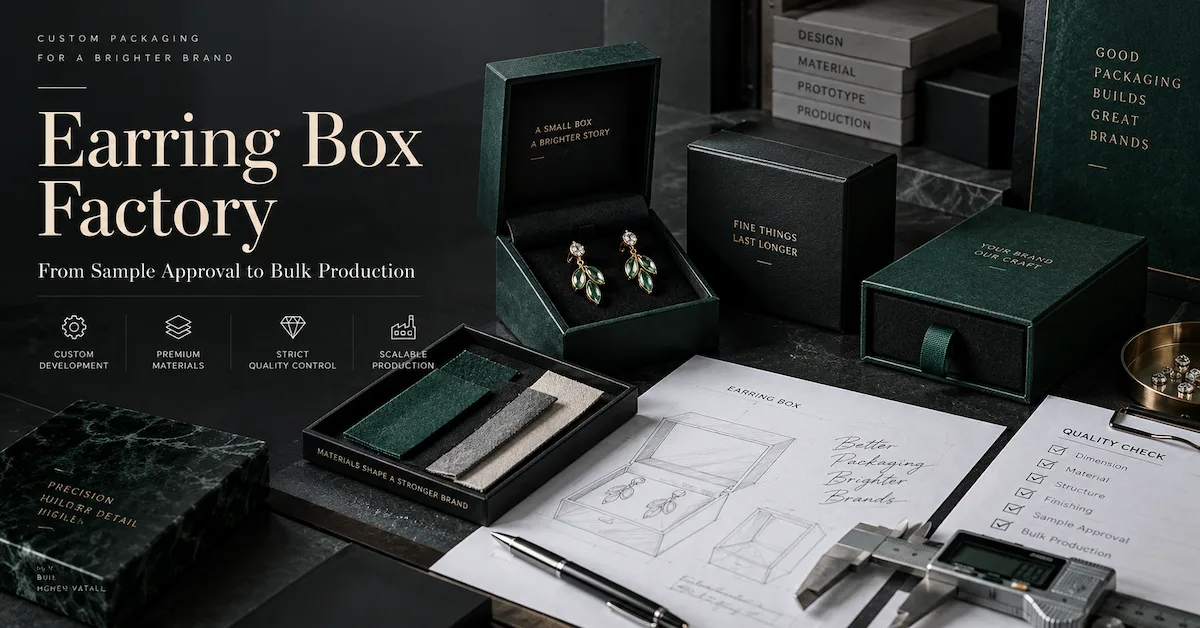
Sample development allows the buyer and manufacturer to verify a proposed design before committing to commercial quantities.
However, not all samples perform the same purpose.
A digital model, an unfinished structural prototype, and a fully decorated production-intent sample provide different levels of evidence.
Stage 1: Concept and Structural Review
At the beginning of development, buyers may provide drawings, sketches, reference images, jewelry dimensions, and brand requirements.
The manufacturer can use this information to discuss possible box formats and material options.
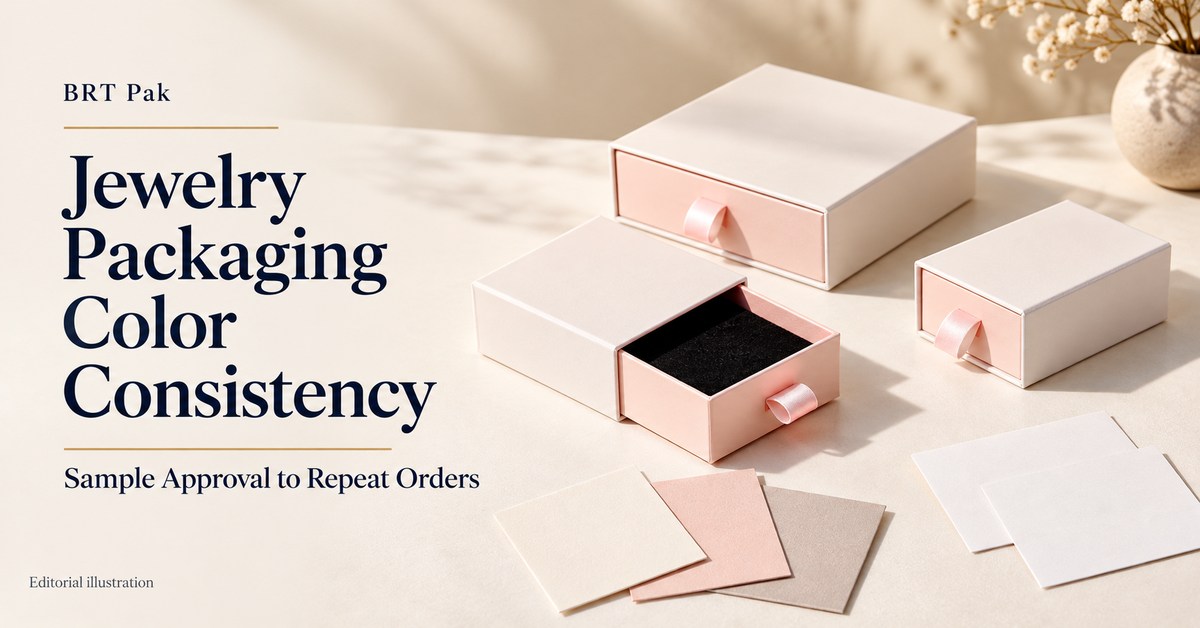
A three-dimensional visualization may help stakeholders understand proportions, opening methods, and product placement before physical development.
However, digital approval cannot establish the actual texture of a material or prove the mechanical behavior of a finished box.
Stage 2: Structural Prototype
A structural prototype focuses on geometry and function.
It can help verify external and internal dimensions, opening movement, insert positioning, and overall construction.
At this stage, some decorative details may not represent the final product.
The buyer should clearly record which characteristics have been approved and which remain under development.
For example, a white structural model may establish that the jewelry fits correctly but cannot confirm the final velvet color or logo finish.
Stage 3: Material and Decoration Sample
Once the proposed structure is understood, the buyer can review material samples and branding effects.
This may include comparing exterior coverings, lining textures, printed colors, foil stamping, embossing, or other suitable decoration methods.
The final decoration should be reviewed on a representative material because the appearance may change depending on the surface.
Where possible, approve the complete assembled product rather than only individual swatches.
Stage 4: Production-Intent Sample
A production-intent sample should represent the proposed finished construction closely enough to support approval.
Buyers should evaluate:
- Jewelry fit and product positioning.
- Exterior and interior materials.
- Opening and closing function.
- Surface quality and corner finishing.
- Logo placement and appearance.
- Interior cleanliness.
- Individual protection and packing presentation.
The approved sample should receive a reference number or revision identifier.
If changes remain unresolved, record them before issuing final production approval.
Stage 5: Golden Sample Confirmation
The approved physical reference can serve as a golden sample for production and inspection.
However, a golden sample should be supported by the technical specification, material references, artwork, and agreed acceptance criteria.
This combination provides a clearer production standard than a single sample alone.
For brands developing several products, the relationship between different samples should also be documented.
For example, multiple jewelry boxes may share the same exterior material reference while using different interior inserts.
A good sample development process makes these shared and different elements explicit.
7. How to Verify Quality Before Bulk Jewelry Box Production
Quality control should be integrated into development and production rather than treated as a final visual inspection.
The most appropriate inspection plan depends on the construction, order quantity, materials, and consequences of nonconforming packaging.
Incoming Material Checks
Before production, the manufacturer should confirm that the planned materials correspond to the approved requirements.
Important checks may include color, texture, dimensions, structural components, lining materials, and any specifically required supporting documentation.
A material substitution should be evaluated before use.
If the replacement changes the appearance or function of the finished box, the buyer may need to approve an updated sample.
First-Article Inspection
A first-article inspection evaluates early production units against the approved requirements.
This helps identify recurring assembly problems before large quantities are completed.
For example, the review might detect inconsistent corner wrapping, incorrect insert dimensions, or a logo positioned differently from the approved sample.
Correcting a problem early can reduce the quantity of affected products.
In-Process Quality Control
Some defects become difficult to correct after assembly.
Therefore, critical characteristics may need to be checked during production.
Depending on the product, relevant checks could include material preparation, structural assembly, covering application, insert positioning, and decoration.
The manufacturer should explain how these activities are controlled for the agreed order.
Finished Product Inspection
Finished product inspection should evaluate the agreed functional and cosmetic requirements.
A practical inspection plan should define sample selection, measurements, defect categories, and acceptance rules.
Buyers should understand that sampled inspection provides evidence about the inspected lot but does not guarantee every individual unit is defect-free.
The inspection method and acceptance limits should be agreed before production.
Export Packing Verification
The inspection process should also consider how finished boxes are protected and identified.
Relevant details include individual wrapping, carton arrangement, quantity per carton, labels, and packing-list accuracy.
Decorative surfaces may be particularly sensitive to rubbing, pressure, and handling.
Where transport testing is required, the buyer should select a relevant procedure for the actual distribution environment and packaged configuration.
The International Safe Transit Association (ISTA) provides distribution simulation procedures that can be considered when establishing a suitable packaging test plan.
A test result should apply only to the configuration and conditions evaluated. It must not be interpreted as a universal guarantee for every packing arrangement.
What About Environmental and Material Certifications?
If a project requires a specific material certification or environmental claim, request documentation that applies to the relevant product and supply arrangement.
For example, FSC chain-of-custody requirements concern the controlled sourcing, processing, identification, and sale of forest-based products carrying applicable FSC claims.
A general statement about responsible sourcing does not establish that every paper or wooden box can carry a certified claim.
Buyers should verify the specific scope of any certification, declaration, or test report before using it in product marketing or purchasing decisions.
8. How Do MOQ, Materials, and Packaging Design Affect Cost?
A custom jewelry box quotation is influenced by more than the external size of the finished box.
The structural design, materials, decoration, inserts, production quantity, protective packing, and development requirements can all affect cost.
For this reason, buyers should compare quotations based on the same approved specification.
Main Cost Drivers
| Cost factor | Why it influences purchasing cost | Possible buyer action |
|---|---|---|
| Box structure | Different structures require different components and assembly operations | Compare suitable construction options |
| Materials | Coverings, structural materials, and linings differ | Select materials according to functional and branding needs |
| Size | Larger dimensions may affect material use and shipping volume | Remove unnecessary dimensions where feasible |
| Insert complexity | Special supports and compartments may require additional development | Standardize only where product compatibility allows |
| Logo decoration | Different methods and artwork requirements affect production | Select the method that delivers the required appearance |
| Quantity | Production setup and material purchasing affect unit economics | Request realistic quantity-based quotations |
| Sampling | New designs may require prototypes and revisions | Prepare a complete initial brief |
| Quality requirements | Inspection scope and testing affect project arrangements | Define necessary controls early |
| Export packing | Unit protection and carton configuration affect packing costs | Review the complete shipping arrangement |
MOQ Should Be Confirmed by Configuration
Minimum order quantities may depend on the selected materials, colors, sizes, decoration methods, and production processes.
For example, ordering several different colors may involve different material purchasing conditions from ordering one color in the same total quantity.
A manufacturer should explain whether the MOQ applies to the overall order or separately to each configuration.
Do not assume that the minimum advertised for one catalog product applies to every customized jewelry box.
Compare Total Cost, Not Only Unit Price
A low unit price may exclude essential components such as inserts, logo decoration, individual wrapping, or export cartons.
Buyers should confirm what is included in the quotation before comparing suppliers.
A useful purchasing calculation is:
Cost per Accepted Unit = Total Applicable Project Costs / Accepted Usable Quantity
This calculation can help compare packaging configurations when inspection, rework, or additional handling affects the usable quantity.
Actual costs and responsibilities depend on the agreed commercial terms.
Avoid Overengineering
Not every packaging improvement requires a completely new box structure.
If an existing format already accommodates the jewelry and supports the brand's design requirements, modifying the insert or decoration may be more appropriate.
Similarly, choosing a heavier material does not automatically produce a better purchasing outcome.
The buyer should evaluate whether added complexity improves product fit, presentation, functionality, or customer experience.
Development expenditure should be connected to a defined commercial benefit.
Plan Lead Times Realistically
A custom packaging project may involve separate stages for design review, sampling, material preparation, production, inspection, and shipment.
The duration depends on the actual product configuration and current manufacturing arrangements.
Ask the supplier to identify the assumptions behind its proposed timeline.
Also establish how revisions and material changes affect the schedule.
A production lead time should not be confused with the complete time required to develop and deliver a new product.
9. What Should Buyers Expect From an OEM/ODM Jewelry Box Manufacturer?
OEM and ODM cooperation can help jewelry brands translate their packaging requirements into commercial products.
However, these terms should describe a defined scope of work rather than an automatic promise of unlimited customization.
OEM Development
For an OEM project, the buyer may already have a developed design or detailed technical requirements.
The manufacturer evaluates how the design can be produced and identifies necessary adjustments.
The buyer should provide product dimensions, drawings, materials, artwork, quantity requirements, and approval criteria.
The manufacturer's response should clarify manufacturing feasibility, sampling, commercial conditions, and any unresolved technical questions.
ODM Development
ODM cooperation may be relevant when the buyer has a concept but needs assistance developing the structure or presentation.
For example, a jewelry startup may know its desired brand colors and product positioning without having a complete box design.
A development partner can help explore suitable constructions, inserts, materials, and manufacturing approaches.
Before beginning, the parties should clarify the development scope, approval stages, associated charges, and ownership arrangements for any custom designs or tooling.
BRT PAK's Relevant Capabilities
BRT PAK / Better Industrial operates under Jinhua Better Industrial Co., Ltd.
The company's published information describes packaging design, research and development, production, and international logistics coordination.
Its product portfolio covers jewelry boxes, watches, gifts, displays, and related accessories.
BRT PAK also describes a development workflow involving requirement confirmation, design sketches, prototypes, material selection, sample confirmation, and packaging preparation.
These capabilities are relevant to jewelry brands seeking coordinated packaging development.
However, the precise manufacturing arrangements, available customization methods, production schedule, MOQ, and quality documentation should be confirmed for the intended project.
How BRT PAK Can Support a Packaging Discussion
A jewelry brand can begin by reviewing BRT PAK's Jewelry Boxes collection and selecting relevant product directions.
The buyer can then provide its jewelry dimensions, required packaging function, branding files, preferred materials, estimated quantity, and target market.
BRT PAK's team can review the project requirements and discuss suitable existing designs or development options.
For buyers planning complete retail presentation systems, the company's related packaging and display categories can provide additional reference points.
The objective is to create a technically clear project before placing a production order.
10. Which Jewelry Businesses Benefit Most From Custom Box Development?
Different buyers require different levels of customization.
The manufacturer's role should reflect the buyer's product portfolio, distribution model, branding requirements, and purchasing resources.
Luxury Jewelry Brands
Luxury brands may prioritize distinctive materials, refined finishing, careful jewelry positioning, and a consistent presentation across product collections.
For these buyers, physical samples and clear cosmetic acceptance criteria are particularly important.
Packaging should complement the jewelry without compromising usability or product fit.
E-Commerce Jewelry Brands
Online jewelry businesses need packaging that works within a complete fulfillment system.
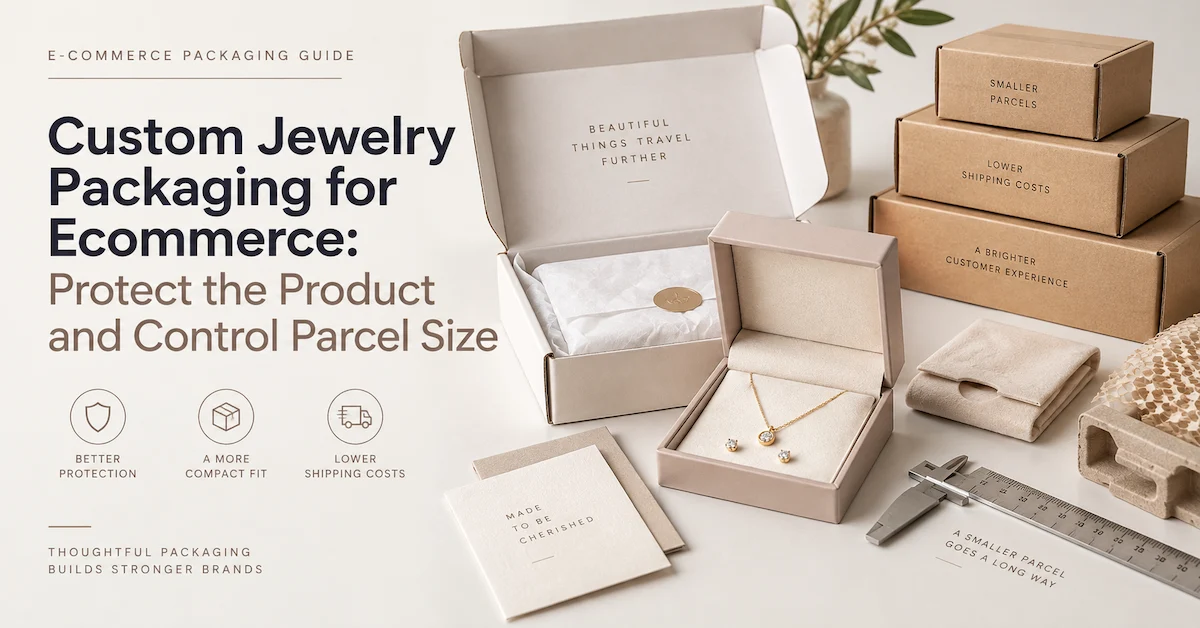
The presentation box may need to fit inside a shipping mailer or carton while maintaining an attractive unboxing experience.
Buyers should evaluate the complete parcel rather than the presentation box in isolation.
Carton dimensions, packing labor, and the risk of product movement may all influence purchasing decisions.
Wedding and Engagement Jewelry Brands
Wedding rings and engagement jewelry often require carefully controlled presentation.
The insert should hold the ring in the intended orientation and provide sufficient clearance for gemstone settings.
The opening mechanism and exterior finish should also support the desired customer experience.
A design should be tested with the actual range of jewelry dimensions rather than assuming all rings fit one standard configuration.
Jewelry Wholesalers and Importers
Wholesalers may prioritize standardized formats, clear pricing structures, consistent product specifications, and reliable replenishment.
Their orders can involve multiple box sizes and materials.
It is important to confirm MOQ by configuration, carton quantities, and product identification to reduce warehouse sorting problems.
Private-Label and Emerging Jewelry Brands
New brands may have strong creative ideas but limited packaging engineering resources.
They can benefit from a structured development process that translates visual concepts into measurable specifications.
However, customization should remain consistent with realistic order quantities and budgets.
A simpler approved design may be preferable to an overly complex concept that is difficult to reproduce commercially.
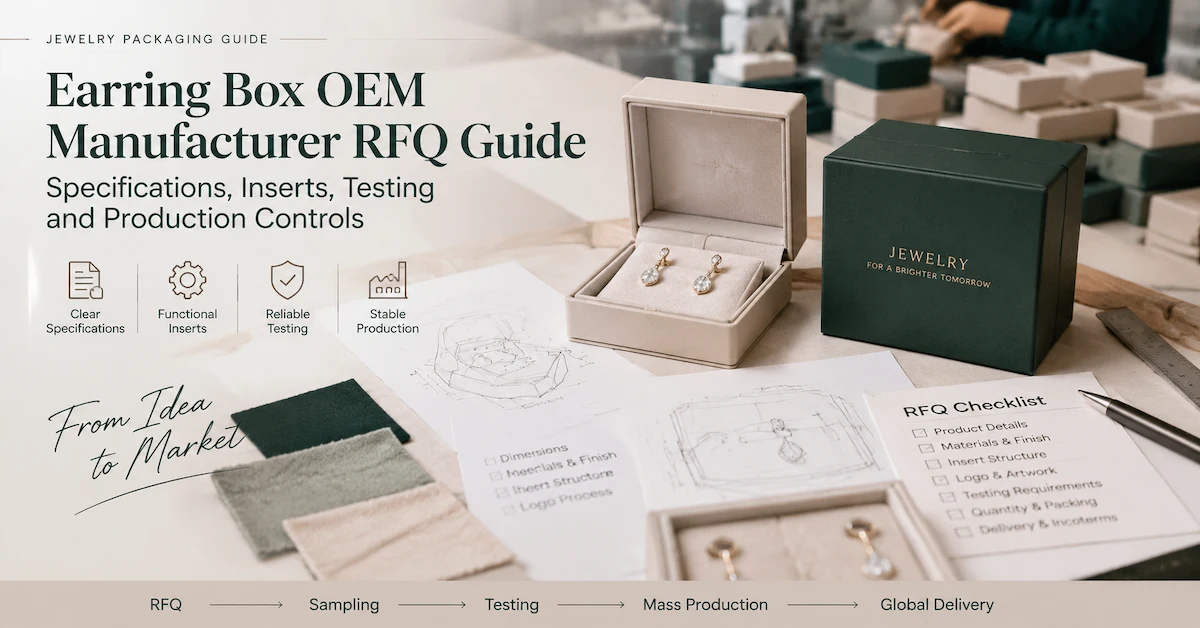
11. How to Prepare an Effective Custom Jewelry Box RFQ
A request for quotation should help the manufacturer understand exactly what the buyer needs.
The most effective RFQs separate mandatory requirements from design preferences and identify any information that still needs supplier recommendations.
Recommended RFQ Information
| RFQ item | Buyer information to prepare |
|---|---|
| Company and product | Brand identity and jewelry category |
| Intended application | Retail, e-commerce, gifting, wholesale, or another channel |
| Jewelry dimensions | Relevant product measurements and representative samples |
| Packaging format | Preferred structure or reference design |
| Material preferences | Exterior, structural, and interior requirements |
| Branding | Logo artwork, colors, and decoration preferences |
| Estimated quantity | Quantity by size, color, and configuration |
| Packaging requirements | Individual packing and export carton expectations |
| Target market | Destination country or sales region |
| Technical documents | Drawings, photographs, and specification references |
| Quality requirements | Inspection, testing, and applicable documentation needs |
| Schedule | Target sample approval and delivery dates |
| Commercial expectations | Target budget and quotation basis |
Example: A Professional Inquiry
We are developing custom jewelry boxes for a new branded collection that includes rings, earrings, necklaces, and bracelets.
We would like to maintain a consistent exterior appearance across the collection while using suitable inserts for each jewelry type.
Please review the attached product dimensions, reference designs, logo artwork, and estimated quantities.
We would appreciate recommendations for suitable box structures and materials, together with information about sample development, MOQ requirements, quotation inclusions, quality approval, and estimated project milestones.
Please identify any specifications that require further confirmation before a final quotation can be prepared.
This approach gives the manufacturer enough information to assess the project without forcing it to guess important details.
Buyers can submit the brief through BRT PAK's Contact Us page .
A well-prepared inquiry can reduce unnecessary clarification, improve quotation comparability, and create a clearer foundation for development.
12. Frequently Asked Questions
1. What Does a Custom Jewelry Box Manufacturer Actually Provide?
A custom jewelry box manufacturer produces or coordinates the production of packaging according to agreed specifications. Depending on its capabilities and project scope, services may include structural development, materials selection, insert design, branding, sampling, manufacturing, inspection, and export preparation. Buyers should verify which services are actually included in their quotation.
2. What Information Is Needed to Design a Custom Jewelry Box?
Start with the jewelry category, dimensions, intended presentation, sales channel, preferred box structure, materials, artwork, and estimated quantity. If the buyer does not know the final structure, the manufacturer can be asked to propose suitable options. Actual product samples or reliable drawings are especially useful when developing custom inserts.
3. Can One Jewelry Box Design Be Used for Rings, Earrings, Necklaces, and Bracelets?
A common exterior design may be suitable for multiple jewelry categories, but the interior requirements often differ. Ring slots, earring supports, necklace positioning, and bracelet retention may require different inserts. Each product configuration should be evaluated individually before a shared design is approved.
4. What Is the Difference Between a Standard Jewelry Box and an OEM Custom Jewelry Box?
A standard box generally uses an existing design with defined dimensions and construction. An OEM custom box is produced according to buyer-specific requirements, which may involve changes to materials, dimensions, inserts, artwork, or structure. The degree of customization and the associated commercial conditions depend on the supplier's actual capabilities.
5. How Can Buyers Choose Between Paperboard, Velvet, PU Leatherette, and Wooden Jewelry Boxes?
Evaluate the materials according to product positioning, required structure, appearance, handling conditions, and budget. Paperboard may suit printed retail packaging, velvet can offer a soft presentation, PU leatherette provides leather-like textures, and wood-based structures create a different visual character. The final decision should be confirmed with appropriate samples.
6. Why Is Jewelry Box Sample Approval Important?
Sample approval verifies that the proposed design meets the buyer's agreed requirements before bulk production. It can confirm dimensions, product fit, materials, opening function, logo application, and workmanship. The approved sample should be linked to a written specification so that manufacturing and inspection use the same reference.
7. What Is the MOQ for Custom Jewelry Boxes?
MOQ depends on the selected product, materials, decoration process, dimensions, and production arrangements. Different colors or configurations may have separate minimum requirements. Buyers should request a project-specific quotation rather than assuming that the MOQ shown for one catalog product applies to every custom packaging design.
8. How Do Manufacturers Maintain Quality Consistency Between Orders?
Consistency depends on controlled specifications, approved materials, artwork versions, reference samples, production checks, and documented change management. Before a repeat order, the supplier should confirm whether the same materials and processes remain available. Any necessary changes should be reviewed and approved before manufacturing.
9. Can Custom Jewelry Packaging Support Sustainability Requirements?
Material selection can support specific environmental objectives, but claims must be supported by relevant evidence. Buyers may request documentation about material composition, recycled content, sourcing, or applicable certification. A natural-looking material does not automatically establish sustainability, and a general supplier certification may not cover every finished product.
10. How Can I Request OEM/ODM Jewelry Packaging From BRT PAK?
Prepare your jewelry dimensions, reference images, preferred materials, logo artwork, estimated quantities, target market, and desired schedule. Review BRT PAK's Jewelry Boxes products , then use its contact page to discuss development options, sampling requirements, customization scope, and a quotation based on your project.
13. Conclusion
Choosing the right custom jewelry box manufacturer is a technical and commercial decision that begins long before bulk production.
For jewelry brands, private-label companies, wholesalers, and retailers, successful packaging development requires more than an attractive exterior design. The box must accommodate the actual jewelry, support the desired presentation, use appropriate materials, and meet clearly defined manufacturing and quality requirements.
The most effective approach is to convert the original brand concept into a factory-ready specification that includes product dimensions, structural construction, insert geometry, exterior and interior materials, logo application, sample references, and acceptance criteria.
This process helps reduce misunderstandings, supports more accurate quotations, and establishes a stronger basis for consistent production.
BRT PAK / Better Industrial provides packaging design, development, manufacturing, and international service capabilities relevant to jewelry brands seeking custom boxes and coordinated packaging solutions.
Buyers can explore the company's Jewelry Boxes collection to identify potential design directions and discuss requirements for rings, earrings, necklaces, bracelets, and other jewelry products.
Ready to turn your packaging concept into a production-ready design? Contact BRT PAK with your jewelry dimensions, preferred materials, logo artwork, estimated order quantity, and target delivery requirements.
A detailed project brief enables a more productive discussion about suitable structures, sample development, quality requirements, and OEM/ODM manufacturing options—helping your brand move from creative concept to a commercially viable packaging solution.
Ready to turn your packaging concept into a production-ready specification?
Contact BRT PAK for a Project Quote →