
Quick Answer:A reliable necklace box supplier should help jewelry brands select suitable box structures, chain retention points, pendant support, interior materials, and branding options. Buyers should evaluate actual chain lengths, clasp dimensions, pendant thickness, and excess-chain storage before approving samples. Effective necklace packaging combines organized presentation with controlled jewelry movement, convenient removal, and repeatable manufacturing specifications.
A necklace can look perfectly positioned when a packaging sample is photographed.
However, the same necklace may arrive at a retail store with its chain tangled, pendant displaced, or clasp trapped beneath the insert.
These problems are not always caused by poor exterior packaging. They frequently originate from the relationship between the jewelry and its internal support structure.
Unlike ring boxes, necklace packaging must accommodate flexible chains, different pendant shapes, adjustable extensions, and multiple possible contact points.
For jewelry brands purchasing hundreds or thousands of boxes, overlooking these details can create additional handling work, packaging replacements, and inconsistent customer experiences.
This guide explains how to evaluate necklace packaging suppliers, compare box structures, and develop suitable inserts before committing to bulk production.
Key Insights: Necklace Packaging Purchasing Requirements
| Purchasing Factor | Common Problem | Recommended Design Approach |
|---|---|---|
| Chain length | Excess chain gathers inside the box | Dedicated excess-chain storage |
| Chain retention | Chain slips out of position | Appropriately positioned attachment points |
| Pendant dimensions | Pendant moves or contacts the lid | Suitable support and interior clearance |
| Insert material | Snagging or unwanted surface contact | Approved jewelry-contact materials |
| Box structure | Insufficient usable interior space | Structure selected around loaded jewelry |
| Branding | Inconsistent logo and color appearance | Controlled artwork and material references |
| Bulk production | Samples and delivered boxes differ | Approved specifications and inspection criteria |
Key Takeaways
- Necklace packaging dimensions should be developed around the actual jewelry, not simply its chain length.
- Excess-chain management is essential for maintaining an organized presentation.
- Delicate chains and heavy pendants require different retention arrangements.
- Soft lining alone does not guarantee suitable necklace protection.
- Physical samples should be evaluated with representative jewelry before bulk purchasing.
1. What Should a Necklace Box Supplier Provide?
A necklace box supplier provides packaging products intended to store, present, and support necklaces during retail handling, gifting, and distribution.
For customized projects, suppliers may also support structural design, material selection, insert development, logo customization, sampling, and bulk production.
However, not every supplier offers the same development capabilities.
Which Buyers Need Custom Necklace Packaging?
| Buyer Type | Primary Packaging Requirement |
|---|---|
| Fine jewelry brands | Refined presentation and appropriate pendant support |
| Fashion jewelry retailers | Commercially practical packaging across collections |
| Jewelry wholesalers | Consistent specifications and bulk purchasing |
| Private-label brands | Customized colors, artwork, and inserts |
| E-commerce jewelry businesses | Organized presentation after delivery |
| Gift distributors | Coordinated branding and attractive unboxing |
Custom packaging is particularly valuable when necklaces have distinctive dimensions, delicate chains, unusual pendants, or specific branding requirements.
For small purchases requiring immediate availability, an existing standard box may be more appropriate if its insert and dimensions suit the jewelry.
2. How Do You Determine the Correct Necklace Box Size?
The correct necklace box size depends on how the jewelry will be arranged inside the packaging.
A long chain does not necessarily require a full-length box. A shorter presentation box may be suitable when excess chain is stored securely behind the insert.
However, this arrangement must not introduce excessive bending, pressure, or uncontrolled movement.
Necklace Packaging Technical Specification Table
| Specification | Required Buyer Information | Design Purpose |
|---|---|---|
| Total chain length | Actual length, including extensions where relevant | Determines chain arrangement |
| Chain width | Maximum chain thickness or width | Supports suitable retention openings |
| Chain construction | Cable, snake, rope, or other structure | Helps assess bending and snagging risks |
| Pendant length and width | Maximum external measurements | Determines presentation area |
| Pendant thickness | Including protruding settings | Establishes interior clearance |
| Pendant weight | Actual jewelry weight | Supports retention design |
| Clasp dimensions | Clasp and extension components | Determines rear storage requirements |
| Usable internal dimensions | Space remaining after lining and insert installation | Confirms jewelry fit |
| Insert attachment positions | Locations of slots, tabs, or hooks | Controls jewelry positioning |
| Closure clearance | Available space when the box is closed | Reduces unwanted contact |
These measurements should be treated as project-specific requirements rather than universal necklace box specifications.
Measure Usable Space, Not Exterior Size
A box's external dimensions include its walls, decorative covering, lid, and internal construction.
The usable interior may be significantly smaller.
Buyers should therefore request internal measurements and evaluate the completed box with its actual insert installed.
3. How Can Necklace Box Inserts Reduce Tangling?
Effective anti-tangle necklace packaging begins with controlled chain positioning.
Loose chain sections, clasps, and extensions should not be allowed to move freely around the pendant.
Use Suitable Chain Attachment Points
An insert may use slots, tabs, loops, or other retention features to maintain the necklace's intended arrangement.
The attachment points should suit the chain construction.
A narrow opening may be unsuitable for a thick chain. An excessively wide opening may allow a delicate chain to slip out.
The final design must be evaluated with representative jewelry.
Manage Excess Chain Separately
For compact pendant presentation boxes, excess chain may be arranged behind or beneath the insert.
Possible design approaches include:
- Rear storage pockets
- Separate chain channels
- Removable insert panels
- Soft retaining tabs
- Dedicated clasp storage areas
These are potential engineering options that require confirmation with the supplier.
A rear compartment should provide sufficient space without forcing the chain into sharp bends or allowing it to become trapped between structural components.
Why Separation Matters
The Gemological Institute of America explains in its jewelry organization guidance that separate compartments and hanging arrangements can help reduce necklace tangling and contact between jewelry pieces.
For packaging buyers, this supports the principle of organized retention rather than uncontrolled storage.
It does not establish that a particular packaging design is completely tangle-proof.
4. Which Necklace Box Structure Is Best for Your Jewelry?
There is no single box structure suitable for every necklace collection.
A professional necklace box supplier should evaluate the intended jewelry, presentation style, price positioning, and distribution requirements before recommending a design.
Necklace Box Structure Comparison
| Box Structure | Suitable Application | Main Advantage | Purchasing Consideration |
|---|---|---|---|
| Long rectangular box | Long necklaces and chain collections | Extended presentation area | Larger storage footprint |
| Compact pendant box | Delicate chains and small pendants | Focused pendant presentation | Requires excess-chain management |
| Drawer-style paper box | Fashion jewelry and retail gifting | Controlled opening experience | Drawer and insert clearance |
| Hinged presentation box | Premium jewelry collections | Convenient display access | Lid clearance and hinge arrangement |
| Bamboo or wooden box | Nature-inspired or premium collections | Distinctive material appearance | Surface variation and weight |
| Multi-piece jewelry set box | Necklace and earring combinations | Coordinated presentation | Separate retention for each piece |
These are general packaging design directions. The availability of specific structures and custom inserts should be confirmed for each project.
Long Boxes Versus Compact Pendant Boxes
Long boxes allow more of the necklace to remain visible.
Compact boxes place greater emphasis on the pendant while storing part of the chain behind the presentation surface.
The correct choice depends on how the brand wants customers to experience the jewelry.
A compact format may save space, but it should not be selected at the expense of chain suitability.
5. Which Materials Are Suitable for Custom Necklace Boxes?
Necklace packaging normally includes several material layers.
These may consist of a structural body, exterior covering, interior lining, insert core, jewelry-contact surface, and decorative elements.
Each component serves a different purpose.
Material Comparison
| Material | Typical Function | Important Selection Criteria |
|---|---|---|
| Rigid paperboard | Structural body | Strength, dimensions, corner finishing |
| Decorative paper | Exterior covering | Color, texture, surface consistency |
| Leatherette | Textured exterior | Seam quality and edge wrapping |
| Velvet | Interior lining or decorative covering | Fiber shedding and snagging potential |
| Microfiber | Jewelry-contact surface | Cleanliness and contact suitability |
| Bamboo | Decorative structural material | Natural variation and finish |
| Foam-based insert | Jewelry support | Shape stability and covering suitability |
Material performance depends on the finished construction.
Buyers should not assume that every soft lining is automatically suitable for delicate chains, pearls, or polished gemstones.
Consider Material Contact Carefully
The interior should be evaluated for exposed adhesive, rough edges, loose fibers, decorative projections, and other features that could interfere with the jewelry.
If anti-tarnish properties or specialized material performance is required, request relevant supporting evidence.
Ordinary soft lining should not be described as anti-tarnish material without verification.
6. How Should Necklace Packaging Protect Different Pendant Types?
Pendant dimensions and weight can significantly influence insert design.
Small and Lightweight Pendants
Small pendants generally require an organized presentation surface and suitable chain positioning.
The main design objective is to maintain visibility without allowing the pendant to disappear beneath loose chain sections.
Large Statement Pendants
Larger pendants may require a wider presentation area and more interior clearance.
The supplier should consider whether additional support is necessary to limit movement without placing excessive pressure on decorative components.
Gemstone and Pearl Necklaces
Jewelry containing delicate stones or pearls may require additional attention to contact materials and storage conditions.
The buyer should communicate any jewelry-specific care requirements during development.
Check Pendant-to-Lid Clearance
A necklace may fit inside an open box while contacting the lid once the box is closed.
Evaluate the completed package with the actual pendant in its intended position.
The inspection should include the highest decorative projections, relevant chain sections, and any components that could become compressed during closure.
7. Compare BRT PAK Jewelry Box Design References
BRT PAK / Better Industrial provides jewelry packaging products that offer different material and presentation directions.
Two relevant examples are its drawer-style paper jewelry box and JBW190 bamboo jewelry box.
BRT PAK Product Comparison
| Published Product | Design Characteristics | Potential Purchasing Application |
|---|---|---|
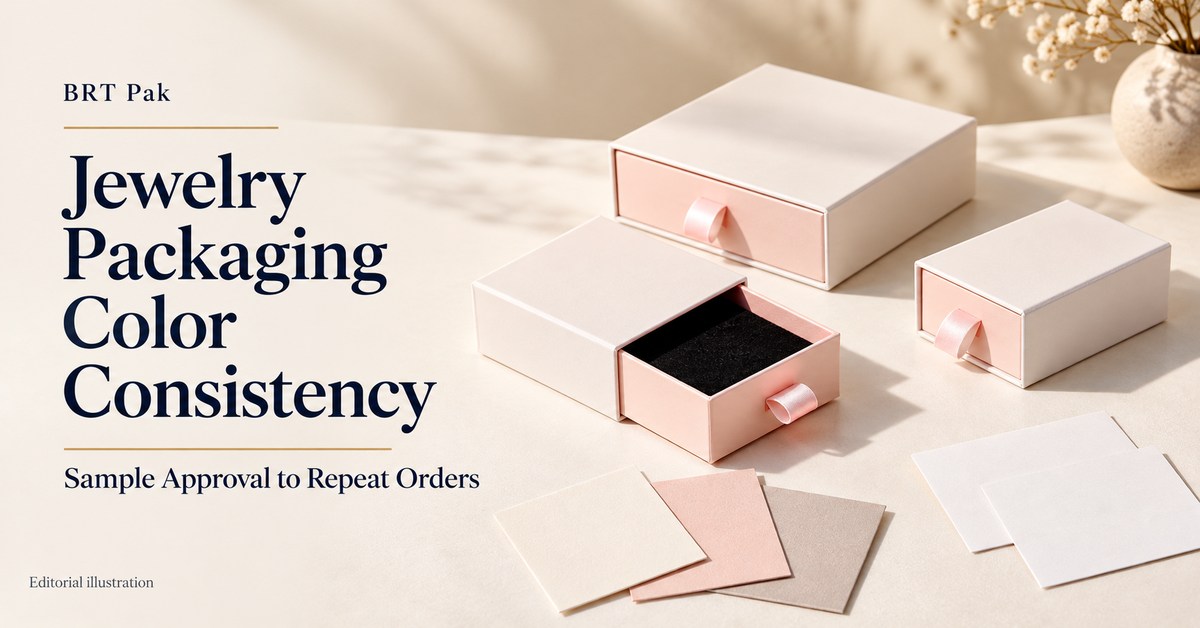
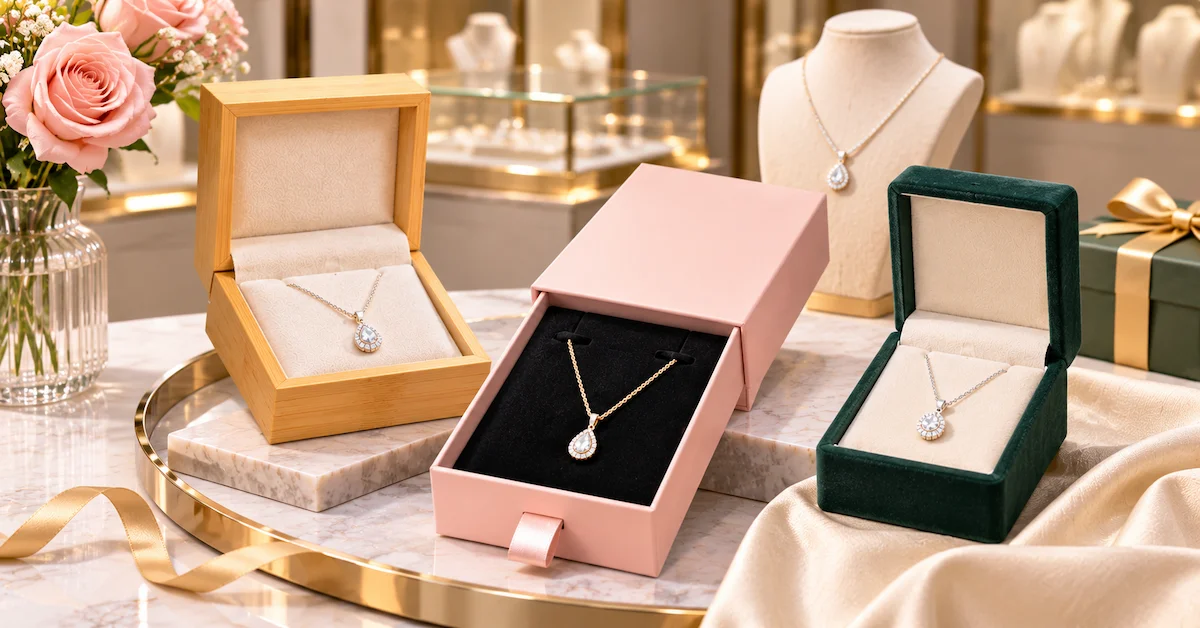
| Paper Jewelry Box | Pink and white matte exterior, drawer opening, ribbon pull, black velvet interior, multiple size options | Fashion necklaces, pendant gifts, branded retail packaging |
| JBW190 Bamboo Jewelry Box | Bamboo exterior and microfiber interior | Nature-inspired jewelry collections and premium presentation concepts |
Paper Jewelry Box
The published Paper Jewelry Box features a drawer-style opening and soft interior presentation.
Its product description identifies multiple sizes intended for different jewelry categories, including necklaces.
Buyers can use this model as a starting reference when discussing custom necklace inserts, branding, and retail gift packaging.
JBW190 Bamboo Jewelry Box
The JBW190 provides an alternative material direction through its bamboo exterior and microfiber lining.
Its natural visual character may appeal to brands developing packaging around a more understated material aesthetic.
Exact necklace compatibility, insert configurations, material documentation, and customization options should be confirmed before ordering.
8. What Manufacturing Details Should Buyers Inspect?
The appearance of necklace packaging depends on the combined quality of structural assembly, covering, lining, insert preparation, and decoration.
Insert Cutting and Assembly
Retention openings should follow the approved design.
Review their position, size, edge condition, and alignment with the necklace.
Poorly positioned openings may create an uneven presentation or make the jewelry difficult to remove.
Interior Material Application
Inspect the lining for wrinkles, exposed adhesive, loose fibers, lifting edges, or unintended contact surfaces.
The insert should remain properly seated during normal handling.
Exterior Finishing
Check corner wrapping, visible seams, surface cleanliness, logo positioning, and opening alignment.
For drawer-style boxes, verify that the loaded drawer operates as intended.
Avoid Unapproved Component Substitution
Changing the insert core, covering, adhesive, or retention feature can affect product suitability.
Any proposed substitution should be reviewed against the approved sample before production.
9. How Should Buyers Approve Necklace Packaging Samples?
Sample approval should include the actual necklace rather than an empty box.
A complete loaded sample provides more useful information about fit, presentation, and handling.
Necklace Box Sample Approval Checklist
| Inspection Area | Approval Requirement |
|---|---|
| Chain retention | Maintains the intended position during agreed handling checks |
| Excess-chain storage | No unacceptable trapping or bending |
| Pendant positioning | Remains within the approved presentation area |
| Interior clearance | No unintended contact when closed |
| Jewelry removal | Product can be removed without excessive force |
| Insert installation | Correct orientation and secure seating |
| Surface appearance | Matches approved material and color references |
| Branding | Correct logo artwork and placement |
| Opening function | Operates according to approved construction |
| Individual packing | Matches agreed protection requirements |
Evaluate Representative Jewelry Variations
When a box is intended for several necklace models, select representative samples covering important differences in chain length, pendant size, and clasp construction.
Approving only the smallest necklace may leave larger configurations untested.
Confirm Quality and Certification Requirements
If the project requires specific material certifications, environmental claims, or packaging performance evaluations, establish these requirements before ordering.
Request documentation relevant to the actual construction.
A general company certificate should not automatically be treated as certification of every custom necklace box.
10. What Determines Wholesale Necklace Box Prices?
Wholesale necklace packaging prices are influenced by construction, materials, size, insert complexity, customization, quantity, and packing requirements.
The lowest unit price may not provide the lowest overall purchasing cost.
Important Cost Factors
| Cost Component | Purchasing Consideration |
|---|---|
| Structural body | Material, size, and construction |
| Exterior decoration | Logo process and surface finish |
| Custom insert | Development, cutting, covering, and assembly |
| Sample development | Prototype and revision requirements |
| Quantity | MOQ and production configuration |
| Protective packing | Individual and master carton arrangements |
| Transportation | Shipment dimensions, destination, delivery terms |
Compare Handling Requirements
A box with a lower quoted price may require additional work when jewelry is packed into it.
For example, a poorly designed insert may require retail staff to spend more time arranging loose chains.
When evaluating competing quotations, consider both packaging cost and the labor associated with loading and handling the jewelry.
Confirm MOQ and Lead Time
There is no universal MOQ or production schedule for every custom necklace box.
Ask whether minimum quantities apply by structure, insert, color, or decoration.
Also confirm the expected milestones for sample approval, material preparation, bulk manufacturing, inspection, and shipment.
A project-specific schedule is more useful than a general delivery promise.
11. How Can OEM and ODM Services Support Necklace Packaging?
OEM and ODM development can help jewelry businesses differentiate their packaging through customized structures, materials, inserts, and branding.
For some projects, an existing box with an adapted insert and approved logo may be sufficient.
Other projects may require a new structural design.
Customization Options to Discuss
- Box dimensions and opening style
- Exterior colors and finishes
- Chain retention positions
- Pendant presentation layout
- Interior lining and insert construction
- Logo artwork and decoration
- Coordinated gift packaging
The availability of each option depends on the chosen construction and project requirements.
Start With the Functional Design
Finalize the jewelry arrangement before committing to decorative details.
An attractive exterior cannot compensate for an unsuitable interior.
BRT PAK's company profile describes services covering requirement confirmation, design development, prototyping, material selection, sample confirmation, and logistics coordination.
Buyers can use this workflow to discuss necklace-specific customization projects.
12. Practical Example: Packaging Delicate Chains and Statement Pendants
Consider a hypothetical jewelry brand developing packaging for three necklace collections.
This example illustrates a purchasing method rather than an actual BRT PAK customer project.
| Jewelry Collection | Main Packaging Challenge | Proposed Design Direction |
|---|---|---|
| Delicate pendant necklaces | Loose fine chains | Compact box with suitable rear-chain storage |
| Large gemstone pendants | Pendant movement and clearance | Larger presentation area with dedicated support |
| Long fashion necklaces | Excess chain organization | Extended box or suitable chain-routing arrangement |
The brand wants a consistent exterior color and logo across all collections.
However, using an identical insert for every necklace could create functional problems.
A better development approach would establish a shared visual identity while evaluating separate retention layouts where necessary.
The supplier would prepare representative samples, and the buyer would approve the loaded jewelry arrangement before confirming quantities.
This approach balances brand consistency with product-specific packaging requirements.
13. How Do You Choose a Reliable Necklace Box Supplier?
A suitable supplier should be able to discuss the functional relationship between the jewelry and its packaging.
Evaluate proposals according to the clarity of their specifications, development process, available materials, sample arrangements, and commercial terms.
Supplier Evaluation Questions
Ask prospective suppliers:
- Can you review our actual necklace dimensions and chain construction?
- Can the insert accommodate the pendant and excess chain?
- What existing box structures are available?
- Which interior materials can be evaluated?
- Can we approve a loaded sample before bulk production?
- What customization options are suitable for the selected structure?
- How will approved specifications be controlled?
- What are the applicable MOQ and project milestones?
- What inspection and packing arrangements are included?
- Can the quotation identify the complete finished configuration?
Prepare a Quote-Ready Necklace Packaging RFQ
| RFQ Item | Information to Provide |
|---|---|
| Jewelry type | Chain necklace, pendant, statement necklace, or set |
| Jewelry measurements | Chain length, pendant size, clasp dimensions |
| Packaging style | Reference image or preferred structure |
| Interior requirements | Retention points, chain storage, contact materials |
| Branding | Logo files, colors, decorative requirements |
| Order quantity | Estimated quantity by configuration |
| Sales channel | Retail, wholesale, gifting, or e-commerce |
| Sample requirements | Loaded sample and approval criteria |
| Delivery destination | Country and required commercial terms |
Providing these details helps a necklace box supplier assess the actual project rather than offering a generic packaging quotation.
If you are developing a custom necklace packaging program, send your jewelry dimensions, design references, and purchasing requirements to BRT PAK for evaluation.
Request a Custom Necklace Packaging Quote
Frequently Asked Questions
1. What Does a Necklace Box Supplier Offer?
A necklace box supplier provides presentation and storage packaging for necklaces. Depending on its capabilities, it may also support custom structures, insert development, logo decoration, sampling, bulk production, and export arrangements.
2. What Is the Best Box for Preventing Necklace Tangling?
A suitable box uses appropriate chain retention and controlled excess-chain storage. The design must be evaluated with the actual necklace because chain construction, length, and clasp dimensions vary.
3. Can One Necklace Box Fit Different Chain Lengths?
Yes, provided the insert arrangement and available chain storage accommodate the intended range. Representative necklace variations should be evaluated before approving a shared packaging design.
4. Are Velvet Necklace Boxes Better Than Paper Jewelry Boxes?
They serve different material and presentation requirements. A paper box can also include a velvet-lined insert. Compare the complete construction, jewelry-contact surfaces, appearance, and commercial requirements.
5. Can Necklace Box Inserts Be Customized?
Custom insert development may be available depending on the packaging structure and supplier capabilities. Provide jewelry measurements and specify the required retention arrangement during development.
6. How Do You Protect a Large Pendant Inside a Necklace Box?
Evaluate pendant dimensions, thickness, weight, support, and closed-box clearance. A suitable arrangement should limit unwanted movement without placing damaging pressure on decorative features.
7. What Is the MOQ for Custom Necklace Boxes?
MOQ depends on the box structure, materials, insert design, decoration, and order configuration. Request project-specific quantities and pricing before making a purchasing decision.
8. Can Necklace Boxes Be Customized With a Brand Logo?
Logo customization may be available through suitable decoration methods. The final process depends on the exterior material and should be confirmed through sample approval.
9. Are Retail Necklace Boxes Suitable for International Shipping?
A presentation box is not automatically a shipping container. Buyers should evaluate the complete distribution package, including individual protection and outer cartons, for the intended delivery conditions.
10. How Can I Order Custom Necklace Boxes From BRT PAK?
Review the BRT PAK jewelry box collection, prepare your necklace specifications, packaging references, artwork, and estimated quantity, and contact the company for available configurations, sampling, and quotation details.
Conclusion
Choosing the right necklace box supplier requires more than comparing attractive designs and wholesale prices.
Effective necklace packaging begins with understanding the actual jewelry, including its chain construction, pendant dimensions, clasp, and presentation requirements.
Suitable retention points, organized excess-chain storage, appropriate contact materials, and verified interior clearance can help jewelry businesses develop more practical retail packaging.
Buyers should approve representative loaded samples, establish clear quality requirements, and confirm the complete commercial specification before releasing bulk orders.
BRT PAK / Better Industrial provides jewelry packaging products and development services that offer practical starting points for custom necklace packaging projects.
Whether you are developing delicate pendant boxes, premium jewelry gift packaging, or a coordinated necklace collection, a clear product specification can help establish a more suitable packaging solution.
Contact BRT PAK today with your necklace dimensions, preferred materials, branding references, estimated order quantity, and destination market to discuss available packaging solutions and request a project-specific quotation.