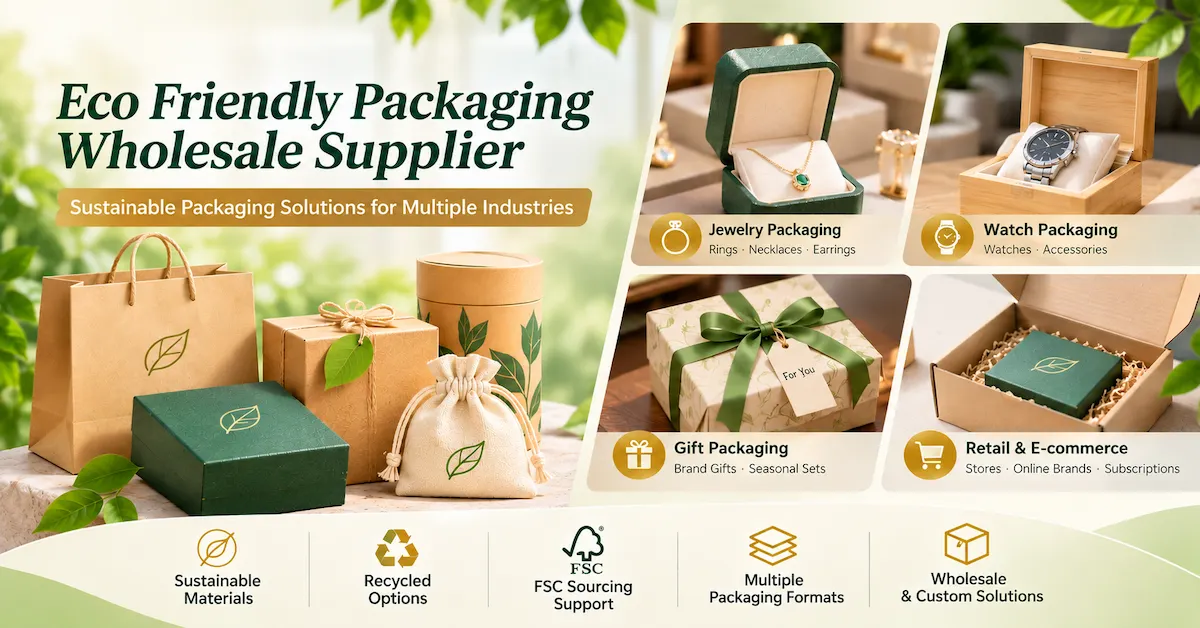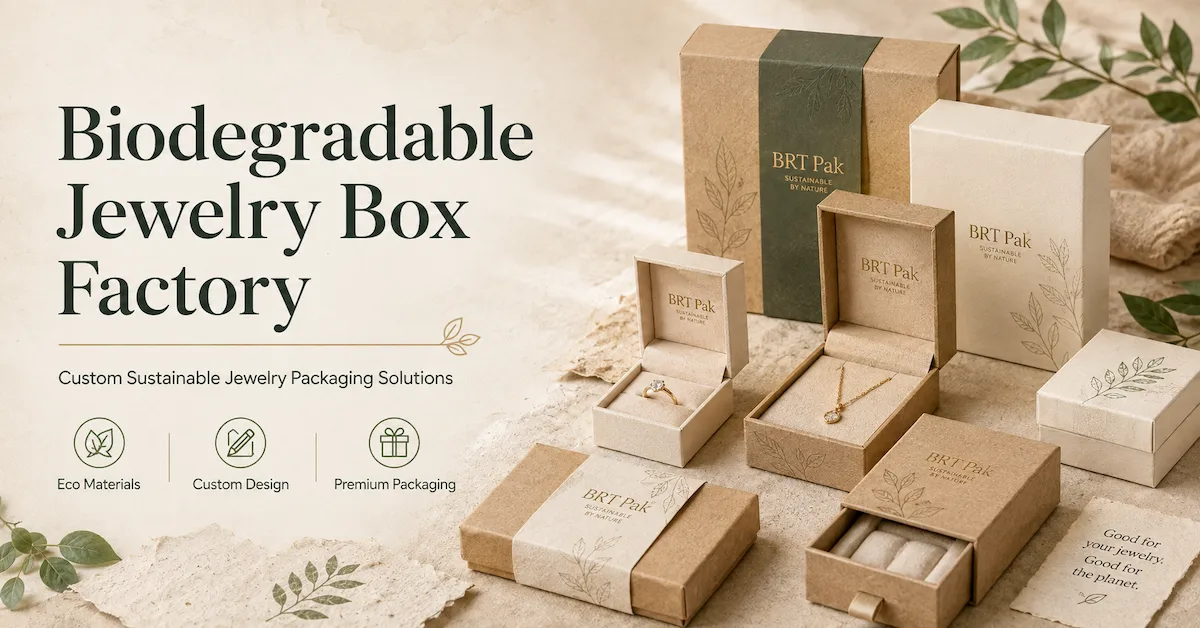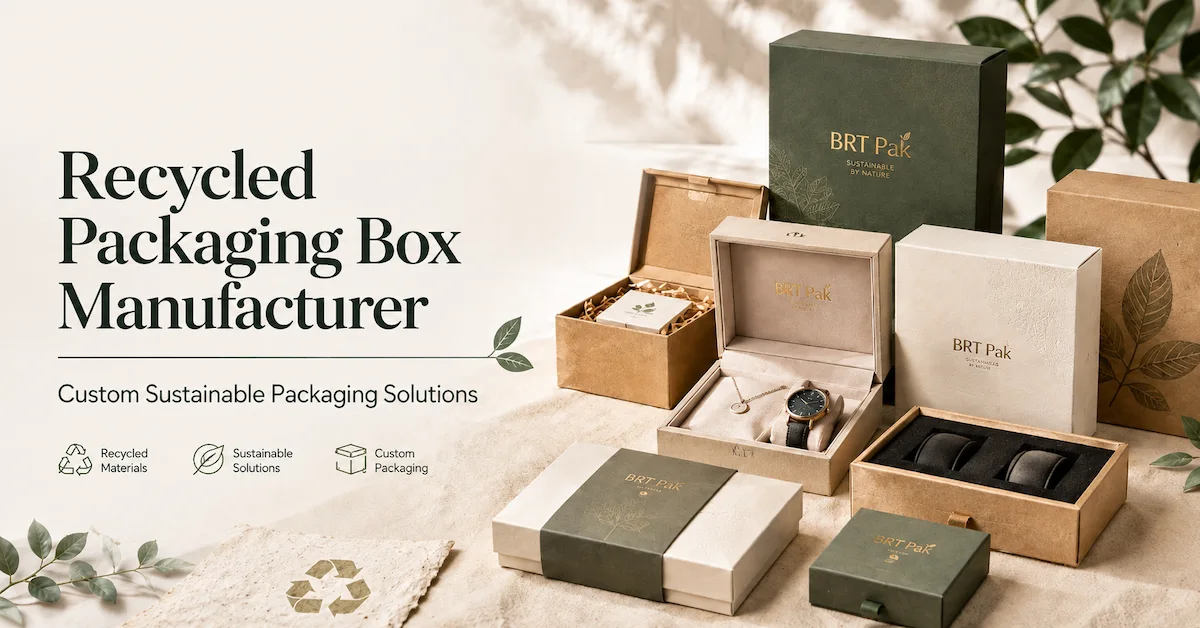

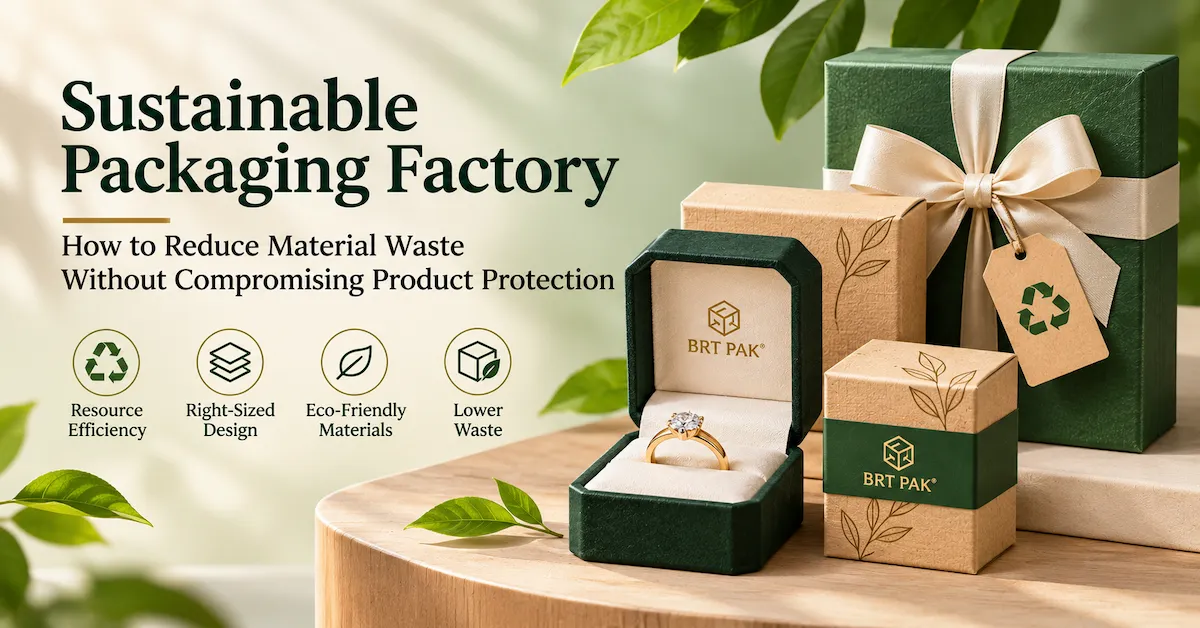
A reliable sustainable packaging factory should help brands reduce unnecessary material consumption while maintaining product protection, presentation, and manufacturing consistency. Buyers should evaluate packaging dimensions, component weight, material utilization, production waste, and end-of-life compatibility. Effective sustainable packaging development begins with a measurable baseline, followed by structural optimization, prototype validation, and controlled bulk production rather than simply replacing conventional materials with natural-looking alternatives.
For jewelry brands, watch companies, and premium gift retailers, sustainable packaging presents a practical design challenge.
Customers expect attractive presentation, while procurement teams must manage packaging costs, material consumption, shipping requirements, and environmental responsibilities.
Simply replacing a conventional box with a kraft paper or bamboo alternative does not necessarily resolve these challenges.
A packaging design may use renewable materials yet remain unnecessarily large, difficult to separate, or inefficient to manufacture.
The better approach is to examine how much material the packaging requires, what each component contributes, and whether the same functional requirements can be achieved with a more efficient construction.
Key Insights: Sustainable Packaging Manufacturing
| Optimization Area | Recommended Approach | Purchasing Benefit |
|---|---|---|
| Packaging dimensions | Eliminate unnecessary internal space | Lower material consumption |
| Structural design | Simplify components while maintaining protection | More efficient assembly |
| Interior inserts | Evaluate suitable removable or simplified structures | Improved material separation |
| Material utilization | Optimize cutting layouts | Reduced manufacturing offcuts |
| Production quality | Prevent avoidable defects and rework | Lower material losses |
| Retail presentation | Use coordinated materials and restrained decoration | Consistent brand identity |
| Distribution | Optimize carton dimensions and packing density | Potential transportation efficiency |
| Environmental communication | Measure and document specific improvements | More credible sustainability claims |
Key takeaway: Sustainable packaging should be evaluated through measurable material efficiency and functional performance, not appearance alone.
1. What Should a Sustainable Packaging Factory Actually Deliver?
A sustainable packaging factory should support packaging development that considers material consumption, manufacturing efficiency, product protection, and the intended end-of-life pathway.
For commercial buyers, the objective is not necessarily to eliminate every synthetic component. It is to identify unnecessary materials and develop practical alternatives without introducing unacceptable product risks.
Which Buyers Benefit Most?
| Buyer Type | Sustainable Packaging Objective |
|---|---|
| Jewelry brands | Reduce excessive packaging while maintaining presentation |
| Watch companies | Balance durable construction and material consumption |
| Gift packaging distributors | Simplify decorative and structural components |
| Retail chains | Standardize resource-efficient packaging |
| Private-label businesses | Develop packaging with documented material attributes |
| E-commerce brands | Optimize presentation and distribution packaging |
This development approach is particularly suitable for businesses with recurring packaging orders or established product collections.
For small purchases requiring immediate delivery, existing packaging may be more practical than developing a completely new structure.
2. Why Should Packaging Waste Reduction Begin With Design?
The most effective opportunity to reduce unnecessary packaging material often occurs before manufacturing begins.
According to the U.S. Environmental Protection Agency's Waste Management Hierarchy, source reduction and reuse take priority over downstream waste management strategies.
Packaging redesign and lightweighting are recognized approaches to preventing waste.
Identify Components That Do Not Add Functional Value
Premium jewelry and gift packaging may contain decorative sleeves, additional wrapping, multiple lining layers, ribbons, magnetic closures, and oversized structural components.
Some provide important functional or branding benefits. Others may be removable without materially affecting the intended customer experience.
Evaluate each component according to three questions:
- Does it protect the product?
- Does it support a necessary presentation or handling function?
- Can a simpler alternative achieve the same result?
Removing unnecessary components can reduce material consumption and assembly complexity.
However, essential protective features should remain until a suitable alternative has been validated.
3. How Can Right-Sized Packaging Reduce Material Consumption?
Right-sized packaging uses dimensions appropriate to the product, necessary protective clearance, and intended presentation.
An oversized necklace box may consume more board, covering material, lining, and shipping space than required.
Nevertheless, simply reducing every external dimension may create insufficient interior clearance.
Sustainable Packaging Technical Specification Table
| Specification | Buyer Should Define | Optimization Purpose |
|---|---|---|
| Product dimensions | Actual jewelry, watch, or gift measurements | Establish minimum usable space |
| External box dimensions | Finished length, width, and height | Control material usage |
| Structural thickness | Approved board or body specification | Balance strength and weight |
| Empty packaging weight | Measured finished weight | Establish a material baseline |
| Insert construction | Material, geometry, and attachment | Optimize support and separation |
| Decorative components | Required branding and accessories | Avoid unnecessary layers |
| Closure mechanism | Functional requirements | Simplify assembly where possible |
| Carton configuration | Quantity, dimensions, and gross weight | Evaluate distribution efficiency |
These specifications should be established for the actual packaging project rather than adopted as universal industry requirements.
Establish a Baseline Before Redesign
Measure the existing packaging and document its complete construction.
Record its weight, dimensions, component count, product fit, and shipping arrangement.
The redesigned version should then be evaluated against the same functional requirements.
Important: Without a consistent baseline, material reduction claims are difficult to substantiate.
4. Which Materials Should Sustainable Packaging Buyers Compare?
Material selection should consider the finished construction rather than a single environmental attribute.
A professional sustainable packaging factory should be able to discuss how materials interact with structural requirements, surface finishes, inserts, and manufacturing processes.
Sustainable Packaging Material Comparison
| Material Direction | Potential Application | Main Consideration |
|---|---|---|
| Paperboard | Jewelry and gift boxes | Strength, coatings, and insert materials |
| Recycled paperboard | Resource-efficient retail packaging | Verified content and suitable performance |
| Kraft paper | Wrapping, sleeves, and retail bags | Actual fiber composition and finishing |
| Bamboo | Premium jewelry presentation | Weight, coatings, lining, and sourcing |
| Molded fiber | Alternative protective inserts | Surface suitability and dimensional accuracy |
| Textile | Jewelry pouches and storage accessories | Fiber composition, durability, and disposal |
| Removable synthetic insert | Specialized product protection | Separation and appropriate recovery pathway |
These are general design options. Their availability and suitability must be confirmed for each project.
Is Paper Always the Better Choice?
Not necessarily.
Paper-based packaging may support material-efficiency objectives, but unsuitable structural performance can increase damage and replacement requirements.
A paper box may also contain synthetic lining, adhesives, coatings, and decorative components.
The complete design must therefore be evaluated before making environmental comparisons.
5. Design Packaging Components for Separation
Jewelry boxes often combine materials that cannot readily enter the same recovery process.
A paperboard shell may contain a textile-covered insert, ribbon, magnet, or plastic component.
Designing selected components for practical removal may help simplify sorting, provided the resulting structure remains functional.
Evaluate Removable Inserts
A removable insert may allow the buyer to separate the protective interior from the outer box.
Potential design approaches include fitted paperboard supports, removable cushions, separate trays, or mechanically retained components.
The appropriate construction depends on the jewelry type and manufacturing feasibility.
Consider Recycling Compatibility
The 4evergreen alliance's Circularity by Design Guideline 2026 provides technical guidance on designing paper-based packaging for collection, sorting, and recycling within European systems.
It highlights the importance of evaluating integrated components and design features that may disrupt sorting or affect recycling processes.
For premium packaging buyers, this supports reviewing the complete material combination during design development.
A removable component does not automatically make the entire package recyclable. Actual compatibility depends on its materials, separation requirements, destination-market infrastructure, and applicable evaluation methods.
6. How Can a Sustainable Packaging Factory Improve Material Utilization?
Manufacturing efficiency is an important but frequently overlooked part of sustainable packaging production.
Even a relatively lightweight box can generate unnecessary production waste if material preparation and assembly are poorly optimized.
Evaluate Cutting and Layout Efficiency
For paperboard, decorative paper, and textile components, cutting arrangements influence how much usable material can be obtained from each sheet or roll.
Factories can evaluate whether revised component dimensions, improved cutting layouts, or compatible shared structures may reduce offcuts.
These opportunities depend on the material, design, equipment, and order configuration.
Measure Material Yield
A practical purchasing metric is:
Material Efficiency Formula
Material yield (%) = Material incorporated into accepted products ÷ Material issued to the production process × 100
Measurements should use consistent production boundaries and account for unused material returned to stock.
Distinguish Different Waste Streams
| Waste Category | Potential Cause | Control Opportunity |
|---|---|---|
| Cutting offcuts | Inefficient component layouts | Improve cutting arrangements |
| Setup waste | Production adjustments | Confirm first-piece settings |
| Assembly rejects | Misalignment or workmanship defects | Introduce in-process checks |
| Decoration rejects | Incorrect artwork or finish | Approve production references |
| Rework losses | Component damage during correction | Investigate recurring defects |
| Unused materials | Excess purchasing or design changes | Improve material planning |
Recycling production offcuts may be beneficial, but preventing avoidable waste remains a separate objective.
7. What Does Measurable Packaging Optimization Look Like?
Consider a jewelry brand planning to purchase 10,000 presentation boxes.
The company wants to reduce packaging weight without changing the jewelry protection requirements.
Illustrative Material Reduction Comparison
| Measurement | Existing Design | Redesigned Concept |
|---|---|---|
| Packaging weight per unit | 120 g | 95 g |
| Order quantity | 10,000 | 10,000 |
| Total finished packaging weight | 1,200 kg | 950 kg |
| Individual weight reduction | — | 25 g |
| Total finished material reduction | — | 250 kg |
| Percentage weight reduction | — | 20.8% |
These figures are hypothetical and illustrate a calculation method. They are not BRT PAK production results, quotations, or independently verified environmental savings.
250 kg
Illustrative Finished Packaging Material Reduction
Based on a hypothetical order of 10,000 packaging units.
The redesigned concept uses approximately 250 kilograms less finished packaging material for the same order quantity.
However, this comparison does not include production waste, changes in material composition, transportation emissions, or end-of-life impacts.
A weight reduction should not automatically be presented as an equivalent carbon footprint reduction.
Validate the Redesigned Structure
Before approving the lighter construction, evaluate:
- Product fit and interior clearance.
- Structural stability and closure operation.
- Surface appearance and logo execution.
- Handling and distribution protection.
- Customer presentation and opening experience.
A lighter package only becomes a commercially suitable alternative when it meets the necessary functional requirements.
8. Reduce Shipping Volume Without Sacrificing Protection
Packaging optimization should extend beyond the individual retail box.
Master carton dimensions, units per carton, protective separators, and packing arrangements influence warehouse and transportation requirements.
Compare Carton Efficiency
Request the proposed carton configuration for both the existing and redesigned packaging.
Evaluate the number of accepted boxes per carton, external carton measurements, gross weight, and any additional protective materials.
A smaller individual box may improve packing density, but the benefit should be calculated using the actual shipping arrangement.
Keep Retail and Distribution Functions Separate
A premium jewelry presentation box is not necessarily an adequate shipping container.
Reducing retail packaging weight should not eliminate essential outer protection.
The complete distribution package should be evaluated for the actual delivery environment.
9. Compare BRT PAK Packaging Products as Design Starting Points
BRT PAK / Better Industrial, operated by Jinhua Better Industrial Co., Ltd., provides jewelry, watch, gift, and related packaging products.
Its catalog includes different construction and material directions that buyers can evaluate when planning sustainable packaging development.
BRT PAK Product Comparison
| Published Product | Construction Direction | Optimization Opportunity |
|---|---|---|
| Paper Jewelry Box | Paper drawer structure with ribbon pull and velvet lining | Evaluate box dimensions, insert alternatives, and component simplification |
| JBW190 Bamboo Jewelry Box | Bamboo exterior with microfiber interior | Evaluate material efficiency, durability requirements, and continued storage use |
| Gift Box Collection | Gift presentation packaging | Discuss right-sized structures and coordinated decorative requirements |
Paper Jewelry Boxes
BRT PAK's published paper jewelry box uses a drawer-style construction and is described in multiple sizes for different jewelry applications.
This provides a starting point for reviewing whether a jewelry collection requires several distinct external structures or can use compatible standardized formats.
Bamboo Jewelry Boxes
The JBW190 offers a different presentation direction through its bamboo exterior and soft interior.
Buyers considering this model should evaluate the actual finished weight, material composition, intended storage function, and available supporting documentation.
Neither product should automatically be described as fully recyclable, plastic-free, or environmentally superior without appropriate evidence.
10. How Should Buyers Validate Sustainable Packaging Before Bulk Production?
A sustainable packaging factory should translate an approved concept into measurable production requirements.
A successful prototype establishes a useful reference, but it does not guarantee identical results across a bulk order.
Sample and Production Approval Checklist
| Approval Area | Required Verification |
|---|---|
| Material reduction | Compare measured weight with the baseline |
| Product protection | Evaluate representative loaded samples |
| Structural dimensions | Confirm approved measurements and tolerances |
| Component separation | Evaluate practical removal where required |
| Surface workmanship | Inspect corners, coverings, and lining |
| Branding | Confirm approved artwork and color references |
| Material consistency | Review specifications and proposed substitutions |
| Manufacturing waste | Request agreed production-level measurements |
| Packing efficiency | Verify actual master carton configuration |
Verify Environmental Documentation
Where a project specifies recycled content, certified sourcing, or recyclability requirements, request documentation appropriate to the actual construction.
Material substitution should not occur without reviewing its effect on performance and any supported environmental claims.
Related Buying Guide
For more detailed supplier documentation guidance, read BRT PAK's Eco Friendly Packaging Factory Audit Guide.
11. Does Sustainable Packaging Always Cost More?
Sustainable packaging can involve additional development, alternative materials, specialized components, or testing requirements.
However, unnecessary material removal and simpler manufacturing arrangements may create opportunities to control costs.
The final commercial result depends on the specific design.
Compare Total Purchasing Costs
Evaluate the following cost components:
- Structural materials and exterior finishes.
- Insert development and assembly.
- Artwork, tooling, and sampling.
- Material yield and rejected-product exposure.
- Individual protection and master cartons.
- Freight, handling, and applicable import expenses.
Request quotations for both the original packaging and the proposed optimized construction wherever practical.
Confirm MOQ and Lead Time
Minimum order quantities and production schedules depend on material availability, structural complexity, decoration, and purchasing volume.
Ask the supplier to confirm capacity and milestones for the actual project, including prototype development, performance evaluation, material preparation, manufacturing, and inspection.
A sustainable redesign should be commercially feasible as well as technically suitable.
12. Develop Custom Sustainable Packaging With BRT PAK
OEM and ODM development allows brands to consider packaging improvements without necessarily abandoning their established visual identity.
BRT PAK's company profile describes services covering packaging design, research and development, production, and international logistics coordination.
These capabilities provide a starting point for discussing custom sustainable packaging projects.
Recommended Development Process
Customization availability and performance requirements should be confirmed before approving an order.
Sustainable Packaging RFQ Checklist
| RFQ Requirement | Information to Provide |
|---|---|
| Product application | Jewelry, watches, gifts, or accessories |
| Existing packaging | Photographs, dimensions, and weight |
| Improvement objective | Material reduction, simplified structure, or separation |
| Functional requirements | Protection, presentation, and handling |
| Material preferences | Proposed materials and required documentation |
| Branding | Artwork and approved visual references |
| Order quantity | Estimated quantities by configuration |
| Destination market | Sales channel and delivery destination |
| Approval requirements | Sample, performance, and inspection criteria |
A complete RFQ allows the supplier to evaluate practical design alternatives and prepare a more relevant quotation.
If you already have an existing packaging design, send its photographs, measurements, and specifications to BRT PAK for a project-specific review.
Develop Your Sustainable Packaging Project
Share your packaging specifications, material preferences, branding requirements, and estimated order quantities with BRT PAK.
Request a Custom Sustainable Packaging QuoteFrequently Asked Questions
1. What Is a Sustainable Packaging Factory?
A sustainable packaging factory develops or manufactures packaging with consideration for resource efficiency, product protection, manufacturing waste, and relevant environmental requirements. Its suitability should be evaluated through project-specific evidence rather than general sustainability claims.
2. How Can Jewelry Brands Reduce Packaging Material Waste?
Jewelry brands can evaluate oversized structures, unnecessary decorative layers, inefficient inserts, and avoidable production defects. Any redesign should maintain the required jewelry protection and presentation.
3. Is Recycled Paperboard Suitable for Luxury Jewelry Packaging?
It may be suitable when the selected material provides the required structural performance, appearance, and finishing compatibility. Confirm its recycled-content documentation and evaluate physical samples.
4. Are Bamboo Jewelry Boxes More Sustainable Than Paper Boxes?
Not automatically. Environmental performance depends on sourcing, material consumption, construction, transportation, intended use, and end-of-life conditions. A meaningful comparison requires an appropriate assessment.
5. Can Sustainable Packaging Still Look Premium?
Yes. Thoughtful proportions, coordinated colors, refined surface finishes, and suitable interior materials can create premium presentation without unnecessary decorative complexity.
6. How Is Packaging Material Reduction Calculated?
Compare the finished packaging weight before and after redesign using the same measurement boundary. Divide the weight difference by the original weight and multiply by 100 to calculate the percentage reduction.
7. Does a Removable Insert Make a Jewelry Box Recyclable?
Not necessarily. Removable components may facilitate separation, but actual recyclability depends on material composition, sorting requirements, and available collection and processing systems.
8. What Is the MOQ for Custom Sustainable Packaging?
MOQ depends on the selected structure, materials, decoration, and order configuration. Request a project-specific quotation for the proposed design.
9. How Can Buyers Verify Sustainable Packaging Manufacturing Performance?
Request material specifications, measured sample weights, relevant production records, inspection criteria, and supporting environmental documentation. Evaluate the finished packaging against the agreed baseline.
10. How Can I Start a Sustainable Packaging Project With BRT PAK?
Provide your existing packaging specifications, product dimensions, material preferences, improvement objectives, artwork, and estimated quantities. BRT PAK can discuss available product references, customization feasibility, sample development, and quotation requirements.
Conclusion
Choosing a sustainable packaging factory requires more than selecting paper-based materials or adding environmentally focused marketing claims.
Effective sustainable packaging development begins with measurable objectives, including reducing unnecessary material consumption, improving production efficiency, simplifying components, and maintaining product protection.
Jewelry brands, watch companies, and gift packaging buyers should establish a clear design baseline, evaluate alternative constructions, approve representative prototypes, and document the requirements for bulk production.
BRT PAK / Better Industrial provides jewelry and gift packaging products and development services that offer practical starting points for resource-efficient packaging projects.
Whether you are redesigning existing jewelry boxes, developing premium gift packaging, or evaluating alternative material combinations, the objective should be to balance environmental considerations with functional performance, brand presentation, and commercial feasibility.
Contact BRT PAK with your existing packaging specifications, material-reduction objectives, branding requirements, estimated quantities, and destination market to discuss custom packaging solutions and request a project-specific quotation.
BRT PAK | Custom Packaging Solutions
Explore packaging development options for jewelry, watches, gifts, and branded retail products.
Explore Packaging Products Request a Quote