
What Should a Biodegradable Jewelry Box Factory Actually Provide?
A professional biodegradable jewelry box factory should not simply replace plastic with paper and describe the finished package as environmentally friendly.
For B2B jewelry buyers, the real challenge is determining whether the complete packaging system—not just the outer shell—supports the environmental claim being made.
A jewelry box may contain:
- Paper or paperboard
- Decorative wrapping paper
- Velvet or microfiber lining
- Foam inserts
- Fabric ribbons
- Magnets
- Metal logo plates
- Plastic windows
- Adhesives
- Coatings
- Printing inks
If only the paper shell can biodegrade, describing the entire box as “biodegradable” may be misleading.
The U.S. Federal Trade Commission's Green Guides specifically caution marketers against making unqualified degradable or biodegradable claims without appropriate evidence.
For this reason, jewelry brands should evaluate biodegradability at the component level before approving packaging claims.
Biodegradable Does Not Mean the Same as Compostable or Recyclable
These terms are often used interchangeably in packaging sourcing, but they describe different end-of-life pathways.
| Claim | What Buyers Should Understand | Key Question |
|---|---|---|
| Biodegradable | Material can be broken down biologically under defined conditions | Under what conditions and how quickly? |
| Compostable | Material meets defined requirements for biological treatment/composting | Industrial or home composting? |
| Recyclable | Material can potentially enter a recycling system | Is appropriate collection infrastructure available? |
| Recycled Content | Packaging contains recovered material | What percentage is recycled? |
| FSC-Certified | Fiber sourcing is covered by an applicable FSC claim | Which FSC claim applies? |
ISO 18606 establishes requirements for packaging intended to be recovered through organic recycling and evaluates biodegradation, disintegration, effects on biological treatment, and compost quality. It also makes clear that the packaging components need to meet the applicable requirements.
This distinction matters when sourcing custom jewelry packaging.
A paper jewelry box may be paper-based, but a permanent synthetic lining, magnetic closure, plastic lamination, or mixed-material insert can change the environmental profile of the finished package.
Who Is Searching for Biodegradable Jewelry Packaging?
The primary buyers are usually not consumers looking for a single jewelry box.
Commercial buyers commonly include:
- Sustainable jewelry brands
- Ethical jewelry companies
- DTC jewelry brands
- Luxury brands developing lower-impact packaging
- Jewelry manufacturers
- Packaging procurement managers
- Private-label jewelry businesses
- Importers and distributors
- Boutique retail chains
- Corporate gifting companies
- Sustainable fashion and accessories brands
Their purchasing priorities are different.
A procurement manager may care about:
material documentation, MOQ, repeatability, lead time, export packaging and price.
A brand manager may prioritize:
appearance, unboxing experience, logo presentation and sustainability claims.
A sustainability team may focus on:
material composition, traceability, recyclability, compostability and substantiation.
A capable factory therefore needs to connect environmental goals with practical packaging engineering.
What Materials Can Be Used for Biodegradable Jewelry Boxes?
There is no single material that automatically creates the ideal biodegradable jewelry box.
The structure needs to be designed around the jewelry product, target market and desired disposal route.
Paper and Paperboard
Paper-based construction is usually the most practical starting point for brands seeking lower-material-complexity jewelry packaging.
Paperboard can be used for:
- Ring boxes
- Earring boxes
- Necklace boxes
- Bracelet boxes
- Jewelry gift boxes
- Drawer boxes
- Lid-and-base boxes
- Folding cartons
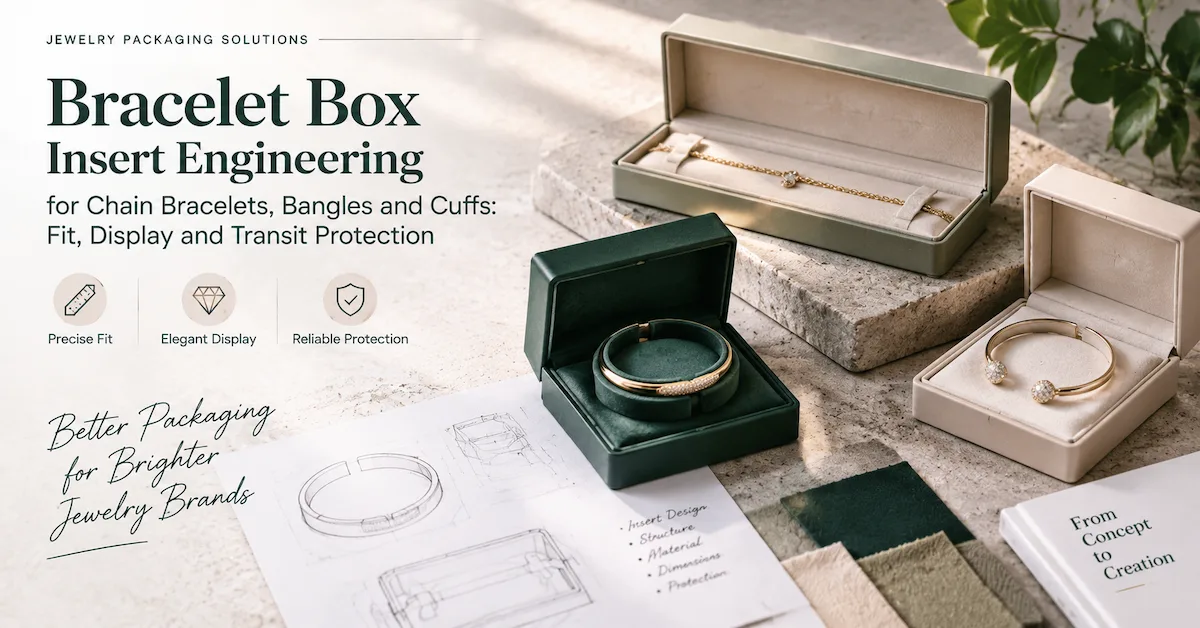
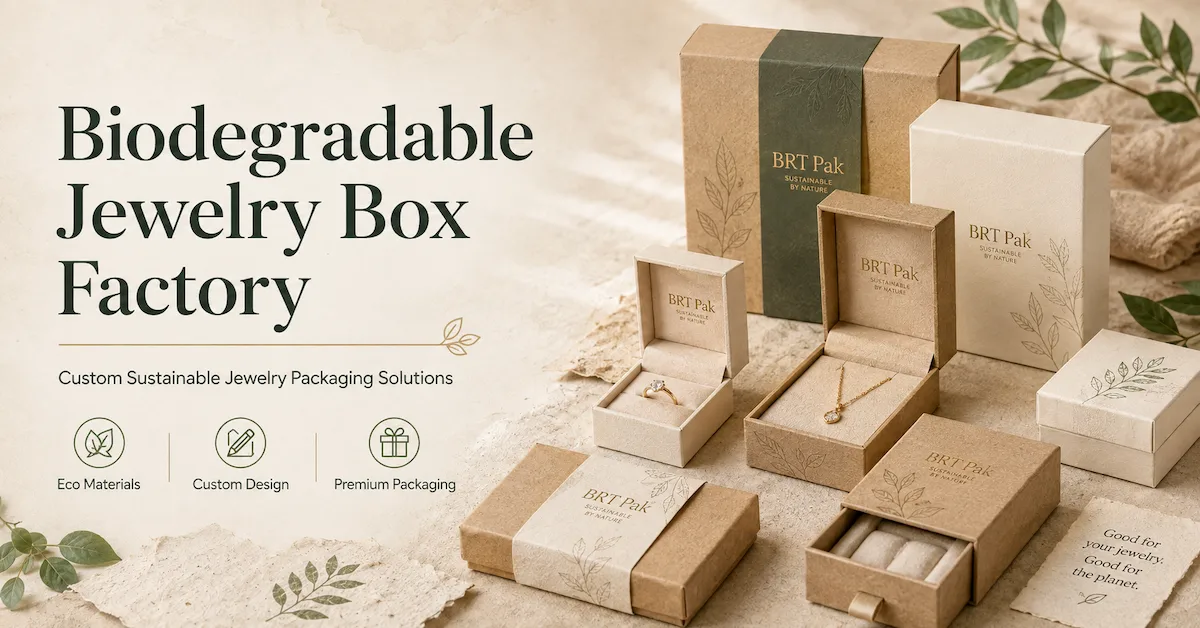
BRT Pak already manufactures paper-based jewelry packaging alongside other jewelry box formats. Buyers can explore its Jewelry Boxes and packaging products. The company also offers a paper jewelry box format with a drawer-style structure.
However, paper-based does not automatically mean fully biodegradable.
For example, the current paper jewelry box described on BRT Pak's site includes a soft internal lining and ribbon-pull construction. If a buyer requires a specific biodegradable or compostable claim, those components would need to be reviewed or redesigned rather than assuming the existing complete box meets that claim.
Molded Pulp Inserts
Molded fiber or pulp inserts can potentially replace some plastic or foam inserts in suitable projects.
They are particularly useful when:
- Product geometry is relatively simple
- A natural paper appearance fits the brand
- High cushioning softness is not required
- Material separation needs to be simplified
Jewelry packaging creates a special challenge because polished metals and gemstones often require a soft contact surface.
A molded paper insert therefore may work better for an outer support structure than as the only surface touching delicate jewelry.
Cellulose-Based Paper Wraps
Decorative papers can provide:
- Color
- Texture
- Printed patterns
- Brand graphics
- Natural fiber appearance
When biodegradability is an objective, buyers should ask whether the paper uses:
- Plastic lamination
- Heavy polymer coatings
- Metallic films
- Synthetic surface treatments
The finished package should be evaluated as a system.
Natural-Fiber Fabrics
Some brands may consider natural-fiber textiles for soft contact areas.
Possible options can include cotton or other fiber-based fabrics, but the environmental performance depends on:
- Fiber composition
- Dye chemistry
- Finishing treatment
- Adhesive
- Backing layer
- Actual disposal conditions
“Natural” should therefore not automatically be translated into “biodegradable packaging.”
Which Jewelry Box Components Create the Biggest Challenges?
The outer board is often the easiest part of the environmental design.
The internal components are usually harder.
Jewelry Inserts
Traditional jewelry packaging may use:
- PU foam
- EVA foam
- Synthetic velvet
- Microfiber
- Plastic trays
- Composite padding
These materials can provide excellent protection, but they may prevent a simple whole-box biodegradable claim.
Alternative structures can include:
- Folded paper inserts
- Molded pulp
- Corrugated paper
- Die-cut board
- Fiber-based cushions
The correct choice depends on jewelry type.
A ring requires different retention from a long necklace.
Magnets
Magnetic closures create a premium opening experience but introduce another material into the packaging.
For projects prioritizing simplified material construction, manufacturers can instead evaluate:
- Drawer structures
- Sleeve boxes
- Friction-fit lids
- Folded locking mechanisms
- Paper tabs
Ribbons
Ribbon pulls are popular in premium drawer boxes.
If the sustainability specification is strict, the ribbon composition should be included in the material review.
Foil and Metal Decorations
Luxury jewelry packaging frequently uses metallic branding.
Options such as foil stamping can deliver premium visual impact with relatively little decorative material, but buyers should still evaluate the complete finishing system against the project's end-of-life requirements.
How Can Sustainable Jewelry Packaging Still Look Luxury?
Reducing material complexity does not require making the packaging look inexpensive.
Luxury presentation is often created through proportion, texture, precision and restraint, rather than the number of materials used.
A premium paper jewelry box can use:
- High-quality textured paper
- Precise wrapped edges
- Controlled neutral colors
- Embossed logos
- Debossed logos
- Minimal foil stamping
- Custom drawer structures
- Precisely fitted paper inserts
- Branded sleeves
- Consistent Pantone colors
A minimalist construction can often reinforce a sustainable brand identity.
For jewelry brands, the goal should be:
less material complexity without sacrificing perceived value.
How Should a Factory Develop a Custom Biodegradable Jewelry Box?
A strong development process should begin before physical sampling.
BRT Pak describes its packaging business as integrating design, R&D, manufacturing and global logistics, with services including 3D visualization and OEM/ODM development.
Buyers can review its custom packaging development capabilities.
Step 1: Define the Environmental Objective
The buyer should first decide what the project actually needs.
For example:
- Increased paper content
- Reduced plastic
- Recyclable construction
- Certified fiber sourcing
- Industrial compostability
- Biodegradable components
- Reduced packaging volume
- Reusable jewelry storage
These are different objectives.
Trying to achieve all of them simultaneously can increase complexity and cost.
Step 2: Define the Jewelry Type
The manufacturer needs to know whether the package holds:
- Ring
- Earrings
- Pendant
- Necklace
- Bracelet
- Bangle
- Brooch
- Jewelry set
Each product requires different insert geometry.
Step 3: Develop the Structure
Possible formats include:
| Structure | Advantages | Suitable Applications |
|---|---|---|
| Lid-and-base | Simple and versatile | Rings, earrings, pendants |
| Drawer box | Premium opening experience | Jewelry gifts, DTC brands |
| Folding carton | Lower material use | Fashion jewelry |
| Sleeve box | Branding flexibility | Retail collections |
| Rigid paper box | Strong premium presentation | Higher-value jewelry |
| Folded-board box | Simplified construction | Sustainability-led projects |
Step 4: Select Every Component
Do not specify only:
“Recycled paper box.”
Specify:
- Outer paper
- Structural board
- Inner paper
- Insert
- Cushion
- Ribbon
- Adhesive
- Printing
- Logo finish
- Closure
This creates a much stronger RFQ.
How Can Brands Avoid Greenwashing?
This is one of the most important questions when working with a biodegradable jewelry box factory.
The FTC warns that environmental claims should be supported and properly qualified. Its Green Guides cover claims including degradable, compostable, recyclable and recycled content.
Instead of saying:
100% eco-friendly jewelry box
a brand should consider a more specific statement supported by evidence, such as:
Paper-based jewelry box with X% recycled fiber
or:
Packaging designed without a plastic foam insert
or an applicable certified claim when documentation supports it.
Specific claims are easier for buyers and consumers to understand and easier for brands to substantiate.
Questions Procurement Teams Should Ask
Ask your factory:
- What exactly is biodegradable?
- Is the claim for one component or the whole package?
- What test or standard supports the claim?
- Under what disposal conditions does degradation occur?
- Is industrial composting required?
- Does the box contain synthetic foam?
- Is the velvet synthetic?
- Is the paper laminated?
- Are magnets removable?
- What adhesive is used?
- Can the material specification be documented?
If these questions cannot be answered, the environmental claim may be too broad.
What Does the EU PPWR Mean for Jewelry Packaging Buyers?
Packaging regulation is increasingly influencing European sourcing decisions.
The EU Packaging and Packaging Waste Regulation, Regulation (EU) 2025/40, entered into force in February 2025 and generally applies from 12 August 2026. The European Commission states that the rules aim to reduce packaging waste, improve recyclability and limit unnecessary packaging.
Because it is now August 2026, European-market packaging buyers should treat PPWR considerations as a current sourcing issue rather than a distant future trend.
The European Commission also states that packaging is intended to become recyclable under the regulation's staged requirements, with broader recyclability objectives developing toward 2030.
This creates an important distinction:
Biodegradable packaging is not automatically the same as PPWR-compliant packaging.
A jewelry brand selling in Europe should evaluate:
- Packaging minimization
- Material composition
- Recyclability
- Labeling
- Applicable EPR obligations
- Restricted substances
- Market-specific implementation
- Documentation
Regulatory compliance should be verified for the specific packaging and destination market.
Biodegradable Jewelry Box vs Conventional Jewelry Box
| Factor | Biodegradable-Focused Paper Box | Conventional Luxury Jewelry Box |
|---|---|---|
| Material simplicity | Potentially higher | Often lower |
| Plastic reduction | Easier to prioritize | Depends on design |
| Luxury appearance | High with good design | Very high |
| Soft protection | Requires careful insert design | Often easier |
| Magnetic closures | May be minimized | Common |
| Multi-material decoration | Usually reduced | Common |
| End-of-life communication | Potentially clearer | More complex |
| Long-term storage | Depends on construction | Often strong |
| Cost | Depends on material and volume | Depends on materials/finishes |
| Best for | Sustainability-led brands | Maximum luxury presentation |
The right choice depends on the brand.
A low-impact DTC jewelry brand and a high-value diamond boutique may require completely different structures.
What Determines the Price of Biodegradable Jewelry Packaging?
There is no universal biodegradable jewelry box price.
The quotation depends on:
- Box dimensions
- Paper grade
- Board thickness
- Insert structure
- Certified material requirements
- Printing
- Logo process
- Number of colors
- Surface finishing
- Order quantity
- Assembly complexity
- Sampling
- Export packing
Certification and documentation requirements may also affect sourcing.
Compare Specifications, Not Just Unit Prices
Two factories may quote the same size box at very different prices because one quotation includes:
- Specialty paper
- Custom insert
- Embossing
- Better board
- Additional QC
- Protective export packing
while another uses a simplified structure.
Ask suppliers to quote against the same specification.
What Should Quality Control Include?
Sustainable packaging still needs to perform like packaging.
A box that crushes, opens during shipping or scratches the jewelry creates waste and commercial loss.
Incoming Material QC
Check:
- Paper reference
- Board thickness
- Color
- Surface quality
- Material documentation
Structural QC
Check:
- Dimensions
- Lid fit
- Drawer movement
- Corner strength
- Insert tolerance
- Product retention
Branding QC
Check:
- Logo position
- Embossing depth
- Print registration
- Foil consistency
- Color consistency
Final Packing QC
Check:
- Cleanliness
- Surface scratches
- Quantity
- Inner protection
- Master carton
- Carton dimensions
For international B2B projects, packaging quality should be assessed both as a retail package and a transport unit.
Why OEM/ODM Capability Matters
A standard stock box rarely achieves a brand's exact environmental and retail objectives.
OEM/ODM development allows buyers to modify:
- Material composition
- Size
- Box structure
- Insert
- Color
- Logo
- Printing
- Surface treatment
- Packaging volume
BRT Pak states that its services include design development, 3D visualization, prototyping, OEM/ODM production and global logistics.
For brands comparing sustainable packaging options, the existing Recycled Packaging Box Manufacturer Guide also provides useful background on recycled content, recyclability, material traceability and sourcing risk.
What Should You Send a Jewelry Box Factory for a Quote?
A detailed RFQ helps the supplier recommend a realistic structure.
Send:
- Jewelry type
- Product dimensions
- Target box size
- Order quantity
- Destination country
- Environmental objective
- Preferred paper or board
- Insert requirement
- Logo artwork
- Color reference
- Printing requirements
- Certification requirements
- Target price range
- Required delivery date
- Reference images
Do not simply write:
“Need biodegradable jewelry boxes. Please quote.”
Instead, provide a target such as:
“We need custom ring boxes for a European DTC jewelry collection. We want a primarily paper-based structure with reduced plastic components and need documentation for all environmental claims.”
That gives the manufacturer enough information to evaluate the project correctly.
Buyers can submit project details through the BRT Pak Contact Us page.
FAQ
What is a biodegradable jewelry box?
A biodegradable jewelry box is packaging whose applicable materials can be biologically broken down under defined conditions. Whether the term can be applied to the complete box depends on every component, including the board, liner, insert, adhesive, ribbon, coating and decorative elements.
Are all paper jewelry boxes biodegradable?
No. A paper outer shell may contain synthetic velvet, foam, plastic lamination, magnets, ribbons or other materials. The complete construction must be evaluated before making a whole-package biodegradable claim.
Is biodegradable the same as compostable?
No. Compostability generally refers to more specific conditions and performance requirements. ISO 18606 defines requirements for packaging recoverable through organic recycling, including biodegradation and disintegration criteria.
Can a biodegradable jewelry box still look luxurious?
Yes. Luxury appearance can be created through premium paper texture, precise construction, embossing, restrained foil stamping, custom colors and well-designed inserts rather than relying on complex plastic-based finishes.
What insert can replace plastic foam?
Depending on the jewelry type, manufacturers may evaluate folded paperboard, die-cut fiber board, molded pulp or other fiber-based structures. Delicate jewelry may still require a specially engineered soft contact layer.
Can I customize biodegradable jewelry boxes with my logo?
Yes. Paper-based packaging can support printing, embossing, debossing and selected foil processes. The branding method should be reviewed together with the desired environmental claim.
Does FSC certification mean the box is biodegradable?
No. FSC relates primarily to responsible forest-based sourcing and chain-of-custody claims. It does not by itself prove that a complete finished jewelry box is biodegradable or compostable.
How do I verify a factory's biodegradable claim?
Ask for material specifications, component lists, applicable test reports or certifications, the conditions under which degradation occurs and evidence supporting the exact claim you intend to make.
What affects the MOQ for custom biodegradable jewelry boxes?
MOQ can be influenced by specialty paper sourcing, printing processes, custom tooling, insert production, logo finishing, color matching and production setup. A project-specific quotation is more reliable than assuming one fixed MOQ.
Can BRT Pak develop custom sustainable jewelry packaging?
BRT Pak offers jewelry packaging plus design, prototyping and OEM/ODM services. However, a specific “biodegradable” claim should be determined from the final material specification and supporting evidence rather than assumed from the company's general packaging capabilities.
Conclusion
Choosing the right biodegradable jewelry box factory requires more than asking whether the manufacturer can make a paper box.
Professional sourcing should evaluate the entire structure:
outer material + board + insert + lining + adhesive + closure + printing + finishing + documentation.
For jewelry brands, the best solution must balance environmental objectives with product protection, premium presentation, manufacturing consistency, logistics and regulatory requirements.
Most importantly, avoid broad environmental claims that cannot be substantiated. A specific, documented claim about material composition or disposal pathway is usually more credible than simply describing a package as “100% eco-friendly.”
BRT Pak supports custom jewelry packaging development through product design, material selection, 3D visualization, prototyping and OEM/ODM production. Explore its custom packaging products, read additional packaging sourcing guides, or contact BRT Pak with your product dimensions, target quantity, material requirements and destination market to discuss a custom jewelry packaging project.