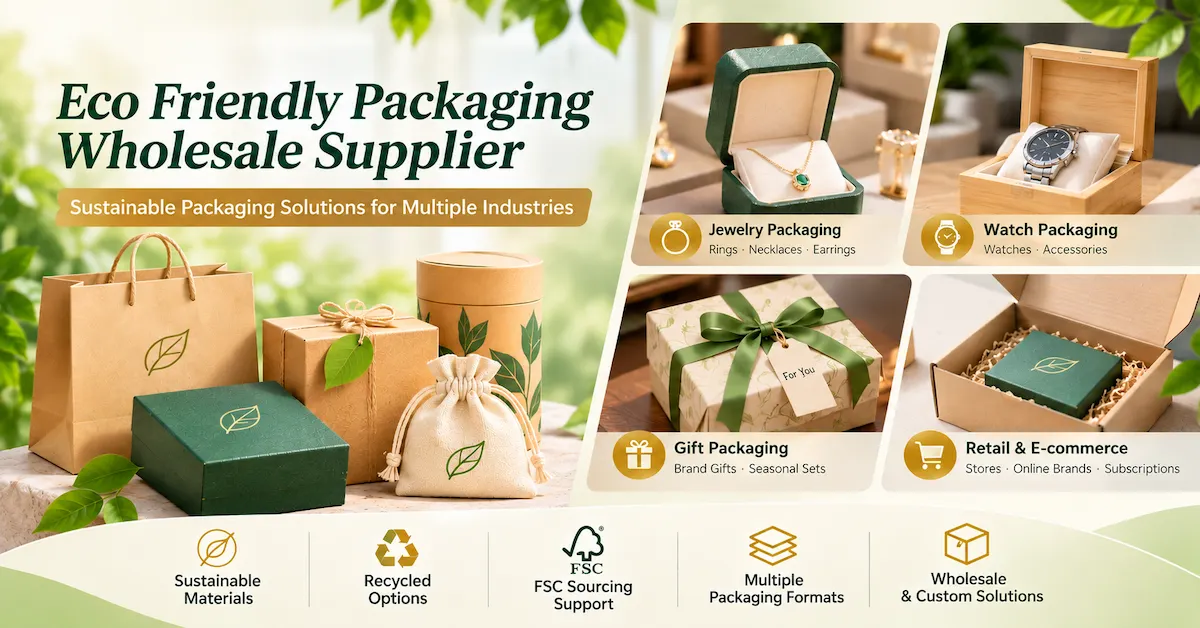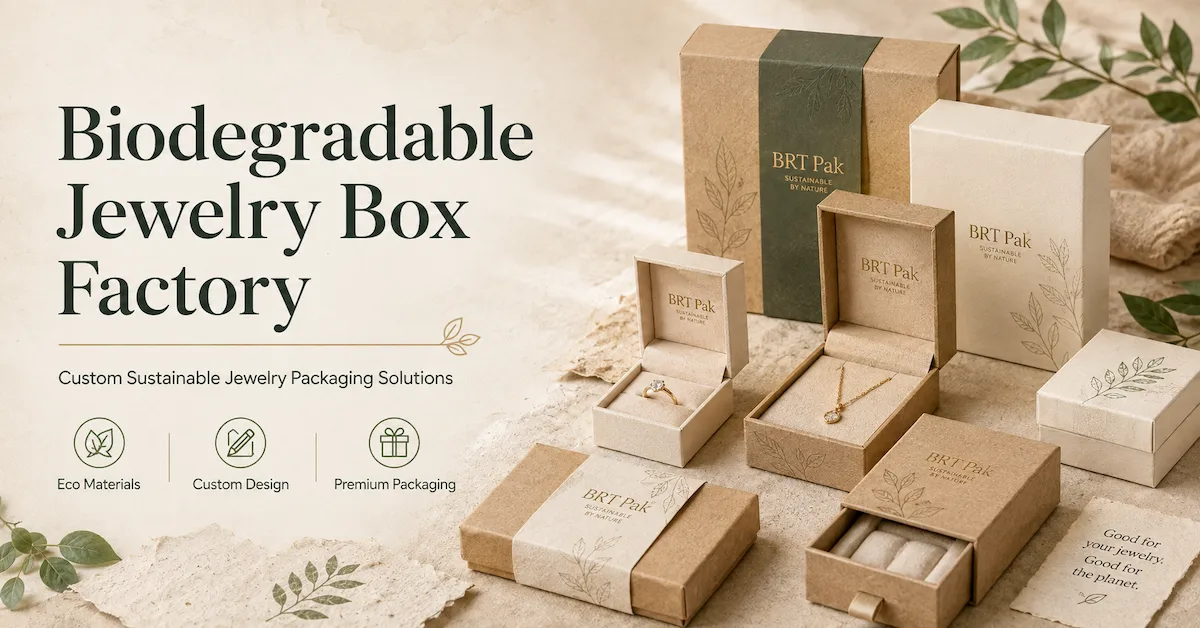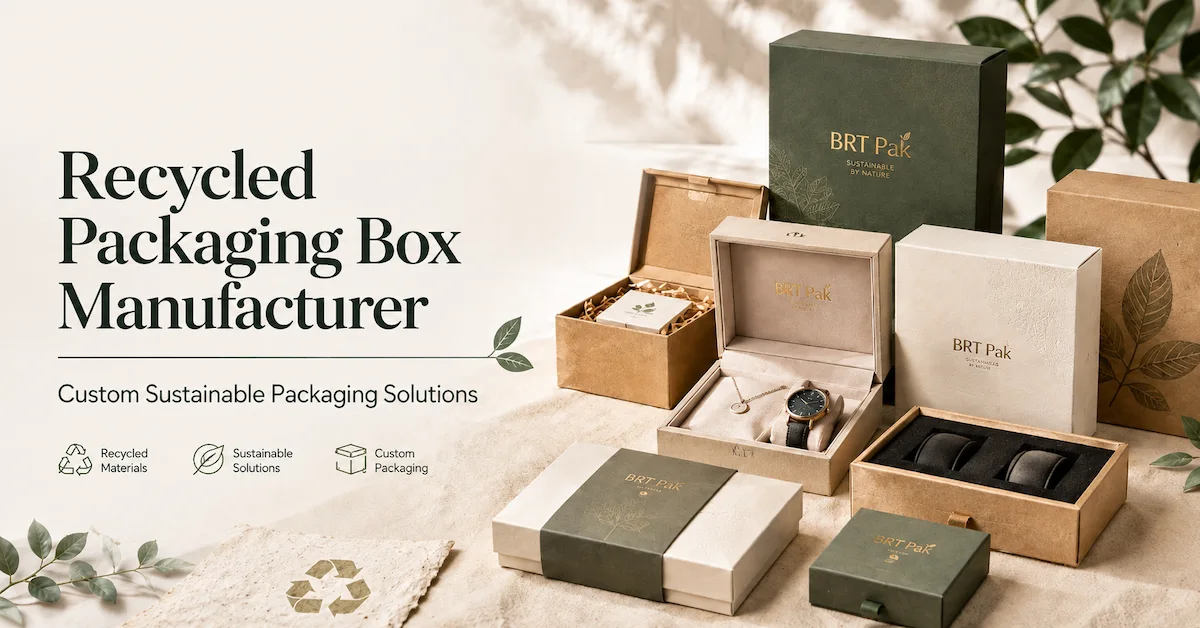

Quick Answer
A reliable eco friendly packaging factory should provide verifiable material specifications, relevant environmental documentation, suitable product protection, and consistent bulk production quality. Buyers should inspect every packaging component, confirm recycled-content or certification claims, approve physical samples, and compare MOQ, manufacturing controls, and delivery requirements. Environmental performance should be evaluated for the complete packaging system—not assumed from one material.
For jewelry brands, watch companies, gift businesses, and luxury retailers, choosing environmentally responsible packaging presents a commercial challenge.
Packaging must protect the product, reinforce brand identity, remain practical for international shipping, and support truthful environmental communication.
Yet a box described as sustainable, recyclable, or eco-friendly may contain several materials with different characteristics.
A rigid jewelry box, for example, can combine paperboard, decorative wrapping, textile lining, adhesives, magnets, ribbons, and synthetic inserts.
Evaluating only its exterior material provides an incomplete picture.
This guide explains how international B2B buyers can audit packaging suppliers, verify environmental claims, evaluate technical specifications, and make better decisions before placing wholesale orders.
Key Insights: Eco Friendly Packaging Factory Selection
| Evaluation Area | What Buyers Should Verify | Main Purchasing Risk |
|---|---|---|
| Material composition | Complete bill of materials | Hidden plastic or mixed-material components |
| Recycled content | Percentage, material source, supporting records | Unsupported recycled-content claims |
| FSC claims | Valid certification, relevant scope, transaction documents | Misleading certification statements |
| Recyclability | Complete construction and destination-market recycling routes | Incorrect whole-package claims |
| Packaging design | Dimensions, inserts, material efficiency | Excess material or insufficient protection |
| Manufacturing quality | Samples, workmanship, inspection requirements | Bulk products differing from approved samples |
| Commercial terms | MOQ, price, sample charges, production milestones | Unexpected sourcing costs |
| Repeat orders | Approved specifications and change controls | Material or appearance inconsistency |
Key Takeaways
- Environmental claims require evidence. A natural-looking material does not automatically make the complete package environmentally preferable.
- The complete construction matters. Linings, adhesives, decorative finishes, and inserts may affect recycling and disposal options.
- Recycled content and recyclability are different. One describes material origin; the other concerns the available end-of-life pathway.
- Certified sourcing must be verified. Buyers should check the relevant company, product scope, and transaction documents.
- Protection cannot be ignored. Packaging that fails to protect valuable products may create additional replacement and transportation impacts.
- A sample is not a production guarantee. Bulk orders require documented specifications and suitable inspection arrangements.
1. What Should an Eco Friendly Packaging Factory Actually Prove?
A professional packaging supplier should demonstrate more than the ability to produce a box from paper or another material associated with environmental benefits.
It should explain what the product contains, which environmental attributes can be substantiated, and how the approved configuration will be reproduced.
Material Transparency
A buyer should be able to identify the structural body, exterior covering, interior lining, insert, closure, adhesives, and decorative accessories.
The supplier does not necessarily need to disclose commercially confidential formulations, but it should provide enough information to evaluate relevant material claims and technical requirements.
Relevant Environmental Evidence
Different claims require different types of evidence.
A recycled-content claim requires support for the stated content. An FSC claim requires applicable certification and supply-chain documentation. A recyclability claim requires consideration of the finished packaging and relevant collection and processing systems.
A single document cannot necessarily support every environmental statement.
Manufacturing Accountability
Ask which operations are performed by the supplier and which involve external manufacturing partners.
The most important issue is who controls material approval, production consistency, quality inspection, and corrective action.
This distinction is particularly relevant when purchasing complex jewelry or luxury gift packaging.
When Is This Type of Supplier Suitable?
An eco-focused packaging project may be appropriate for jewelry brands redesigning their retail boxes, private-label companies reducing unnecessary packaging components, and gift businesses seeking better material documentation.
However, buyers should not force a paper-only design into an application where it cannot adequately protect the product.
The correct approach is to define functional requirements and environmental objectives together.
2. How to Audit an Eco Friendly Packaging Factory Before Ordering
Supplier evaluation should use a consistent checklist rather than relying on promotional descriptions.
Packaging Factory Audit Checklist
| Audit Question | Evidence to Request | Warning Sign |
|---|---|---|
| What is the complete material construction? | Component-level specification | Only a generic description such as “eco paper” |
| What recycled content is claimed? | Material percentage and supporting records | No defined percentage or material |
| Is FSC certification relevant? | Certificate details, scope, and product claim | Logo shown without verifiable details |
| What supports recyclability claims? | Construction details and destination-market assessment | “100% recyclable everywhere” |
| Can product dimensions be customized? | Drawings and prototype process | No technical review |
| How is bulk quality controlled? | Inspection criteria and approval records | Quality described only as “excellent” |
| Are materials consistent between orders? | Material references and change-control procedure | Substitutions without approval |
| What is included in the quotation? | Itemized commercial offer | Unclear inserts, decoration, or packing costs |
| How is export packing managed? | Unit protection and carton specifications | No packing plan |
| Who handles production problems? | Defined corrective-action responsibilities | No written resolution process |
Use a Three-Gate Supplier Approval Process
Gate 1: Evidence review. Confirm the packaging concept, material construction, and support for the proposed environmental claims.
Gate 2: Technical approval. Test representative samples for product fit, material quality, branding, and protection.
Gate 3: Commercial and production approval. Confirm the final specification, quantity, price, inspection criteria, and delivery responsibilities.
If the supplier cannot satisfy an essential requirement at one stage, resolve it before proceeding.
This approach helps prevent environmental claims from becoming disconnected from the packaging that is actually delivered.
3. Which Environmental Packaging Claims Need Independent Verification?
The term eco-friendly is broad. For purchasing purposes, it should be replaced or qualified by specific, supportable attributes.
The U.S. Federal Trade Commission's Green Guides advise marketers against broad, unqualified environmental benefit claims and explain how to substantiate and qualify particular claims.
Environmental Claim Verification Table
| Claim | What It Describes | What Buyers Should Request |
|---|---|---|
| Recycled content | Use of recovered material | Claimed percentage, component, and supporting evidence |
| Post-consumer recycled content | Material recovered after consumer use | Defined PCR percentage and sourcing records |
| Recyclable | Ability to enter an appropriate recycling system | Complete material construction and relevant local recycling information |
| FSC-certified | Applicable certified forest-based sourcing claim | Valid certificate, product scope, and transaction claim |
| Compostable | Suitability for specified composting conditions | Relevant test evidence, standard, and conditions |
| Biodegradable | Breakdown under specified environmental conditions | Evidence defining conditions, extent, and timing |
| Plastic-free | Absence of plastic within the defined product boundary | Complete component information |
| Reduced material use | Lower material usage against a defined baseline | Comparison method and measurements |
These claims are not interchangeable.
How Should Buyers Verify FSC Claims?
The Forest Stewardship Council operates an official FSC certificate search database.
Buyers can use it to check the certificate holder, status, and relevant certification scope.
However, confirming that a company holds an FSC certificate does not automatically establish that every packaging product purchased from that company carries an FSC claim.
For an order requiring FSC-certified packaging, request the applicable product specification, supplier information, and relevant sales documentation showing the correct claim.
Avoid Unsupported Whole-Package Claims
A paperboard shell with synthetic fabric lining should not automatically be described as a fully recyclable paper package.
Similarly, using bamboo for the outer structure does not establish the environmental attributes of its adhesives, coatings, or lining.
Ask exactly which component an environmental claim covers.
The strongest packaging claims are specific, understandable, and supported by evidence appropriate to the finished product.
4. Which Packaging Materials Should Buyers Compare?
A suitable material must meet functional requirements while supporting the buyer's documented environmental objectives.
Material Comparison for Jewelry and Gift Packaging
| Material or Construction | Potential Purchasing Benefit | Main Limitation to Evaluate | Common Application |
|---|---|---|---|
| Paperboard | Structured presentation and material options | Coatings, wrapping, adhesives, inserts | Jewelry and gift boxes |
| Recycled paperboard | Opportunity to specify recovered fiber | Actual content, stiffness, appearance | Custom rigid boxes |
| Kraft paper | Distinctive paper appearance | Actual fiber composition and finishing | Bags, wraps, retail packaging |
| Bamboo | Natural texture and distinctive design | Construction, coating, lining, source claims | Premium jewelry boxes |
| Wood-based structure | Substantial feel and potential for prolonged use | Weight, surface finish, sourcing evidence | Watch and jewelry presentation |
| Molded fiber insert | Potential alternative to some polymer inserts | Fit, surface contact, finish, availability | Protective internal supports |
| Textile pouch | Flexible storage and brand presentation | Fiber composition, durability, recyclability | Jewelry and accessory packaging |
These are general design possibilities, not a list of materials guaranteed to be available for every BRT PAK product.
Paperboard Packaging
Paperboard can offer a useful starting point for packaging development because it supports many structural and decorative formats.
However, buyers should specify more than the term paper box.
Important details include board thickness, fiber content, wrapping paper, surface coating, adhesive, and insert construction.
A paper-based box with permanent mixed-material components requires a different end-of-life assessment from a simpler paper construction.
Bamboo and Wood-Based Packaging
Bamboo and wood-based designs can provide distinctive presentation and may be appropriate for packaging intended to be retained and reused.
However, natural materials should not automatically be treated as proof of lower total environmental impact.
Sourcing documentation, finishing, weight, durability, and intended use should all be considered.
Protective Inserts and Linings
Jewelry and watches often need soft contact surfaces.
Replacing a textile insert with paper or molded fiber may change product fit, abrasion behavior, and presentation.
Before approving a substitution, test representative products against the new insert.
An environmentally motivated design change must still satisfy the agreed protection requirements.
5. Why Does the Complete Packaging Structure Matter?
The physical construction of a finished box can affect material consumption, separation, recyclability, and product protection.
This is especially important for luxury packaging because several materials are often combined for presentation.
BRT PAK Product Example: Paper Jewelry Box
BRT PAK's Paper Jewelry Box features a drawer-style structure, satin ribbon pull, and soft interior lining.
It illustrates an important purchasing distinction.
Although the main structure is paper-based, a buyer evaluating recyclability should also review the ribbon, lining, adhesives, and decorative components.
The product description alone does not establish the recyclability of the complete finished box.
BRT PAK Product Example: Bamboo Jewelry Box
The JBW190 Bamboo Jewelry Box combines bamboo construction with microfiber lining.
Its material combination may be attractive for jewelry presentation, but buyers should separately verify any claimed sourcing or environmental attributes.
These product examples demonstrate why environmental assessment should extend beyond the visible exterior.
Consider Material Separation
Where practical, buyers can discuss whether inserts, ribbons, or other components can be removed separately.
The benefit depends on the complete design and the available disposal systems.
A removable component may simplify a particular recovery pathway, but it does not automatically make the entire package recyclable.
6. What Technical Specifications Should Sustainable Packaging Buyers Confirm?
A useful technical specification combines environmental requirements with the performance characteristics that the packaging must achieve.
Technical Specification Checklist
| Specification | What to Define | Approval Method |
|---|---|---|
| External dimensions | Finished length, width, height | Measured sample |
| Usable internal space | Space after insert and lining installation | Product-fit test |
| Structural material | Board or other construction | Approved material specification |
| Environmental attribute | Exact claimed content or certification | Applicable supporting documentation |
| Exterior covering | Material, finish, and color | Physical sample |
| Insert | Geometry, material, product-contact surface | Representative product test |
| Decoration | Logo, printing, foil, coating | Approved artwork and sample |
| Closure | Drawer, lid, hinge, or other mechanism | Functional inspection |
| Individual protection | Wrapping and separators | Packed-unit review |
| Master cartons | Quantity, dimensions, and protection | Approved packing configuration |
Avoid Excessive Packaging Without Reducing Protection
Material efficiency can be considered through dimensions, wall thickness, inserts, and shipment arrangement.
However, lighter packaging is not always suitable.
If the packaging fails to protect high-value products, additional replacements and shipping may be required.
Buyers should validate the actual design rather than assume that the lightest construction is preferable.
Evaluate Real Distribution Conditions
Retail presentation and international parcel delivery are different applications.
A jewelry presentation box may require an outer shipping carton and additional protective materials during fulfillment.
When transit testing is appropriate, establish the actual package configuration, test conditions, and acceptance criteria.
7. How Can Buyers Control Environmental Quality During Bulk Production?
An approved sample establishes what the factory should produce.
Production quality control evaluates whether the finished order matches that specification.
Recommended Production Inspection Stages
Incoming material verification: Check the approved material type, appearance, specification, and applicable documentation.
First-article inspection: Review early production units for dimensions, construction, insert position, and decoration.
In-process inspection: Monitor wrapping, adhesive application, assembly, and visible workmanship.
Final inspection: Check the agreed dimensions, functionality, cosmetic requirements, quantity, and packing.
Shipment documentation review: Confirm the identification and supporting records required for the purchased configuration.
Control Material Substitutions
A supplier might propose an alternative paper, board, lining, or adhesive because of procurement availability.
Such changes should not be treated as automatically acceptable.
A replacement may affect appearance, product protection, cost, or environmental claims.
Require written approval for changes that affect the agreed specification.
Maintain Traceability Where Required
If the purchase relies on a documented recycled-content or certified sourcing claim, agree on which records must accompany the relevant transaction.
Ask how the supplier connects material declarations to the product actually supplied.
The level of traceability should match the claim and the buyer's contractual requirements.
8. How Do MOQ, Lead Time, and Costs Affect Eco Packaging Orders?
Choosing an eco friendly packaging factory also involves commercial evaluation.
Custom materials, finishes, inserts, and documentation requirements may influence production quantities and pricing.
There is no universal MOQ or unit price for sustainable jewelry and gift packaging.
Main Cost Factors
| Cost Factor | Why It Matters |
|---|---|
| Material specification | Different grades and sourcing requirements affect procurement |
| Recycled-content requirement | Material availability and documentation may vary |
| Box structure | Complexity affects tooling and assembly |
| Insert design | Product-specific support may require additional development |
| Printing and decoration | Finishes and setup affect cost |
| Order quantity | Setup costs may be distributed across different quantities |
| Quality requirements | Inspection and testing influence project scope |
| Export packing | Protection and carton configuration affect delivery expenses |
Compare Like-for-Like Quotations
Request each supplier's quotation against the same approved specification.
If a supplier proposes a different material, ask for the difference to be identified.
Do not compare a simple paper box directly with a multi-layer luxury box without accounting for structural and functional differences.
Confirm Production Milestones
Ask the supplier to distinguish design development, sample approval, material preparation, manufacturing, inspection, and shipment.
A quoted production period may begin only after the sample and commercial order are approved.
This is particularly important when specialized materials or new constructions are required.
9. Practical Buying Example: Redesigning a Jewelry Gift Box
Consider a hypothetical jewelry brand that currently uses a rigid presentation box with decorative wrapping, a textile lining, and a synthetic insert.
The brand wants to reduce unnecessary packaging materials while preserving its established retail appearance.
This is an illustrative procurement scenario, not a verified BRT PAK customer project.
Option A: Retain the Existing Premium Structure
The supplier evaluates whether the board specification, overall dimensions, or individual shipping protection can be optimized.
This option prioritizes continuity of appearance and functionality.
Option B: Develop a Simpler Material Configuration
The supplier proposes an alternative box structure and insert, with fewer mixed-material components where technically feasible.
The buyer evaluates product contact, jewelry retention, decorative quality, assembly, and end-of-life considerations.
Option C: Use a Reusable Presentation Format
For a product positioned as a long-term keepsake, the buyer may evaluate a durable box intended for continued storage.
The project must still consider material sourcing, construction, realistic reuse, and cost.
How Should the Buyer Decide?
Compare each option using the same criteria: product protection, material composition, evidence supporting environmental claims, appearance, MOQ, total purchasing cost, and repeat-order feasibility.
No option should be described as environmentally superior without an appropriate basis for comparison.
The objective is a documented decision—not an unsupported percentage reduction or marketing promise.
10. Why Consider BRT PAK for Custom Packaging Development?
BRT PAK / Better Industrial, operated by Jinhua Better Industrial Co., Ltd., publishes information about packaging design, research and development, manufacturing, and international logistics coordination.
Its company profile describes a development process involving requirement confirmation, design sketches, product prototypes, material selection, sample confirmation, and logistics planning.
These activities are relevant to buyers evaluating alternative packaging materials and structures.
BRT PAK's product portfolio includes jewelry boxes, watch-related packaging, gift boxes, display products, and bags.
For projects involving environmentally focused materials, buyers should ask which specific materials, design adaptations, and supporting documents are available for their selected product.
The company publicly references certifications and environmental positioning, but the validity, scope, and applicability of any specific claim should be confirmed for the transaction.
What Can Buyers Discuss With BRT PAK?
A project inquiry may cover paperboard construction, alternative materials, interior supports, surface decoration, logo application, sample development, and export packing.
The company can review the buyer's requirements and discuss suitable options within its available development scope.
For more detailed information about recycled-content packaging, buyers can also read BRT PAK's Recycled Packaging Box Manufacturer Guide.
11. What Should Buyers Include in an Eco Packaging RFQ?
An RFQ should establish the product requirements and define the environmental objective clearly.
Recommended RFQ Information
- Product category and dimensions.
- Preferred box structure and design reference.
- Quantity by packaging size and SKU.
- Destination market and intended sales channel.
- Target material composition.
- Recycled-content requirement, if applicable.
- FSC or other certification requirements, where relevant.
- Interior insert and product-protection requirements.
- Logo artwork and finishing preferences.
- Required environmental evidence.
- Sampling and quality-acceptance requirements.
- Target production and delivery milestones.
Example Inquiry for B2B Buyers
We are developing custom jewelry packaging for an international retail collection.
We would like to evaluate paper-based and alternative material constructions while maintaining a premium presentation and suitable jewelry protection.
Please review our product dimensions, reference designs, estimated quantities, and branding artwork.
We would appreciate proposed packaging structures, complete material specifications, available recycled-content or certified sourcing documentation, MOQ by configuration, sampling requirements, quality-control arrangements, and an itemized quotation.
Please identify which environmental claims can be substantiated for the proposed finished packaging.
A detailed request helps the supplier recommend a feasible solution instead of relying on a vague instruction such as “make the box more eco-friendly.”
Frequently Asked Questions
1. What Is an Eco Friendly Packaging Factory?
An eco friendly packaging factory is a supplier offering packaging solutions with specific environmental attributes, such as documented recycled content, applicable certified sourcing, or material-efficient design. Buyers should assess these attributes individually rather than treating the description as proof of overall environmental superiority.
2. How Can I Verify a Sustainable Packaging Manufacturer?
Request complete material specifications, relevant environmental documentation, representative samples, and information about manufacturing and inspection controls. Verify any applicable certification using the issuing organization's official resources and confirm that the claim covers the purchased product.
3. Is Recycled Packaging the Same as Recyclable Packaging?
No. Recycled packaging contains recovered materials. Recyclable packaging concerns the ability to collect and process the product or package through an appropriate recycling system. A finished box can contain recycled paper while still having components that complicate its recycling.
4. Does FSC Certification Mean a Jewelry Box Is Recyclable?
No. FSC certification addresses defined forest-based sourcing and chain-of-custody requirements. It does not automatically establish the recyclability of a finished box containing multiple materials. Buyers should assess the relevant FSC claim and recycling characteristics separately.
5. Are Bamboo Jewelry Boxes More Sustainable Than Paper Boxes?
Not necessarily. Environmental comparisons depend on sourcing, processing, materials, weight, durability, transportation, intended use, and disposal conditions. Buyers should avoid broad superiority claims without appropriate comparative evidence.
6. Can Luxury Jewelry Packaging Use Recycled Paperboard?
It may be possible, depending on the selected board, structure, finishing, and product requirements. Buyers should test stiffness, appearance, dimensional consistency, product protection, and assembly quality using representative samples.
7. What Is the MOQ for Custom Eco Packaging?
MOQ depends on the selected construction, material procurement, decoration, quantity, and supplier production arrangements. Different colors, sizes, or material configurations may have separate requirements. Request a project-specific quotation.
8. How Can Brands Reduce Plastic Components in Jewelry Packaging?
Review inserts, windows, coverings, laminations, and other accessories. Ask the supplier to propose technically suitable alternatives and test the resulting packaging for product fit, protection, and presentation. Any environmental claim should reflect the actual finished construction.
9. How Do I Prevent Greenwashing in Packaging Procurement?
Require precise environmental statements, define the component or product covered, and request appropriate supporting evidence. Avoid unqualified claims such as “100% sustainable” when the complete environmental impact has not been established.
10. How Can I Request Eco-Focused Custom Packaging From BRT PAK?
Prepare your product dimensions, desired structure, material preferences, environmental requirements, artwork, estimated quantity, and destination market. Review the BRT PAK packaging portfolio and contact the team to discuss available options and supporting documentation.
Conclusion
Choosing an eco friendly packaging factory requires a disciplined purchasing process that connects environmental evidence with practical manufacturing requirements.
For jewelry, watch, gift, and premium retail brands, the most important question is not whether a supplier describes its packaging as green or sustainable. It is whether the proposed product has documented material attributes, meets functional requirements, and can be manufactured consistently at the agreed commercial scale.
Buyers should evaluate the complete packaging construction, verify applicable environmental claims, approve physical samples, and establish clear production and quality-control arrangements.
They should also compare MOQ, costs, export packing, and future replenishment requirements before selecting a supplier.
BRT PAK / Better Industrial provides packaging products and publicly describes design-development, material-selection, sampling, and logistics services relevant to custom packaging projects.
Explore the BRT PAK Jewelry Boxes collection or contact BRT PAK with your material requirements, product dimensions, artwork, estimated quantities, and destination market.
A well-documented packaging specification helps buyers move from broad environmental ambitions to a practical, verifiable, and commercially manageable sourcing decision.