
Quick Answer
A qualified eyewear packaging factory should demonstrate consistent case construction, suitable interior protection, reliable opening mechanisms, and controlled finishing quality. Before bulk approval, optical brands should verify component specifications, inspect representative samples, establish acceptable workmanship standards, and confirm export packing. Multi-compartment eyewear boxes require particular attention to divider alignment, lining cleanliness, transparent lids, and closure performance.
For optical brands, sunglasses companies, packaging importers, and private-label accessory businesses, the challenge is not simply finding an attractive eyewear case.
The finished product must maintain its intended appearance and function across a commercial order.
A storage box may look excellent in a supplier's catalog but show uneven stitching, misaligned compartments, adhesive residue, or surface scratches in production.
These problems can affect retail presentation, customer satisfaction, and the usable quantity received.
This guide explains what buyers should inspect inside an eyewear packaging production process, how to evaluate quality-control evidence, and which acceptance and shipping requirements should be agreed before ordering.
Key Insights: Eyewear Packaging Factory Quality Checklist
| Inspection Area | Potential Problem | Recommended Verification |
|---|---|---|
| Structural body | Warping, uneven corners, dimensional variation | Approved drawings and dimensional checks |
| Exterior covering | Wrinkles, lifting edges, surface marks | Material and workmanship inspection |
| Decorative stitching | Uneven spacing, loose threads | Visual reference and seam inspection |
| Interior lining | Adhesive stains, wrinkles, loose fibers | Cleanliness and finish checks |
| Compartments | Misaligned or unsecured dividers | Position, retention, and dimensional checks |
| Hinged lid | Poor alignment or inconsistent closing | Opening and closing inspection |
| Transparent panel | Scratches, chips, contamination | Surface and edge inspection |
| Branding | Incorrect logo position or finish | Approved artwork and physical sample |
| Export packing | Abrasion, compression, transit damage | Packing specification and appropriate testing |
Key Takeaways
- Factory quality is determined by the finished assembly. Attractive individual materials cannot compensate for poor workmanship.
- A six-slot eyewear organizer has more inspection points than a basic single-pair case. Dividers, lining, hinges, and transparent surfaces must work together.
- Cosmetic and functional defects should be distinguished. A minor surface variation is different from a lid that cannot close properly.
- Production samples require documented approval. A photograph or verbal confirmation is not sufficient for every technical requirement.
- Transport protection should match the actual shipment. Retail storage packaging and export cartons serve different purposes.
- Supplier selection should emphasize evidence. Buyers should evaluate specifications, samples, inspection procedures, and commercial responsibilities.
1. What Should an Eyewear Packaging Factory Provide?
An eyewear packaging factory should be evaluated on its ability to deliver products that meet agreed construction, appearance, protection, and commercial requirements.
For a custom project, this may involve structural design, material selection, prototype development, branding, manufacturing coordination, quality inspection, and export preparation.
The actual service scope varies between suppliers.
Who Needs Factory-Level Quality Evaluation?
Factory-level evaluation is particularly important for premium eyewear brands, retail chains, importers, and private-label businesses purchasing customized packaging.
A buyer sourcing an existing organizer may need to confirm product conformity and export protection.
A brand developing a new case structure may also require technical drawings, prototypes, material approval, and design revisions.
When Is a Simple Catalog Purchase More Appropriate?
A standardized existing product may be sufficient when it meets the required function and appearance without extensive customization.
However, buyers should still confirm the product configuration, quantity, packing, and condition of the finished goods.
The purpose of manufacturing evaluation is to match the inspection effort to the actual purchasing risk.
2. Which Components Determine Eyewear Box Quality?
Eyewear packaging performance depends on the interaction between its structural body, surface materials, interior support, and opening mechanism.
BRT PAK Eyewear Box: A Real Product Reference
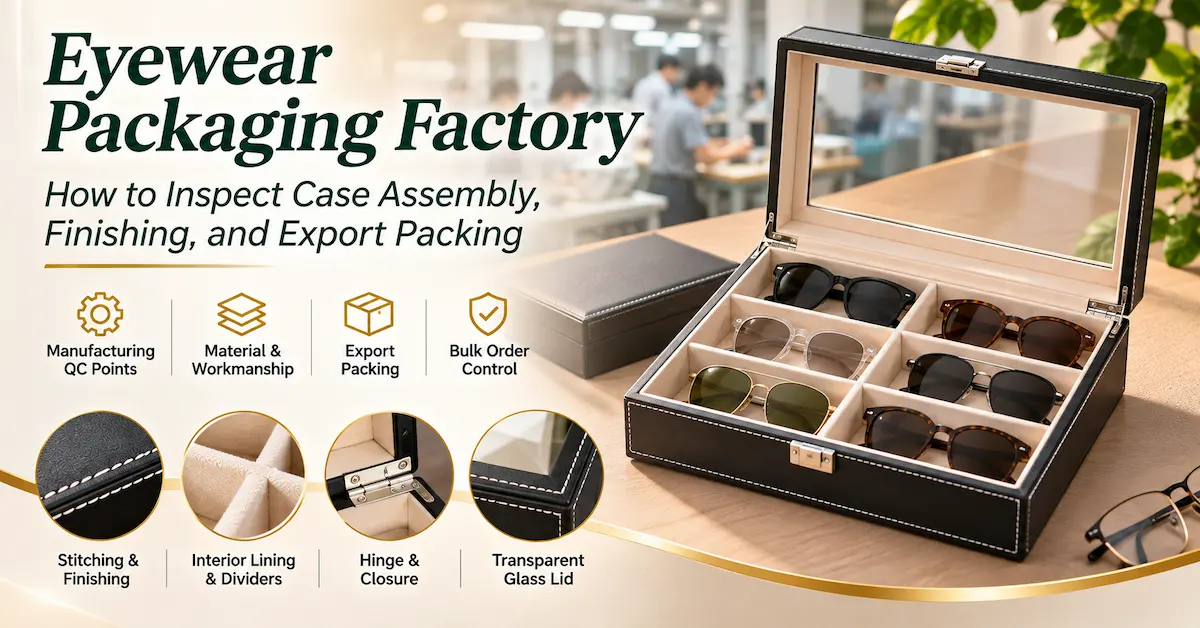
BRT PAK / Better Industrial publishes an Eyewear Box featuring a black faux-leather exterior, white contrast stitching, a hinged transparent glass lid, a cream-colored soft lining, and six individual compartments.
This published configuration provides a useful reference for discussing multi-pair eyewear storage manufacturing.
It is primarily a collection and presentation format, rather than proof that the company offers every possible single-pair optical case construction.
Structural Body and Exterior Covering
The body establishes the box's shape and supports its lid and internal compartments.
The exterior covering provides the visible texture and finish.
Buyers should inspect corner alignment, covering tension, edge finishing, and any areas where the material is folded or joined.
A premium-looking surface should remain consistent across the approved production range.
Transparent Panel and Hinge
A transparent lid introduces additional inspection requirements.
Buyers should check panel condition, visible scratches, edge finishing, hinge attachment, and alignment.
The closing mechanism should function without causing unwanted contact with the stored eyewear.
Lining and Dividers
The lining forms the product-contact surface.
Its cleanliness, adhesion, and finish can affect eyewear presentation.
Internal dividers should maintain their intended position and provide the space defined by the approved design.
Where several frame sizes are intended for one organizer, compatibility should be evaluated using representative products.
3. What Manufacturing Stages Should Buyers Inspect?
A useful factory inspection plan follows the product from material approval through finished assembly.
The stages below are recommended inspection points, not claims that every BRT PAK product is made using identical processes or equipment.
Stage 1: Incoming Material Verification
Check whether the structural material, covering, lining, and decorative components match the approved specification.
Material color names alone may be insufficient. Use physical references and agreed acceptance criteria where appearance is critical.
Stage 2: Structural Forming and Assembly
Review body dimensions, corner geometry, panel positioning, and basic structural stability.
An error in the underlying structure may be difficult to correct after decorative materials are applied.
Stage 3: Exterior Covering and Stitching
Inspect covering alignment and visible workmanship.
For a design using decorative stitching, check spacing, thread appearance, loose ends, and visible inconsistencies against the approved sample.
Not every eyewear case uses stitching, so the inspection checklist should reflect the selected construction.
Stage 4: Interior Lining and Divider Installation
Check that the lining is clean and positioned correctly.
Inspect divider alignment, attachment, compartment geometry, and any visible adhesive residue.
For multi-slot designs, evaluate the assembled interior rather than individual divider parts alone.
Stage 5: Lid and Closure Assembly
Verify that the lid aligns correctly and opens and closes as intended.
Where a transparent panel is used, check its surface and attachment.
The required functional checks should be defined for the specific construction.
Stage 6: Final Appearance and Packing
Confirm the complete product's dimensions, visible finish, functionality, logo application, quantity, and protective packing.
The finished product should be evaluated against the approved specification, not against a different catalog version.
4. Which Technical Specifications Should Optical Buyers Approve?
A complete technical specification should identify both the finished eyewear box and the features essential to its intended use.
Eyewear Packaging Technical Specification Table
| Specification | Buyer Requirement | Verification Method |
|---|---|---|
| External dimensions | Finished length, width, height | Dimensional inspection |
| Usable compartment space | Space available after lining installation | Measurement and representative frame check |
| Structural body | Approved construction and materials | Material and assembly review |
| Exterior covering | Material, color, and finish | Approved physical reference |
| Stitching | Location and visual requirements, if applicable | Workmanship inspection |
| Interior lining | Material and finish | Visual and product-contact review |
| Divider system | Number, location, and attachment | Assembly inspection |
| Transparent lid | Approved panel material and appearance | Surface and edge inspection |
| Hinge and closure | Intended operation and alignment | Functional checks |
| Branding | Artwork, position, size, and finish | Decorated sample |
| Individual packing | Protective wrapping and separation | Packed-unit inspection |
| Master carton | Quantity, dimensions, and identification | Packing-list verification |
Why Usable Interior Space Matters
Exterior dimensions do not indicate the full usable compartment volume.
Structural walls, dividers, and soft linings reduce the available space.
Buyers should evaluate the completed product with actual representative eyewear.
This is particularly important for oversized sunglasses, frames with projecting details, or designs that require a specific storage orientation.
Set Acceptance Limits Before Production
Where dimensions are critical, the buyer and supplier should agree on the nominal measurements, acceptable variation, and inspection method.
It would be misleading to assign one universal dimensional tolerance to every eyewear box.
The appropriate acceptance criteria depend on materials, construction, intended function, and the agreed specification.
5. Which Manufacturing Defects Matter Most?
Eyewear packaging defects should be classified according to their consequences.
A functionally unusable closure is different from a small cosmetic inconsistency.
Common Defect Categories
| Potential Defect | Main Consequence | Inspection Priority |
|---|---|---|
| Lid cannot close as intended | Functional failure | Critical to acceptance |
| Damaged transparent panel | Product safety or usability concern | High |
| Divider moves or separates | Reduced product support | High |
| Interior contamination | Presentation or product-contact concern | High |
| Incorrect dimensions | Product incompatibility | High |
| Misplaced logo | Branding nonconformity | Based on agreed criteria |
| Uneven decorative stitching | Appearance inconsistency | Based on agreed criteria |
| Minor surface variation | Cosmetic inconsistency | Based on approved tolerance |
These are examples of potential defect severity, not a substitute for an agreed inspection classification.
Evaluate Surface Quality Under Defined Conditions
When appearance is important, agree on reasonable viewing conditions and approved references.
A supplier and buyer may otherwise disagree about the visibility of scratches, marks, or material variation.
Inspect Functional Components Separately
The hinge, lid, and compartment structure should be checked for their intended functions.
A case should not pass final acceptance merely because its decorative finish appears correct.
Likewise, functional quality does not excuse unacceptable visible defects on premium retail packaging.
6. How Do Different Eyewear Packaging Constructions Compare?
Packaging structures create different manufacturing and inspection requirements.
Eyewear Packaging Construction Comparison
| Packaging Format | Main Advantage | Important Inspection Area | Common Application |
|---|---|---|---|
| Single-pair rigid case | Individual eyewear storage | Closure and internal clearance | Retail eyewear |
| Foldable case | Compact storage when empty, depending on design | Folding geometry and material wear | Portable accessories |
| Soft eyewear pouch | Lightweight, flexible format | Seams, material, closure | Travel and accessories |
| Multi-slot organizer | Stores several pairs separately | Dividers and compartment consistency | Collectors and premium retail |
| Transparent-lid display box | Visible product presentation | Panel condition and lid alignment | Showroom and gift presentation |
These are general industry packaging formats.
BRT PAK's published six-compartment Eyewear Box is a confirmed product reference. Availability of other constructions, dimensions, materials, and customization arrangements should be checked directly.
For the full related product range, buyers can review BRT PAK Eyewear & Watch Boxes.
7. How Should Buyers Approve Samples and Inspect Bulk Production?
An effective quality-control plan connects the buyer's approved design to actual production.
Approve a Representative Golden Sample
The golden sample should represent the agreed construction, materials, finish, lining, closure, and branding.
It should be associated with a written specification and artwork revision.
Review Initial Production Units
Early production inspection can identify recurring assembly or finishing problems before a large quantity has been completed.
The buyer and supplier should agree on the appropriate timing and inspection scope.
Conduct In-Process Checks
Review important characteristics while production is underway.
For a multi-compartment box, these may include covering quality, divider attachment, lining, hinge alignment, and surface finish.
Define Final Inspection Requirements
Finished-product inspection should cover agreed functional, dimensional, and cosmetic criteria.
Where an acceptance sampling method is used, the sampling plan, defect classifications, and acceptance thresholds should be agreed in advance.
Sampled inspection provides evidence about the inspected lot but does not guarantee that every unit is free from defects.
Record Corrective Actions
If recurring defects occur, identify their likely cause and establish how corrections will be verified.
For repeat orders, retain the approved specification and relevant change records.
8. How Can Buyers Verify Eyewear Packaging Export Protection?
Export packing should protect the finished packaging during handling, storage, and transportation.
The transport package is not necessarily the same as the retail box.
A premium eyewear display box may require individual protection and a suitable master carton, even when the product itself has a rigid structure.
Inspect Individual Protection
Confirm how finished boxes are separated or wrapped to reduce unwanted surface contact.
For products with glass or other transparent panels, consider the risks associated with the actual construction.
Select Transport Testing Based on the Distribution Route
The International Safe Transit Association explains that test selection should reflect the actual distribution environment.
For example, the ISTA guidance on selecting transport packaging tests discusses how shipping and handling conditions influence the appropriate testing approach.
ISTA Procedure 3A addresses certain individual packaged products distributed through parcel systems.
However, the appropriate test depends on the actual shipment and its intended distribution conditions.
Buyers should not assume that an eyewear case or a supplier has passed an ISTA test without the relevant test evidence.
Review Export Carton Marking
Where handling symbols are appropriate, ISO 780:2015 provides a reference for graphical symbols used on distribution packaging.
Symbols should be selected according to the actual handling requirements.
They do not replace suitable protective packing or demonstrate that the contents have passed transport testing.
Confirm Commercial Shipping Details
Request carton dimensions, gross weight, quantity per carton, labeling, protective materials, and the applicable delivery terms.
If the order contains several configurations, carton identification should clearly distinguish them.
9. How Do MOQ, Manufacturing Costs, and Production Schedules Affect Orders?
An eyewear packaging factory should provide a quotation based on the actual product and required quality standard.
Price comparisons are meaningful only when the quoted configurations are equivalent.
Main Cost Drivers
Commercial pricing may depend on body construction, exterior covering, stitching, lining, transparent panels, hinge components, logo decoration, order quantity, sampling, inspection, and export packing.
More complex structures can create additional assembly and inspection requirements, although actual costs must be established by quotation.
Ask for MOQ by Configuration
Different sizes, colors, materials, and decorations may have separate minimum quantities.
Do not assume one MOQ applies to every eyewear packaging design.
Confirm Production Milestones
Separate design development, sample approval, material preparation, production, inspection, and shipment preparation.
A quoted production period may begin only after final sample and commercial approval.
Review Total Delivered Cost
Compare the cost of receiving accepted, usable products rather than evaluating only the quoted unit price.
Inspection, packing, transport, import charges, and other applicable expenses may affect the final purchasing cost.
10. Practical Example: Approving a Six-Slot Eyewear Display Box
Consider a hypothetical premium eyewear retailer introducing a six-compartment storage box.
The buyer wants a dark exterior covering, contrasting decorative stitching, a transparent lid, and soft-lined compartments.
This is an illustrative purchasing example, not a verified BRT PAK customer order.
Step 1: Define the Product
The buyer identifies the intended eyewear types and the required compartment geometry.
Representative frames are used during sample evaluation.
Step 2: Confirm Visible Materials
The selected exterior covering, lining, thread appearance, and transparent panel are approved using representative samples.
Step 3: Inspect the Finished Prototype
The buyer checks divider alignment, lid operation, surface condition, interior cleanliness, and the approved dimensions.
Step 4: Establish Bulk Acceptance Criteria
The supplier and buyer agree on inspection checkpoints, relevant cosmetic requirements, and handling of nonconforming units.
Step 5: Review Shipment Protection
The buyer approves the individual protective arrangement and master-carton specification.
The expected distribution route is considered when deciding whether transport testing is necessary.
Practical result: The buyer has a defined product and inspection process rather than relying on the general promise of premium quality.
No numerical defect reduction or transport performance is assumed.
11. Why Consider BRT PAK for Custom Eyewear Packaging?
BRT PAK / Better Industrial, operated by Jinhua Better Industrial Co., Ltd., publishes information about packaging development, manufacturing, product prototypes, material selection, and international logistics coordination.
Its company profile outlines a process involving requirement confirmation, design sketches, physical prototypes, material selection, sample confirmation, and logistics preparation.
These activities are relevant to eyewear packaging projects that require approval of both appearance and functionality.
Review Its Published Eyewear Product
The company's six-compartment Eyewear Box provides a concrete reference for discussing premium storage products with exterior covering, decorative stitching, a transparent lid, and soft-lined compartments.
Buyers should confirm the current specification and available customization options for their intended order.
Request Project-Specific Manufacturing Information
For a custom eyewear packaging project, ask which structures are available, what development services can be provided, and how sample and bulk inspection requirements will be handled.
The exact production arrangements, MOQ, lead time, and quality documentation should be confirmed for the selected configuration.
12. What Should Buyers Include in a Factory Inspection RFQ?
An RFQ should help the supplier understand both the product to be supplied and the evidence required before shipment.
Recommended RFQ Checklist
| RFQ Information | Buyer Input |
|---|---|
| Product format | Single-pair case, organizer, display box, or other |
| Intended eyewear | Frame types and representative dimensions |
| Construction | Body, covering, lining, divider, and closure |
| Technical details | Drawings and critical dimensions |
| Cosmetic requirements | Color, stitching, finish, logo |
| Quantity | Required units by configuration |
| Sample approval | Prototype and finished sample requirements |
| Quality control | Inspection stages and acceptance criteria |
| Export protection | Individual wrapping and master cartons |
| Destination | Country and distribution route |
| Commercial terms | MOQ, quoted price, production milestones |
Example Factory Inquiry
We are sourcing customized eyewear packaging for an optical retail collection.
We would like to review available case structures and the manufacturing requirements for our selected design.
Please evaluate our eyewear dimensions, covering materials, lining, logo artwork, and estimated quantities.
We would appreciate confirmation of prototype requirements, available customization options, MOQ, production milestones, proposed quality-control checkpoints, individual protection, and master-carton details.
Please provide a quotation based on the complete approved specification.
A detailed inquiry makes it easier to compare suppliers on consistent technical and commercial terms.
Frequently Asked Questions
1. What Does an Eyewear Packaging Factory Produce?
An eyewear packaging factory may produce or coordinate the manufacture of spectacle cases, eyewear organizers, protective pouches, display boxes, and other related products. The actual available formats and manufacturing responsibilities must be confirmed with the supplier.
2. What Should Buyers Inspect on a Multi-Slot Eyewear Box?
Check compartment dimensions, divider alignment, interior cleanliness, lining attachment, structural corners, exterior finishing, lid function, and any transparent-panel condition. Inspection should use the finished assembled product.
3. How Can I Verify Eyewear Case Manufacturing Quality?
Review the specification, approved samples, workmanship criteria, and proposed inspection process. Request appropriate evidence of the checks performed on the actual order rather than relying only on catalog photographs.
4. Why Is Interior Lining Important?
The lining is a product-contact surface that affects presentation and handling. Buyers should evaluate its material, cleanliness, adhesion, and compatibility with the intended eyewear.
5. Are Glass-Lid Eyewear Storage Boxes Suitable for Export?
They may be shipped internationally when the finished product and export package meet the applicable requirements. Buyers should evaluate surface protection, carton construction, handling risks, and appropriate transport testing where necessary.
6. What Is the MOQ for Custom Eyewear Packaging?
MOQ varies according to the structure, materials, decorations, quantity, and production arrangements. Request a quotation for the specific design rather than assuming a universal minimum.
7. Can Eyewear Boxes Be Customized With a Brand Logo?
Brand decoration may be possible depending on the selected materials and construction. Confirm the available processes and approve a representative decorated sample before bulk production.
8. Does Every Eyewear Packaging Factory Perform ISTA Testing?
No. Testing capabilities and practices vary. Buyers should request relevant testing evidence when needed and should not assume that a product has passed an ISTA procedure without documentation.
9. How Can Buyers Prevent Quality Differences Between Samples and Bulk Orders?
Use approved samples, written specifications, controlled material references, artwork revisions, and agreed inspection criteria. Review changes before production and document corrective actions where appropriate.
10. How Can I Request Custom Eyewear Packaging From BRT PAK?
Review the Eyewear & Watch Boxes collection, prepare your eyewear dimensions and design preferences, and contact BRT PAK with the proposed order quantity, quality requirements, and destination market.
Conclusion
Choosing the right eyewear packaging factory requires a clear understanding of how case construction, materials, assembly quality, inspection, and export protection affect the finished product.
For optical brands, sunglasses retailers, and private-label buyers, the strongest sourcing process goes beyond exterior appearance.
It includes identifying critical dimensions, reviewing components and workmanship, approving representative samples, establishing bulk inspection criteria, and confirming the protective shipping configuration.
BRT PAK / Better Industrial provides a published eyewear storage product and describes design-development, sample confirmation, and international packaging services relevant to these projects.
To explore suitable options, review the BRT PAK Eyewear Box and contact BRT PAK with your product specifications, preferred materials, artwork, estimated quantity, and delivery requirements.
A documented manufacturing and acceptance process helps buyers turn an appealing eyewear packaging concept into a more consistent, inspectable, and commercially manageable product.