

An eyewear packaging manufacturer should help brands choose a case or display box that fits actual frames, prevents unwanted contact with lenses and hinges, supports consistent branding, and can be produced and packed reliably. Before approving an OEM order, compare usable interior dimensions, case construction, lining, opening function, sample quality, order quantities, and delivered cost—not appearance or unit price alone.
A case that photographs beautifully but presses against a temple hinge can create problems. So can a premium six-slot display box that accommodates standard spectacles yet cannot accept oversized sunglasses without the lid touching the frames. An appealing material is only one part of a product that has to survive handling and work for the buyer's distribution channel.
This guide is written for eyewear brands, optical wholesalers, retail chains, sourcing agents, and private-label buyers. It explains how to turn frame dimensions and brand requirements into a quote-ready specification, compare construction options, evaluate samples, and organize bulk inspection. It also distinguishes general packaging-engineering advice from the published products and services of BRT PAK / Better Industrial, so that buyers can request realistic quotations without assuming every custom format is already a catalog item.
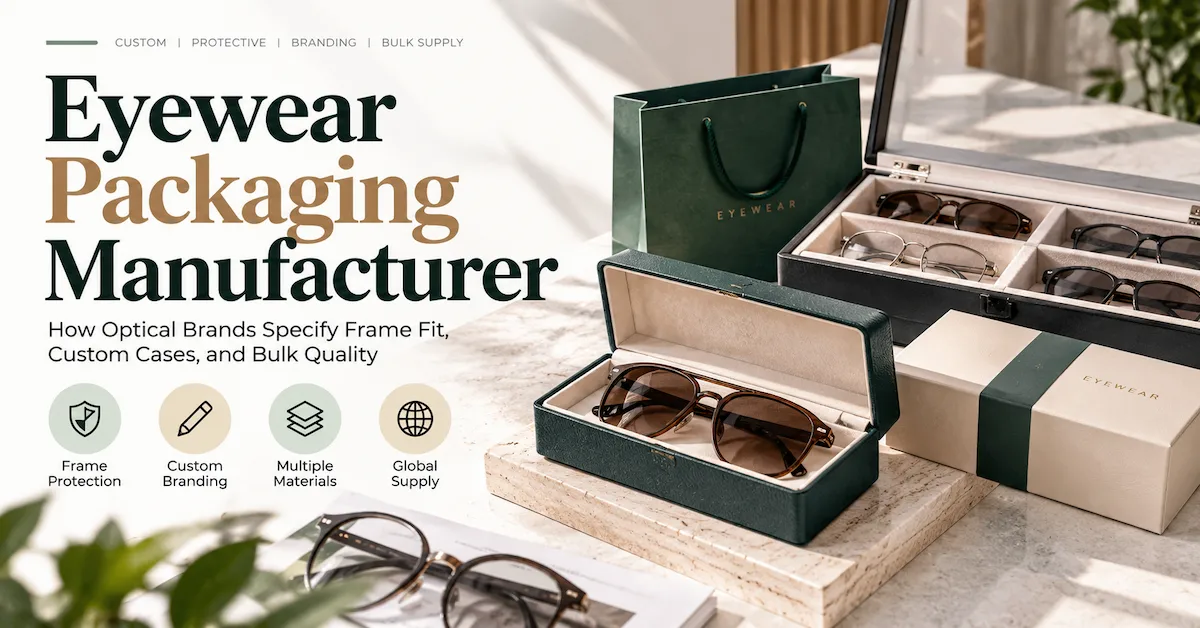
Compare your frame-fit requirements with available structures, then request a sample and an itemized proposal.
1. What Problems Should Optical Buyers Solve Before Ordering Cases?
The most costly errors often begin when a supplier receives an attractive reference image without enough detail about the actual eyewear. A purchasing team may approve exterior color, logo position, and estimated price, only to discover that a wider frame does not fit or the next production batch uses a different lining. Clear specifications are the practical answer to these risks.
Frame clearance is more important than a generic case label
“Fits sunglasses” is not a measurable requirement. Lens width, bridge width, lens height, frame curvature, temple length, and the shape of decorative parts all influence the space occupied by a folded pair. The folded package also changes when temples overlap at a different angle or a frame uses a thick acetate front.
Prepare a small matrix of representative products: the widest, tallest, deepest, and most delicate pairs in the planned collection. If the product range changes frequently, define a fit envelope rather than relying on one convenient sample. A buyer purchasing packaging for optical frames and oversized sunglasses may need two cavity sizes or two insert designs rather than one purportedly universal solution.
A soft lining does not guarantee safe lens contact
A lining described as velvet or microfiber can look refined, but its actual performance depends on construction, cleanliness, pressure points, and how the eyewear moves inside the box. A lens should not be forced against hard fittings or a rough seam when the lid closes. Likewise, the case must not put unintended loads on hinges, nose pads, or decorative temple parts.
Review the physical contact points with actual frames. Ask whether the product stays where intended during ordinary lifting and opening. If long-term storage, abrasion, or coating compatibility is important, define an appropriate evaluation; do not assume that material names alone establish scratch resistance or chemical compatibility.
One shipping method does not suit every eyewear program
An individual case given to a retail customer, a multi-pair display organizer for home use, and an empty case shipped in bulk to a fulfillment center have different requirements. A hard retail case is not automatically an export shipping carton. A collector's six-slot organizer may need protection for its lid and exterior, while an e-commerce parcel needs an outer distribution package capable of handling its expected route.
Record the complete route: factory to importer, importer to store or warehouse, and potentially store to end customer. Identify which party adds the final shipping package and where damage can occur. That prevents confusion when “packaging” refers to different layers of the delivery system.
Branding errors scale quickly in bulk orders
A wrong logo revision, inconsistent foil color, off-center embossing, visible adhesive, or incorrect case lining may be repeated across thousands of units. These defects can affect retail presentation and create sorting or replacement work. Define a finished-sample approval with artwork revision, accepted material reference, color, decoration method, and visual criteria.
Do not use an unbranded structural sample as evidence that the branded product is ready for production. First approve construction and fit, then confirm the actual decoration on production-representative materials.
2. How Do Eyewear Cases Actually Protect Frames and Lenses?
An effective eyewear package combines appropriate space, controlled contact, stable construction, a functional closure, and an outer packing plan. No single material provides all of those functions. Buyers should evaluate the assembled product rather than treating shell hardness or lining softness as a complete measure of protection.
The frame must have clearance without excessive movement
Start with the frame in its intended storage position. For a single-case design, this usually means evaluating the folded eyewear; for a display box, the intended orientation may differ. Determine where the front, temples, bridge, and lenses sit relative to the insert and lid. Assess whether the frame can be inserted and removed without forcing a hinge or dragging a lens against a wall.
Clearance does not mean unlimited empty space. If the glasses can strike the case repeatedly when handled, the support strategy may need adjustment. A suitable insert or divider should prevent unintended movement while avoiding concentrated pressure on vulnerable components. Test the intended frame range, not just one aesthetically pleasing sample.
Hinges, nose pads, and frame finishes need specific attention
Hinges and nose pads can project beyond the main frame outline. Thick temples and decorative metal components may also be taller than expected. A supplier cannot infer these details reliably from the overall advertised width of a sunglass model.
Use physical frames or dimensioned drawings when developing the insert. For premium optical products, check whether soft pads or coatings might be affected by the support material. If the packaging is expected to remain closed for extended periods, review compatibility under representative storage conditions rather than assuming the initial fit test is sufficient.
Closure and lid design affect usability
A hinged lid may create a refined opening sequence, but the buyer must evaluate alignment, closure force, and how much space the lid occupies when opening. Magnetic, snap, zipper, or lift-off closures present different workmanship and access considerations. The appropriate option depends on the proposed construction and whether that option is actually available from the manufacturer.
For a transparent-lid display organizer, check panel attachment, visibility, edge finishing, and potential contact between stored eyewear and the underside of the lid. For an individual travel case, assess how it opens in daily use and whether its closure remains secure under the intended conditions.
Retail protection and transport protection are separate approvals
A retail presentation case protects and presents the frame under expected customer handling. A shipping package must protect the complete packed product during distribution. Review the unit case, any sleeve or separator, inner carton, master carton, and final parcel configuration separately.
When formal transit testing is necessary, choose a relevant method based on the shipment route and product configuration. ISTA procedures can be considered when a buyer and packaging specialist select a distribution test plan; a test result for one carton arrangement should not be applied automatically to a revised package. Record the test scope, contents, acceptance criteria, and any deviations.
3. Which Eyewear Packaging Format Should You Source?
The correct packaging format depends on whether the buyer is protecting one frame for daily use, preparing a premium retail presentation, organizing multiple pairs, or developing coordinated store displays. A manufacturer should not treat those different products as interchangeable just because they belong to an eyewear category.
| Format or proposal | Typical application | Potential advantage | Main qualification question |
|---|---|---|---|
| Individual rigid optical case | Prescription eyewear and branded retail handover | Defined single-pair storage and gift presentation | Does the closed case accommodate the folded frame without pressure? |
| Individual premium sunglasses case | Designer sunglasses and private-label accessory sets | Premium exterior and coordinated branding | Does the case fit oversized or curved frames in the intended orientation? |
| Soft eyewear pouch or sleeve | Supplemental storage or low-volume accessories | Light and compact when suitable | Is it intended for surface separation rather than stand-alone impact protection? |
| Fold-flat or paper-based presentation format | E-commerce and price-sensitive retail programs | Potentially efficient carton packing | Does the assembled format provide adequate protection for its real use? |
| Multi-slot eyewear storage box | Collectors, boutique retail display, and premium gifts | Organized separation of multiple pairs | Do all compartments fit the target frames and remain separated during handling? |
| Store display tray or stand | Optical counters and merchandising | Quick product access and brand visibility | Is the display intended for stationary presentation rather than shipping? |
These are industry packaging approaches to compare, not a claim that every format is an existing BRT PAK model. Confirm development scope and current availability for any custom option.
A verified BRT PAK reference: six-compartment Eyewear Box
BRT PAK currently lists an Eyewear Box with a black faux-leather exterior, contrasting stitching, a hinged transparent lid, a soft cream-colored interior, and six separate compartments. It is best understood as a multi-pair organizer and display reference. Its product description discusses use with sunglasses and prescription glasses but does not provide complete engineering dimensions or prove universal fit for oversized frames.
Review the BRT PAK Eyewear Box to understand its published visual direction. Request actual cavity dimensions, sample availability, decoration options, packed dimensions, and current commercial terms before using it as the basis for a wholesale program.
The corresponding Eyewear & Watch Boxes collection provides a wider category entry point. Because the category combines eyewear and watch products, buyers should specify that their inquiry concerns optical frames, sunglasses, or multi-pair eyewear storage—not assume every listed case is designed for glasses.
How to compare a single case with a six-slot box
A single case is primarily a protective and presentation accessory for one pair. A six-slot box is a different product proposition: centralized display, separation, and collection management. Its larger exterior may increase storage and shipment volume but create a more substantial retail or gift product. These formats should be quoted as separate SKUs and assessed against different customer requirements.
If your business sells individual sunglasses, do not choose a multi-slot collector box merely because it appears luxurious. Conversely, do not use individual travel cases as substitutes for a requested display organizer. Product purpose determines the right baseline for comparison.
4. What Technical Specifications Belong in an Eyewear Packaging RFQ?
A useful request for quotation should tell suppliers which frame must fit, what the customer sees and touches, how the product is labeled, and how finished boxes will be shipped. Mark each line as fixed, supplier-proposed, or pending sample review. That allows technical discussion without treating an incomplete reference image as a final drawing.
| Specification | What to define or verify | Recommended approval method |
|---|---|---|
| Frame fit envelope | Folded width, height, depth, curvature, temples, and protruding parts | Measurements and representative frame fit matrix |
| Usable internal dimensions | Clear space after lining, walls, supports, and lid are installed | Measured assembled sample |
| Exterior dimensions | Overall length, width, and height at agreed points | Drawing and physical sample |
| Case construction | Structural shell, panels, lid, closure, and any dividers | Bill of materials and construction review |
| Interior contact | Fabric/lining, support placement, seams, and insert density if specified | Physical contact and removal test |
| Capacity | One pair or specified number of independent compartments | Load all intended pairs and close lid |
| Artwork | Logo file, version, printing/embossing method, position, and dimensions | Decorated production-representative sample |
| Surface finish | Color reference, texture, coating, and acceptable variation | Approved swatch and golden sample |
| Workmanship | Lid alignment, stitching, adhesive appearance, panel edges, and cleanliness | Written visual criteria |
| Individual pack | Sleeve, tissue, protective film, or other agreed components | Packed unit sample |
| Export packing | Carton count, orientation, cushioning, labels, dimensions, and weights | Approved carton pack-out |
| Commercial terms | MOQ by configuration, price inclusions, tooling, sampling, lead time, Incoterm | Signed quotation or purchase order |
Define the frame family before defining a universal case
Create a short fit matrix using representative SKUs. For example, compare narrow prescription glasses, wide acetate sunglasses, wraparound sports frames, and eyewear with substantial temples. Record which pair fits each prototype and whether there is acceptable clearance at the lid and side walls.
If one format does not accommodate the full range, consider a second case size or an alternate insert. The cost of an additional SKU may be justified when it avoids damage or a poor user experience. Conversely, a common case may be efficient if the entire approved frame family fits without compromise.
Capacity is a technical specification, not a marketing label
For a six-compartment organizer, confirm whether capacity means six folded pairs of the buyer's target dimensions, or simply six cavities in the reference product. An organizer with six dividers cannot be claimed compatible with six oversized frames without a physical fit check.
Ask whether dividers are fixed or removable, whether each compartment has adequate depth, and whether the lid can close without touching any frames. Assess stability when only some slots are occupied, since the end user may not keep the box fully loaded.
Power ratings do not apply to ordinary eyewear boxes
Unlike electronic accessories, conventional optical cases and passive display boxes do not require motor ratings, turns-per-day settings, or electrical power specifications. Their technical evaluation should focus on fit, construction, closure performance, surface finish, contact safety, packing, and any special features actually specified. Do not introduce unrelated electrical parameters simply to make a specification table appear technical.
5. How Should Buyers Compare Materials and Finishes?
Material choice should follow function, positioning, and distribution conditions. A soft interior and a durable-looking exterior are not enough to establish performance. The whole case structure, fabrication, finishing process, and product-contact surfaces need review together.
| Material or finish | Possible design benefit | Risks to examine | Useful sample check |
|---|---|---|---|
| PU/faux-leather covering | Textured, premium-style exterior with branding options | Edge wrapping, seam alignment, wear, odor, and color consistency | Finished corners, cover tension, and abrasion where appropriate |
| Velvet-type lining | Soft visual and tactile surface | Lint, pressure marks, contamination, and color transfer | Frame contact and repeated placement/removal |
| Microfiber lining or pad | Potentially suitable soft-contact direction | Fiber quality, cleaning requirements, and coating compatibility | Contact checks on actual lens/frame finishes |
| Paperboard structure | Printable and adaptable brand presentation | Crushing, corner finish, moisture response, and assembled stiffness | Closure, corners, and packed condition |
| Wood-based structure | Solid presentation and finish versatility | Weight, joint quality, coating, and surface marks | Stability, lid alignment, and finished edges |
| Clear panel | Visibility for multi-slot display | Scratches, attachment quality, edge safety, and weight | Panel finish, lid motion, and frame clearance |
| Logo foil or embossing | Visible brand identity | Small-detail legibility, adhesion, positioning, and finish variation | Production-material artwork approval |
Compare material samples under relevant conditions
A color displayed on a monitor is not a controlled material reference. Review physical swatches or decorated samples under agreed lighting. Confirm whether the specification uses a printed color code, supplied material swatch, or physical approval sample as the governing reference.
An optical brand selling brightly colored acetate frames may want a restrained case interior so the product remains visible. A luxury sunwear brand may prefer a darker exterior or high-contrast logo. Neither choice is inherently superior; evaluate the visual system against the intended retail experience and target cost.
Avoid automatic environmental claims
If sustainability is central to procurement, request exact evidence for the claim being considered, such as recycled-content documentation, material traceability, or an applicable chain-of-custody certificate. Natural-looking textures do not establish certified sourcing, and a recyclable component does not automatically make the entire assembled case recyclable in every market.
Use destination-market requirements and reliable material declarations when deciding what claims may be placed on packaging. Confirm the specific product and transaction scope rather than relying on a general company statement.
6. How Can You Approve Samples and Verify Bulk Quality?
An eyewear case should be approved as a finished product, not only as an exterior mockup. Establish at least three decisions: structural fit, material/decorated appearance, and bulk-ready packing. Whether these are separate physical samples or a coordinated development process depends on the project complexity.
Step 1: Confirm the concept and frame envelope
Review drawings or 3D images for proportions, lid type, frame orientation, compartment layout, and branding placement. Identify dimensions that may change when materials or linings are installed. The concept stage is useful for catching obvious conflicts, but it does not replace physical fit verification.
Step 2: Test physical prototypes with actual frames
Place each representative frame into the case, close it, reopen it, and remove the glasses. Check lens contact, frame movement, temple interference, hinge pressure, nose-pad contact, and practical user access. For a six-slot storage box, load the proposed assortment rather than a single pair in an empty organizer.
Photograph any interference and record the action needed. If the insert or lining is changed, repeat the checks affected by the change. Do not approve a change merely because the exterior appearance remains similar.
Step 3: Approve workmanship and branding
Evaluate production-representative materials. Check logo size and position, foil or print integrity if applicable, stitching, adhesive marks, seams, panel attachment, and interior cleanliness. Document cosmetic acceptance using sample references and illustrated examples of unacceptable defects.
Where frame finish or lens coating contact is sensitive, consult the eyewear brand's technical team about suitable contact or storage evaluation. A packaging manufacturer should not independently promise universal coating compatibility without evidence.
Step 4: Define lot inspection and acceptance criteria
Before production, agree who will inspect, how samples will be selected, which defects are major or minor for this product, and who can accept or reject a shipment. The appropriate sample plan depends on the contract and risk level. Do not use a generic AQL number without agreement on the defect categories and consequences.
Possible checkpoints include incoming material verification, first-off assembly review, in-process alignment checks, and finished-unit inspection. For private label eyewear packaging, include artwork version and item-code correctness as acceptance criteria. A structurally acceptable case bearing the wrong logo is not an acceptable unit for that order.
Step 5: Validate the actual shipping configuration
Inspect the unit protective wrap, inner carton, master carton, packing quantity, orientation, and labeling. Agree whether a distribution test is necessary, and if so, which packaged configuration will be tested and how acceptance is measured. Retesting should be considered when changes alter the tested design or route.
Keep shipment-release evidence separate from sample approval. A successful prototype does not prove that the bulk lot has been packed in the same way or that the intended quantities are correct.
Step 6: Document changes for repeat orders
Keep the golden sample, drawing revision, material references, logo artwork, carton layout, and corrective actions in one controlled record. Before reordering, ask the supplier to confirm whether the specified materials and processes remain available. Agree on the evidence required for any substitution.
This protects both parties from informal changes being mistaken for approved revisions. It also makes replenishment quicker when the design really has not changed.
Review frame fit, approved materials, branding, carton packing and production quality before committing to an export order.
7. How Do MOQ, Landed Cost, and Export Packing Affect the Quote?
A low per-unit quotation may omit critical components: customized inserts, logo finishing, individual wrapping, carton protection, testing, or freight assumptions. Compare suppliers only after confirming that they are quoting the same construction and delivery scope.
Ask for MOQ by configuration
Minimum order quantity may apply separately by shell type, size, fabric, color, insert, or decoration run. For example, one shipment with three exterior colors and two inserts may be more complex than an order for one standard case in the same total quantity. Request a price schedule by configuration rather than assuming that mixed variants can always be combined under a single MOQ.
Also ask about sampling charges, tooling or setup charges, and whether any costs apply again to later orders. A supplier can quote responsibly only when quantity, specification, and customization scope are clear.
Calculate landed cost, not just case price
For internal comparison, use: landed packaging cost per accepted unit = total applicable purchasing, packing, inspection, freight, clearance, and correction costs divided by units accepted for use. Include only expenses borne by the buyer under the agreed terms, and do not double-count services already included in a quotation.
Consider an illustrative example: 2,000 cases quoted at $2.00 each cost $4,000 before other expenses. If a protective packing arrangement adds $180 but meaningfully reduces handling risk, it should be compared against actual risk and expected distribution needs. The figures are hypothetical and do not represent BRT PAK pricing or guaranteed savings.
Large multi-slot organizers may occupy more shipping volume than compact single cases. Obtain finished carton dimensions and weights before deciding whether a design is economically appropriate. Reducing an organizer's height is useful only if it does not compromise lid clearance or frame contact.
Clarify Incoterms and export responsibility
ICC Incoterms 2020 terminology can help specify delivery and risk responsibilities, but the chosen rule does not automatically answer every issue about packaging quality, customs obligations, product compliance, or payment. Confirm the named place, transport arrangements, required documents, and buyer-versus-seller duties in the actual purchase agreement.
If the destination imposes material labeling or other compliance requirements, identify them at the briefing stage and obtain appropriate documentation for the final configuration. Do not assume a single certificate covers all eyewear packaging designs or markets.
Plan lead time around development gates
Separate concept development, physical sampling, material readiness, bulk production, final inspection, and transport. An estimate described as “production lead time” usually does not include every earlier approval stage. Ask when the estimate starts and which decisions are prerequisites.
For time-critical launches, an existing compatible structure may be preferable to a fully bespoke design. Request the current availability, minimum quantity, and customization limits of the actual option rather than relying on historical catalog conditions.
8. What Should an Eyewear Packaging Manufacturer Deliver for OEM/ODM?
BRT PAK, operated by Jinhua Better Industrial Co., Ltd., presents itself as a packaging design, development, production, and logistics business. The company website includes an Eyewear & Watch Boxes category and a six-slot Eyewear Box product page. Its About Us material outlines requirement confirmation, sketches, prototypes, material selection, sample confirmation, and logistics/packing stages.
This published scope is relevant to eyewear buyers who need custom branding, display packaging, inserts, or a coordinated accessories collection. However, the exact construction, minimum quantities, lead times, testing, and any custom single-case capability must be confirmed for the proposed order. The six-slot organizer is a verified catalog reference; it is not evidence that every optical case structure is already available.
Work from a buyer-owned brief
For OEM development, provide the actual frame matrix, sales channel, quantity, brand specifications, and technical acceptance criteria. Ask for a feasibility review and a written response indicating which requirements can be met with an existing format and which require development.
For a broader ODM project, identify the design problem before selecting decorative details. Perhaps the buyer needs a multi-pair display that suits several sunglasses sizes, or a compact branded package that fits a retail assortment. Agree on the drawing, prototype, ownership of custom artwork, review stages, and change process.
What good technical support looks like
Useful support produces decisions and evidence: a documented case structure, suitable material options, a fit-tested sample, verified artwork, a packing layout, and a clear quotation. Claims of superior quality or speedy development matter less than whether the proposed deliverables are specific and reviewable.
BRT PAK's published company profile is a starting point for these conversations. Buyers can also review the Eyewear Box product and Eyewear & Watch Boxes category before submitting a technical inquiry.
9. Which Buying Priorities Change by Customer and Sales Environment?
An optical retailer, sunglass brand, and storage-accessory distributor may buy from the same broad supplier category but require different products. Begin with the purchasing outcome, not a universal “best eyewear case” assumption.
| Buyer or channel | Primary need | Recommended sourcing priority |
|---|---|---|
| Prescription optical brand | Consistent individual presentation for different frames | Fit envelope, branded single-case feasibility, repeat-order specifications |
| Luxury sunglass label | High-end appearance and larger frame compatibility | Product-contact checks, finish references, logo quality, and presentation |
| Optical chain retailer | Consistency across locations and seasonal collections | SKU identification, color control, replenishment, and warehouse receiving |
| Wholesale accessories importer | Commercial assortment of packaging/storage products | MOQ by style, carton packs, defects, and total delivered cost |
| E-commerce eyewear brand | Customer unboxing plus parcel distribution | Case-to-shipping-package compatibility and final packed-product review |
| Collector accessory brand | Multi-pair storage and display | Slot capacity, dividers, lid, materials, and actual frame assortment |
| Corporate gift buyer | Branded gift presentation with fixed event deadlines | Artwork approval, lead-time gates, labels, and shipment plan |
In-store optical retail
Optical retailers may prioritize a clean handover experience, ease of opening, and a branded case that suits the purchased frame. A case repeatedly handled by staff and customers must remain functional and visually consistent. Specify the retail use conditions, not only warehouse requirements.
High-end sunglasses and fashion collections
For premium sunglasses, oversized frames, wraps, and metal accents often create a more challenging fit envelope. Evaluate the largest examples before finalizing case dimensions and presentation. A luxurious exterior cannot compensate for pressure on a frame or for difficult removal.
Online sales and fulfillment
A branded case may become one element in a customer parcel. Verify how it nests inside the outer mailer or carton, whether any protective wrap is needed, and what arrives at the customer after typical fulfillment handling. The same presentation product may need a different distribution package from the one used for wholesale replenishment.
Multi-pair storage and display
For collectors and accessory wholesalers, the appeal is organization and display. Assess whether the six compartments accommodate the proposed range of frames, whether the clear lid remains free of unwanted contact, and how the product will be protected during shipment as a saleable organizer. BRT PAK's verified six-compartment Eyewear Box can serve as a useful reference for this specific application.
10. A Quote-Ready RFQ Checklist for Optical Packaging Buyers
A good RFQ reduces guesswork. Send enough information to let the supplier propose a realistic design and explain any limits. State what is mandatory and what is open to recommendation.
- Buyer and intended market: company type, destination country, sales channel, and any applicable distribution requirements.
- Eyewear details: product photographs, representative physical samples or measured drawings, folded dimensions, frame curvature, temples, and fragile protrusions.
- Format and capacity: single case, organizer, display box, or other proposed form, with the number of pairs that must fit.
- Construction and visual brief: structural material direction, covering, lining, closure, color reference, and design inspirations.
- Branding assets: vector logo where available, artwork revision, application method preference, positioning, and labeling requirements.
- Quantity planning: volume by style, size, color, insert, and delivery phase; expected reorder pattern if relevant.
- Quality requirements: sample approval, fit tests, appearance criteria, inspection expectations, and any evidence or declarations needed.
- Export details: shipping destination, proposed Incoterm, packing expectations, carton labeling, and receiving requirements.
- Schedule: desired sample decision date, production readiness date, shipment window, and required arrival date.
- Commercial response: request a clear breakdown of unit price, setup charges, sample costs, pack-out, lead-time basis, and assumptions or exclusions.
A concise inquiry might read: “We are developing eyewear packaging for three sunglass sizes and one multi-pair display option. Please assess the attached folded-frame dimensions, proposed branding, and annual quantity ranges. Identify compatible existing formats and any custom development required. Provide a sample plan, MOQ by configuration, preliminary packing proposal, and itemized quotation with commercial assumptions.”
This is more productive than asking only for the “best price,” because it invites a technically grounded proposal and makes supplier responses easier to compare.
11. Frequently Asked Questions
1. What is the difference between an eyewear packaging manufacturer and a wholesaler?
A manufacturer is responsible for production or for managing manufacturing activities, while a wholesaler typically supplies commercial quantities of available products. Some companies perform both roles, and an exporter may coordinate international delivery. Ask who controls the agreed construction, inspection, artwork, and change approvals. The right partner is the one that can document responsibility for your specific order, not merely advertise a particular label.
2. Can one custom case fit both prescription glasses and oversized sunglasses?
Sometimes, but do not assume universal fit. Measure the representative folded frame envelope, including lens height, curvature, temples, and protruding parts. Test physical samples with the smallest, largest, and most delicate products. If the proposed interior leaves excessive movement for small frames or insufficient clearance for large ones, consider a second size or a revised insert rather than forcing a single universal SKU.
3. What MOQ should I expect for OEM sunglasses cases?
MOQ varies by structure, material, customization, production process, and order mix. The minimum may apply separately to a size, color, or logo version. Request quantity breaks for the exact design and ask whether an existing format can reduce development complexity. Do not treat a historical MOQ shown on an unrelated catalog item as a current commitment for your proposed case.
4. Is a six-slot eyewear organizer suitable for all types of glasses?
A six-slot organizer provides six compartments, not guaranteed compatibility with every frame type. Verify usable cavity dimensions, divider spacing, lid clearance, and the intended frame orientation. If the products include oversized wraps or unusually thick temples, test them before placing an order. BRT PAK's catalog Eyewear Box provides a six-compartment reference, but specific fit must be confirmed.
5. Which lining is best for premium optical frames?
There is no single best material for every lens coating and frame finish. Velvet-type and microfiber materials are potential soft-contact options, but their suitability depends on actual fiber quality, surface cleanliness, pressure points, and long-term contact conditions. Evaluate the proposed lining with real frames, and request appropriate compatibility evidence if lens-surface performance is a critical buying requirement. Avoid interpreting softness as a tested scratch-proof guarantee.
6. Can the factory add a logo to an existing eyewear storage box?
Branding may be possible, but the available methods, positioning, minimum quantities, and development scope must be checked against the chosen construction. Ask for a production-material sample showing the actual logo finish, size, and placement. A digital mockup is useful for visual planning but does not validate foil edges, embossing detail, print durability, or interaction with a textured covering.
7. How do buyers approve an eyewear packaging sample remotely?
Use dimensioned drawings, photographs, and videos for preliminary checks, but define which requirements still need physical validation. Frame fit, closure function, contact pressure, texture, and finishing often require a sample in hand. A buyer can assign local staff or an inspection partner to review physical evidence. Record the specific revision and which decisions were approved rather than issuing an unconditional approval from appearance alone.
8. Which quality tests and documents should an exporter provide?
Ask for evidence appropriate to the actual product and claims: material specifications, inspection records, relevant compliance declarations, and transport test results if required. Confirm the document issuer, scope, and date. The required set varies by destination, product composition, and contract. A general company certification does not establish that every case configuration meets every optical-brand requirement or distribution test.
9. How can I reduce the landed cost of wholesale glasses cases?
First compare equivalent specifications. Review unnecessary external dimensions, carton quantity, unit wrapping, material choices, decoration complexity, and the volume of each configuration. Then calculate all costs borne by the buyer under the agreed delivery terms. An apparently cheaper box may cost more if it requires repacking, sorting, or returns. Do not remove essential protection simply to reduce the quoted unit price.
10. What should I send to BRT PAK to request a useful quotation?
Send the eyewear type, folded-frame dimensions, sample or product drawings, desired single-case or multi-pair format, material direction, branding artwork, target quantity by version, sales destination, and required timing. Specify any mandatory test, labeling, or quality requirements. BRT PAK can then review the request against its published eyewear packaging and broader customization capabilities and clarify the actual options and commercial conditions for the project.
Include folded frame dimensions, case capacity, logo artwork, target quantity, destination and timing.
Conclusion
Selecting an eyewear packaging manufacturer is an engineering and purchasing decision, not simply a style choice. A successful order begins with real frame dimensions and a clear sales-channel requirement, then progresses through construction selection, physical fit testing, material and logo approval, production inspection, and export packing. The best solution is the one that accommodates the eyewear safely, matches the brand's presentation, and can be supplied consistently under documented commercial terms.
For optical brands, sunglass labels, importers, and accessory wholesalers, compare suppliers using the same RFQ and inspection criteria. Confirm which features are existing catalog options and which require OEM/ODM development; do not assume all frames or finishes are compatible without testing. Use BRT PAK's Eyewear & Watch Boxes collection and its six-compartment Eyewear Box as verified starting points, then contact BRT PAK with your drawings, quantities, branding needs, and delivery requirements to discuss suitable samples and a project-specific quotation.
