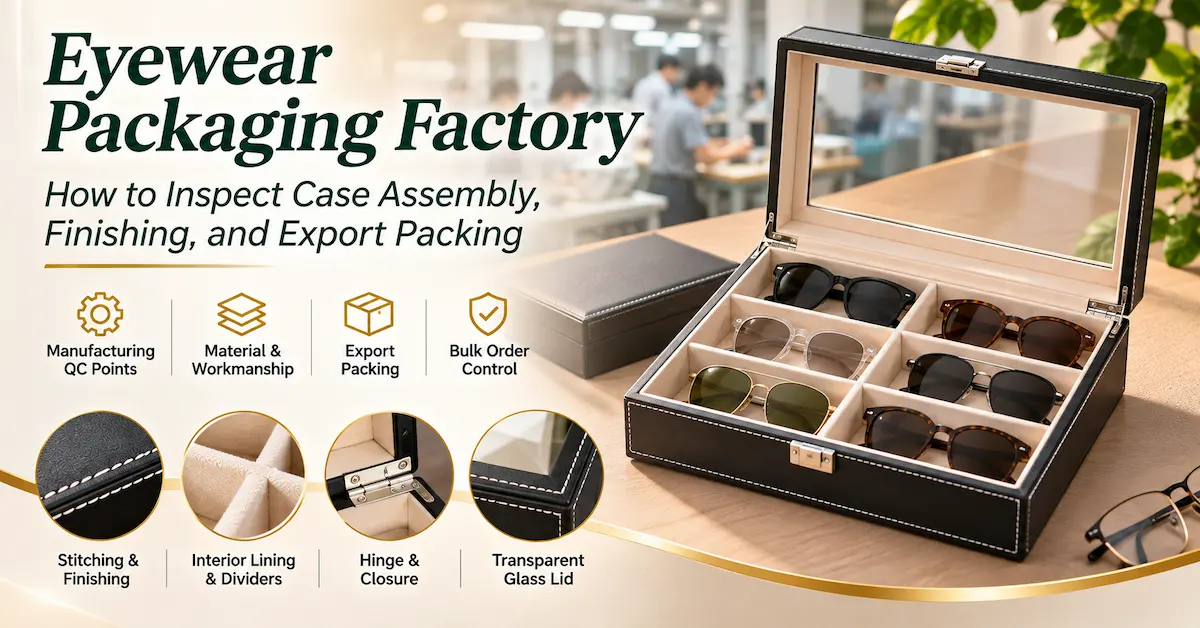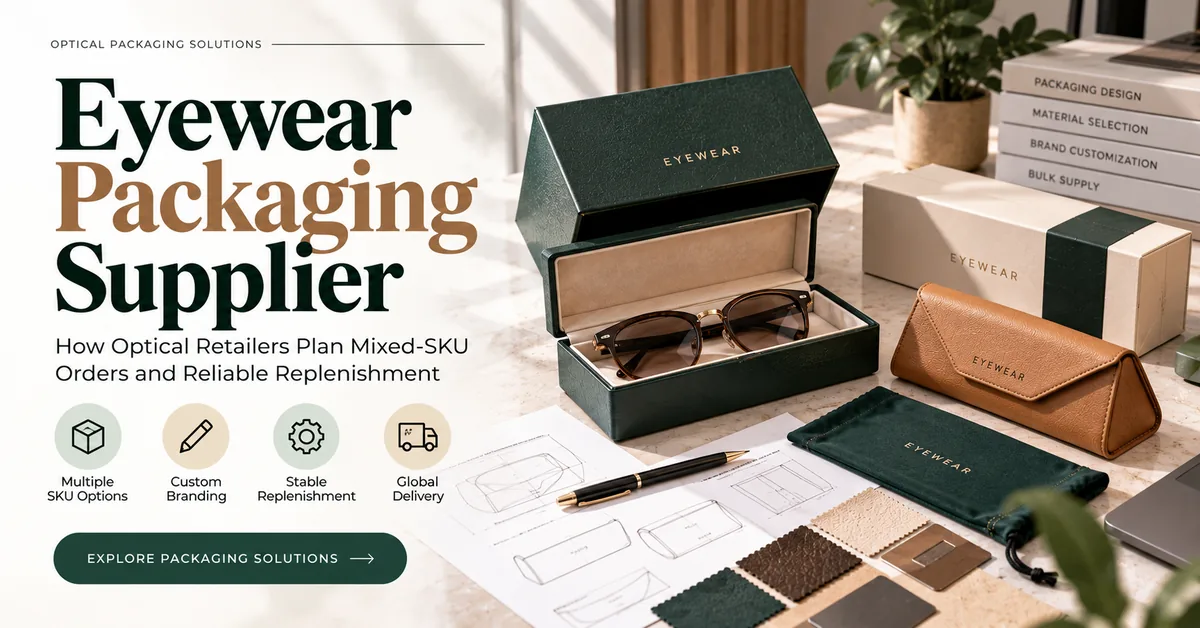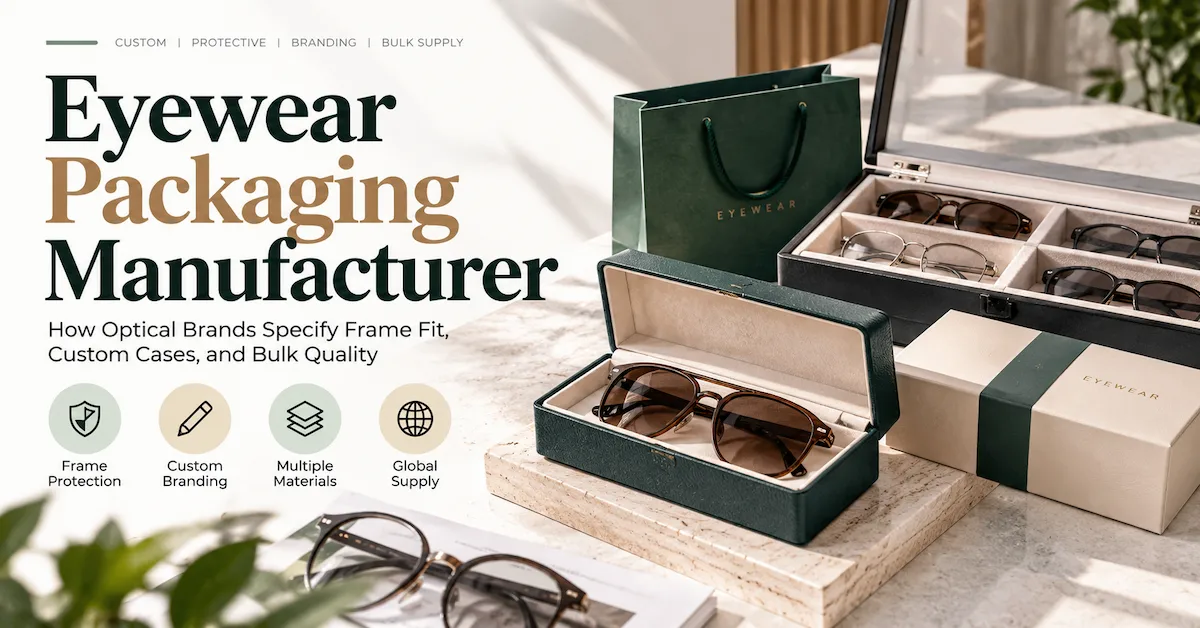

For optical retailers, sunglasses brands, and accessories distributors, packaging has two commercial roles.
It can be a protective accessory supplied with purchased eyewear, or it can be a retail product sold independently, such as a multi-pair sunglasses organizer.
These two applications require different purchasing decisions.
A simple case supplied with prescription glasses must support the intended eyewear. A premium storage box sold through a boutique must also meet merchandising, presentation, product identification, and shelf-space requirements.
A product that is suitable for an online accessories store may not be practical for a small retail counter.
Likewise, a box designed for premium gifting may require different outer packing from one distributed in bulk to multiple retail locations.
This guide explains how international buyers can develop an eyewear packaging wholesale program around the actual selling environment—not simply the lowest quoted unit price.
Key Insights: Retail-Ready Eyewear Packaging
| Purchasing Priority | What Buyers Should Evaluate | Commercial Benefit |
|---|---|---|
| Sales channel | Optical store, boutique, e-commerce, or gift market | Better product positioning |
| Packaging function | Individual case, display organizer, or gift presentation | Suitable product selection |
| Shelf compatibility | Box dimensions, display orientation, and available space | More practical merchandising |
| Retail identification | SKU, product description, barcode requirements | More reliable retail handling |
| Branding | Exterior materials, colors, and decoration | Consistent brand presentation |
| Wholesale pricing | Quantity, customization, packing, and freight | Improved cost visibility |
| Launch approval | Finished sample, retail pack-out, carton identification | Reduced rollout errors |
Key Takeaways
- An individual eyewear case and a six-compartment storage box are different products with different wholesale applications.
- Retail-ready packaging must be evaluated in its intended selling environment.
- Store presentation, customer handling, labeling, and distribution packing should be considered before approving a design.
- Product identification requirements depend on whether the packaging itself is sold as a retail item.
- Wholesale quotations should identify the exact finished configuration and commercial responsibilities.
- A physical product reference and a clear retail launch brief are more valuable than general promises about packaging quality.
1. What Does Retail-Ready Eyewear Packaging Mean?
Retail-ready eyewear packaging is packaging or an eyewear storage product prepared for its intended retail channel.
The requirements depend on what the customer is purchasing.
For example, a sunglasses brand may supply an individual protective case with each pair of glasses.
An accessories retailer may instead offer a six-compartment eyewear organizer as a standalone product.
Although both belong to the eyewear packaging category, they perform different commercial functions.
Packaging Supplied With Eyewear
An individual case is normally associated with the eyewear being sold.
The buyer's priorities include suitable protection, branded presentation, convenience, and compatibility with the retailer's fulfillment process.
Packaging Sold as an Independent Product
A multi-pair organizer can be positioned as a storage accessory, premium gift, or collection display.
In this situation, its own retail presentation becomes important.
Buyers must consider external dimensions, display orientation, finish, product description, and the complete selling unit.
Who Benefits Most From This Purchasing Approach?
This guide is particularly relevant to optical retail chains, fashion sunglasses brands, accessories wholesalers, department-store buyers, private-label gift brands, and international distributors.
Buyers requiring only an inexpensive individual eyewear case may not need an elaborate retail display program.
The appropriate solution should reflect the actual product and channel.
2. Which Eyewear Packaging Formats Suit Different Retail Applications?
An eyewear packaging wholesale supplier should be evaluated according to the formats relevant to the buyer's target market.
Retail Packaging Format Comparison
| Packaging Format | Typical Application | Main Selling Advantage | Buyer Consideration |
|---|---|---|---|
| Individual rigid eyewear case | Eyewear retail handover | Branded protective presentation | Product suitability and case dimensions |
| Soft pouch or sleeve | Fashion accessories | Lightweight presentation | Limited structural protection |
| Multi-compartment organizer | Accessories retail and collectors | Multiple-pair storage and display | Box size, compartments, and merchandising space |
| Premium gift presentation box | Seasonal gifting and promotions | Gift-oriented appearance | Decoration, packing, and commercial timing |
| Counter display solution | Optical shop merchandising | Product visibility | Stability and usable counter space |
| Retail storage accessory set | Gift and accessories programs | Coordinated product presentation | Contents, labeling, and total pack-out |
These are general packaging categories for evaluating purchasing options.
They do not establish that every format is currently available as a standard BRT PAK product.
Individual Cases Versus Multi-Pair Storage Boxes
Individual cases primarily support single-pair storage or presentation.
Multi-pair organizers are more appropriate for customers seeking organized storage of several pairs.
A collector-oriented organizer should not be treated as a replacement for an individual travel case.
The two formats should be specified and quoted separately.
3. How Can a Six-Slot Eyewear Box Support Retail Merchandising?
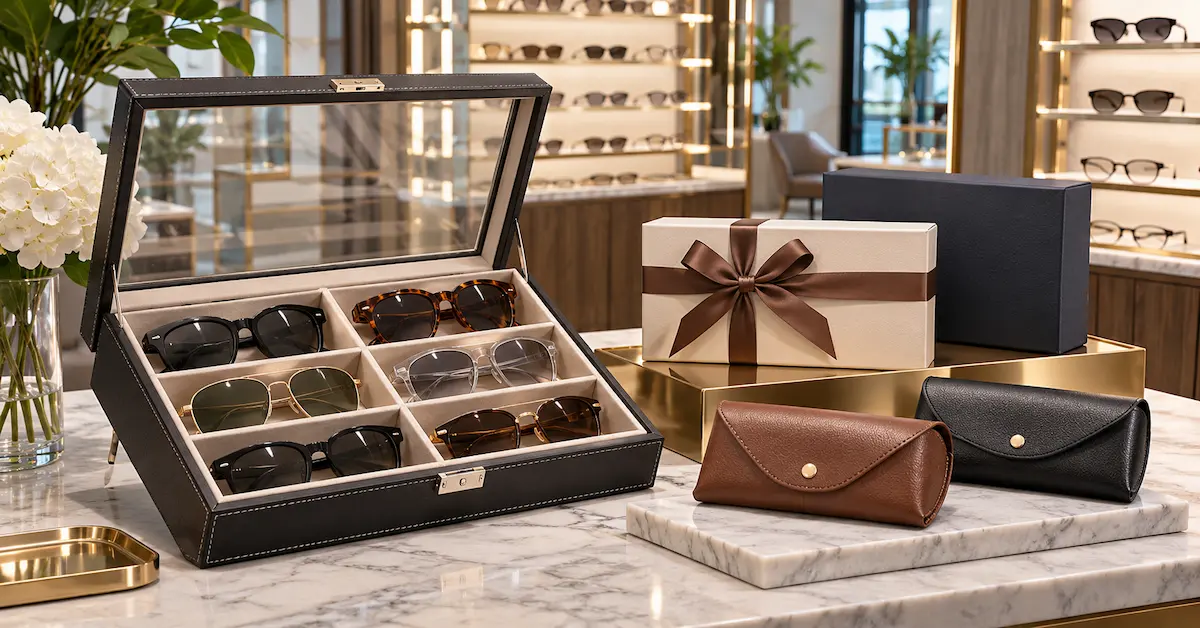
BRT PAK / Better Industrial publishes an Eyewear Box designed for multi-pair eyewear storage.
Its published configuration includes a black faux-leather exterior, white contrast stitching, a transparent hinged glass lid, cream-colored soft lining, and six individual compartments.
These features provide a concrete starting point for evaluating a premium eyewear storage product.
Application: Boutique Eyewear Accessories
A boutique may evaluate this type of organizer as a retail accessory for customers who own several pairs of glasses.
The transparent lid allows the contents to remain visible while the box is closed.
Before approval, buyers should confirm the actual external dimensions and available shelf space.
Application: Premium Gift Retail
A multi-compartment eyewear box may also be considered for gift-oriented product collections.
Buyers should evaluate the appearance of the finished product, individual protective packing, and any additional gift presentation requirements.
Application: Collector Storage
For a collector-focused product, the compartment arrangement is an important selling feature.
However, six compartments do not establish universal compatibility with every frame size.
Representative eyewear should be checked before making product-fit claims.
What Should Wholesale Buyers Confirm?
The published product description provides design information but does not establish every technical and commercial specification.
Request the actual dimensions, current material options, customization availability, MOQ, packing configuration, and quotation for the intended order.
View BRT PAK's Six-Compartment Eyewear Box
4. How Do You Prepare a Retail Merchandising Specification?
Retail buyers should evaluate the complete finished product, not only its exterior design.
A merchandising specification describes how the product will be presented, handled, identified, and distributed.
Retail-Ready Technical Specification Table
| Specification | Buyer Should Define | Why It Matters |
|---|---|---|
| Product format | Case, organizer, or gift box | Establishes intended use |
| External dimensions | Length, width, height | Determines display and storage space |
| Display orientation | Horizontal, vertical, or other approved position | Affects presentation planning |
| Usable interior space | Compartment dimensions | Determines intended storage function |
| Exterior finish | Material, texture, color | Supports brand positioning |
| Transparent panel | Material and finished appearance, if applicable | Affects product visibility |
| Closure | Opening direction and operation | Affects handling experience |
| Branding | Artwork, position, finish | Supports retail identity |
| Retail label | Information and placement requirements | Supports product identification |
| Individual protection | Wrap, separator, or approved protective arrangement | Helps maintain saleable condition |
| Master carton | Units, dimensions, weight, identification | Supports distribution planning |
Consider Shelf Footprint
A large organizer may be visually attractive but require substantial shelf space.
The retail buyer should compare the product dimensions with the allocated selling area.
A practical merchandising review asks how many units can be displayed safely, whether the lid can be demonstrated, and whether the product remains accessible.
Do not assume a particular display arrangement is safe or suitable without checking the actual product.
Consider the Customer's Interaction
Customers may want to inspect the lining, compartments, and opening mechanism.
The retailer should decide whether the product will be displayed open, closed, or demonstrated by staff.
The selected method may affect display protection and handling requirements.
5. Do Wholesale Eyewear Packaging Products Need Barcodes?
Product identification is an important distinction between packaging used internally and a packaging product sold to consumers.
An individual case supplied as part of a completed eyewear sale does not automatically require its own separate retail barcode.
However, a storage organizer sold independently may need its own product identifier according to the retailer's requirements.
Understand GS1 GTIN Requirements
The official GS1 GTIN Management Standard explains how Global Trade Item Numbers identify distinct trade items and when product changes require new identification.
For a saleable eyewear storage product, the responsible brand owner and retailer should determine the applicable GTIN and barcode requirements.
New products and certain product variations may require distinct identifiers under GS1 rules.
Do Not Reuse Product Codes Indiscriminately
A six-compartment organizer and an individual eyewear case are not interchangeable retail products.
Different retail configurations should be identified correctly.
Buyers should distinguish internal supplier item codes from retail trade item identifiers.
Confirm Label Placement
If a retail label is required, agree on its size, location, content, and application method.
For a premium display box, label placement should be considered as part of the presentation design.
Do not assume the wholesale supplier provides GTIN assignment or barcode services unless this is confirmed.
6. How Do Packaging Requirements Change Between Sales Channels?
The same eyewear storage product can require different distribution arrangements depending on the sales channel.
Sales Channel Comparison
| Channel | Primary Objective | Important Packaging Requirement |
|---|---|---|
| Optical boutique | Premium presentation | Product appearance and display suitability |
| Accessories retailer | Saleable standalone product | Retail identification and merchandising |
| E-commerce | Customer delivery | Complete parcel protection |
| Department store | Coordinated retail assortment | Product identification and shelf planning |
| Gift distributor | Gift-ready presentation | Finished appearance and packing completeness |
| International wholesaler | Commercial distribution | Carton identification and shipment consistency |
Brick-and-Mortar Retail
Physical stores may need packaging products that can be displayed and inspected without losing their intended appearance.
Retail buyers should evaluate shelf dimensions, product access, labels, and display instructions.
E-Commerce
An eyewear organizer shipped directly to a consumer needs suitable outer packaging.
A decorative or transparent-lid storage box should not automatically be treated as a parcel shipping carton.
Buyers should review the complete packed product for the intended delivery conditions.
Gift Distribution
Gift programs may emphasize presentation and coordinated branding.
The purchasing brief should identify whether decorative accessories, sleeves, cards, or additional packaging are required.
Such accessories should be quoted separately unless explicitly included.
7. What Determines Wholesale Eyewear Packaging Prices?
Wholesale prices depend on the finished configuration, order quantity, material choices, decoration, manufacturing requirements, and packing arrangements.
A lower unit price is not necessarily a better commercial offer.
Compare the Complete Product
Two suppliers may quote products described as premium eyewear boxes while including different materials or packaging services.
One quotation might cover only the finished organizer.
Another may include individual protection, labels, or different export packing.
Without equivalent specifications, the prices cannot be compared reliably.
Wholesale Cost Comparison
| Cost Component | What to Check |
|---|---|
| Finished product | Approved construction and quantity |
| Decoration | Logo process and setup |
| Retail preparation | Labels or additional accessories, if requested |
| Individual packing | Wrapping and protection |
| Export cartons | Quantity and packing configuration |
| Inspection | Agreed scope and responsibility |
| Transportation | Shipment terms and destination |
| Import charges | Costs applicable under the purchase arrangement |
Calculate the Cost of a Saleable Unit
A useful internal comparison is:
Cost per accepted saleable unit = Total applicable purchasing and delivery costs ÷ Accepted saleable units
Include only costs borne by the buyer and avoid double-counting services already included in the quotation.
For retail programs, the final calculation may also consider storage, shelf preparation, and handling expenses.
Confirm MOQ by Product Configuration
Different constructions, colors, and decoration requirements may have separate minimum quantities.
Request a commercial quotation that identifies the actual product and quantities.
Do not rely on MOQ figures from unrelated products.
8. How Should Buyers Approve a Retail-Ready Eyewear Packaging Program?
Retail programs benefit from a launch approval process that checks the product in its intended selling configuration.
Gate 1: Commercial Concept Approval
Confirm the target customer, retail channel, product format, intended positioning, and budget.
Decide whether the packaging is supplied with eyewear or sold as an independent retail accessory.
Gate 2: Finished Product Approval
Review the physical sample against its technical and cosmetic specification.
For a multi-pair organizer, examine the complete product, including lid, dividers, lining, and exterior finish.
Gate 3: Retail Presentation Approval
Check the intended display orientation, labels, product information, and any additional merchandising accessories.
Where a retailer has its own onboarding requirements, obtain them before final approval.
Gate 4: Packing and Distribution Approval
Confirm the protected selling unit, quantity per master carton, carton identification, and shipment arrangement.
Test or evaluate the packing arrangement when appropriate for the actual distribution route.
Gate 5: Shipment Release
Review the agreed inspection evidence and packing information before release.
The exact responsibilities and approval milestones should be documented with the supplier.
9. What Should Buyers Know About International Wholesale Delivery?
International eyewear packaging orders can involve different freight, handling, and import responsibilities.
The buyer should understand what is included in the quoted price and when risk transfers between the parties.
Clarify Incoterms
The International Chamber of Commerce publishes Incoterms® 2020, which explains commonly used international trade rules covering delivery responsibilities, costs, and risk allocation.
Specify the selected rule, named place, and edition in the agreement.
A quotation that includes different transportation obligations should not be compared as though the delivery terms were identical.
Confirm Distribution Cartons
Request external carton dimensions, gross weights, quantities, individual protection, and carton marks.
If the order contains distinct retail products, carton identification should support accurate receiving and allocation.
Distinguish Freight Protection From Retail Presentation
The outer shipping package protects goods during distribution.
The retail presentation box serves its intended display or storage purpose.
Combining these roles without evaluating the actual shipping conditions may create unnecessary damage risk.
10. How Can OEM and ODM Services Support Retail Differentiation?
OEM and ODM development may be relevant when a retailer requires a distinctive product appearance or new design.
For some projects, an existing construction with approved decoration may be sufficient.
Others may require more substantial design development.
Possible Customization Requirements
A wholesale buyer may request particular exterior colors, logo artwork, lining preferences, decorative details, or gift presentation elements.
The availability of each option must be confirmed against the selected construction.
Avoid Unnecessary Development
A custom design is not automatically more suitable than an existing product.
Compare the commercial value of differentiation with the resulting sample work, manufacturing complexity, and order conditions.
Protect Approved Artwork
Suppliers and buyers should agree on the final artwork version, decoration position, and relevant production approvals.
Where the design is proprietary, appropriate ownership and confidentiality arrangements should be confirmed in writing.
11. Practical Example: Launching an Eyewear Organizer in Boutique Retail
Consider a hypothetical accessories importer planning to introduce a premium multi-pair eyewear storage box through boutique retailers.
This is an illustrative purchasing scenario, not a documented BRT PAK customer project.
Step 1: Define the Retail Product
The buyer selects a multi-compartment organizer concept intended for customers with multiple pairs of sunglasses.
It will be sold as a standalone product rather than supplied as a complimentary eyewear case.
Step 2: Establish the Merchandising Requirement
The buyer reviews shelf space, the intended display orientation, product information, and the customer's ability to inspect the organizer.
Step 3: Approve the Finished Configuration
The buyer requests a representative sample with the proposed exterior finish, lining, lid, and branding.
Step 4: Confirm Retail Identification
The retailer defines its item identification and barcode requirements.
The buyer ensures the applicable product information is incorporated into the retail preparation plan.
Step 5: Confirm Wholesale Delivery
The supplier provides a quotation for the approved configuration and identifies the packing requirements and commercial terms.
The buyer compares the complete delivered cost with the intended retail positioning.
This approach connects product selection with merchandising and distribution requirements rather than treating packaging as a purely decorative purchase.
12. Why Consider BRT PAK for Eyewear Storage Packaging?
BRT PAK / Better Industrial, operated by Jinhua Better Industrial Co., Ltd., publishes a product portfolio that includes eyewear and watch boxes, jewelry boxes, gift packaging, and display-related products.
Its About Us page describes packaging design, development, production, and international logistics coordination.
For buyers sourcing eyewear storage products, its published six-compartment organizer provides a relevant starting point for discussing a retail-oriented product.
Start With a Verified Product Reference
Review the BRT PAK Eyewear Box and identify which aspects of its construction suit your target customer.
Request the current product specification, available options, sample arrangements, and commercial terms.
Explore the Related Product Category
The Eyewear & Watch Boxes collection provides an entry point for related products.
Because the category includes watch packaging, buyers should clearly identify their eyewear-specific requirements.
Ask for a Retail-Oriented Quotation
When contacting BRT PAK, explain whether the product will be sold in physical stores, online, through gift channels, or as part of an eyewear purchase.
Ask the team to confirm which requirements can be supported and which would require further development.
Request a Wholesale Eyewear Packaging Quote
13. What Should Be Included in an Eyewear Packaging Wholesale RFQ?
A retail-oriented RFQ should clearly describe the finished product and how it will be sold.
RFQ Checklist
| Requirement | Information to Supply |
|---|---|
| Buyer profile | Optical brand, retail chain, or accessories distributor |
| Product purpose | Eyewear accessory or independent retail product |
| Sales channel | Boutique, e-commerce, gift, or wholesale |
| Product format | Individual case, organizer, or other proposal |
| Dimensions | Required external and usable internal measurements |
| Materials | Exterior, lining, lid, and construction preferences |
| Branding | Artwork, colors, and decoration requirements |
| Quantity | Planned quantity by configuration |
| Retail identification | SKU and applicable labeling requirements |
| Packing | Individual protection and master cartons |
| Destination | Market, delivery location, and terms |
| Approval requirements | Sample, inspection, and launch milestones |
Example Wholesale Inquiry
We are sourcing eyewear storage packaging for a premium retail accessories program.
The product will be sold through physical retail stores and online channels.
We are interested in reviewing multi-compartment eyewear organizers and would like to evaluate available material finishes, branding options, and finished-product specifications.
Please review our estimated quantities, intended retail presentation, product identification requirements, and destination market.
We would appreciate confirmation of available products, sample arrangements, customization options, MOQ, packing specifications, and commercial quotation.
A complete RFQ helps both parties identify the appropriate product and avoid misunderstandings about what is included in the order.
Send Your Eyewear Packaging RFQ to BRT PAK
Frequently Asked Questions
1. What Does an Eyewear Packaging Wholesale Supplier Offer?
An eyewear packaging wholesale supplier may offer eyewear cases, storage organizers, presentation boxes, and related packaging products in commercial quantities. Available product formats, customization services, order minimums, and delivery arrangements should be confirmed individually.
2. What Is the Difference Between an Eyewear Case and an Eyewear Organizer?
An individual eyewear case is generally intended to store or present one pair of glasses. A multi-compartment organizer provides separate storage spaces for several pairs and may be sold as an independent retail accessory.
3. Are Multi-Slot Eyewear Boxes Suitable for Boutique Retail?
They may be suitable for accessories retailers, gift stores, and collector-oriented product collections. Buyers should evaluate the actual product dimensions, presentation, intended customer, pricing, and display requirements.
4. Can Eyewear Packaging Be Sold as a Standalone Retail Product?
Yes. Some eyewear storage products can be positioned as independent accessories. The buyer should prepare suitable product identification, retail information, packing, and commercial arrangements for that selling model.
5. What Is the MOQ for Wholesale Eyewear Packaging?
MOQ depends on the selected construction, materials, decoration, and purchasing quantity. Request a quotation for the exact product rather than assuming one minimum applies across all eyewear packaging formats.
6. Do Custom Eyewear Storage Boxes Require Barcodes?
A storage box sold as a separate trade item may require an appropriate product identifier and barcode depending on the retailer and applicable identification system. A case supplied as part of another product does not automatically require a separate retail GTIN.
7. Can I Customize Eyewear Packaging With My Brand Logo?
Customization may be available depending on the product and chosen materials. Confirm the decoration options and approve a representative finished sample before production.
8. How Can I Compare Wholesale Eyewear Packaging Costs?
Compare equivalent specifications and include all relevant costs borne by the buyer, such as decoration, individual protection, export cartons, inspection, transportation, and import expenses.
9. Is a Six-Compartment Eyewear Box Suitable for Every Sunglasses Model?
No universal fit should be assumed. Confirm the usable compartment dimensions and evaluate representative eyewear before making compatibility claims.
10. How Can I Request Wholesale Eyewear Packaging From BRT PAK?
Review the BRT PAK Eyewear Box, prepare your retail requirements, preferred materials, artwork, expected quantities, and delivery destination, and contact BRT PAK for available options and a project-specific quotation.
Conclusion
Selecting an eyewear packaging wholesale supplier is not simply about finding attractive products at competitive prices.
For optical retailers, sunglasses brands, accessories importers, and private-label businesses, successful purchasing begins with a clear understanding of the product's retail function.
An individual protective case, a multi-pair storage organizer, and a premium gift presentation are different commercial propositions.
Buyers should evaluate the intended sales channel, product specifications, merchandising requirements, retail identification, and complete packing configuration before approving a wholesale order.
They should also compare quotations using equivalent commercial terms and confirm which customization and distribution services are actually available.
BRT PAK / Better Industrial offers a published six-compartment eyewear storage product and related packaging services that buyers can use as starting points for evaluating potential projects.
Explore the BRT PAK Eyewear & Watch Boxes collection or contact BRT PAK with your intended retail application, design references, quantity, branding requirements, and destination market.
A retail-ready purchasing approach helps businesses choose suitable eyewear packaging products, improve commercial clarity, and bring a more consistent presentation to their target sales channels.