
What Should You Expect From a Recycled Packaging Box Manufacturer?
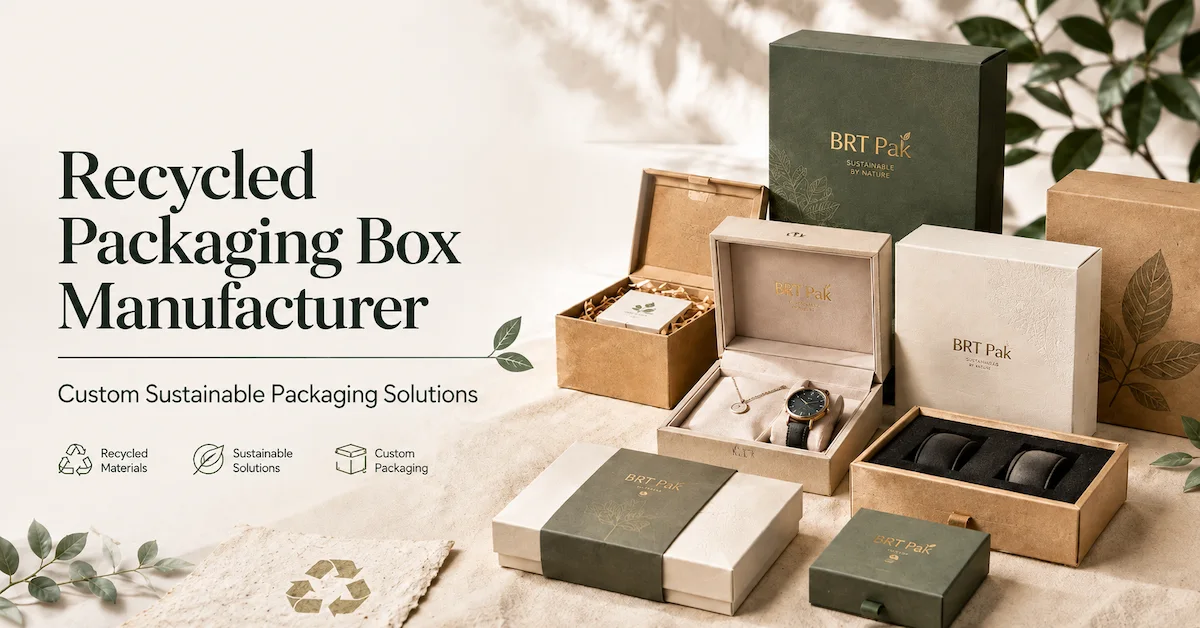
A recycled packaging box manufacturer should do more than replace virgin paper with recycled board. For a brand buyer, the real task is to develop packaging that balances recycled content, structural protection, visual quality, manufacturability, branding, transport efficiency, and end-of-life considerations.
That distinction matters because recycled and recyclable do not mean the same thing.
A recycled-content product contains material recovered from waste or manufacturing streams. The U.S. Environmental Protection Agency defines recycled-content products as products manufactured with recycled materials collected through recycling programs or recovered from manufacturing waste. A recyclable package, by contrast, must be capable of entering an appropriate recovery and recycling system after use.
For jewelry, watches, cosmetics, gifts, eyewear, accessories, and premium retail products, the challenge becomes more complex. A package may combine paperboard, decorative paper, foam, fabric, magnets, plastic windows, adhesives, metal logos, or laminated surfaces.
Therefore, sustainable sourcing should begin with the whole packaging system, not with one environmental claim printed on the box.
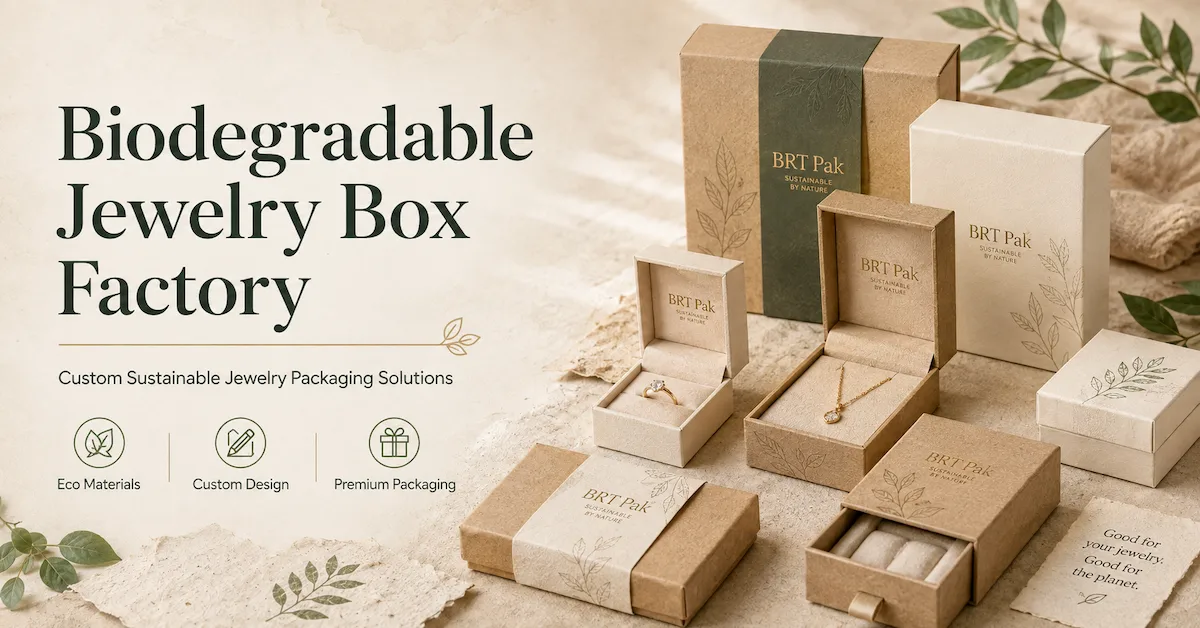
Brands looking for custom development can review BRT Pak's packaging product range, which includes jewelry boxes, watch packaging, gift boxes, displays, pouches, and related custom solutions. BRT Pak describes its business as integrating design, R&D, production, OEM/ODM services, and global logistics.
Who Needs Custom Recycled Packaging Boxes?
Recycled packaging is particularly relevant when packaging is part of both the product presentation and the buyer's sustainability strategy.
Typical B2B buyers include:
- Jewelry brands developing lower-impact retail packaging
- Watch brands replacing conventional presentation boxes
- Fashion and accessory companies launching sustainable collections
- Cosmetic and fragrance brands reviewing secondary packaging
- Gift companies sourcing custom branded boxes
- DTC brands trying to reduce unnecessary packaging materials
- Importers and distributors serving environmentally regulated markets
- Private-label companies requiring customized packaging at scale
- Retail groups standardizing packaging across multiple stores
- Procurement teams preparing for stricter packaging requirements
However, recycled materials are not automatically the right answer for every component.
A highly protective luxury box that must survive repeated opening, international transport, long-term storage, humid conditions, or high-value retail use may require a hybrid structure. In these situations, the more useful question is not:
“Can everything be recycled material?”
It is:
“Where can recycled content be introduced without compromising protection, appearance, manufacturability, or realistic end-of-life recycling?”
That is the type of engineering discussion a capable recycled packaging box supplier should support.
Recycled Packaging vs Recyclable Packaging vs FSC-Certified Packaging
These terms are frequently mixed together during sourcing.
They should be evaluated separately.
| Term | What It Means | What Buyers Should Verify |
|---|---|---|
| Recycled-content packaging | Contains recovered material | Recycled percentage and material source |
| Post-consumer recycled content | Comes from material recovered after consumer use | PCR percentage and evidence |
| Recyclable packaging | Can potentially enter a recycling stream after use | Material combinations, coatings, adhesives and local systems |
| FSC Recycled | FSC label for products made from recycled material under applicable FSC requirements | Valid FSC claim and chain-of-custody documentation |
| FSC Mix | Can combine FSC-certified, recycled and/or controlled sources | Exact applicable FSC claim |
| Reusable packaging | Intended for repeated use | Durability, closure performance and use cycle |
The Forest Stewardship Council states that products carrying the FSC Recycled label are made from 100% recycled materials. FSC also distinguishes this from FSC Mix, which can include a combination of FSC-certified materials, recycled sources, and/or controlled wood.
This is why a buyer should never assume that the terms FSC, recycled, and recyclable are interchangeable.
Ask for Evidence, Not Just Sustainability Language
When evaluating a supplier, request information such as:
- Material specification
- Recycled-content percentage
- Pre-consumer versus post-consumer content
- Paper or board grade
- Applicable FSC claim
- Supplier certificate information where relevant
- Surface coating
- Lamination
- Adhesive system
- Inserts and internal components
- Plastic or metal accessories
- Printing and finishing methods
This makes sustainability measurable rather than promotional.
Which Materials Can Be Used in Recycled Packaging Boxes?
For premium boxes, the outer appearance is only one layer of the structure.
A typical rigid or presentation box may consist of:
Decorative surface → structural board → adhesive → inner lining → insert → closure → logo or finishing element
Each component influences recyclability, cost, appearance, and production.
Recycled Paperboard
Recycled paperboard is one of the most obvious starting points for recycled boxes.
It can provide the structural body for:
- Jewelry boxes
- Gift boxes
- Watch boxes
- Cosmetic boxes
- Accessory packaging
- Subscription packaging
- Retail presentation boxes
The U.S. EPA's procurement guidance recognizes recycled paperboard and recovered fibre as established materials for paper and packaging applications.
For premium packaging, however, board selection cannot be based only on recycled percentage.
Buyers also need to evaluate:
- Thickness
- Stiffness
- Surface flatness
- Edge quality
- Compression performance
- Moisture response
- Wrapping performance
- Odor
- Color variation
- Compatibility with adhesives
Recycled or Responsibly Sourced Paper Wrap
Decorative wrapping paper determines much of the visual identity of a rigid box.
It can carry:
- Solid colors
- Textures
- Printed artwork
- Brand patterns
- Matte finishes
- Embossed surfaces
Brands should confirm whether decorative coatings or plastic laminations affect the desired end-of-life strategy.
Fabric and Soft Linings
Jewelry and watch packaging may need velvet, microfiber, textile, or other soft linings because highly polished products require a different contact surface than ordinary merchandise.
This creates a design trade-off.
A mono-material paper package can be easier to assess for recycling, while a premium multi-material package can provide better presentation and product protection.
The correct choice depends on the application.
Why Packaging Structure Matters as Much as Recycled Content
A recycled box that fails in transit is not a good packaging solution.
If the product is damaged, the brand may need to replace:
- The product
- The box
- The shipping carton
- Protective materials
- International transport
For this reason, structural optimization should be included in sustainability discussions.
A professional manufacturer should consider:
Board Thickness
Insufficient board thickness can cause:
- Lid deformation
- Crushed corners
- Bowing
- Poor alignment
- Reduced stacking strength
Excessive thickness can add unnecessary material, volume, and cost.
Internal Fit
The insert should prevent movement without creating excessive pressure on the product.
This is particularly important for:
- Rings
- Earrings
- Necklaces
- Watches
- Eyewear
- Fragile accessories
Packaging Dimensions
Reducing unnecessary empty space can reduce material consumption and improve carton utilization.
The EPA's sustainable packaging guidance similarly highlights lightweighting and material efficiency as strategies that can reduce both material use and packaging waste.
Transport Packaging
The retail box cannot be designed independently from the master carton.
Buyers should evaluate:
- Units per carton
- Carton dimensions
- Gross weight
- Dividers
- Protective corners
- Compression resistance
- Pallet configuration
- Dimensional shipping volume
This is where a manufacturer with packaging development and logistics experience can add more value than a factory that only reproduces an existing box.
Can Recycled Packaging Still Look Premium?
Yes—but material selection and finishing need to be planned together.
Recycled packaging does not have to look unfinished, brown, or industrial.
A premium presentation box can use controlled colors, textures, printed surfaces, precision wrapping, and carefully selected branding techniques.
Common Branding Options
Depending on the material and project requirements, custom packaging may use:
- Embossing
- Debossing
- Hot foil stamping
- Screen printing
- Printed logos
- Paper sleeves
- Custom textures
- Metal logo elements
- Custom inserts
The best finish should be selected based on both brand effect and material strategy.
For example, adding multiple permanent components may improve visual complexity but make material separation more difficult.
Minimalist packaging can therefore have both aesthetic and material-efficiency advantages.
How Should Jewelry and Watch Brands Approach Recycled Packaging?
Jewelry and watches create a different packaging problem from low-value consumer goods.
The package often has three jobs:
- Protect the product
- Communicate perceived value
- Remain useful after purchase
A ring box may be kept for years.
A watch box may become permanent storage.
A premium jewelry box may be displayed on a dresser rather than discarded immediately.
Therefore, buyers should evaluate sustainability across the use cycle, rather than judging only the recycled percentage of one component.
BRT Pak currently offers a paper jewelry box featuring a drawer-style structure and multiple size options, demonstrating how paper-based formats can also be developed for presentation-focused jewelry applications.
BRT Pak also works with wooden, PU-covered, velvet-lined and other packaging formats, allowing material selection to be matched to positioning and application rather than applying one structure to every project.
What Should Brands Know About European Packaging Requirements?
For companies selling into the European Union, packaging decisions increasingly need to consider regulatory requirements alongside aesthetics.
The EU's Packaging and Packaging Waste Regulation, Regulation (EU) 2025/40, entered into force on 11 February 2025 and generally applies from 12 August 2026. The European Commission states that the regulation is intended to reduce packaging waste and move packaging toward recyclability, with recyclability requirements developing toward 2030.
For packaging buyers, this means future sourcing discussions should increasingly include:
- Material composition
- Packaging minimization
- Recyclability
- Separation of components
- Documentation
- Restricted substances where applicable
- Market-specific labeling obligations
- Extended producer responsibility considerations
This does not mean every recycled paper box automatically complies with EU requirements.
Compliance depends on the complete packaging configuration, product category, market, applicable provisions, and implementation requirements.
Brands selling in regulated markets should therefore combine supplier documentation with advice from their own compliance specialists.
How to Evaluate a Recycled Packaging Box Manufacturer
Do not select a supplier based on a sample image alone.
A better qualification process examines the supplier across several dimensions.
| Evaluation Area | Questions to Ask |
|---|---|
| Recycled materials | What recycled content can you document? |
| Material sourcing | Can the source or certification claim be verified? |
| Structure | Can you optimize dimensions and inserts? |
| Prototyping | Can I review the structure before mass production? |
| Branding | Which finishes work with the chosen material? |
| Quality control | What is inspected during production? |
| Repeatability | How are color and dimensions controlled between batches? |
| Packaging | How will finished boxes be protected in export cartons? |
| OEM/ODM | Can size, structure, material and logo be customized? |
| Documentation | What certificates or material records can be provided? |
| Logistics | Can carton volume be optimized? |
| Communication | Who manages design changes and approvals? |
Red Flags During Supplier Selection
Be cautious if a supplier:
- Uses “100% eco-friendly” without defining the claim
- Cannot state recycled-content percentages
- Confuses FSC-certified with FSC Recycled
- Provides no material specification
- Cannot explain multilayer construction
- Ignores coatings or inserts when discussing recyclability
- Quotes mass production before confirming structure
- Offers no physical or digital approval process
- Makes absolute compliance claims for every country
- Cannot explain how export packaging is tested or controlled
Sustainability claims should be specific enough to verify.
What Should a Sample Approval Process Include?
A strong recycled packaging project should not move directly from quotation to production.
The sample should be used to confirm several variables.
Structure
Check:
- Length
- Width
- Height
- Lid fit
- Drawer movement
- Hinge performance
- Closure
- Insert tolerance
Material
Verify:
- Board grade
- Surface appearance
- Recycled-content claim
- Texture
- Color
- Lining
- Insert material
Branding
Confirm:
- Logo size
- Position
- Foil color
- Embossing depth
- Print registration
- Surface adhesion
Product Fit
Put the actual product inside the sample whenever possible.
A box can look correct on a drawing while still creating movement, excessive compression, or poor presentation when the real item is inserted.
BRT Pak describes a development process that includes requirement confirmation, design, prototype development, material selection, sample confirmation, and packaging/logistics planning. Buyers can review the company's custom packaging capabilities before starting a project.
How Should Quality Control Be Structured?
Recycled-content materials can introduce appearance or consistency variables that need to be considered during specification.
A purchasing agreement should therefore define what is acceptable before production begins.
Important checkpoints can include:
Incoming Material Inspection
Confirm:
- Board thickness
- Surface condition
- Material reference
- Color range
- Required documentation
In-Process Inspection
Monitor:
- Die cutting
- Corner construction
- Wrapping
- Glue application
- Alignment
- Printing
- Logo position
- Insert assembly
Finished Product Inspection
Check:
- Dimensions
- Appearance
- Opening and closing
- Product fit
- Surface defects
- Packaging cleanliness
- Quantity
- Export packing
For premium retail packaging, consistency usually matters as much as an attractive first sample.
What Determines the Cost of Custom Recycled Packaging Boxes?
There is no reliable universal price for a custom recycled box.
Cost depends on the complete specification.
Major variables include:
| Cost Factor | Why It Matters |
|---|---|
| Box dimensions | Changes material consumption |
| Board thickness | Affects material and structural cost |
| Recycled-content specification | Can change sourcing options |
| Outer wrap | Basic paper and specialty surfaces differ |
| Insert | Paper, textile and other inserts have different costs |
| Printing | Number of colors and coverage affect production |
| Logo process | Foil, embossing and metal logos differ |
| Box structure | Drawer, lid-base and hinged structures require different processes |
| Order quantity | Influences setup cost per unit |
| Assembly | Complex structures need more labor |
| Export packing | Affects carton and logistics cost |
| Quality requirements | Tighter tolerances require additional control |
This is why comparing only unit price between two recycled packaging box manufacturers can be misleading.
The lower-priced quotation may use:
- Different board
- Different recycled content
- A thinner structure
- A simpler insert
- Different finishing
- Less protective export packing
A meaningful comparison requires a matched specification.
Recycled Paper Box vs Conventional Premium Box
| Factor | Recycled Paper-Based Box | Conventional Multi-Material Premium Box |
|---|---|---|
| Recycled content potential | High | Depends on materials |
| Brand customization | High | Very high |
| Structural flexibility | High | Very high |
| Luxury tactile options | Moderate to high | High |
| Ease of material separation | Potentially better with simple construction | Often more complex |
| Long-term storage | Depends on design | Often strong |
| Shipping weight | Often favorable | Depends on structure |
| Best for | Sustainability-led retail and DTC projects | High-protection and luxury presentation |
| Main sourcing risk | Assuming all recycled board performs equally | Excessive material complexity |
Neither format is universally better.
The correct structure depends on the product, price positioning, customer experience, protection requirement, shipping environment, and sustainability objective.
Why Work With a Manufacturer That Supports OEM and ODM Development?
Sustainable packaging projects are rarely solved by choosing an existing box from a catalog.
Brands may need to modify:
- Dimensions
- Board thickness
- Recycled-content level
- Structural design
- Insert
- Surface paper
- Color
- Logo
- Printing
- Box opening
- Shipping configuration
An OEM/ODM manufacturer can evaluate these variables as one system.
BRT Pak states that it provides packaging design, R&D, 3D visualization, prototyping, manufacturing, OEM/ODM support, and global logistics services.
For buyers developing jewelry, watch, eyewear, gift or retail packaging, this makes it possible to move from an initial requirement toward a production-ready package rather than sourcing design, sampling, manufacturing, and export packing independently.
You can explore BRT Pak's product categories or review more packaging sourcing guides before defining your project.
What Information Should You Send Before Requesting a Quote?
A detailed RFQ produces a more useful quotation than sending only a reference photograph.
Prepare:
- Product type
- Product dimensions
- Desired box dimensions
- Target order quantity
- Destination market
- Preferred recycled-content requirement
- FSC requirement, if applicable
- Preferred structure
- Surface material
- Insert requirement
- Logo artwork
- Printing or finishing process
- Target price range
- Required delivery date
- Reference packaging images
If the material is not yet decided, explain the commercial goal.
For example:
“We need premium jewelry packaging for a European retail launch and want to increase recycled paper content while keeping a soft jewelry-contact surface.”
That gives the manufacturer enough context to propose alternatives rather than simply duplicate an existing box.
For a custom development request, buyers can use the BRT Pak contact page.
FAQ
What is a recycled packaging box manufacturer?
A recycled packaging box manufacturer produces or develops boxes containing recovered materials such as recycled paperboard and may provide structural design, printing, finishing, inserts, OEM customization, and production support. Buyers should verify the actual recycled-content specification rather than relying only on environmental terminology.
Is recycled packaging the same as recyclable packaging?
No. Recycled packaging contains recovered material, while recyclable packaging refers to packaging that can enter an appropriate recycling process after use. A package can contain recycled material while still being difficult to recycle if it combines incompatible coatings, laminates, plastics, fabrics, or metal components.
What does FSC Recycled mean?
According to FSC, the FSC Recycled label identifies products made from 100% recycled materials under the applicable FSC certification system. FSC Mix is a different claim and can include FSC-certified, recycled, and/or controlled sources.
Can recycled boxes be customized with a logo?
Yes. Depending on the selected paper, board, coating, and surface construction, common branding options can include printing, embossing, debossing, foil stamping, sleeves, and other decorative treatments. The finishing process should be evaluated together with recyclability objectives.
Are recycled packaging boxes suitable for luxury jewelry?
They can be. Luxury positioning depends on structure, proportion, surface texture, color, printing, insert fit, opening experience, and manufacturing consistency—not simply on whether virgin or recycled board is used.
What is the best recycled material for a jewelry box?
There is no universal best material. Recycled paperboard can form the structural shell, but premium jewelry may still require a soft internal contact layer or specially engineered insert. Material selection should reflect jewelry type, retail positioning, shipping conditions, and sustainability goals.
How can buyers verify recycled content?
Request the material specification, recycled-content percentage, relevant supplier documentation, and applicable certification claims. If an FSC claim is required, verify that the claim and certification scope match the actual packaging project.
Does recycled packaging automatically comply with EU PPWR requirements?
No. The EU PPWR covers broader packaging requirements including waste reduction and recyclability. Compliance depends on the complete packaging format and the relevant legal requirements, not simply the use of recycled paper. The regulation generally applies from 12 August 2026.
What affects the MOQ for custom recycled boxes?
MOQ can depend on material procurement, board specification, printing method, specialty paper, finishing, tooling, structure, and production setup. Buyers should request a project-specific MOQ instead of assuming one standard quantity applies to every box.
What should I provide to BRT Pak for a recycled packaging project?
Prepare your product dimensions, target quantity, destination market, preferred structure, recycled-content requirement, branding artwork, insert requirements, reference images, and target delivery date. BRT Pak can then evaluate the project through its design and packaging development process.
Conclusion
Selecting a recycled packaging box manufacturer should be treated as a packaging engineering and sourcing decision, not simply an environmental marketing exercise.
The strongest solution balances verified recycled content, structural protection, material efficiency, brand presentation, realistic recyclability, quality control, customization, and export logistics. Buyers should also distinguish clearly between recycled content, recyclability, FSC claims, and regulatory compliance.
For jewelry, watches, eyewear, gifts, accessories, and premium retail products, the best sustainable package is usually the one designed around the real product and supply chain rather than copied from a generic eco-box template.
BRT Pak supports packaging design, material selection, prototyping, OEM/ODM production, and export packaging for international B2B projects. Explore BRT Pak custom packaging products or contact the team with your dimensions, quantity, material requirements, logo file, and target market to discuss a custom packaging solution.