
Custom Jewelry Packaging for Ecommerce: Which Box Fits the Whole Order?
For custom jewelry packaging for ecommerce, put a complete paid order beside the box you want to buy. Does everything fit, including the parts behind the jewelry? Develop those parts together. You're buying an arrangement that somebody can load and close, and that the customer can open without having to untangle the product. A price for an empty branded box answers only part of that question.
“The cheaper supplier says its box does the same job. What are we missing?”
Possibly a component. Suppose the lower price covers a drawer box with a standard insert. The second price also pays for the fitted insert and card, with the pack assembled and an outer mailer supplied. Put those numbers beside each other and the first one looks better. You haven't priced the missing pieces yet. Negotiating the difference now could remove something that fulfillment has to add back later.
The buyer questions in this article are illustrative prompts used to explain purchasing decisions. They aren't quotations from BRT Pak customer projects.
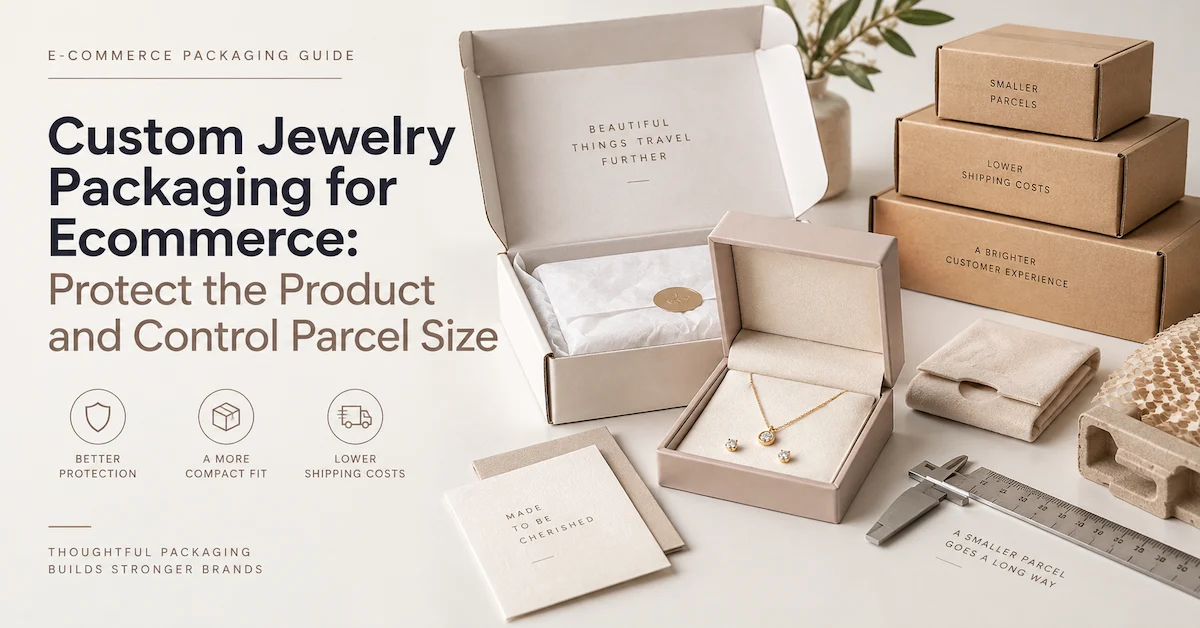
What would leave the warehouse if someone placed that order today? Put that on the table. Don't stop at the pendant. Bring its chain; bring the earring backs, the supplied pouch, and the gift message too. That's the order as sold. It gives a purchasing team a much clearer brief than “a premium box with our logo.” The same reference can go to each custom jewelry packaging supplier, so a proposed saving has an explanation.
A pendant makes the point well. You can see the pendant from the front and think the job is nearly done. Turn it over. Where have the chain and clasp been put? Somebody packing the next order has to reproduce what's there. Lift the pendant yourself, leaving the chain as it was packed. What comes out with it? A loaded sample lets you examine the answer, including the parts an exterior photograph conceals.
“It's only a care card. Does it really affect the quote?”
I'd want its position settled before buying the pack. Under the loaded support, it could make the customer lift the jewelry to read it. Over the necklace, it occupies room when the drawer closes. The handwritten message brings another step if it arrives after packing. Those choices belong to the order you're pricing, so a sample with the card missing leaves a question open.
The discussion below stays with that order, from its empty components to the parcel you would actually send. It's intended for DTC jewelry brands, packaging buyers, distributors, and businesses moving from generic packaging to a coordinated online range. The calculations later in the article use hypothetical design inputs. They aren't supplier measurements or customer results.
We can begin with the order you want to pack. Its photograph and dimensions let us discuss a particular item. Tell us what comes with it and where the proposed quantity will be delivered; the quotation can then refer to a defined pack.
Let the order mix decide how many formats to buy
“We have a large gift set. Should we make every box that size?”
I'd price the frequent orders first. The gift set needs a solution, but if most parcels contain one pair of earrings, you would be choosing those parcels around an order they don't contain. Most customers would receive a box with room for a set they haven't bought. That choice follows you into the stockroom and onto the packing bench. It may follow you into the delivery bill as well.
“Do we group the range by its catalog categories?”
I'd group the loaded packs first. Several earring styles might use one card and support. Within the necklace category, a longer chain could change the arrangement behind the insert. Those packing views give the supplier something specific to compare. You may be able to reuse a format across product names without pretending every necklace asks the same thing of its interior.
“We haven't launched yet. There are no orders to group.”
Use the combinations you're about to sell. If checkout offers a single item or a matching pair, put both arrangements into the inquiry. Perhaps gift presentation is an extra choice. Include that one too, so the supplier can show how it changes the pack. After launch, you'll have actual orders to compare with those assumptions.
Gifting can justify an additional format. A customer choosing a larger presentation at checkout creates a different packing job, with its own components and warehouse trigger. The brand can offer that experience while keeping an appropriate everyday pack. The important detail is that operators can tell which arrangement an order requires.
For a subscription, what happens when the next item arrives? You may want the exterior to stay familiar while the jewelry changes. Lay out the proposed pieces for the coming assortments. A taller setting or more chain gives the interior another job. You might keep the box and change the support; if so, label the revised insert rather than letting “the subscription box” mean two interiors.
“Will two sizes look like two different brands?”
Try them with their decoration. For private label jewelry packaging, I'd look at where the logo sits on each box, then put the cards in their intended places. Do the colors and layout already give you the relationship you wanted? If they do, you have a reason to consider the better fit for each product.
For in-store-only presentation, the outer parcel may be irrelevant. High-value shipping brings separate security and insurer requirements to settle through the relevant service arrangements.
“How many formats should we order, then?”
For custom jewelry packaging for ecommerce, I would take that question back to the packing bench. Put the common single-item order beside the occasional set. Does either fit badly in the proposed common box? A separate set format could be justified without making the everyday earring order use that much space.
Can the ring and necklace share that drawer box?
“The stock drawer box looks right. Can we use it for rings and necklaces?”
Keep it in the comparison. One exterior with two inserts might be a sensible purchase. Look at the ring and chain inside it before deciding, though. They're small products with very different claims on the space.
The ring uses height that the necklace may not
“The band is secure. Why are we worried about the ring?”
If the demonstration ring has a low setting, the sample can look settled without showing what a taller variant does near the drawer's top. The proposal is meant to cover that taller item too. I'd put it in the loaded reference before approving the common format. Band fit below the setting is only one part of what that sample has to show.
The slot is holding the band. Above it, you still have a height decision to make.
A lower insert or another ring orientation could be worth sampling before increasing the whole box. Each option changes the presentation. The purchasing judgment is whether the upright display matters enough to justify a taller format for that collection.
Try the tallest setting and relevant band-width variations. Record the covered range beside the sample; the easiest demonstration ring cannot establish fit for every variant.
The chain needs a place behind the pendant
“We like the front view. Why would you review the back?”
I wouldn't approve the chain arrangement from a photograph that doesn't show it. A length folded beneath the pendant may come out differently from one placed behind the support. An adjustable necklace brings an extension and clasp into that hidden space too. If the clasp has been tucked near the pendant, that's a concern to discuss while the sample is loaded. A rear photograph preserves what prompted the question and gives the next packer an arrangement to reproduce.
If removal leaves you unable to see how the necklace was held, the return arrangement may be just as puzzling for its customer.
Earrings bring their own hidden space. Posts, backs, and hooks extend behind the display surface. A flat-looking earring card can place a post against the bottom of the box if the available depth is wrong. Review the back of the loaded card as well as the presentation.
If most orders are necklaces, how much unused height does the ring impose on them? Price a shallower exterior beside the common-box proposal. Look at both with their decoration before deciding whether the dimensions must match.
For custom jewelry packaging for ecommerce, the decision is which components can be shared without creating another job elsewhere. Keep the exterior where it works. Give different jewelry its own retention features. The quotation should name the two inserts separately, even if both have the same visible lining color.
Write the component specification around the loaded pack
“We've approved the sample. Can't we just order that?”
“Why put the mailer in this brief? We buy it from another supplier.”
Because the inner box has to fit it. I would keep the mailer in the arrangement even when its price comes from elsewhere. The bill of materials, or BOM, can name that component along with the presentation exterior and insert, so “necklace box” no longer leaves the included parts uncertain. You can compare the quote against what the loaded sample actually contains.
Here is a practical way to divide the specification. The entries are information to establish for the project, rather than fixed BRT Pak specifications.
| Part | What it does | What belongs in the specification |
|---|---|---|
| Insert | Locates the jewelry and separates sensitive features | Product range, support geometry, contact material, attachment positions, revision |
| Presentation box | Carries the insert and creates the opening experience | Usable interior, closed exterior, material construction, closure, decoration reference |
| Cards and accessories | Supply the information and extras sold with the order | Dimensions, approved content, position, quantity, applicable order configuration |
| Shipping package | Carries the complete inner pack through delivery | Construction, assembled size, internal supports, closure, label area, evaluation requirement |
Dimensions deserve labels. The internal usable space is not the exterior size printed beside a catalog image. Walls, wrapping, the insert, and the closure take up room. For a drawer box, the pull can also affect its placement inside a mailer. A drawing showing the loaded jewelry and the box inside the outer package helps explain where each allowance goes.
Materials and decoration have to work on the chosen construction
“Would thicker board make this a better shipping box?”
Thicker board might be worth proposing when the structure is the concern. For a necklace moving inside its insert, the problem is elsewhere: the support has not settled where the chain and pendant will sit. A loaded drawer that is awkward to slide gives you another issue to discuss against its proposed construction. Changing the board without naming the problem can leave both parties reviewing a larger sample for different reasons.
“The quote says premium paper. We like the sample. Is that settled?”
I would keep the piece that persuaded you and describe the feature it represents. A paper name in the quote can't show the finish you liked on that drawer, or the texture you noticed when holding it. The retained sample gives the next person something to compare with the order. It also lets you distinguish an approved material appearance from an unfinished structure.
“There is a lifting edge. Should we change the paper?”
I'd want to see the edge before choosing a replacement. It may be where the wrap meets the join, rather than a problem with the sheet you liked. A close photograph of that location, with any exposed glue visible, gives the supplier a particular defect to address. The reply can then explain the proposed correction instead of just naming another paper.
“Both insert proposals have black lining. Are they the same purchase?”
They may have different constructions beneath that surface. Fabric over a support, foam, paperboard, and a molded component give you alternatives to examine with the jewelry in place. The exterior covering, perhaps leatherette or paper, has another role. I'd judge that appearance separately from whether the item is positioned and removed comfortably inside.
“The black lining feels soft. Is that enough?”
Enough to approve the look? Possibly. Enough to promise tarnish control? I'd want evidence for that particular material and use. Keep those decisions separate on the order. You can approve the black surface you like without signing off on a function the supplier hasn't demonstrated.
Approve the logo where it will be produced
“We use this logo on the card. Why change it for the box?”
A logo file can be reused without carrying over its card layout. The area beside a drawer pull is different from the flat space around the artwork on a card. At the intended size, that relationship may make you prefer another position. A process sample then answers the remaining reproduction question, especially for the small lettering you want to preserve.
Keep your artwork in the discussion of jewelry box logo printing options. An attractive example of foil stamping or debossing on another design doesn't show your thin line, and printed decoration offers another appearance to review. I'd select the direction from examples, then see the chosen process on the proposed surface with the intended artwork. The layout and reproduction references can answer their own parts of that purchase.
“We sent the same Pantone code for the card and box. Why look at them together?”
For jewelry packaging color consistency, the shared code explains what prompted the sample. Approval concerns what happened on the surfaces. A card viewed against the lining inside the open box has a relationship the exterior comparison cannot show. I'd want to see that intended arrangement under the inspection light agreed with the supplier, with the physical color reference available beside it.
A decorated sample can answer the appearance question while an earlier prototype remains the accepted fit reference. If both are part of the approval, the record can name the feature taken from each. Applying the finished surface to the production construction may also affect the drawer movement, so the combined loaded sample deserves attention. Two useful references are manageable when their roles are explicit.
“The exterior is paper. Can we describe the set with the same environmental claim?”
I'd check the scope before writing that description. The customer receives a lining and accessories too. Which component does the sourcing or disposal evidence cover? Give the claim that component's name. Custom jewelry packaging for ecommerce can include several materials even when the box looks like a paper product from outside.
Here is the current drawer-box reference. Compare its opening and interior with what you want to pack. The item dimensions and proposed shipping package can guide the next discussion.
Which opening and structure would you pay for?
“We prefer the drawer. Do we still need another structure in the comparison?”
Another structure is useful when it answers something the drawer proposal leaves uncertain. A lid-and-base sample changes access to the jewelry, which may matter to the intended opening experience. A folding carton brings a different storage and assembly arrangement to examine. With the same loaded order in the comparison, you can see what those alternatives change and whether the difference earns its price.
| Candidate | Reason to consider it | Question for the loaded sample |
|---|---|---|
| Drawer presentation box with separate mailer | A defined opening action and fitted interior for gifting | Does the drawer move properly, with room for the jewelry and pull? |
| Lid-and-base box with separate mailer | Direct access to an insert or coordinated gift set | Does the lid close correctly without contact at a raised feature? |
| Folding presentation carton with support and outer pack | A format to examine where storage and assembly are priorities | Can operators assemble it consistently around the intended contents? |
| Card or pouch in a supported shipping pack | A simpler presentation for selected everyday products | Is retention adequate, and does the presentation meet the buyer's brief? |
These are alternatives for discussion, not a list of confirmed BRT Pak offerings. The existing paper jewelry box is a product reference. Feasibility and terms for another structure belong in its own proposal.
Use the closed parcel for the shipping calculation
“The smaller box will lower our delivery bill, won't it?”
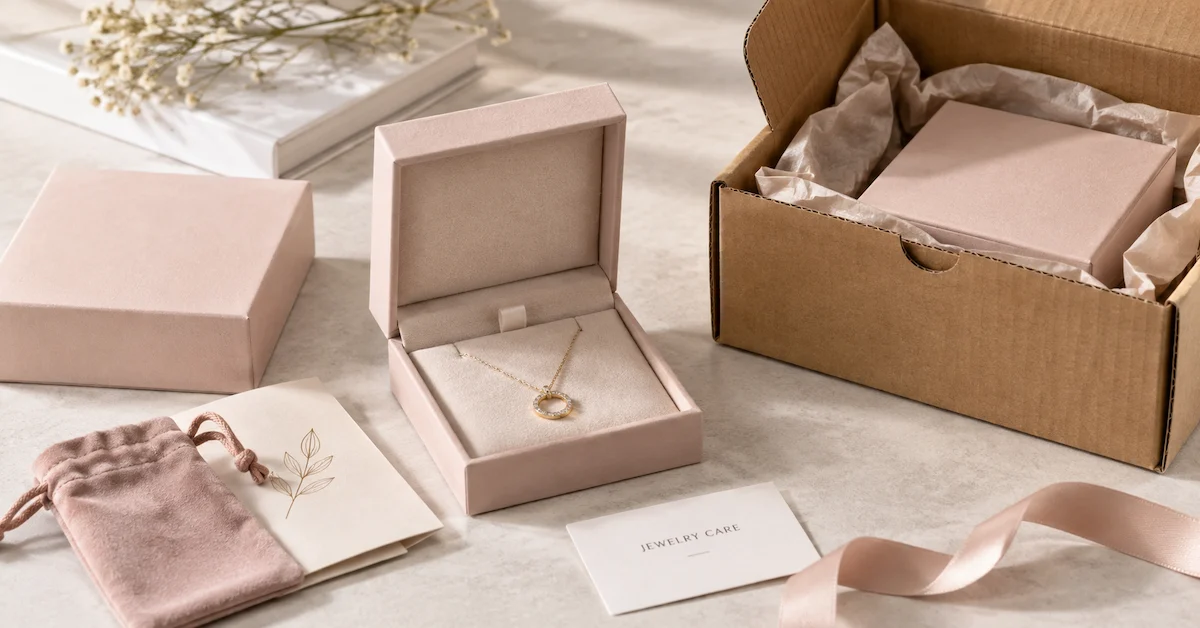
Price the finished parcel. Put the loaded presentation box inside its proposed shipping pack and close it. That is the package the delivery service receives. An empty mailer or a flat blank gives you different information.
Look at the gap beside the inner box. It has to be dealt with somehow, perhaps through a support or filler. Now try a closer fit. Can you still insert the box and close the mailer without forcing it? Those are different packing jobs even when the inner-box dimensions in the two quotations are identical.
The internal arrangement in ecommerce jewelry shipping boxes determines where the presentation box sits after packing. Close the proposed shipment with the cards and protection in it, rather than judging the empty mailer. A crowded closure or an obstructed label area would be a concrete issue for the proposal to resolve. The reference needs to represent the parcel you plan to send.
Does your delivery service charge partly by volume? That's the first question behind jewelry packaging dimensional weight. Get your service's divisor and charging rules from the contract. Look at its rounding and minimum charges too. Otherwise you can spend time making the parcel smaller without knowing whether the difference changes what that service bills you.
An illustrative comparison of two parcel sizes
For the arithmetic, suppose parcel A closes at 180 × 140 × 80 mm, while B closes at 150 × 120 × 60 mm. These are invented dimensions. We are assuming that each accepts the same inner box and meets the protection brief, simply to separate the volume calculation from the fit decision. The example demonstrates no BRT Pak specification or assessment result.
After multiplying the three dimensions, A occupies 2,016 cubic centimeters and B occupies 1,080. That puts B's volume about 46.4% below A's. The difference is worth taking to your delivery contract; there is no freight price attached to those volumes yet.
Now suppose, for illustration only, that a delivery service divides cubic centimeters by 5,000 to calculate dimensional kilograms. A works out to 0.4032 kg and B to 0.216 kg before rounding. With an assumed actual packed weight of 0.30 kg, a service comparing actual and dimensional weight would have the higher dimensional figure for A and the higher actual figure for B.
“So we've proved the smaller one is cheaper to ship?”
We haven't priced the shipment yet. A rounded charge band or minimum charge could put both packs into the same tier. Your contract could also use a different divisor. Enter the measured dimensions and weight into that schedule, or get matched quotes from the delivery partner. Then you can attach a price to the difference.
I'd keep that calculation separate from the discussion about presentation. A compact parcel is useful only after the design has room to do its job. Removing space beneath an earring card, or around the inner box, creates a physical change that requires another review. A theoretical freight saving cannot approve it.
Put the parcel findings beside the component quote and packing work. Is the saving still there? Custom jewelry packaging for ecommerce includes the job of getting that order ready and delivered. The inner-box price belongs in the comparison, but it can't tell you what the whole arrangement will cost.
Try the packing sequence before assigning it to the warehouse
“We can pack the sample easily. Why involve fulfillment now?”
You may have settled the chain route while developing the sample. The next operator sees an insert and a necklace, with another order waiting. If the route is hidden behind the support, how would that person recognize it? The packing method ought to show the arrangement you accepted, including the part the front view leaves out.
“What would you have fulfillment try?”
Give them the components as they will arrive and a reference order to pack. Notice the step that doesn't explain itself. Perhaps the chain has to be arranged behind the support before it is installed, or the card has to go in early. You can change that arrangement or photograph the sequence so the next operator isn't solving it again.
A ring insert and a necklace insert can both look black in a tray of components. Would you recognize which one to pick? Give the variants names in the receiving record and show the correct jewelry loaded in each. If a mark is going onto the actual component, settle its position on the drawing before it appears somewhere the customer sees.
Look at the delivery form beside the unit price. Flat components may use less storage room and leave someone at the warehouse assembling them. A more expensive assembled pack can arrive ready for a simpler job. What does “assembled” mean in this quotation, though? An exterior assembled without its insert is still leaving work for the operator.
“Could we put the gift message in at the end?”
Try it on the closed pack. You may find an easy place for it, or you may have to reopen the drawer and lift the necklace. For custom jewelry packaging for ecommerce, that small card can determine a step in fulfillment. Move it in the sample before deciding to enlarge the box. Try retrieving the care card too if it's tucked beneath the support.
Give the customer a workable route back into the pack
“Can the customer put the necklace back for a return?”
Try it with the instructions put aside. You know the pack better than the customer does, so an unclear chain route here deserves attention. Would you have to find a fresh adhesive or thread the chain through an awkward opening? Try another route in the support while you still have a sample to change.
The customer works with the mailer after opening it, so that condition belongs in the return review. A tear strip may have altered the structure and the first seal may no longer be usable. The proposed return closure has to accommodate that, with somewhere appropriate for its label. An untouched empty mailer cannot show how the return arrangement will work.
Your returns team has its own way to identify an item and order. That information needs a place in the pack, rather than being assumed from a promotional card that may say nothing about the returned SKU. Keeping the jewelry organized can help the physical receiving task. Your policy still governs what the team does with the identified return.
A supplied return-instruction card is another part of the order to place in the loaded sample. It may fit an existing location, or it may change what sits above the insert. Either way, its position can be settled while the complete pack is still under review.
Approve the sample for the decisions it can actually answer
“Which of these samples are we approving?”
A plain prototype may be the sample that settled the fit. The process sample may be the one showing the logo you accepted. Before giving the production instruction, say that explicitly. Otherwise the person making the order has to work out which features you meant to take from each piece.
For jewelry packaging sample approval, show what you packed. Photograph the open insert with the jewelry in place, then the closed inner box and parcel. Put the product name and revision beside the photographs, with the measurements. Photograph behind the support too if that's where the chain has been arranged. The record should show what you were looking at when you made the decision.
Keep workmanship observations concrete. Lifting wrap, exposed glue, contaminated lining, a damaged corner, and a drawer that binds are recognizable conditions. “Premium quality” is much harder for two parties to interpret in the same way.
There's a signature beside three requested changes. Does it mean “make this sample” or “make it after those changes”? Write which one you intend. If you'd like to see a revised sample first, say that on the same record. The supplier shouldn't have to interpret the signature as permission to begin.
Use a distribution evaluation relevant to the actual shipment
The International Safe Transit Association distinguishes its 1-Series integrity screening from transport simulation. Its public procedure list describes 3A for parcel-delivery shipments of 70 kg or less and 3L for ecommerce fulfillment. Select the procedure with a qualified packaging or testing provider for the actual distribution system. Source consulted: the ISTA procedure list at https://ista.org/test_procedures.php. This reference is guidance for test selection; it does not state that BRT Pak packaging has passed a procedure.
Fit review and distribution assessment serve different purposes. A piece can fit correctly yet release from its support during an agreed evaluation. It can also remain intact while its presentation box becomes visibly marked. Include presentation condition if that matters to the sale.
“Would a marked gift box count as a failed result if the jewelry is intact?”
For gifting, a marked box may be a buying issue in its own right. I'd state the condition you expect before commissioning the assessment. In the same brief, identify the other failure concerns for your loaded sample, such as jewelry no longer held in place or an opening mechanism that won't work properly. The report then has an agreed pack and criteria to address.
“We've changed the insert. Can we keep using the earlier report?”
Look at what changed against what the report covered. Was the new support part of the assessed arrangement? Keep the report with that revision so the difference is visible. Evidence for some other material won't answer whether this altered pack still has the outcome you require.
Negotiate quantities and timing after the specification is clear
“Now can we compare the unit prices?”
Yes. Put the included parts beside each price, and leave a useful alternative in the comparison. A different construction might suit you better. The custom jewelry packaging cost guide can help separate charges for development and setup from the components you expect to buy again.
MOQ deserves the same level of detail. Does it apply to each size, color, artwork, insert, or structure? A total order across a collection may not meet a minimum for each variant. Obtain the project quantity in writing instead of filling the gap with a general supplier number.
“The minimum is more than we want for the launch. Is there another route?”
Ask about using an existing structure with selected customization. It may leave you accepting a different dimension or presentation. Compare its loaded sample with the full-development version. You can then judge the compromise as a particular purchase, instead of repeatedly asking for fewer units of the same unresolved design.
“Who draws the box in this project?”
The drawing work can stay unclear even when the quote uses an OEM or ODM label. With an established design, an OEM request can identify the files and revision to manufacture against. When the jewelry still needs a proposed structure, I'd want the ODM quotation to say which drawings are being commissioned and what remains for the buyer to decide. Responsibility for tooling, sign-off, and later changes belongs beside that scope, so the development fee has a particular job attached.
A delivery period written beside the price needs a starting point. Does it begin after sample approval, or is the design work included? Put the required arrival date into the discussion and work back through transit, dispatch, inspection, production, materials, and the sample decision. It is easier to see a timing problem there than in a single promise of a number of days.
“The quantity is within the supplier's capacity. Does that settle the schedule?”
The first batch may have an earlier purpose than the balance of a staged order. Its quantity, destination, and requested timing belong beside that stage of the schedule, so an overall capacity figure doesn't stand in for a dispatch commitment. Replenishment needs a discussion too. An agreed first run is useful, but it hasn't automatically reserved the slot for the next purchase.
“Should we send the artwork and dimensions only?”
They explain part of the request. Your jewelry packaging RFQ also needs the complete order view, quantity, destination, and what you want from the sample. A packing photograph can show the difficult chain arrangement prompting the inquiry. If parcel size is the concern instead, that constraint gives the proposal another purpose. The supplier then has a particular job to price.
Before signing for custom jewelry packaging for ecommerce, put the agreed revision and delivered form beside the price. What happens to a shortage, or a component you reject? How will a substitution be approved? Settle those terms while everyone is discussing the same sample. The next purchase can then refer to that arrangement rather than reopening the whole box brief.
Give each supplier the same packed order to price. A complete brief helps distinguish a real structural alternative from an incomplete quote.
Use the BRT Pak reference to begin a specific proposal
“Who is behind the BRT Pak name?”
The name to compare with your quotation is Jinhua Better Industrial Co., Ltd., the company using BRT Pak for packaging. Its location is Jinhua in China's Zhejiang province. In the published development description, design and materials lead into prototype and sample stages, with logistics also included. The company information provides that reference before you settle the scope of your order.
“Can we point to this drawer box when requesting a sample?”
Yes. You might be referring to the satin pull on a pink or white drawer, rather than the finish of the whole box. The reference also has black velvet lining and a matte exterior. I'd make the feature you like explicit, so it doesn't get lost in an instruction to copy the picture. Your sample and drawing then need to establish the chosen structure, dimensions, and construction.
The custom jewelry packaging manufacturer guide looks at the collection and brand system more broadly. Here the question is what happens to one online order. Custom jewelry packaging for ecommerce has to hold that jewelry and then fit the parcel you intend to send.
That is the brief to take to BRT Pak, with the intended quantity and destination. What structure can be offered, and what would the sample represent? Get the proposed files with the quotation so the price refers to a defined pack. MOQ and timing belong to that proposal, and a quality or sourcing statement needs the evidence relevant to it.
FAQ: ten questions before you order
1. Can a rigid jewelry box go straight into the delivery network?
That requires approval of the direct-shipping configuration. A rigid presentation box can hold an insert and create a gifting experience, but external contact, closure, movement, and labeling remain part of delivery. In a proposal with a separate mailer, evaluate both boxes together. If the supplier proposes no outer package, the specification and relevant evaluation need to cover that arrangement. The presence of rigid board doesn't settle the shipping decision.
2. Do we measure the item flat or as packed?
Measure the packed position. A raised ring setting uses space the band measurement won't reveal; earring backs sit behind the face you photograph. Show those details, with the clasp or extension if present.Give the supplier the variations that could change the fit. When the drawing returns, distinguish the room inside from the closed dimensions outside. Your warehouse's parcel constraint belongs in the inquiry as well.
3. Can rings and necklaces use one drawer box?
Possibly, with different supports inside. Try the two loaded versions. The ring has a setting to accommodate above the band; the necklace has chain to arrange behind its pendant.If the ring drives the height for a range made up mostly of necklace orders, include a shallower exterior in the price comparison. See that version decorated before deciding that shared dimensions are necessary for the brand.
4. Will the smaller parcel actually cost less to send?
It doesn't give you a price on its own. Take the two closed parcels to your own charging schedule. Rounding or a minimum charge could put them together in one tier, and actual weight may govern instead of volume. Before pricing them, settle the fit and protection requirements for each. The small pack has to be a viable alternative before its freight quote becomes useful.
5. How is MOQ quoted for custom jewelry packaging for ecommerce?
Get the quantity against the design you're asking to buy. Does the minimum apply to the exterior, each color, or each insert? This guide gives no BRT Pak number to put in that gap. For a launch, it can be worth discussing selected customization on an existing structure beside a fully developed design. You then have two specific purchases to compare.
6. Which sample should become the production reference?
Keep the physical references and write what you accepted from each. Perhaps the plain prototype established the space, while the later process sample established the decoration. Photograph the loaded order and identify its revision. If something remains to change, state whether you'd like another sample. That makes an attractive demonstration useful without asking the production team to guess which features belong in your order.
7. What does that soft black lining actually do?
What's under the soft surface? Put your jewelry on that support and examine the parts hidden by the presentation. The necklace brings its chain; the earring card brings posts behind it. Decide whether that arrangement works as well as whether you like the black appearance. A functional claim such as tarnish control needs its own material and use evidence, rather than approval by touch.
8. Could the customer pack a return in this?
Open the sample and try putting the jewelry back without the original packer helping. Is the route obvious? If you need new adhesive or awkward threading, consider another retention arrangement. Open the mailer too and try its proposed return closure. Put the instructions and label into that exercise. Your return policy governs the business decision; the packaging should make the physical task understandable.
9. What can make two unit prices misleading?
Look for something one quote includes and the other leaves to you. It could be the insert, an assembly step, or the outer mailer. Development and setup charges may also sit outside one unit price. Put the BOM, quantity, and delivery form together before negotiating. A cheaper alternative can be useful, provided you can see which parts and packing work change.
10. What should I send BRT Pak to get the discussion started?
A useful first inquiry describes the complete order with product photographs and dimensions, quantity, and destination. The artwork and an existing packing photograph help explain what you want to retain. Describe the difficulty prompting the review as well: an awkward chain route or an unnecessarily large parcel gives the sample discussion a focus. The requested arrival timing can then be considered alongside that proposal.
Conclusion
For custom jewelry packaging for ecommerce, put the finished order behind the price you negotiate. Try the jewelry in its support, close the parcel, and see what each proposal includes. Keep the agreed sample and revision with the order. Send BRT Pak your jewelry dimensions and ecommerce packing brief to discuss the next proposal.