
Search for a watch winder manufacturer and you will find the same names on almost every list. Search a little further and something odd appears. Several of those names do not describe themselves as manufacturers at all. One calls itself a luxury brand. Another describes itself as a boutique and an authorised dealer. A third never says what it is.
That matters because the three words are not interchangeable. A brand decides what a product should be and markets it. A dealer sells it. A manufacturer builds it — and if you are sourcing private label, only one of those three can actually take your brief, hold your tooling and quote your quantity.
So this article does something narrower than a ranking. It sorts the companies buyers ask about most into four identities: makers who openly describe themselves as OEM or ODM, makers who work only to their own designs, sellers who do not manufacture, and companies whose identity their own homepage does not state. Every claim below comes from that company's own website as read on 1 October 2026. Where a site did not say something, this article says not stated instead of guessing.
Who should read it? Private-label founders deciding whether to approach a factory or a brand. Retail buyers told to "go direct to the manufacturer" and unsure who that is. And anyone who has been quoted a private-label programme by a company that may not own a production line.
Publisher, conflict and research disclosure — reviewed 1 October 2026: BRTPAK publishes this article. It is a trading name of Jinhua Better Industrial Co., Ltd., which manufactures watch winders and watch and jewellery packaging in Jinhua, China. We have a commercial interest in the subject and we route readers from this page to our own product and contact pages. The four categories, the sorting of companies and every judgement about what a buyer should do are the publisher's editorial view. Our own company is described in a separate section and is not ranked among the companies listed. We did not audit any factory, inspect any production line, verify any certificate, test any winder, or send an identical request for quotation to the companies named. Nothing here is an award, a certification, a ranking by quality, or a customer survey.
Method limit: the company facts come from reading each company's own public pages — 11 companies, 15 pages in total — and from nothing else. We did not interview anyone, did not approach companies that did not publish a self-description, and did not examine company registries, import records or financial filings. Several fields a buyer would normally want are simply absent from these websites, and where they are absent this article reports the absence. Coverage was limited by a page budget: for two of the eleven companies the homepage did not state an identity and we did not read further pages, so those two are recorded as unconfirmed rather than assumed in either direction.
✉ Request a Custom Watch Winder OEM Proposal
Why the word "manufacturer" gets used loosely in this category
Watch winders sit in an awkward place. The visible experts — the names buyers already trust because they see them in magazines and on retailer shelves — are mostly brands. Their reputation is genuine, and it is about design, distribution and after-sales service. It says nothing about who cuts the wood, wires the motor or assembles the drum.
Then there is the sourcing side. Trade directories list thousands of suppliers under the word "manufacturer", and a listing does not prove production. Some entries are trading companies that quote competitively and then place the order with a plant that never appears in the correspondence.
Put those two things together and you get the pattern this article is about. A search result can reasonably mix a Swiss luxury brand, a British online retailer and a Chinese contract manufacturer, all filed under the same heading, with no signal telling the buyer which one can build a private-label programme.
The confusion is not a scam. It is a labelling failure, and it persists because most lists never ask the one question that resolves it. Not "who is best", but which of these companies actually makes the thing.
That is also how we approached the reading. The test was not size, reputation or price. It was whether a company's own words place it on the production side of the line. Four pages of a site usually answer it: the homepage, the about page, and any page describing a factory, an OEM service or a workshop.
Four identities, and how to tell them apart
Almost every company in this category lands in one of four groups. The grouping is not a compliment or a criticism — a brand that does not manufacture is a perfectly good business, and approaching it for private label simply wastes both sides' time.
1. Manufacturers
These companies build product. The strongest self-description includes the word manufacture, factory or plant, and is specific about what it makes. A claim of a workshop or a production facility is the ordinary marker. When a manufacturer also advertises OEM or ODM work, it is telling you that it accepts other companies' designs and specifications, which is usually the whole reason a private-label buyer is searching.
2. Brands
A brand owns the design language, the catalogue and the relationship with the end customer. Some brands do own production; many do not, and some describe themselves plainly as a brand rather than a maker. That is a meaningful distinction for a buyer, because a brand will normally decline to build a competing label's product — even where it has the capacity to do so.
3. Retailers and dealers
A retailer sells finished goods. Sites in this group often describe themselves as a boutique, an authorised dealer or a stockist, and their content is organised around buying rather than making. Their value to a consumer is real. Their value to a private-label sourcing programme is essentially zero, because they do not control production.
4. Unstated identity
Some sites simply do not say. The homepage describes the collection, the materials and the warranty without ever naming a production role. This is not evidence of anything — plenty of legitimate companies write marketing copy rather than company profiles. It is a reason to ask one direct question before you shortlist, not a reason to assume.
| Identity | Self-description that signals it | What it means for a private-label buyer |
|---|---|---|
| Manufacturer | Uses manufacture, factory, plant or workshop about itself; names what it produces | Can accept your design and specification; ask separately about OEM and about wholesale terms |
| Brand | Describes itself as a brand or a house; catalogue-led, design-led language | Usually will not build a competing label, even where it owns production |
| Retailer or dealer | Boutique, authorised dealer, stockist, shop | No production to offer; treat as a sales channel, not a source |
| Identity not stated | Product and service copy only; no production role named anywhere on the reviewed pages | Ask directly and in writing before spending time on a brief |
Read that table again with one thing in mind. None of the four rows describes product quality. A retailer can sell excellent winders and a manufacturer can build poor ones. The table answers exactly one question, which is who is able to take your specification.
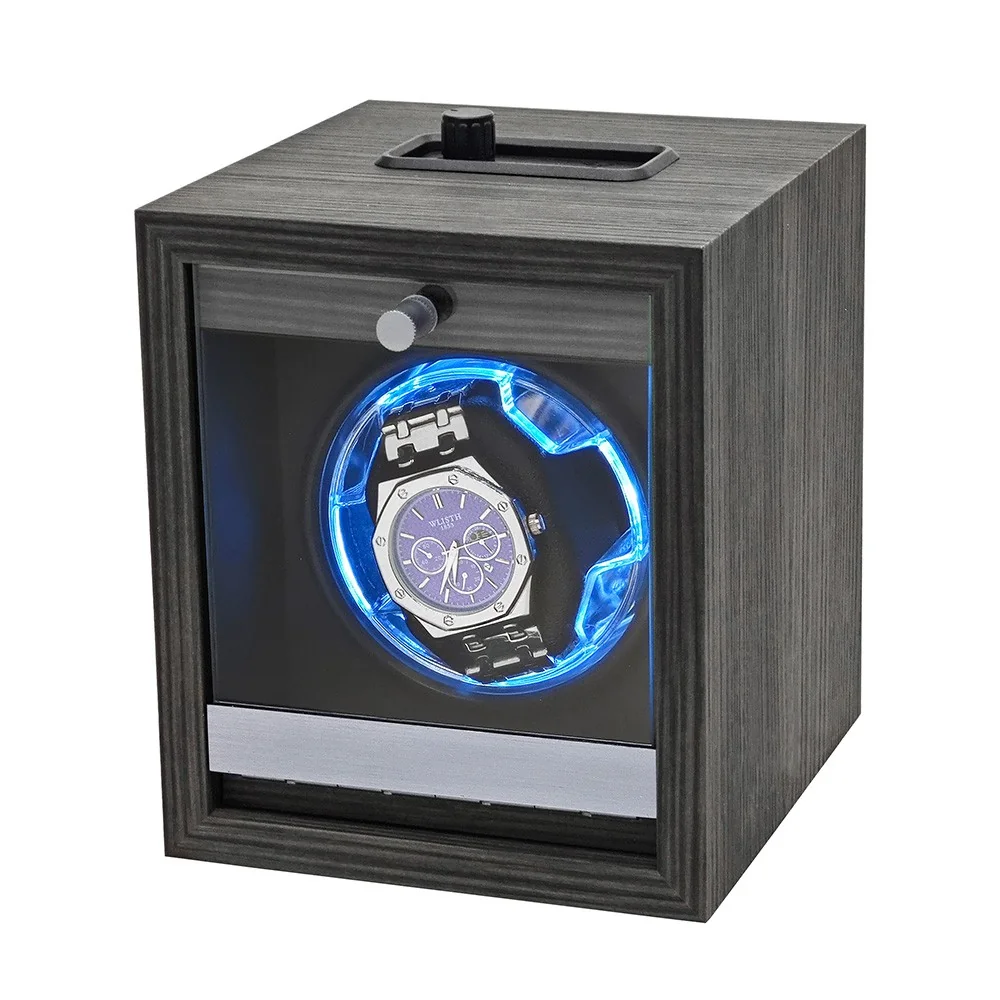
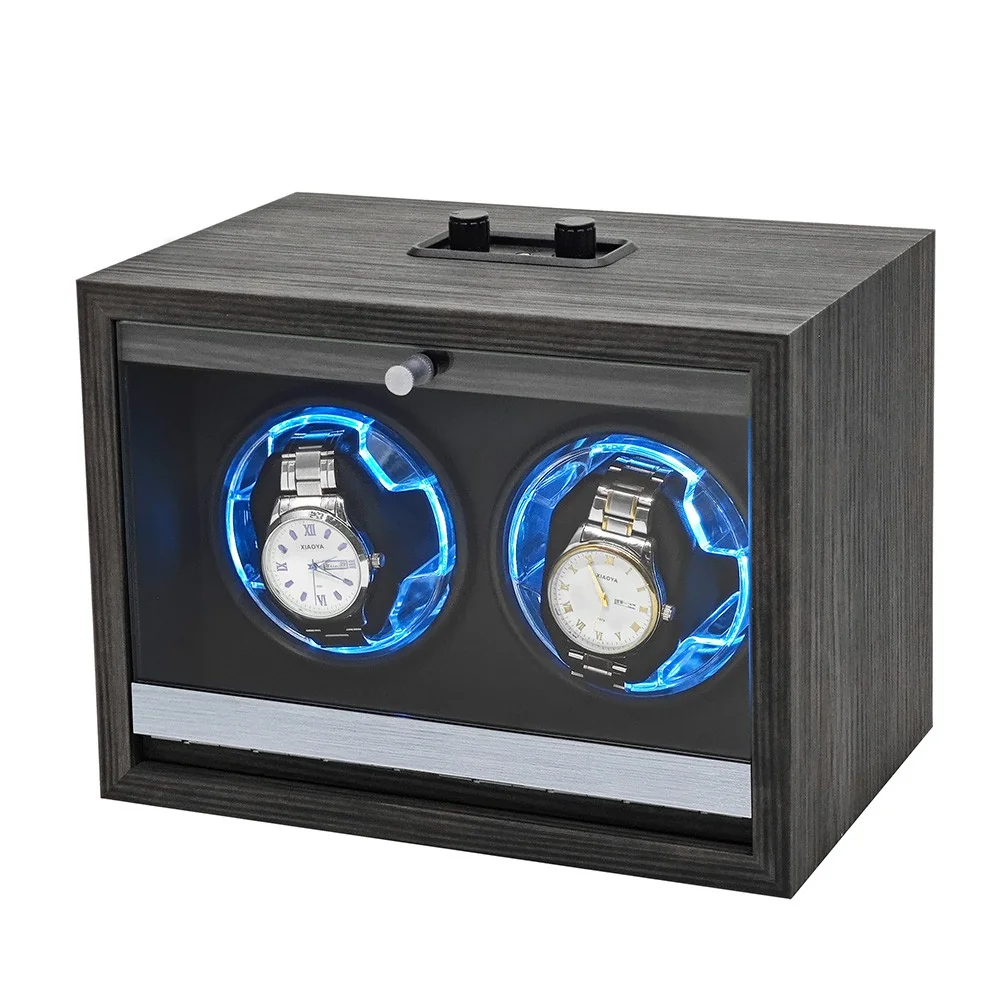
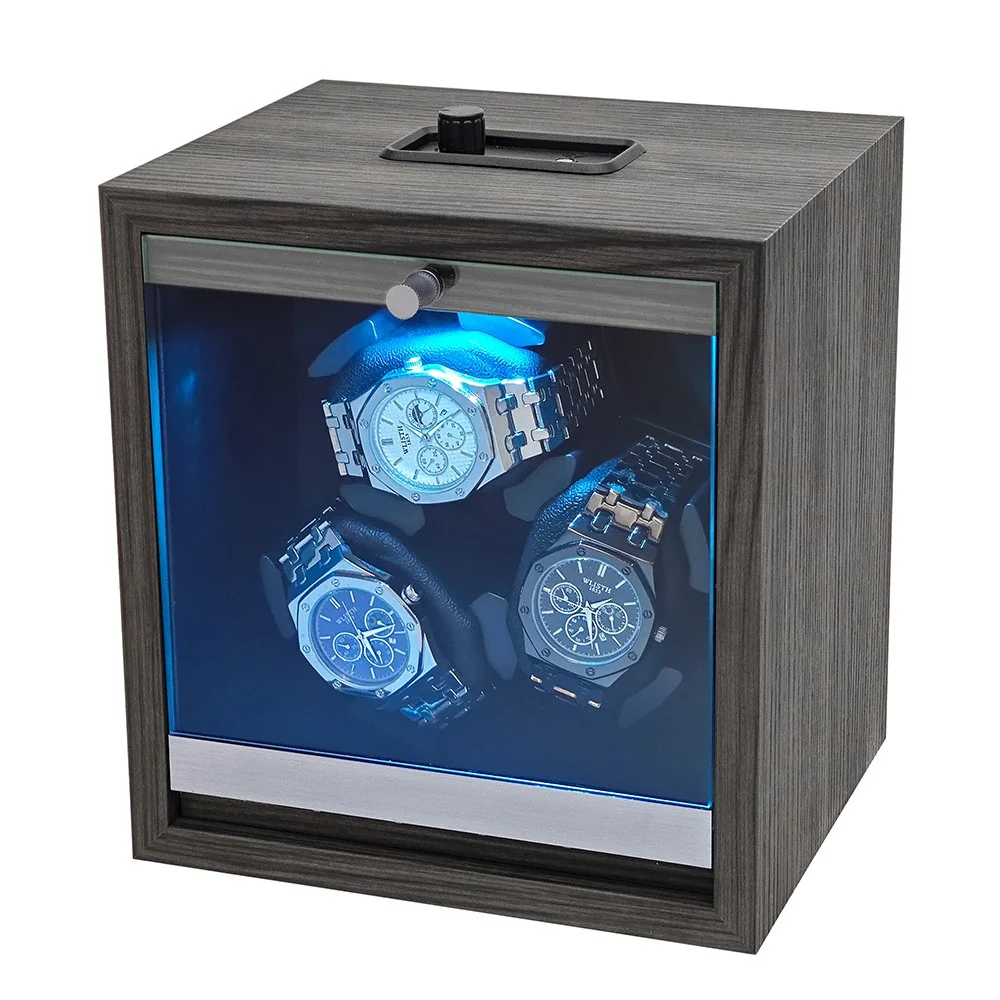
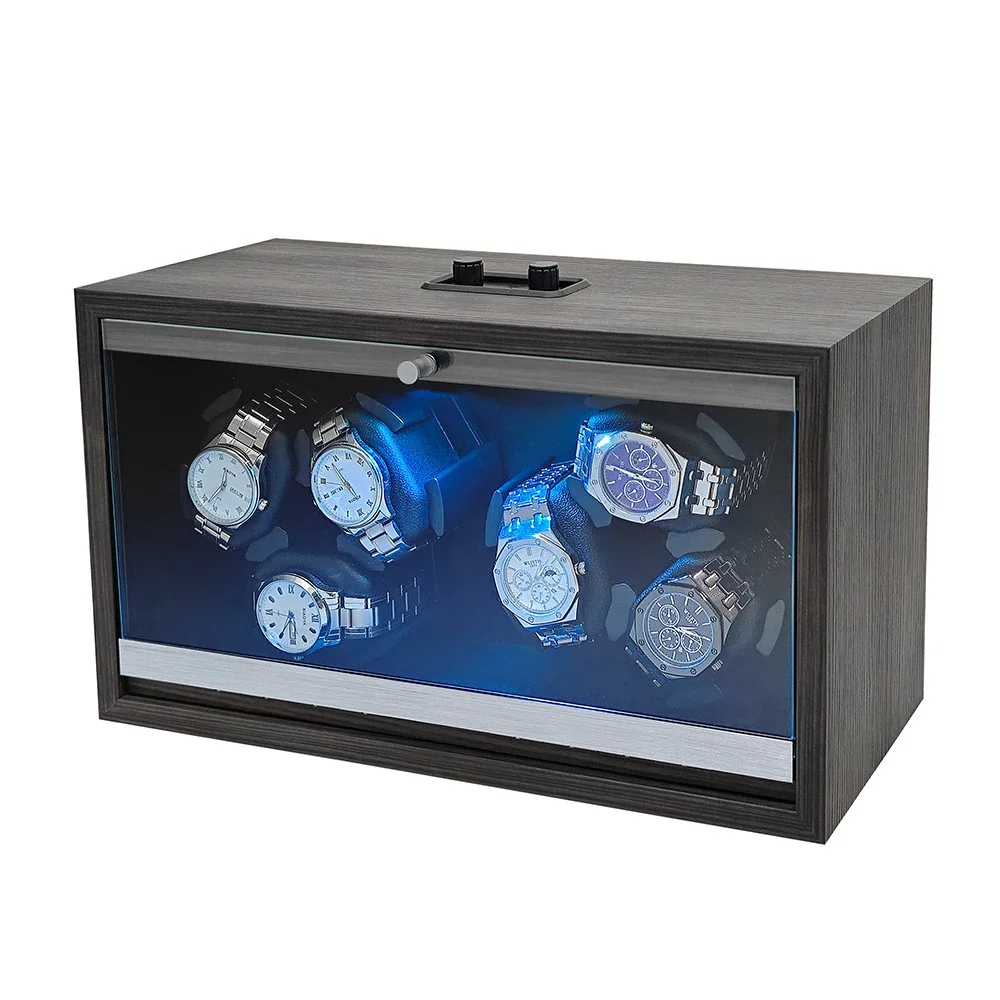
Look at the three cabinets above. Same family. Same wood grain, same door, same blue lighting. What changes is capacity — one position, two, three. Why does that matter to a buyer? Because a private-label range usually grows by adding formats, not by redesigning the one you already sell. A supplier running those housings on a single design language can extend your range without going back to a blank sheet. That is the practical difference between a supplier who can grow with you and one who starts over every season. Our own range sits on the watch winders page, and the engineering behind a multi-position housing is described in our notes on the multi watch winder system factory.
The eleven companies, and what each one says about itself
The table below is the whole reading, summarised. It is deliberately plain. Each row states what the company's own pages said on 1 October 2026, and the last column records the field that a buyer would usually want next. Where that field was never published, the row says not stated. Nothing in this table was inferred from a logo, a domain name or a directory listing.
| Company | Identity | Based in | OEM / ODM | Makes | Ask them |
|---|---|---|---|---|---|
| OEEA (OEEA INDUSTRY CO,. LTD., watchwinder.oeea.com) | Manufacturer | Guangzhou and Shantou, China | Stated | Winders; watch, jewellery and cigar boxes | Which site runs my order? |
| SUPER (superwatchwinder.com) | Manufacturer | Jiangmen, China | Stated | Winders | Who is the legal entity? |
| TaiHua (taihua-watchbox.com) | Manufacturer | Jiangmen, China | Stated | Winders | Read the note below first |
| SwissKubik (swisskubik.com) | Manufacturer, own workshop | Givisiez, Switzerland | Not used | Winders, watch boxes | Will you take a third-party brand? |
| Scatola del Tempo (scatoladeltempo.com) | Manufacturer | Italy | Not used | Winders, boxes, safes | What does bespoke cover here? |
| American Chest Company (americanchest.com) | Manufacturer | United States | Not stated | Hand-built wooden chests, including winders | Do you take OEM work? |
| Rapport London (rapportlondon.com) | Brand | London, per its own pages | Not stated | Winders, watch and jewellery boxes | Do you own production? |
| Barrington Watch Winders (barringtonwatchwinders.com) | Brand | United Kingdom | Not stated | Winders | Own plant, or commissioned? |
| TimeScape (timescapeusa.com) | Retailer | Edina, Minnesota, US | Not stated | Winders, watches | Not a sourcing target |
| WOLF 1834 (wolf1834.com) | Not stated | Not stated | Not stated | Winders, boxes, safes | Ask them directly |
| DUKWIN (dukwin.com) | Not stated | Not stated | Not stated | Winders, watches, safes | Ask them directly |
A warning about two of those rows. The contact details published by SUPER and by TaiHua are identical — the same email address, taihuawatchbox@gmail.com, and the same street address in the Xinsha industrial area of Jiangmen. Two websites, one set of contact details. We are not able to say from public pages whether these are one company operating two brands, or two companies sharing a sales office. What we can say is that a buyer should treat them as a single source until one of them demonstrates otherwise, and should not build a two-supplier strategy on the assumption that they are independent. Send both the same question and compare the answers line by line. If the answers are identical, you have one supplier, not two.
How to read the "OEM / ODM" column. It records only whether the company itself uses those words. A not stated entry is not a refusal. SwissKubik and Scatola del Tempo both describe custom work and neither describes a wholesale private-label service — which is a difference in business model, not a difference in quality. A brand that says nothing about OEM may still accept a project; a company that advertises OEM may still decline yours on volume. The column tells you what to ask, not what you will be told.
China: the manufacturers that openly describe themselves as OEM or ODM
Three of the eleven companies clear every filter at once: they describe themselves as manufacturers, they use OEM or ODM language, and they are based in China. For a private-label buyer that combination is the practical target, because it means the production side and the contract-work side are both on the table from the first message.
OEEA — OEEA INDUSTRY CO,. LTD.
Based in Guangzhou and Shantou, OEEA describes itself as a manufacturer and works across a wider footprint than most of this list: watch winders alongside watch boxes, jewellery boxes and cigar boxes. Publishing OEM or ODM capability matters here for a specific reason. A supplier that already builds four adjacent categories has existing jigs, inserts and finishing routines to borrow, which usually shortens the distance between a concept and a sample.
Two things to settle before you shortlist them. Which of the two cities actually runs your order, since a two-site footprint means one site is the nominated plant and the other is not. And what the OEM minimum looks like for your specific format, because a catalogue-wide statement about OEM capability does not tell you the entry point for a six-slot cabinet with a custom housing.
SUPER
SUPER is based in Jiangmen and describes itself as a manufacturer of watch winders, with OEM and ODM capability stated on its own pages. Jiangmen sits inside the Guangdong manufacturing belt, and the practical consequence is short material supply lines for the wood, hardware and motors this product needs.
Read the warning above the previous section before you add SUPER to a shortlist. Its published contact details are identical to TaiHua's, so the two should be treated as one source until proven otherwise.
TaiHua
TaiHua describes itself the same way — a watch winder manufacturer in Jiangmen with OEM and ODM stated — and publishes the same contact details as SUPER. On the evidence available from their own websites, there is no basis for describing them as two independent factories.
That is worth turning into a habit rather than a footnote. When two suppliers on your list share a phone number, an email address or a street address, you have not widened your supply base. You have given one supplier two chances to quote, and you have lost the second opinion you thought you were buying.
Switzerland: an in-house workshop that does not sell wholesale private label
SwissKubik is based in Givisiez, in the canton of Fribourg, and describes its products as assembled in its own workshop in Switzerland. That is a manufacturer, and its pages are specific about the production role — which is exactly the kind of statement the first section of this article was asking for.
What it is not is a private-label channel. The company describes personalised and customised work, but its own pages do not use the words OEM or ODM, and the business it describes is built around its own collection and its own brand. If your project is a competing label at wholesale quantities, this is the wrong first call, and it is better to know that before drafting a long introduction.
Where it does belong on a shortlist is a different kind of project. If you are a brand looking for a small run of high-craft units with your name on them, or a retailer building a premium display piece, a Swiss workshop with a stated in-house assembly model is a legitimate target. The question to ask first is not price. It is whether they will work with a third-party brand at all.
What "custom" means, and what it does not
There is a gap between customising a catalogue product and manufacturing someone else's design, and the two are often described using the same word. A maker offering personalisation may be changing a material, an engraving or a dial colour on an existing housing. A maker offering ODM is building from your brief, or from a design you have not finalised yet.
Ask which one is on offer, and ask it early. It changes the tooling conversation, the sample cost and the ownership of the drawing. It also decides whether the result can be sold under your name without restriction.
Italy: an inventor lineage and a bespoke route
Scatola del Tempo describes itself as the maker of the first automatic watch winder, and its pages carry that origin story openly. Whether or not a buyer cares about the history, the useful part is what follows from it: a company selling on design authorship is usually organised around bespoke and retail work rather than around contract manufacturing.
That is what its pages show. Custom and bespoke work is described; the OEM and ODM labels are not used. For an Italian maker with a design heritage, contracting to produce a third party's range would sit awkwardly against the brand it has built — so the absence of OEM language is consistent with the business model rather than an oversight.
Treat this route as a possible fit for a design-led collaboration where the maker's identity is part of the product, and as a poor fit for a buyer who needs anonymous volume production with their own label on the housing.
United States: a hand-built wooden chest line
American Chest Company describes furniture-grade wooden chests made by hand, and its range includes watch chests and winders. The word manufacturer applies, and the pages are specific about how the goods are made and by whom.
What the reviewed pages do not state is whether any OEM or private-label work is accepted. That is the open question, and it is the first thing to ask. A small hand-built operation often has real capacity for a limited run and no interest at all in a volume programme, and it may have no published minimum because the answer depends on the piece.
The other thing to raise early is freight. A solid wooden chest is heavy relative to its value, and a hand-built unit is harder to nest than a modular cabinet. Ask for the packed dimensions and the packed weight alongside the drawing, because on a landed-cost comparison those two numbers decide more than the unit figure does.
If your interest in this category extends beyond winders, the same buyer questions apply to the box side of the product line — see watch winder box OEM, watch winder manufacturer and the wider watch winder OEM options we describe ourselves.
Brands that do not describe themselves as manufacturers
This is the part most lists leave out, and it is the part with the most commercial value for a buyer. Three of the best-known names in this category describe themselves in ways that place them on the selling side of the line rather than the making side. That is not a flaw. It is the single most useful fact to know before you send a private-label enquiry.
Rapport London
Rapport London's own pages describe the business as a luxury brand. The description is about design, heritage and collection, and it does not claim a production role. The site refers to London in its name and its presentation; it does not state a country and city for a manufacturing operation in the way a factory page normally would.
So the honest summary is: a brand, and its reviewed pages do not state an OEM or ODM service. Whether it owns production or commissions it is not something we can answer from those pages. If you are sourcing, that is the question to put in writing — and it is a fair question to ask a brand, because plenty of brands do own their production and simply do not market it that way.
Barrington Watch Winders
Barrington describes itself as a United Kingdom business and presents a watch winder collection. Its reviewed pages do not state a manufacturing role, and do not mention OEM or ODM.
For a private-label buyer, the practical position is the same as above. Approach it as a brand unless and until it confirms otherwise. The reason to say this plainly is that trade listings frequently file well-known brand names under "manufacturers", and a buyer who trusts the listing rather than the company spends a week writing an introduction that will not go anywhere.
TimeScape
TimeScape is the clearest case on the list. Its own description uses boutique and authorised dealer language, and its location — Edina, Minnesota — is stated. It sells watch winders and watches. Nothing on the reviewed pages describes production, and nothing describes OEM or ODM work.
This one needs no interpretation at all. It is a retail and dealership business, its own words say so, and it is well suited to what it does. It is simply not a source for a private-label programme, and treating it as one would be a category error rather than a discovery.
| Company | Does its own site claim to make the product? | Can it plausibly take an OEM wholesale brief? | Who should approach it |
|---|---|---|---|
| Rapport London | No — describes itself as a brand | Not stated; ask directly before spending time | Shoppers, and brands exploring a design collaboration |
| Barrington Watch Winders | No manufacturing role stated | Not stated | Shoppers and retail buyers |
| TimeScape | No — describes itself as a boutique and authorised dealer | No, on its own description | Shoppers and retail buyers |
| OEEA | Yes — manufacturer, with OEM and ODM stated | Yes, subject to the minimum for your format | Private-label and contract buyers |
| SUPER / TaiHua | Yes — manufacturer, with OEM and ODM stated | Yes, but treat as one source, not two | Private-label and contract buyers |
| SwissKubik | Yes — assembled in its own Swiss workshop | The words OEM and ODM are not used; personalisation is offered | Brands seeking a high-craft collaboration |
| Scatola del Tempo | Yes — manufacturer, with an inventor heritage | Bespoke work described; OEM and ODM are not | Design-led collaborations and premium retail |
One pattern is worth naming. The companies that most often get called manufacturers in general web results are the ones that spend the most on brand marketing, and brand marketing is not the same activity as production. That is why the question in the second column of this table is the only one that matters when you are sourcing. Ask it of every name on your list, including the ones you think you already know.
Two identities we could not confirm
Two companies on the list are well known in this category and, on the pages we reviewed, do not state what they are. We are reporting that as a fact about our reading, not as a fact about them.
WOLF 1834. The reviewed pages present a collection across watch winders, watch boxes, jewellery boxes and safes, with the usual brand-level content about materials, care and warranty. No production role was stated on those pages. Country and city were likewise not stated in a manufacturing context. We did not read the company's about page, so the gap is ours as much as theirs — and the correct action for a buyer is to ask rather than infer.
DUKWIN. Same position. The reviewed pages cover winders, watches and safes without stating an identity. Its name appears in AI-generated overviews for OEM-related searches, which is interesting but is not evidence of anything: an engine can cite a page for matching a topic without that page claiming a manufacturing role. A citation is not a self-description.
Two questions resolve both cases in one email. What is the legal name of the entity that will invoice me, and where is the production site that will make my order? A company that manufactures answers both without hesitation. A company that does not will explain its model, which is also a useful answer.
A three-minute verification routine for buyers
Everything above sorts companies. This section is what to do with the sorting when a supplier you have never met claims to be a factory. None of it requires travel, and none of it requires technical knowledge. All of it requires asking in writing and reading the answer carefully.
Start with the entity. Two facts settle this. The legal name that will appear on the invoice, and the full address of the site that will make the goods. Put both beside the website. A domain name, a brand name and a legal entity are three separate things, and the space between them is where sourcing surprises hide.
Then move to the plant. A showroom proves little and a catalogue shoot proves less. What you want is the line that will run your job, live. Keep it narrow: the housing assembly, the motor fitting, the finishing lane, the final test bench. One targeted walk-through beats a glossy general tour, and a trading company cannot fake it.
Then test the paperwork. A certificate without a holder, a scope and a validity period is decoration. Ask for the file itself, not a logo. Then read whose name sits on it. If it is not your supplier's name, keep asking.
One commercial question finishes the job. What changes between your quantity and four times your quantity, and where do the savings flatten out? Now listen to how it is answered. Setup, material terms, line allocation, packing — that is a factory talking. A single rounder number, with no account of where it came from? That is a sales desk.
| Ask this | What a maker answers | Warning sign |
|---|---|---|
| Who invoices me? | A named entity, plus a plant address that matches | A vague entity, or a mailbox address |
| Can I see my line? | A live walk-through of the relevant process | Pre-recorded clips, or a showroom only |
| Which site runs my order? | One site named, and owned or partnered stated | "Our factory", with no city and no relationship |
| Show me the certificate | Holder, scope and dates, on the document | A logo image, or another company's name |
| What changes at four times the quantity? | Setup, material terms, line time, packing | A discount with no account of where it came from |
| Who owns the tooling? | The buyer, in writing, with storage and retrieval terms | Deflected, or left unstated |
| Do you supply my competitors? | A direct answer, plus how projects are separated | A denial the public catalogue contradicts |
| Assumption | What the evidence here shows instead |
|---|---|
| A famous name in this category is a manufacturer | Three of the best-known names call themselves a brand, a brand and a dealer |
| A trade directory listing proves production | Listings are self-published. Only the company can say |
| A manufacturer with a plant will accept my brief | A plant can build. Taking your label is a separate decision |
| Two websites mean two suppliers | Two companies on this list publish identical contact details |
| An AI overview citing a company proves its identity | Engines cite for topical match. That is not a self-description |
| OEM in a description means private label is available | OEM is a capability. The terms are still negotiated |
Run that routine on three candidates and you will learn more than a week of directory reading gives you. Run it on five and you will usually find that one of them is a front for another on your list.
Where Better Industrial sits in this framework
Claim boundary: this section is publisher self-description. It is not independent verification of factory ownership, in-house control of every process, materials, origin, certification, sample or bulk quality, capacity, minimum order, price, timing or delivery, and it creates no relationship with any company named above. Everything here is subject to contract, released specification and written confirmation on the specific order.
We are in the first of the four categories, and we are not ranked among the eleven companies above. BRTPAK is a trading name of Jinhua Better Industrial Co., Ltd., a manufacturer in Jinhua, Zhejiang, working across watch winders, watch rolls, watch boxes, jewellery boxes, trays and displays. We hold our own production building of roughly 4,000 square metres rather than renting a line inside someone else's plant, and we are willing to show it live on a video call instead of describing it. The production route is set out in more detail under watch winder factory.
On compliance, our documentation set includes WCA social compliance auditing, third-party testing through TÜV, FSC chain-of-custody material, and market documentation for CE, RoHS, REACH and UKCA, with French and German EPR registrations handled as part of the market pack. Paper and board sourcing claims are worth checking against the FSC system rather than trusting a logo, which is the same advice we gave above — the certification body explains its own labels on fsc.org.
On timing, we describe our service as a 2-3-7 model, and the wording matters: two hours for a concept response, three days for a design proposal, seven days for a physical sample. That is the design and sampling stage. It is not a bulk production lead time, and anyone who reads it that way will be disappointed. Ask us for the production schedule separately, because it depends entirely on the format, the finish and the quantity.
Two things about us are relevant to the verification routine above. We produce a 3D concept before physical sampling, so a rejected shape costs a screen review rather than a sample budget — which matters most when a buyer is testing several directions. And we optimise structure for carton efficiency rather than chasing the lowest possible unit price, because on winder cabinets the freight line is a real part of the landed cost. The sealed housing and glass door help here, and most of the gain comes from the internal packing plan rather than from shaving millimetres off the product.
We are not able to verify our clients' names publicly, and we will not publish them here. What we can say is that we have supplied Swiss and European watch brands and jewellery groups, three of them for more than a decade. Treat that as a stated claim, not as a certification.
✉ Send Your Watch Winder OEM Brief
Questions buyers ask us
Who are some OEM watch manufacturers?
Of the companies in this article, three state both a manufacturing role and OEM or ODM capability on their own pages: OEEA in Guangzhou and Shantou, and SUPER and TaiHua in Jiangmen. SwissKubik describes an in-house Swiss workshop and offers personalisation but does not use the OEM or ODM wording. Scatola del Tempo describes bespoke work on the same basis. Be careful with that distinction: OEM describes a willingness to build to someone else's specification, while the terms — minimum, tooling, ownership — are a separate negotiation on every project.
Who are some famous Chinese OEM watch manufacturers?
Fame is the wrong filter here, and it is worth saying why. The Chinese suppliers that appear most often in general search results are the ones investing most in marketing, which says nothing about their production. What you can act on is location and disclosure. The three manufacturers in this article sit in Guangdong — Guangzhou and Shantou, and Jiangmen — which is the established belt for wooden cases, hardware and the small precision components a winder needs. The useful test is not fame but the one used throughout this article: does the company state a manufacturing role, name a plant, and describe its OEM service in its own words? We apply the same test to ourselves under automatic watch winder factory.
What company makes the best watch winders?
The word "best" splits into two questions that need different answers. If best means the most refined finished product with the strongest brand support, the answer is a brand, and the names buyers already recognise are the right shortlist — that is what brand investment buys. If best means the most capable manufacturing partner for your own label, the answer is a manufacturer that accepts external specifications, and the relevant criteria become tooling ownership, sample turnaround, quality control and packaging efficiency rather than brand recognition. Ask which of the two questions you are actually asking before you look at any list. They do not share a shortlist, and a list built for one wastes your time on the other.
Who makes the best watch boxes?
The box side of this category follows the same identity logic as the winder side, with one difference: far more of the capacity is in Asia, and much of it is the same plants that build winder housings. Several of the manufacturers above state watch boxes alongside winders — OEEA names watch boxes, jewellery boxes and cigar boxes on its own pages, and SwissKubik and Scatola del Tempo both list boxes next to winders. If you need both, ask a single supplier first: the finishes and insert materials should match, and matching them across two factories is harder than sourcing them from one.
Are WOLF and Rapport watch winder manufacturers?
We can only report what their own reviewed pages said. Rapport London describes itself as a luxury brand and does not state a production role on those pages. For WOLF 1834, the pages we reviewed did not state an identity or a production location, and we did not read the company's about page, so we are not in a position to answer either way. Neither company's pages, as reviewed, stated an OEM or ODM service. If the answer matters to your project, ask them directly — and judge them on the answer, not on the fact that they were asked.
How do I check that a watch winder factory is real?
Four steps, in this order. Ask who will invoice you and where the production site is, then compare both against the website. Ask for a live video walk-through of the specific process your product needs, not a showroom tour. Ask for certificates as documents with a holder, a scope and dates, rather than as logo images. Then ask what changes at four times your quantity — a manufacturer describes setup, material terms, line allocation and packing, while a reseller offers a discount with no explanation. If any step is deflected twice, move on.
What is the minimum order for custom watch winders?
There is no single figure, and any supplier who quotes one without knowing your format is guessing. Three separate minimums apply: per design, per material or housing, and per finish. A winder cabinet is a multi-part assembly, so the material and finish minimums usually bind before the quantity of units does. Ask what changes between quantity tiers and where the savings flatten, rather than only the entry point, and ask it in writing against your own specification. Our own contract-work terms are described under custom watch winder OEM. We do not publish figures here because a number that suits one format misleads on another; ask us for a quotation against your brief and compare it with the other candidates on the same basis.
Can a brand with no factory still sell custom watch winders?
Yes. It happens constantly, and plenty of good ranges are built exactly that way — the brand handles design, packaging and selling, and a plant handles the making. So the model is not the problem. Not knowing which model you are dealing with is the problem. Three things change once a middle layer appears: whose name sits on the tooling, who signs off a material substitution, and who answers when a batch fails inspection. Get those three answers in writing. If they are clear, the model is fine.
Which is better for private label, Chinese or European makers?
Neither, asked that way. Your project decides it, not the map. If you are building your own label, your own design and tooling you want to own, you need a manufacturer that takes external specifications at your volume — and that profile is mostly in Asia. If the maker's craft is part of what you sell, and smaller runs at a higher unit cost still work for your market, a Swiss or Italian workshop can make sense. The failure mode runs both ways and is always the same: picking a country before picking a business model. One question sorts it. Will you build to my design, at my quantity? Whoever says yes is your shortlist.
✉ Request a Watch Winder Quotation
Next step: send one brief, and compare like with like
Match the supplier to the project, not to the label
Before you send a brief, decide which of three projects you are actually running. They filter the list fast, and they stop you from judging a supplier against criteria it was never built to meet.
| Your project | Identity you need | What to dig into |
|---|---|---|
| Own brand, your design, your label | Manufacturer stating OEM or ODM | Tooling ownership, design handover, sample rounds, packing plan |
| Own brand from an existing range | Manufacturer willing to adapt a housing | Which parts change, and what that costs per unit |
| Retail display and store fit-out | Manufacturer with consistent multi-slot formats | Series consistency, finishes, lighting, spare parts |
| Corporate or gift programme | Manufacturer already running short, high-finish runs | Small-volume feasibility, decoration, delivery window |
| Design collaboration | In-house workshop or bespoke maker | Third-party brands at your quantity, and unit cost |
| Buying finished goods to resell | Brand or dealer | Trade terms, stock, after-sales — not production |
Work down that table before you work down a supplier list. It is the difference between a search that ends in a quotation and a month of introductions that end in "we do not do that".
Put the project in writing: the format and slot count, the housing material and finish, the lining and insert, the branding method with artwork, the quantity per variant, the packing requirement and the destination market. Send the identical document to every candidate and ask each one to price it exactly, listing any deviation as a separate alternate line rather than a silent substitution.
Then apply the identity test one last time. A supplier that answers the entity question, names the plant, offers a live walk-through and explains where quantity savings come from is a manufacturer. One that answers with a unit price and a delivery date has told you what you needed to know about which of the four categories it belongs to.
Send your brief. Include the destination market, the slot count and format, the housing material and finish, the lining and insert, the branding method, the quantity by variant and the date you need the goods. We will return our own proposal and a named production site, so you can put it beside every other quotation on this page. Final cost and delivery are subject to actual specifications and a formal quotation.
✉ Send Your Sourcing Brief to BRT Pak
Company identities, production roles, locations, OEM and ODM services, materials, certifications, samples, tests, capacity, minimum order, price, packing, schedule and delivery terms remain subject to current source checks, destination requirements, contract, released specification and written confirmation. No figure in this article constitutes a price, an offer or a commitment, and no statement about any company named above should be read as an endorsement or a criticism of that company.
Research basis: company facts were read from each company's own public pages - 11 companies, 15 pages - on 1 October 2026, and are limited to what those pages stated on that date. Fields that were not published are recorded as not stated rather than estimated. Demand-side evidence comes from Google results pages collected the same day across five sourcing queries, including the related questions quoted in the FAQ. All five external sources cited or relied on here were re-fetched and reachable on 1 October 2026: the ISO 9001:2015 record, which now reads Withdrawn at stage 95.99 dated 16 September 2026 with ISO 9001:2026 as the replacement, and the FSC certification pages were re-read in full that day; the statements drawn from the European Commission's REACH pages, California's Proposition 65 pages and ISTA's test procedures were last read in full on 27 September 2026. Known gaps in this piece: the single-keyword volume and difficulty for watch winder manufacturer was never captured because of a tool quota limit and is therefore not estimated anywhere above; the about pages of two companies were not read, so their identities remain unconfirmed rather than resolved; and the related-question sample covers five queries, not the whole category.