
⌚ The Operational Risk of Improper Watch Storage
Automatic mechanical watches rely on movement to maintain power reserve. When left idle, lubricants settle unevenly, and accuracy may fluctuate after restart. According to coverage from WatchTime, consistent winding cycles help maintain lubrication distribution and long-term performance stability in mechanical timepieces.
However, low-grade winding devices often rotate excessively or irregularly. Over-rotation can stress movement components. Insufficient torque may fail to maintain reserve.
A reliable watch winder factory must therefore control rotation logic with precision rather than relying on simple motor cycles.
🧩 Motion Control and Structural Calibration
Professional manufacturing of watch winders requires integration between electronic modules and mechanical housing.
At BETTER INDUSTRIAL, the watch winder factory production process follows ISO quality management protocols to ensure motor consistency, alignment accuracy, and long-term durability.
Rotation Programming
Wind cycles are calibrated to support common TPD (Turns Per Day) ranges between 650–1200 rotations, covering most Swiss and Japanese automatic calibers.
Directional Control
Bi-directional or programmable direction modes prevent overwinding and maintain movement balance.
Noise Regulation
High-quality DC motors operate below 10–15 dB, making them suitable for bedroom or office placement.
Structural Housing
Outer cases are built from solid wood, MDF, or composite panels, with vibration dampening layers integrated between motor unit and housing frame.
Wood components are sourced through FSC certified suppliers, ensuring material traceability and structural reliability.
⚙️ Standard Winder Units vs. Professional Watch Winder Factory Production
| Feature | Generic Retail Winder | Factory-Calibrated System |
|---|---|---|
| TPD Control | Fixed rotation | Programmable 650–1200 TPD |
| Motor Quality | Basic DC motor | Low-noise calibrated motor |
| Housing | Thin panel | Reinforced MDF / solid wood |
| Power Options | Single adapter | Adapter + battery backup |
| Lifespan | 1–2 years | 5+ years under stable use |
Mass-market units often lack torque calibration testing. In contrast, a structured watch winder factory environment conducts cycle simulations to ensure rotation smoothness and alignment stability across batch production.
💡 How BETTER INDUSTRIAL Approaches Watch Winder Manufacturing
Rather than assembling generic rotation boxes, BETTER INDUSTRIAL integrates motion calibration, structural reinforcement, and aesthetic customization within its watch winder factory operations.
Motor units are sourced from tested suppliers and undergo torque consistency checks before assembly. Each batch is randomly inspected for alignment tolerance within narrow millimeter ranges to prevent off-center rotation.
Interior watch cushions are engineered to accommodate varying strap types—steel bracelets, leather bands, and rubber straps—ensuring secure grip without deformation.
Surface finishing options include lacquer-coated wood, PU leather wrapping, and matte composite panels. These finishes are evaluated for scratch resistance and humidity response under simulated storage conditions.
Before shipment, every unit passes vibration simulation tests to ensure stable performance during international freight transport.
🧭 Selecting the Right Watch Winder Based on Collection Size
Choosing the right configuration depends on watch quantity and usage pattern:
Single Watch Owners
Compact single-slot winders with programmable TPD offer quiet, space-efficient operation.
Dual or Multi-Watch Collectors
Two-slot or four-slot units support synchronized or independent rotation settings.
Retail Display Environments
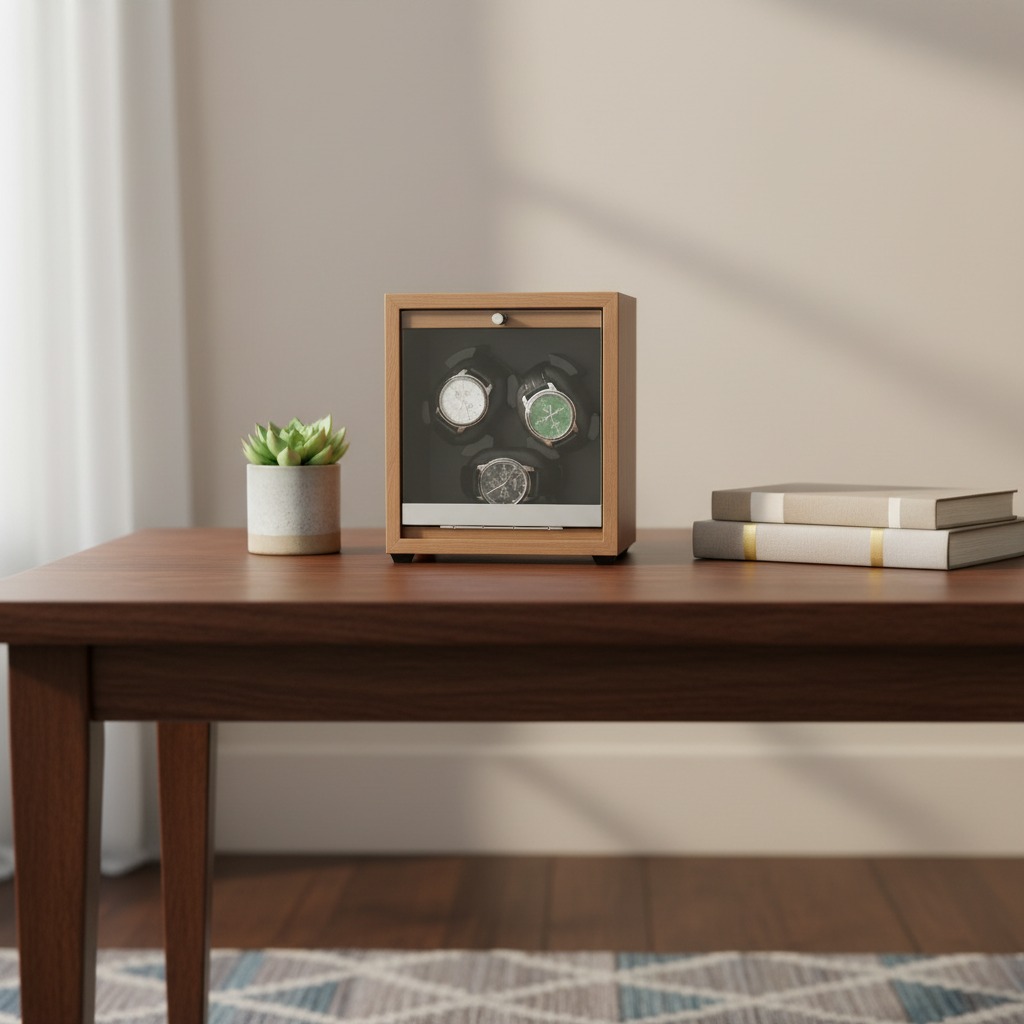
Multi-watch systems with transparent lids enhance visibility while maintaining controlled winding cycles.
Travel-Focused Users
Battery-powered compact winders reduce reliance on external adapters.
By aligning rotation capacity with collection size, users ensure efficient energy use and mechanical stability.
❓ Frequently Asked Questions
Q1: What TPD setting is ideal for most automatic watches?
Most models operate efficiently within 650–900 TPD, but specifications vary by movement.
Q2: Can winders operate continuously?
Yes, programmable pause intervals prevent excessive motion and reduce motor strain.
Q3: What is the typical MOQ from a watch winder factory?
MOQ generally begins at 200–300 units depending on housing finish and motor configuration.
Q4: Are OEM customization options available?
Yes, including logo engraving, surface material selection, and motor programming adjustments.
🎯 Controlled Motion for Long-Term Performance
A professionally operated watch winder factory ensures rotation stability, structural durability, and consistent manufacturing quality. Mechanical watches require measured motion—not guesswork.
With calibrated production processes and scalable OEM capability, BETTER INDUSTRIAL delivers watch winder systems that preserve timepiece performance while supporting brand-level presentation standards.
Explore our full watch storage and motion solutions on our homepage or contact our team directly here to discuss custom watch winder production.