
Quick Answer
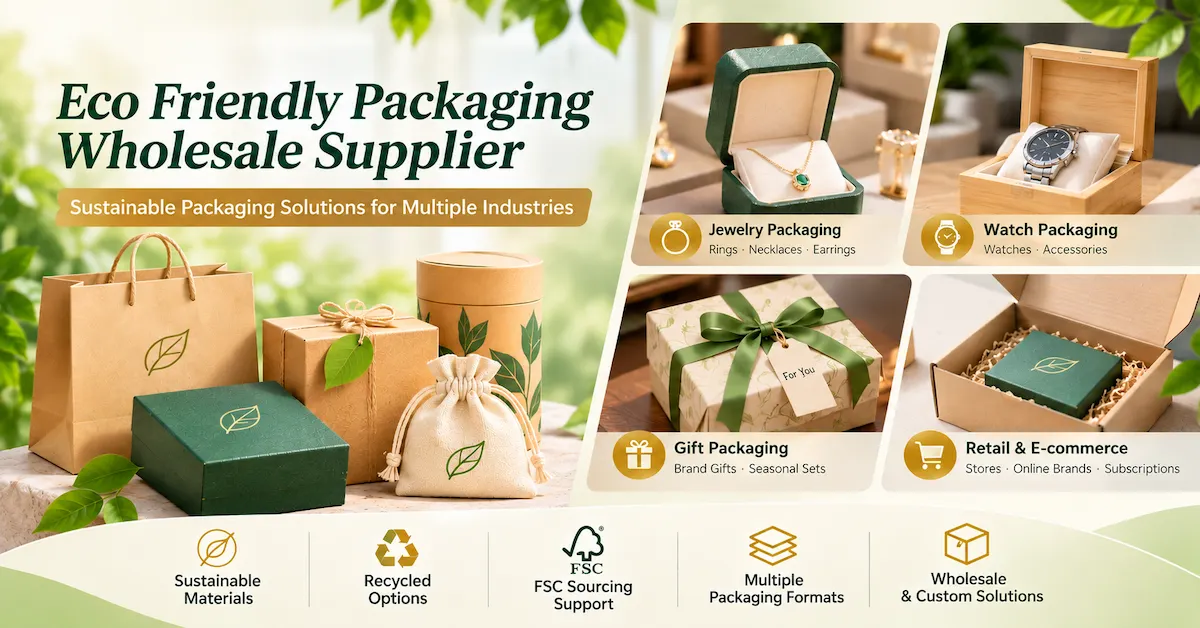
An eco friendly packaging wholesale supplier should help businesses purchase suitable packaging in commercial quantities while maintaining documented material specifications, competitive pricing, and reliable replenishment. Buyers should confirm MOQ by SKU, compare complete quotations, verify environmental claims, approve samples, and establish repeat-order controls. The most effective wholesale sourcing strategy balances packaging suitability, stock availability, total delivered cost, and consistency across future orders.
For jewelry brands, gift retailers, wholesalers, and international importers, sustainable packaging procurement becomes more complicated as purchasing volumes increase.
A company may need ring boxes, necklace boxes, gift packaging, shopping bags, and soft pouches in different quantities. Each packaging format can involve separate materials, order minimums, printing requirements, and production arrangements.
Buying all products from one supplier may simplify communication, but it does not automatically eliminate individual MOQ requirements or guarantee consistent material availability.
This guide explains how to compare wholesale packaging options, organize purchasing quantities, control environmental documentation, estimate costs, and build a more reliable replenishment program.
Key Insights: Eco Friendly Packaging Wholesale Purchasing
| Purchasing Factor | Common Challenge | Recommended Action |
|---|---|---|
| Mixed-SKU orders | Different products require separate quantities | Request MOQ and pricing by configuration |
| Material sourcing | Recycled-content or certified materials vary | Approve exact material specifications and supporting evidence |
| Wholesale pricing | Low unit prices may exclude additional charges | Compare complete landed costs |
| Packaging consistency | Reorders may use different materials or finishes | Maintain approved samples and revision-controlled specifications |
| Inventory management | Overstocking creates unnecessary holding costs | Forecast demand by SKU and establish reorder points |
| Export transportation | Carton dimensions increase freight and storage costs | Compare packing efficiency and shipment arrangements |
| Environmental communication | General sustainability claims may lack evidence | Use specific, substantiated material claims |
Key Takeaways
-
Wholesale quantity is not the same as MOQ eligibility. Suppliers may apply minimums separately to each size, color, or design.
-
A standardized material specification helps repeat purchasing. However, approved references must remain appropriate for every packaging application.
-
Environmental claims need supporting records. A paper-based construction alone does not prove that the complete box is recyclable or certified.
-
Total landed cost matters more than unit price alone. Sampling, decoration, cartons, freight, inspection, and inventory should be considered.
-
Replenishment should begin before stock runs out. Buyers need realistic forecasts and confirmed supplier lead-time assumptions.
1. Why Is Wholesale Sustainable Packaging Sourcing Different From Factory Auditing?
Factory auditing focuses on evaluating production capabilities, documentation, environmental claims, and manufacturing controls.
Wholesale sourcing requires an additional commercial decision: whether the supplier can support the buyer's required assortment, purchasing quantities, and replenishment schedule.
A supplier may offer an attractive recycled-paper gift box but be unsuitable for a retailer needing several packaging sizes at different quantities.
Likewise, a supplier may handle large orders efficiently but lack a practical solution for small-volume seasonal designs.
Who Should Use a Wholesale Supply Program?
This approach is particularly relevant to jewelry retail chains, private-label jewelry brands, gift distributors, e-commerce companies, and packaging importers purchasing repeatedly.
These buyers often need consistent packaging across multiple sales channels.
For a business purchasing only a few ready-made boxes, a wholesale customization program may be unnecessary.
For buyers with long-term demand, however, standardizing requirements and maintaining controlled supplier records can simplify future purchasing decisions.
The primary objective is not merely finding a company that offers environmentally focused packaging.
It is developing a commercially practical supply arrangement.
2. How Do You Plan Mixed-SKU Eco Packaging Wholesale Orders?
A mixed-SKU order contains several packaging configurations that may differ by product type, dimension, color, material, or branding.
Before contacting suppliers, build a purchasing matrix.
Example Wholesale Packaging Assortment
Consider a hypothetical jewelry business planning the following order:
| Packaging SKU | Packaging Type | Planned Quantity | Primary Requirement |
|---|---|---|---|
| SKU-A | Paper ring box | 1,200 | Compact structure and ring support |
| SKU-B | Necklace box | 800 | Chain organization and pendant presentation |
| SKU-C | Gift box | 1,000 | Coordinated branded exterior |
| SKU-D | Jewelry pouch | 600 | Soft storage and suitable closure |
| Total | Four configurations | 3,600 | Coordinated purchasing program |
These figures illustrate an RFQ planning method. They are not BRT PAK MOQ requirements, available stock quantities, or verified customer orders.
The buyer should not assume that a total order of 3,600 units satisfies the minimum for all four configurations.
Confirm Whether MOQ Applies Per SKU
Ask the supplier whether minimum quantities apply by structure, size, exterior material, color, or logo process.
Different products may require separate material procurement or production setups.
Where quantities can be consolidated, request written confirmation of the eligible combinations.
Identify Shared Material Opportunities
Some packaging products may share the same wrapping paper, logo artwork, or color reference.
This can simplify design management when technically feasible.
However, ring inserts, necklace supports, and gift box compartments must still suit their intended products.
Distinguish Core and Seasonal Packaging
Core packaging represents products with recurring demand.
Seasonal packaging includes limited-edition designs, promotional colors, and special gift collections.
Keeping these categories separate helps buyers avoid applying the same order quantities to products with different sales patterns.
3. Which Packaging Formats Should Wholesale Buyers Compare?
A sustainable packaging purchasing program may include rigid boxes, folding cartons, paper bags, pouches, and other product-specific formats.
Different formats have different structural, functional, and environmental considerations.
Wholesale Packaging Format Comparison
| Packaging Format | Suitable Applications | Purchasing Advantages | Main Considerations |
|---|---|---|---|
| Rigid paperboard box | Jewelry, watches, premium gifts | Structured retail presentation | Covering, lining, insert, packing volume |
| Folding paper carton | Lightweight retail items | Potentially compact shipment format | Structural suitability and decoration |
| Kraft paper bag | Retail shopping and gifting | Flexible branding and material options | Handle construction, reinforcement, coatings |
| Textile jewelry pouch | Jewelry and small accessories | Flexible storage and presentation | Fiber content, seams, closure, durability |
| Bamboo presentation box | Premium jewelry and keepsakes | Distinctive material appearance | Weight, finish, lining, sourcing evidence |
| Gift box with insert | Multi-item gift collections | Organized presentation | Compartment fit and material complexity |
The right option depends on product protection, brand requirements, distribution conditions, and the environmental attributes the buyer wishes to substantiate.
Paper-Based Jewelry Packaging
Paperboard is often considered for customized retail packaging because it supports multiple structural and decorative formats.
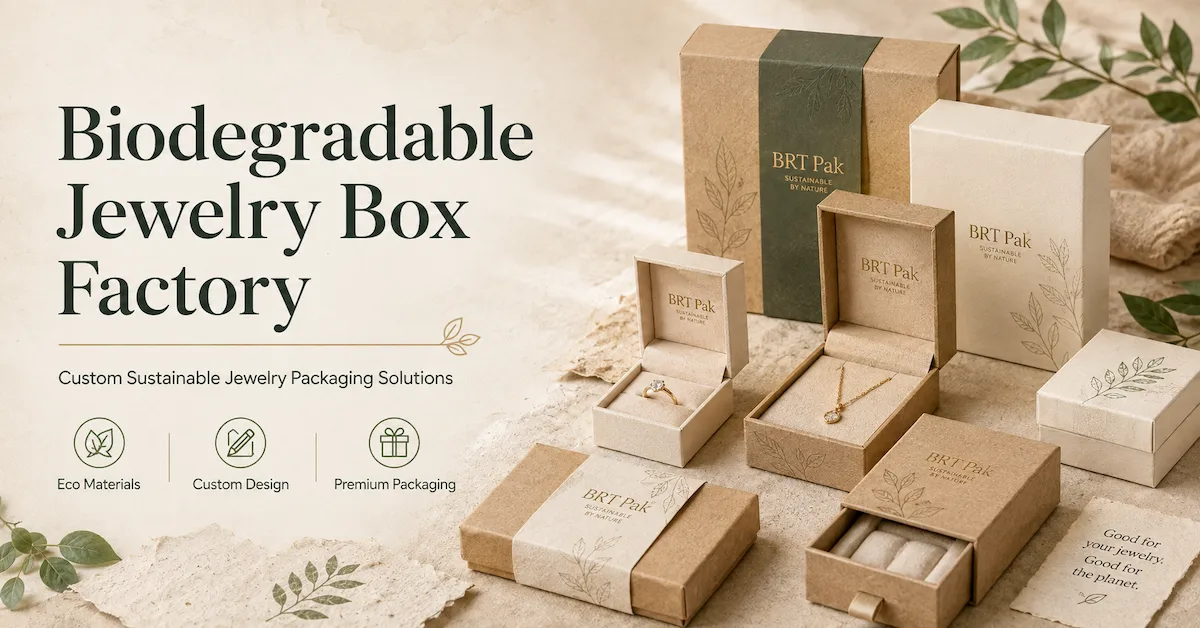
BRT PAK's Paper Jewelry Box provides a drawer-style design reference with a ribbon pull and soft lining.
However, its paper-based structure should not be treated as proof that the complete packaging is recyclable or made from recycled material.
Those attributes require confirmation for the selected construction.
Bamboo and Other Presentation Boxes
BRT PAK's JBW190 Bamboo Jewelry Box illustrates another material direction with microfiber lining.
For wholesale buyers, the evaluation should include product fit, construction consistency, carton dimensions, weight, and supporting material information.
A natural material appearance does not automatically establish environmental superiority.
Bags and Gift Packaging
Retailers may need shopping bags, jewelry boxes, and gift packaging under one coordinated brand identity.
Buyers can review BRT PAK's Bags collection and Gift Box collection as starting points.
Confirm available designs and customization options for each category rather than assuming identical manufacturing conditions apply across all products.
4. How Do Wholesale MOQ and Price Breaks Affect Purchasing?
An eco friendly packaging wholesale supplier should provide quotations that make quantity requirements and included costs clear.
The buyer needs to distinguish production-related minimums from the overall shipment quantity.
Compare Pricing at Realistic Quantities
Request quotations at quantities relevant to your demand forecast.
For example, the buyer might request separate prices at 500, 1,000, and 2,000 units where those quantities are feasible for the selected product.
These are illustrative quotation levels, not universal order minimums.
Understand What Drives Wholesale Pricing
A supplier's quotation can be influenced by structural materials, surface finishes, insert complexity, decoration, printing setup, quantity, inspection, and export packing.
Additional documentation or material requirements may also affect sourcing.
Evaluate the Complete Unit Cost
A lower factory price does not necessarily mean a lower delivered cost.
A useful comparison is:
Landed cost per accepted unit = Total applicable purchasing and delivery costs ÷ Accepted usable quantity
Depending on the transaction, the numerator may include packaging production, sample charges, decoration, inspection, freight, import charges, and other relevant purchasing expenses.
Keep ongoing inventory holding costs visible as a separate planning measure where appropriate.
Avoid Buying Excess Inventory for a Price Break
Increasing order quantities may reduce unit costs but raise storage expenses and the risk of obsolete packaging.
This is particularly important for seasonal branding or changing jewelry collections.
Compare the value of a price break against realistic sales demand and warehouse requirements.
5. How Can Buyers Verify Environmental Claims Across Wholesale Orders?
Environmental documentation should be linked to the specific packaging configuration, not treated as a general supplier-wide promise.
What Evidence Should Be Requested?
| Environmental Requirement | Relevant Information |
|---|---|
| Recycled-content specification | Material component, percentage, and supporting records |
| FSC-related sourcing | Applicable certificate, scope, and product or transaction claim |
| Recyclability statement | Complete packaging construction and relevant recycling conditions |
| Reduced material use | Defined comparison baseline and measurements |
| Plastic-reduction project | Original and revised component specifications |
| Repeat-order consistency | Approved material references and change records |
Recycled Content Is Not the Same as Recyclability
A box containing recycled paper may include other materials that affect its end-of-life options.
Similarly, a package designed for recycling does not necessarily contain recycled material.
The FTC's Environmental Claims: Summary of the Green Guides explains why environmental marketing statements should be specific and substantiated.
This guidance is particularly relevant for buyers selling packaging into the United States. Other destination markets may have different requirements.
Verify FSC Claims Before Marketing
If an order requires FSC-certified sourcing, the buyer can consult the official FSC Certificate Search.
Verify the relevant certificate holder and scope, and confirm that the required claim is supported by the actual product and transaction documentation.
A supplier having an FSC certificate does not automatically mean every item in its catalog can be sold with an FSC claim.
Repeat Verification When Specifications Change
If a supplier substitutes a board, covering, or other relevant component, the buyer should determine whether the previous environmental claim remains applicable.
Environmental evidence should follow the approved product specification through future orders.
6. How Do You Maintain Consistent Packaging Quality in Bulk Orders?
Wholesale purchasing introduces a specific challenge: different production batches must meet the same agreed requirements.
A physical sample is an essential reference, but it should be supported by written specifications.
Establish a Golden Sample
The approved sample should represent the relevant box structure, exterior finish, insert, color, logo, and opening mechanism.
Keep the specification and artwork revision associated with that sample.
Confirm Quality-Control Responsibilities
Important checks may include incoming materials, initial production units, in-process workmanship, finished dimensions, cosmetic appearance, closure function, and packing.
For jewelry packaging, evaluate product-contact surfaces and inserts with representative jewelry.
Use Consistent Acceptance Criteria
Buyer and supplier should agree on how functional and cosmetic defects will be assessed.
If sampled inspection is used, confirm the sampling method and acceptance conditions.
No inspection plan guarantees that every unit will be defect-free.
Manage Reorder Changes
Before each repeat order, confirm whether any approved material, component, or decoration process has changed.
A substitute material should be reviewed before production if it affects appearance, function, environmental claims, or cost.
Written change control is more reliable than relying only on previous order photographs.
7. How Do Shipping and Carton Dimensions Affect Wholesale Cost?
Packaging is often shipped as finished empty products.
For bulky rigid boxes, transportation and warehouse space can be important commercial factors.
Confirm Export Packing Information
Request the number of units per master carton, external carton dimensions, gross weight, protective arrangement, and labeling.
Calculate total shipment volume using the agreed carton configuration.
Shipment volume (m³) = Carton length × width × height in meters × Number of cartons
This calculation gives a planning figure for the cartons themselves; actual freight charging rules and loading efficiency must be confirmed with the logistics provider.
Compare Packing Efficiency
Ask whether individual protection and master-carton arrangements can be optimized without increasing damage risks.
Folding packaging may provide different transport characteristics from rigid presentation boxes.
However, the appropriate comparison depends on finished construction, assembly requirements, and product suitability.
Clarify Delivery Terms
Confirm the agreed Incoterms rule and named place, as well as the responsibilities for export arrangements, transportation, insurance where applicable, import clearance, and delivery.
A quotation should be evaluated against the same commercial terms.
8. How Should Buyers Plan Sustainable Packaging Replenishment?
For repeat wholesale purchasing, the main challenge is keeping enough packaging available without creating excessive inventory.
The supplier relationship should support planned reorders rather than relying only on emergency purchasing.
Establish a Reorder Point
A simple inventory planning formula is:
Reorder point = Expected demand during replenishment lead time + Safety stock
Safety stock should reflect demand variability and potential supply delays.
Illustrative Replenishment Example
Consider a retailer using 500 packaging units per month.
If its planning assumption is two months from reorder to usable stock, and it chooses a safety stock of 300 units:
Reorder point = (500 × 2) + 300 = 1,300 units
This is a hypothetical inventory calculation, not a BRT PAK production lead time or a recommended universal safety stock.
The appropriate figures should be determined from actual sales, supplier confirmations, transit arrangements, and business risk tolerance.
Maintain an Approved Reorder Record
A practical reorder record should include the SKU, latest approved drawing, material reference, artwork revision, insert specification, individual packing requirements, and any documentation needed for environmental claims.
Ask the supplier to confirm availability and schedule before each repeat order.
Review Slow-Moving SKUs
A product with irregular demand may require a different purchasing strategy from a standard box used throughout the year.
Avoid maintaining unnecessary inventory simply to achieve an attractive unit price.
9. Single Supplier or Multiple Suppliers: Which Is Better?
One supplier may simplify communication and shipment coordination, especially when several related packaging products are involved.
However, a single supplier should not automatically be considered better than several specialist suppliers.
| Sourcing Approach | Potential Advantage | Main Risk |
|---|---|---|
| Single packaging supplier | Fewer commercial contacts and potentially coordinated development | Dependence on one supply relationship |
| Multiple specialist suppliers | Access to different product expertise | More complex quality and scheduling coordination |
| Primary supplier with approved alternatives | Additional flexibility | Requires duplicate specifications and qualification work |
The correct approach depends on purchasing volume, product complexity, brand consistency, and business continuity requirements.
Where a supplier supports multiple categories, confirm its responsibilities and actual production arrangements for each product.
A company acting as a wholesale supplier may coordinate production through different facilities. Buyers should understand who is accountable for approved specifications and quality.
10. How Can OEM/ODM Customization Support Wholesale Packaging?
OEM and ODM development can support wholesale purchasing when a buyer needs more than a standard catalog product.
OEM projects may begin with buyer-defined specifications, while ODM projects can involve supplier-supported design development.
For an established wholesale packaging program, the priority is maintaining a repeatable and approved design.
Standardize Branding Where Practical
A coordinated packaging family may use shared logo artwork, colors, and selected material references.
However, different products can require different dimensions and inserts.
Control Design Revisions
Packaging artwork and structural specifications should carry clear revision identifiers.
If a buyer updates its logo or changes the exterior material, the change should be reflected in the quotation and production approval.
Request a Project-Specific Development Proposal
Ask which services are available, what sample stages are required, and how the commercial terms are structured.
Do not assume that all materials, logo finishes, sizes, or design changes are available at the same MOQ.
11. Why Consider BRT PAK for Wholesale Packaging Projects?
BRT PAK / Better Industrial, operated by Jinhua Better Industrial Co., Ltd., publishes a portfolio covering jewelry boxes, gift packaging, bags, displays, and related packaging products.
Its company profile describes packaging design, development, manufacturing, and international logistics coordination services.
These product categories and services are relevant to buyers planning coordinated commercial packaging orders.
Evaluate the Published Product Range
BRT PAK's Jewelry Boxes collection provides references for different jewelry packaging directions.
Buyers looking at paper-based and alternative material concepts can discuss suitable constructions, customization requirements, and sampling.
For environmental claims, the proposed finished configuration should be reviewed separately from general company or product descriptions.
Confirm Actual Wholesale Terms
When contacting BRT PAK, request MOQ and pricing by configuration, material information, customization options, sample arrangements, packing details, and project-specific production milestones.
Buyers should not infer stock availability, delivery times, certifications, or price reductions from general marketing information.
Explore BRT PAK Packaging Products
Request Wholesale Packaging Pricing
12. What Should You Include in a Wholesale Eco Packaging RFQ?
A clear RFQ allows suppliers to quote the intended products and identify any constraints.
Wholesale RFQ Checklist
| Information | Buyer Input |
|---|---|
| Buyer type | Brand, importer, distributor, or retailer |
| Product categories | Boxes, bags, pouches, gift packaging |
| SKU list | Each design, size, and color |
| Estimated quantities | Forecast by SKU |
| Packaging specifications | Dimensions, structure, insert, covering |
| Environmental requirements | Defined material attributes and supporting documentation |
| Branding | Artwork, logo method, color references |
| Sampling | Required approvals and inspection criteria |
| Delivery destination | Country and agreed delivery terms |
| Replenishment | Forecast frequency and planned reorder process |
Example Wholesale Inquiry
We are sourcing coordinated packaging for our jewelry and gift collections.
We require several packaging SKUs with different expected quantities and would like to evaluate paper-based and other suitable material options.
Please review the attached dimensions, reference designs, branding artwork, and purchasing forecast.
Kindly provide MOQ and quantity-based pricing for each configuration, material specifications, available environmental documentation, sampling requirements, quality-control arrangements, and export-carton information.
We would also like to understand how approved materials and artwork can be maintained for repeat orders.
This gives the supplier an actionable brief and creates a basis for comparing quotations.
Send Your Wholesale Packaging RFQ
Frequently Asked Questions
1. What Does an Eco Friendly Packaging Wholesale Supplier Provide?
An eco friendly packaging wholesale supplier provides packaging in commercial quantities and may support material selection, customization, sampling, production coordination, and repeat orders. Buyers should verify the actual services offered and any environmental claims applicable to the products purchased.
2. Can Different Eco Packaging Products Be Ordered Together?
They may be included in one commercial project or shipment, but different configurations can have separate MOQ requirements. Ask whether quantities may be combined for production and quotation purposes.
3. What Is the MOQ for Sustainable Jewelry Packaging Wholesale?
MOQ varies by box construction, material procurement, decoration, size, and production arrangements. Request quantities and price breaks for the specific configurations you intend to purchase.
4. Is Recycled Paper Packaging Always Recyclable?
No. Recycled content and recyclability describe different attributes. Adhesives, coatings, linings, and other components can affect the recycling options of the finished packaging.
5. Can Wholesale Packaging Be Customized With a Logo?
Customization may be available through suitable printing or decoration processes. Confirm the available methods for the selected material and approve a decorated sample before commercial production.
6. How Can Buyers Compare Wholesale Packaging Prices?
Compare the same structural specifications, materials, inserts, decoration, quantity, packing requirements, and delivery terms. Evaluate total landed cost and inventory implications, not only unit price.
7. How Can I Verify FSC Packaging Claims?
Check the relevant certificate details using official FSC resources and request supporting documentation for the actual ordered product. A supplier's general certification claim does not automatically cover every product.
8. How Do I Maintain Color and Material Consistency in Repeat Orders?
Use approved samples, material references, artwork revisions, and written specifications. Review changes before production and confirm the approved configuration for each reorder.
9. How Early Should I Reorder Wholesale Packaging?
Determine the reorder point from expected demand during the full replenishment period plus appropriate safety stock. The correct timing depends on your sales patterns, production arrangements, transit time, and risk tolerance.
10. How Can I Request Wholesale Packaging From BRT PAK?
Prepare a list of packaging SKUs, product dimensions, preferred materials, artwork, forecast quantities, environmental requirements, and destination market. Review the BRT PAK product portfolio and contact BRT PAK for project-specific information.
Conclusion
Choosing an eco friendly packaging wholesale supplier requires more than comparing materials or asking for a lower bulk price.
For jewelry brands, gift companies, importers, and retailers, successful wholesale sourcing depends on managing multiple packaging configurations, verifying environmental documentation, controlling MOQ, and building reliable replenishment procedures.
Buyers should prepare SKU-level purchasing forecasts, compare complete quotations, approve representative samples, and maintain clear material and artwork specifications.
They should also evaluate export-carton arrangements, landed costs, inventory holding requirements, and future production changes before establishing a long-term supply program.
BRT PAK / Better Industrial provides jewelry boxes, gift packaging, bags, and related products, alongside published design-development and international service capabilities.
Explore the BRT PAK Jewelry Boxes collection and contact BRT PAK with your packaging specifications, material requirements, estimated order quantities, and replenishment plans.
A well-organized wholesale purchasing strategy helps businesses maintain consistent brand presentation, make more informed environmental claims, and manage packaging supply with greater commercial confidence.