
What Should an Earring Box Factory Control Beyond Appearance?
An earring box factory should be able to convert a jewelry brand's product and packaging requirements into a controlled production specification that can be repeated after the first approved sample. For earrings, this involves more than manufacturing a small box in the correct color. The factory needs to understand how the earrings sit inside the insert, how the insert interfaces with the box structure, how the exterior material responds to wrapping and logo processes, and which characteristics must remain consistent during bulk production.
This is the main difference between evaluating a finished sample and evaluating a manufacturing system. A sample can look excellent as a single piece, while bulk production still develops problems such as inconsistent insert positioning, color variation, uneven wrapping, inaccurate logo placement or changes between repeat orders. BRT Pak's existing earring box supplier guide focuses heavily on product fit and insert design; when evaluating a factory, buyers should take the next step and ask how those approved details are transferred into production controls.
Who Should Source Directly From an Earring Box Factory?
Direct factory sourcing is particularly relevant to jewelry brands launching branded collections, private-label companies that expect repeat orders, importers managing several earring packaging SKUs, retailers developing coordinated packaging systems, and buyers who require changes to structure, insert, materials, colors or branding. These projects benefit from tighter control over samples, revisions, production instructions and quality acceptance because the packaging must remain consistent beyond one shipment.
Direct factory development may be less necessary when the buyer only needs a small quantity of an existing generic box with no meaningful structural or branding changes. In that situation, an established stock format may be sufficient. The decision should therefore depend on how much control the project requires rather than on the word “factory” itself. Buyers can first review BRT Pak's Jewelry Boxes range and determine whether an existing product direction can be adapted or whether the earring collection requires a more customized development route.
Start With a Factory-Ready Earring Packaging Specification
One of the most common purchasing mistakes is sending only a reference image and asking a factory to “make something similar.” A photograph communicates visual direction, but it does not define internal dimensions, earring fit, material construction, insert layout, logo method, color standard or individual packing. Two factories can therefore quote apparently similar boxes while actually planning different products.
A stronger RFQ separates the packaging into controllable elements. The table below is a buyer-side specification framework rather than a statement that every BRT Pak project uses identical dimensions or tolerances.
| Specification Area | What the Buyer Should Define or Confirm | Production Risk if Left Vague |
|---|---|---|
| Earring type | Stud, hoop, drop, huggie, statement or mixed SKU | Insert may not match the jewelry |
| Product dimensions | Overall width, height, depth and fastening structure | Clearance and positioning may be wrong |
| Box dimensions | External and usable internal dimensions | Product may fit the box externally but not internally |
| Insert layout | Pair spacing, holes, slots, backing clearance | Earrings may tilt, move or become difficult to remove |
| Structural material | Actual body construction | Cost and rigidity can vary significantly |
| Exterior finish | Material, texture, color and reference | Sample-to-bulk appearance may drift |
| Interior contact material | Lining or insert covering | Product presentation and contact conditions can change |
| Branding | Artwork, size, location, color and process | Logo result becomes subjective |
| Closure | Hinged, lid-and-base, drawer or other agreed format | Opening behavior may differ from expectation |
| Individual packing | Sleeve, pouch, protective wrap or carton | Finished delivery scope may be misunderstood |
| Export packing | Carton arrangement and agreed protection | Shipping cost and damage risk are harder to assess |
| Approved revision | Drawing, artwork and physical sample version | Factory may manufacture from an outdated version |
BRT Pak's OEM jewelry box guide similarly starts custom development from product requirements, structure, material, logo, sample confirmation and bulk production rather than from appearance alone.
The Insert Is a Manufacturing Component, Not Just Decoration
For an earring box, the insert is often the component most closely connected to actual product functionality. Stud earrings need controlled spacing and sufficient room for posts and backs; hoops require clearance for diameter and fastening mechanisms; drop earrings need enough usable height to avoid folding or overlapping; irregular statement earrings may require more customized support.
An earring box factory should therefore receive actual earring dimensions or representative samples before the final insert is approved. The buyer should test how easily the earrings are mounted, whether both pieces appear level, whether the fasteners have enough clearance, whether the product moves during normal handling, and whether removing the jewelry damages the insert or requires excessive force. BRT Pak's current OEM packaging content specifically notes that earring boxes require accurate positioning and that jewelry-specific packaging structures should be developed around the actual product rather than a universal insert.
This is also where repeat-order control begins. If one insert version is approved for studs and another for larger hoops, those versions should not be identified only as “small insert” and “large insert.” Each should have a controlled reference linked to the corresponding box and product group.
Separate Every Material Layer Before Sample Approval
“Velvet jewelry box,” “PU box” and “rigid earring box” are useful marketing descriptions, but they are often incomplete manufacturing specifications. A factory-ready bill of materials should distinguish the structural body, exterior covering, interior lining, insert base, insert covering, closure components and branding treatment.
BRT Pak's jewelry-packaging content discusses material directions including velvet, PU leather, microfiber, suede, rigid paperboard, MDF and wood, but the correct construction depends on the selected design and must be confirmed for the actual order.
For buyers, the useful question is not “Do you have premium materials?” It is “Which exact materials are used in this approved sample, and how will those references be controlled during the bulk run?” Where color or texture matters, physical swatches or the approved sample provide a stronger reference than a verbal description such as “light beige” or “soft-touch green.”
Prototype Approval Should Find Production Problems Early
A physical prototype serves a different purpose from a 3D visual. Digital development can help buyers evaluate proportions, general layout and branding direction, but the physical sample reveals material behavior, fit, opening experience, insert position, logo execution and actual dimensional relationships.
BRT Pak's prototype jewelry box factory guide identifies incorrect dimensions, poor jewelry fitting, unsuitable materials, weak structural design, unsatisfactory logo effects and manufacturing difficulties as issues that can be discovered before mass production.
For an earring project, sample approval should therefore answer two questions at the same time: Does the box meet the brand's expectations, and can the approved construction realistically become the production reference? Buyers should avoid approving an empty sample when the real challenge is how the earrings interact with the insert.
Create a Golden Sample and Revision Record Before Production
The phrase “same as the approved sample” only works when everyone knows which sample is approved. Once a design goes through multiple material, color, insert or logo revisions, an uncontrolled sample history can create serious confusion.
Before bulk manufacturing begins, identify one final sample revision together with the related artwork, material references and structure information. Any later change should be documented rather than communicated only through messaging or photographs. If the buyer approves a different insert after the exterior box has already been approved, the production record should make that new combination explicit.
A practical approval file can contain the sample code, date, exterior reference, insert reference, logo artwork version, approved colors, photographs and packing requirements. This workflow is a buyer-side recommendation, but it follows the same sample-confirmation logic presented in BRT Pak's custom jewelry packaging manufacturer guide.
How Should an Earring Box Factory Transfer a Sample Into Bulk Production?
A factory audit should look beyond the sample room. The buyer needs to understand how the approved product is communicated to purchasing, material preparation, production, assembly, branding, inspection and packing. The exact documents and production stations will differ by factory and product, so buyers should not assume one universal process. What matters is whether the important approved characteristics are transferred into repeatable instructions.
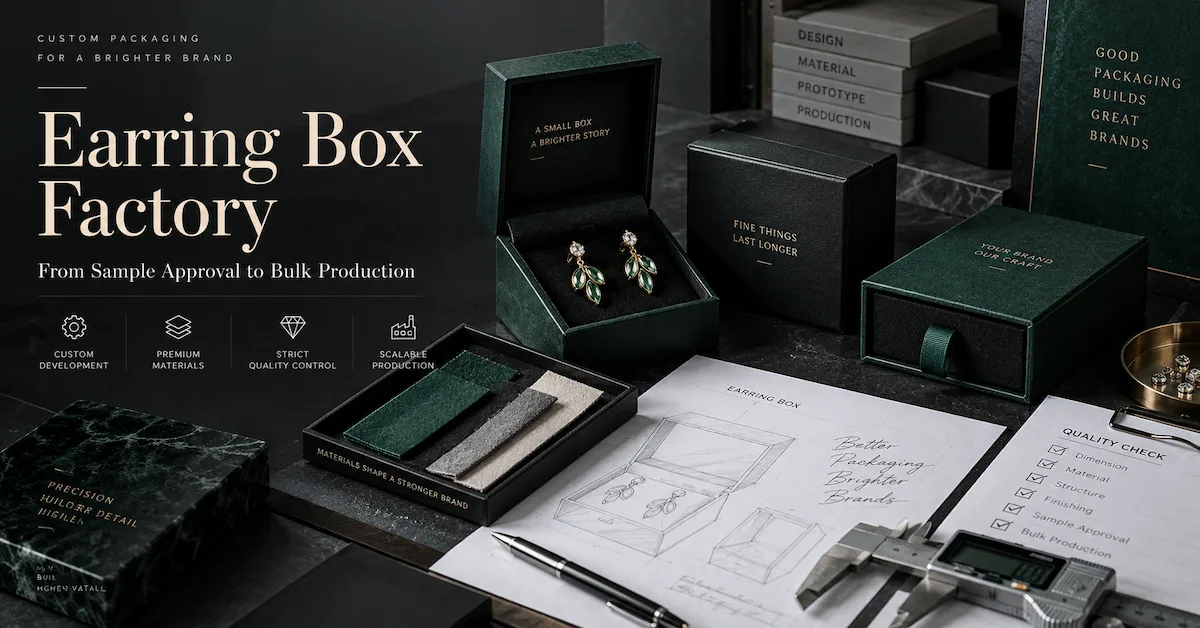
A practical production-transfer discussion should cover the approved structure, materials, cutting or forming dimensions, insert position, wrapping and assembly details, logo reference, color reference, packing specification and inspection checkpoints. BRT Pak describes its broader business model as integrating packaging design, R&D, production and global logistics management, while its OEM guidance presents design communication, structure development, materials, logo customization, samples, QC and bulk production as connected stages.
The key purchasing question is therefore not simply “Can you manufacture this?” It is “How will you ensure the bulk production team manufactures the version we actually approved?”
Inspect Workmanship at the Points Where Variation Can Occur
Earring boxes are small products, which can make minor visual differences more noticeable. A few millimeters of insert misalignment, an off-center logo or uneven wrapped edges can alter the presentation even when the box remains functional. Buyers should identify critical visual and structural characteristics before inspection begins.
For covered or wrapped boxes, review corners, seams, edges, wrinkles, visible adhesive and material direction. For rigid structures, check shape, alignment and opening behavior. For inserts, check position, pair symmetry, openings or slots, exposed edges and fit. For branded surfaces, check logo position, size, clarity and agreed color or finish.
The important point is to define what should be checked against a reference. “Fine workmanship” is difficult to inspect consistently; “logo centered according to approved artwork and physical sample” is much clearer.
Build Quality Control Around Incoming, In-Process and Final Checks
An earring box factory should not rely only on finished-product inspection when important problems can begin earlier in the process. Buyers should discuss which characteristics are checked before production, which are controlled during assembly and which are verified after the product is completed.
| Quality Stage | Examples of What Buyers Can Ask to Control | Reason |
|---|---|---|
| Material confirmation | Material type, color reference, surface appearance | Prevents an incorrect material from entering the batch |
| Structure preparation | Relevant dimensions and component matching | Reduces accumulated dimensional errors |
| Insert preparation | Layout, openings, covering and positioning | Directly affects earring presentation |
| Assembly | Alignment, wrapping, edges and closure behavior | Problems may be harder to correct after finishing |
| Branding | Artwork, position, size and finish | Prevents batch-wide logo errors |
| Final inspection | Appearance, fit, cleanliness, opening and packing | Confirms the completed box against approval |
| Packing review | Individual protection, quantity and carton arrangement | Ensures goods leave production in the agreed configuration |
This table is an inspection framework, not a claim that every box requires the same checkpoints. BRT Pak's existing OEM content identifies material consistency, surface finishing, logo accuracy, insert fitting and structural stability as production quality concerns for custom jewelry boxes.
Control Logo and Color Before They Become Batch-Wide Problems
Logo and color problems can affect an entire collection even when the physical box is structurally correct. Buyers should define the artwork version, dimensions, location and process during sample approval, then preserve the approved physical result as a reference.
Color control also needs context. Different substrates, textures and surface treatments can make nominally similar colors appear different. For a coordinated collection, do not assume the same digital color value will create an identical visual result across a rigid box, pouch and display tray. Instead, approve how the color should appear on each relevant material.
This matters particularly for jewelry brands developing matching packaging. BRT Pak offers jewelry boxes together with Bags and Displays & Trays, so a project can be discussed as a coordinated system while still allowing each product type to use an appropriate material construction.
How to Evaluate MOQ, Capacity and Lead Time Without Guessing
MOQ and production timing should be evaluated against the actual earring box configuration.A standard model with an existing material and a logo change may create a different production situation from a new dimension, custom-colored material, revised insert and special surface finish. Buyers should therefore ask whether the minimum applies per model, color, logo version or material configuration.
The schedule should also separate major stages rather than presenting one unexplained number. Design confirmation, sample development, buyer revisions, material preparation, bulk production, inspection and dispatch are different events. A delay in sample approval should not be confused with manufacturing time, just as factory completion should not be confused with international transit time.
BRT Pak publishes a broader workflow connecting requirements, design, prototyping, materials, production and delivery support, but order-specific MOQ, capacity allocation and dates still need to be confirmed for the actual project.
Earring Box Factory vs. Packaging Supplier: What Should Buyers Compare?
Searching for an earring box factory does not automatically guarantee a better project, and working with a supplier does not automatically mean weaker control. The more useful comparison is responsibility: who manages design decisions, material specifications, sample revisions, manufacturing, inspection, communication and export preparation?
| Sourcing Question | Basic Trading/Sourcing Role | Direct or Integrated Manufacturing Role |
|---|---|---|
| Existing product sourcing | Can consolidate suitable products | Can offer its available production platforms |
| Structural customization | Depends on manufacturing partners | Can discuss manufacturing feasibility directly |
| Sample revisions | May coordinate between buyer and factory | Can connect revisions more closely with production |
| Material control | Depends on partner documentation | Can define materials within its own production system |
| Production questions | May need additional communication layers | Can explain applicable production controls directly |
| QC responsibility | May arrange third-party or supplier inspection | Can combine in-process and final factory QC |
| Multi-category coordination | Often strong for sourcing breadth | Depends on actual in-house/product capabilities |
| Best fit | Buyers prioritizing sourcing convenience | Brands requiring stronger production-definition control |
BRT Pak positions itself as an integrated packaging company covering design, R&D, production and logistics rather than only a finished-product trading catalog. Buyers should still confirm which parts of their specific earring packaging project are managed directly and which, if any, involve external processes.
Compare Factory Quotations by Construction, Not Only Unit Price
A price comparison becomes meaningful only after the products being quoted are comparable. If Factory A prices a rigid box with one insert construction and individual protective packaging while Factory B uses a different body material, simpler insert and no individual packing, the unit prices do not represent the same purchasing decision.
For each quotation, compare dimensions, structural material, exterior finish, insert, interior covering, logo process, packaging configuration and quantity. Mark sample costs, tooling where applicable, special color development, individual packaging and export cartons as included, excluded or pending confirmation.
The lowest quotation may still be the correct commercial choice, but only after the differences are visible. This approach also makes later cost-down discussions safer because the buyer can see which specification is being changed instead of asking for a lower price while expecting an identical product.
Certifications and Material Claims Should Be Checked by Scope
Quality documents should be reviewed for what they actually cover. A company-level management certificate does not automatically establish the performance or material compliance of every earring box, and a certificate for one material does not automatically apply to another. BRT Pak's company page publishes several certification and audit-related statements; buyers with specific retailer, sustainability or destination-market requirements should request current documentation and verify the company name, scope, material or product covered and applicable validity before including those claims in their own packaging specification.
This is particularly important for environmental language. If a brand plans to print claims about recycled content, certified sourcing or other material attributes on retail packaging, the supporting documentation should correspond to the material actually purchased rather than to a generic factory capability.
Repeat Orders Are the Real Test of Factory Control
The first production batch receives the most attention, but repeat orders show whether the manufacturing system is truly controlled. A jewelry brand may reorder six months later and expect the same insert fit, surface appearance and logo positioning. Material availability, production personnel and operating conditions may change, which makes revision control important.
Keep the approved specification, artwork, sample reference, packaging configuration and any accepted deviations together. Before a repeat order enters production, ask whether the factory proposes any material, component or process substitution. A change may be perfectly acceptable, but it should be reviewed rather than introduced silently.
For private-label brands, this production history becomes increasingly valuable as the packaging range grows. A controlled record makes it easier to distinguish an intentional redesign from an unapproved production variation.
How BRT Pak Fits an Earring Box Factory Sourcing Project
BRT Pak's published company information describes an end-to-end model integrating packaging design, R&D, production and logistics support, while its jewelry packaging materials cover structure development, material selection, logo customization, prototype confirmation, quality control and bulk production.
For an earring brand, a practical starting route is to review the Jewelry Boxes category, compare the required structure with existing packaging directions, and then decide whether the project is an existing-model adaptation or a deeper custom development. The related prototype development guide is useful when the insert or structural design still needs physical verification, while the earring box supplier guide provides more detail on earring fit and insert selection. These pages form a clearer sourcing path than treating every earring packaging question as one generic topic.
What Should You Send an Earring Box Factory Before Requesting a Quote?
A useful RFQ should state the type of earrings, overall product dimensions, fastening structure, target quantity, preferred box format, material direction, brand colors, logo file, insert requirements, destination market and required timing. If several earring SKUs need one packaging format, identify the full size range and send representative products or dimensions rather than only the easiest SKU.
Also distinguish requirements from preferences. For example, “the earrings must remain level when the box is opened” is a functional requirement; “we prefer a muted green exterior” may be a design preference that the factory can help refine. Clear priorities give the factory more room to solve the actual packaging problem without accidentally changing a requirement that matters to the brand.
Buyers who already have this information can use BRT Pak's Contact Us page to submit the project together with reference images, artwork and product information.
FAQ About Choosing an Earring Box Factory
1. What Is the Main Difference Between an Earring Box Factory and a General Box Supplier?
The important difference is not the name but the level of manufacturing responsibility. For a custom earring project, buyers should determine who controls structure development, materials, insert production, branding, sample revisions, bulk manufacturing and inspection. A direct factory relationship can simplify some of these discussions, but actual capabilities should still be verified.
2. What Should I Check During an Earring Box Factory Audit?
Focus on how the factory converts an approved sample into repeatable production. Ask about material references, production instructions, insert controls, logo approval, in-process checks, final inspection, revision management and packing. The purpose is to understand the control system rather than simply count machines.
3. Should I Send Actual Earrings to the Factory?
For customized insert development, actual earrings or accurate dimensional references can make fit evaluation more reliable. The sample should represent the relevant range of studs, hoops, drops or other SKUs that will use the box.
4. Can One Insert Be Used for Different Types of Earrings?
Possibly, but it should be demonstrated through physical testing. Studs, hoops and drop earrings interact differently with openings, backing clearance and usable box space. Test every SKU intended to share the insert before treating it as universal.
5. What Should the Final Approved Sample Include?
The final sample should represent the agreed box structure, materials, insert, colors, logo process, opening configuration and individual packing. The corresponding artwork and specification revision should be stored with the sample reference.
6. How Should Bulk Quality Be Compared With the Sample?
Define the characteristics that matter before inspection. This can include dimensions, shape, material and color appearance, insert position, logo placement, wrapping, cleanliness, opening behavior and final packing. Use the written specification and approved physical reference together.
7. Does a Factory Certificate Apply to Every Custom Earring Box?
Not necessarily. Check the certificate or report scope, named company, covered process or material and current status. Product- or material-specific requirements should be verified separately rather than inferred from a general factory document.
8. How Should I Compare Two Earring Box Factory Quotations?
First make the specifications comparable. Confirm that both quotations cover the same dimensions, materials, insert, branding process, individual packing, quantity and commercial scope. Only then compare price, sampling, timing and production terms.
9. How Can Jewelry Brands Reduce Repeat-Order Differences?
Keep one controlled record containing the approved sample, specification revision, material references, artwork and packing requirements. Require review before material or process substitutions are made on later orders.
10. Can BRT Pak Develop Other Packaging to Match the Earring Box?
BRT Pak's product portfolio includes jewelry boxes together with bags, gift-related packaging and displays/trays, making coordinated packaging discussions possible. The exact customization, material matching, MOQ and production scope should be confirmed for each product rather than assumed to be identical across categories.
Conclusion
Choosing an earring box factory is ultimately about controlling the transition from design intent to repeatable manufacturing. Jewelry brands should begin with the actual earrings, define the insert and material construction clearly, approve a physical production reference, understand how that reference moves into bulk production, and establish quality checkpoints before the order is completed. Price, MOQ and lead time become meaningful only after the specification and responsibilities are clear.
For private-label brands, retailers and importers, the strongest factory relationship is one that makes changes visible and repeat orders easier to control rather than relying on vague promises of “premium quality.” BRT Pak's packaging model covers design, development, production and related delivery support, while its jewelry-packaging content provides additional guidance on OEM development and prototype validation. Review the complete product range and contact BRT Pak with your earring dimensions, target quantity, box concept, material direction, logo artwork and delivery requirements to define which elements can use an existing platform and which need custom development.