
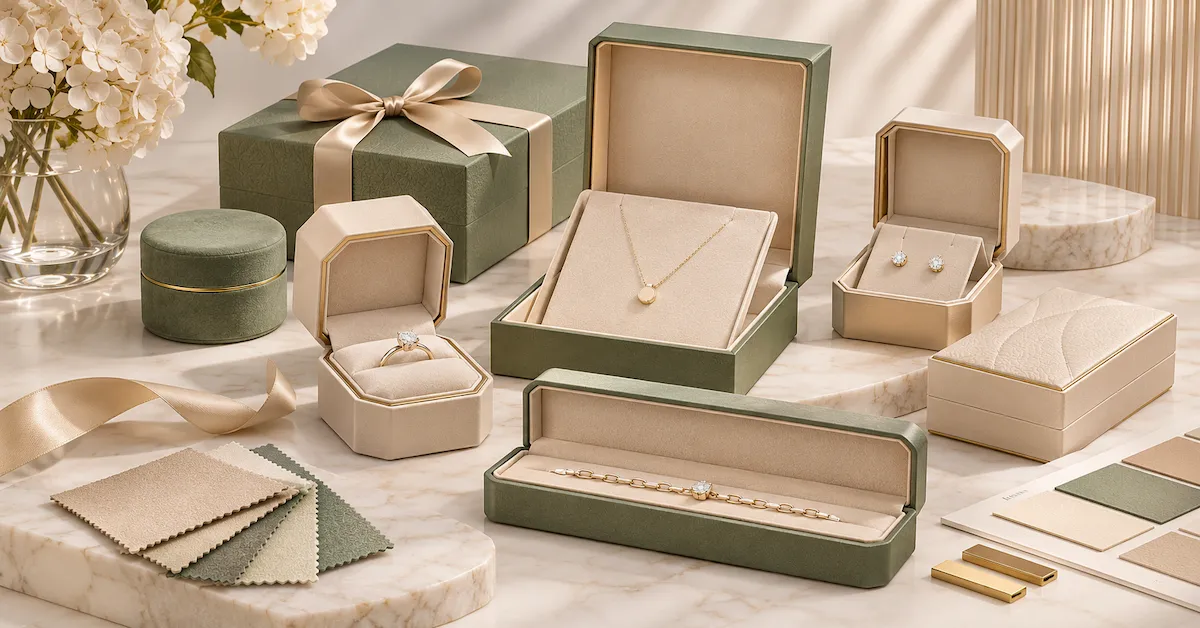
A reliable custom jewelry box supplier should help brands coordinate ring, necklace, earring, and bracelet packaging while maintaining consistent materials, branding, and quality. Buyers should evaluate product-specific inserts, shared box structures, minimum order quantities, sample approval, and repeat-order controls. The most effective sourcing strategy standardizes suitable components without compromising jewelry fit, retail presentation, or purchasing flexibility.
For a growing jewelry brand, packaging complexity often increases faster than the product range. Different boxes may require separate materials, inserts, artwork, and production quantities. Without a coordinated purchasing strategy, brands can face inconsistent colors, unnecessary inventory, repeated development costs, and delayed replenishment.
This guide provides a practical framework for consolidating jewelry packaging procurement, comparing supplier capabilities, controlling specifications, and preparing efficient wholesale orders.
Custom Jewelry Box Supplier: Key Purchasing Insights
The following table summarizes the most important factors for buyers managing multiple jewelry packaging categories.
| Purchasing Factor | Common Problem | Recommended Solution | Buyer Benefit |
|---|---|---|---|
| Packaging consistency | Different boxes use inconsistent colors and finishes | Establish shared material and artwork references | Stronger brand consistency |
| Product compatibility | Standard inserts do not fit every jewelry type | Specify inserts by jewelry category | Better fit and presentation |
| MOQ management | Each design requires separate purchasing quantities | Request MOQ by SKU and configuration | More accurate inventory planning |
| Material selection | Similar-looking boxes use different constructions | Approve actual material specifications | Easier quotation comparison |
| Quality control | Bulk products differ from approved samples | Use golden samples and written acceptance criteria | Reduced sourcing uncertainty |
| Repeat orders | Materials or artwork change without approval | Maintain controlled specifications and revisions | More consistent replenishment |
Key Takeaways
-
Standardize the brand identity, not every box dimension. Exterior colors and logo treatments may be shared, while inserts remain product-specific.
-
Compare complete product configurations. A quotation should define the structure, materials, insert, decoration, packing, and quantity.
-
Treat MOQ as a commercial constraint. Different colors, inserts, or designs may require separate minimum quantities.
-
Approve changes before production. Material substitutions and artwork revisions should follow an agreed process.
-
Evaluate total purchasing cost. Storage, inspection, freight, and unusable inventory can affect the value of a quotation.
Why Trust This Guide? Packaging Knowledge and BRT PAK's Product Scope
This guide combines practical B2B purchasing principles with the product categories and development services publicly described by BRT PAK / Better Industrial.
BRT PAK, operated by Jinhua Better Industrial Co., Ltd., provides information about jewelry boxes, bags, gift packaging, display products, and customization services.
Its published company profile outlines a development process involving requirement confirmation, design sketches, prototyping, material selection, sample confirmation, and logistics preparation.
These activities are relevant to coordinated packaging projects because buyers need consistent communication between design development, production, and delivery.
However, actual manufacturing arrangements, MOQ, lead times, certifications, and available customization options should be confirmed for each product.
The recommendations in this guide are procurement methods, not claims of independently tested BRT PAK performance. No specific defect-rate reduction, cost saving, or production guarantee is implied.
Why Do Multi-Collection Jewelry Packaging Orders Become Difficult?
A jewelry brand may begin with one ring collection and gradually introduce necklaces, earrings, bracelets, and gift sets.
Each new product category creates additional packaging requirements.
Different Jewelry Products Require Different Inserts
A ring requires support around its band and sufficient clearance for decorative settings.
A necklace may need a hanging arrangement or attachment points that organize the chain and pendant.
Earrings require suitable spacing and retention for their fastening systems.
Bracelets vary significantly between flexible chains, rigid bangles, and open cuffs.
Although these products can share a brand presentation, they should not automatically share an identical insert.
Material Differences Can Weaken Brand Consistency
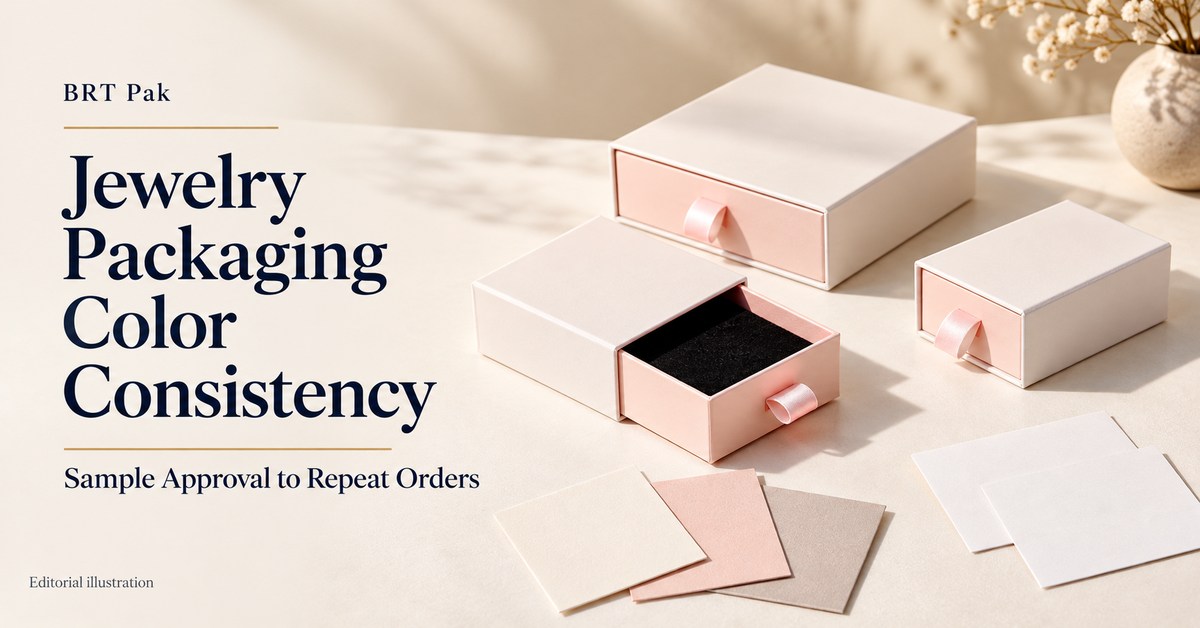
Two packaging suppliers may describe their products using the same color name while delivering visibly different finishes.
For example, the same shade of cream may appear different on velvet, leatherette, and printed paper.
A coordinated collection should therefore use approved material references rather than relying only on color descriptions.
Where different materials must be used, evaluate how they appear together in the intended retail environment.
Multiple SKUs Increase Inventory Complexity
Consider a brand offering four box types, three exterior colors, and two decoration versions.
If every combination is maintained independently, the business could theoretically create 24 packaging SKUs.
Not every variation will have equal demand.
This can increase warehouse requirements and tie working capital to slow-moving inventory.
The solution is to identify which variations add commercial value and which can be consolidated without compromising the product.
How Should Jewelry Brands Standardize Their Packaging Collections?
The most effective approach is to divide packaging specifications into shared brand elements and product-specific functional elements.
Build a Common Brand Specification
A common specification can identify exterior colors, logo artwork, decoration style, material references, and overall presentation direction.
These elements help ensure that ring, necklace, earring, and bracelet packaging belong to the same visual family.
However, a shared brand specification should not determine the interior construction without considering the actual jewelry.
Create a Product-Specific Packaging Matrix
| Requirement | Ring Box | Necklace Box | Earring Box | Bracelet Box |
|---|---|---|---|---|
| Exterior color | Shared reference | Shared reference | Shared reference | Shared reference |
| Logo artwork | Shared | Shared | Shared | Shared |
| Exterior material | Coordinated | Coordinated | Coordinated | Coordinated |
| Internal dimensions | Ring-specific | Necklace-specific | Earring-specific | Bracelet-specific |
| Insert | Ring slot or support | Chain and pendant support | Earring retention | Bracelet support |
| Product fit testing | Required | Required | Required | Required |
| Individual packing | Based on construction | Based on construction | Based on construction | Based on construction |
This matrix provides a starting point for design coordination and quotation preparation.
Identify Opportunities for Component Standardization
Some packaging configurations may share a structural shell while using different inserts.
Others may share materials or decoration processes while requiring different dimensions.
Buyers should ask the supplier which elements can realistically be standardized.
Standardization is useful only when it preserves product suitability. Reducing SKU counts should not create pressure on gemstones, allow necklaces to tangle, or make jewelry difficult to remove.
Which Jewelry Box Materials Are Suitable for Coordinated Collections?
Material selection should balance appearance, construction, cost, and the intended sales environment.
There is no universally superior jewelry box material.
| Material | Main Characteristics | Purchasing Considerations | Common Applications |
|---|---|---|---|
| Rigid paperboard | Structured, suitable for printed presentation | Board quality, corners, finish, moisture exposure | Retail and gift boxes |
| PU leatherette | Leather-like texture and varied colors | Edge wrapping, surface consistency, wear | Branded jewelry packaging |
| Velvet | Soft visual and tactile appearance | Lint, pressure marks, color matching | Engagement and premium gifts |
| Wood-based construction | Substantial structure and distinctive finishes | Weight, joints, surface quality | Premium jewelry presentation |
| Bamboo | Natural texture and material character | Variation, finishing, construction | Nature-inspired collections |
| Microfiber | Soft interior contact surface | Cleanliness, abrasion, contact suitability | Interior linings and inserts |
Actual performance depends on the finished construction, and material suitability should be confirmed through samples.
BRT PAK Product References
BRT PAK provides several published product examples that can support initial design discussions.
The Paper Jewelry Box illustrates a drawer-style presentation with a ribbon pull and soft interior lining.
The Leatherette Jewelry Box provides a faux-leather design direction for jewelry storage.
The JBW190 Bamboo Jewelry Box offers a bamboo-based reference with microfiber lining.
These are useful design references, not evidence that every size, material combination, or customization option is available for every order.
Explore BRT PAK Jewelry Box Products
How Do MOQ and Order Consolidation Affect Procurement Costs?
MOQ is one of the most important commercial factors when purchasing several packaging styles.
A supplier may have separate minimum requirements for different structures, colors, materials, or branding processes.
MOQ Should Be Evaluated by Configuration
Ask whether minimum quantities apply to the total order or separately to each design.
A shipment containing 2,000 boxes does not necessarily satisfy the MOQ for every individual SKU.
For example, a supplier may be able to coordinate several products in one shipment while still requiring separate production quantities.
Buyers should request written confirmation before assuming different configurations can share a minimum order.
Compare the Complete Quotation
A useful quotation should identify:
-
Product structure and materials.
-
Insert configuration and interior lining.
-
Logo decoration and setup charges.
-
Quantity and price by SKU.
-
Sample development requirements.
-
Individual protection and export packing.
-
Production milestones and delivery terms.
The purpose is to compare equivalent specifications rather than simply selecting the lowest unit price.
Evaluate Total Cost per Usable Box
A practical internal purchasing metric is:
Cost per usable box = Total relevant procurement costs ÷ Accepted usable quantity
This calculation can include applicable product, inspection, packing, freight, and corrective expenses, depending on the agreed transaction.
For example, a large order may offer a lower unit price but increase inventory holding costs.
The buyer should therefore compare expected demand, storage requirements, and replenishment frequency before committing to a quantity.
Practical Sourcing Example: Coordinating Four Jewelry Collections
Consider a hypothetical jewelry brand preparing a new collection with the following purchasing forecast.
| Product Category | Planned Quantity | Main Requirement |
|---|---|---|
| Ring Boxes | 1,000 | Compact box and appropriate ring support |
| Necklace Boxes | 600 | Chain organization and pendant presentation |
| Earring Boxes | 800 | Pair retention and suitable spacing |
| Bracelet Boxes | 400 | Support for different bracelet shapes |
| Total | 2,800 | Four coordinated product configurations |
These quantities are illustrative, not an actual BRT PAK project, MOQ, or customer order.
The brand wants matching colors, logo treatments, and overall packaging appearance.
A useful sourcing process would begin by determining whether all four products can share selected exterior materials and artwork.
The buyer would then develop separate inserts and confirm which structures require different production arrangements.
Next, the supplier would provide quantity-based quotations for each configuration.
The buyer could compare the cost of four fully independent designs against a coordinated range using shared materials where feasible.
What Should the Buyer Evaluate?
The decision should not be based only on whether the boxes look similar.
The buyer must also consider whether the manufacturer can reproduce the approved design, supply the required assortment, and support future replenishment.
Where a particular SKU falls below the applicable MOQ, the buyer may need to review its forecast, adjust the product range, or consider an existing suitable design.
This example illustrates how packaging consolidation becomes a structured purchasing decision rather than an automatic cost-saving claim.
How Can Buyers Maintain Quality Across Multiple Jewelry Box Styles?
Quality control should connect the approved design with bulk production and repeat orders.
Use a Golden Sample and Written Specification
For each product configuration, retain an approved physical sample supported by drawings, material references, artwork versions, and acceptance criteria.
The sample provides a visual and functional reference, while the specification records requirements that may not be visible.
Define Inspection Checkpoints
A practical quality-control plan can include material verification, first-article inspection, in-process checks, finished-unit inspection, and packing verification.
Each stage addresses a different risk.
For example, an early production review may identify incorrect insert dimensions before the entire quantity is completed.
Final inspection can then check agreed functional, dimensional, and cosmetic requirements.
Control Material Substitutions
If an approved covering or lining becomes unavailable, the supplier should communicate the proposed replacement before production.
The buyer should review whether the change affects appearance, product fit, compliance documentation, or cost.
Any approved change should be recorded for future orders.
Verify Export Packing
Finished jewelry boxes may require individual protection to prevent decorative surfaces from rubbing against each other during shipment.
Buyers should confirm carton quantities, dimensions, weights, labeling, and the proposed protective arrangement.
Where transit testing is necessary, the procedure and acceptance criteria should be selected for the actual packed configuration and distribution conditions.
A generic claim of export-quality packing is not a substitute for a documented packing plan.
What Supplier Capabilities Matter for OEM/ODM Jewelry Packaging?
A supplier should be evaluated on its ability to translate brand requirements into a clear development and production process.
Design and Product Development
For OEM projects, buyers may provide detailed specifications and artwork.
For ODM development, buyers may require assistance with structures, materials, inserts, and visual concepts.
The supplier should clarify the development scope, approval stages, associated charges, and any relevant intellectual-property arrangements.
Sample Approval
Samples should verify jewelry fit, construction, materials, logo appearance, and opening function.
A digital mock-up may support early design decisions, but it cannot replace all physical checks.
Before approving bulk production, the buyer should identify the final sample and specification revision.
Production and Delivery Coordination
BRT PAK's published company information describes a process from requirement confirmation and prototype development through material selection, sample confirmation, and logistics preparation.
For a specific project, buyers should confirm which services are included, who is responsible for production controls, and what information will be provided before shipment.
Discuss OEM/ODM Packaging Requirements
How Should Different Jewelry Buyers Select Their Packaging Supplier?
Different business models require different purchasing priorities.
| Buyer Type | Primary Requirement | Recommended Purchasing Focus |
|---|---|---|
| Luxury jewelry brand | Premium presentation | Materials, finishing, branding consistency |
| Jewelry retail chain | Standardized store presentation | Repeat-order quality and SKU control |
| Private-label brand | Distinctive packaging identity | OEM customization and artwork management |
| Jewelry wholesaler | Commercial assortment | MOQ, pricing, inventory, carton quantities |
| E-commerce brand | Presentation and delivery suitability | Product fit and complete shipping package |
| Seasonal gift buyer | Coordinated campaign packaging | Sample approval and delivery milestones |
For a luxury brand, surface appearance and product presentation may receive greater attention.
For a wholesaler, inventory turnover and minimum quantities may be more commercially significant.
For an e-commerce brand, the presentation box must also work within the final fulfillment package.
The supplier selection criteria should reflect these differences.
What Should Buyers Include in a Jewelry Packaging RFQ?
A detailed request for quotation improves the quality and comparability of supplier proposals.
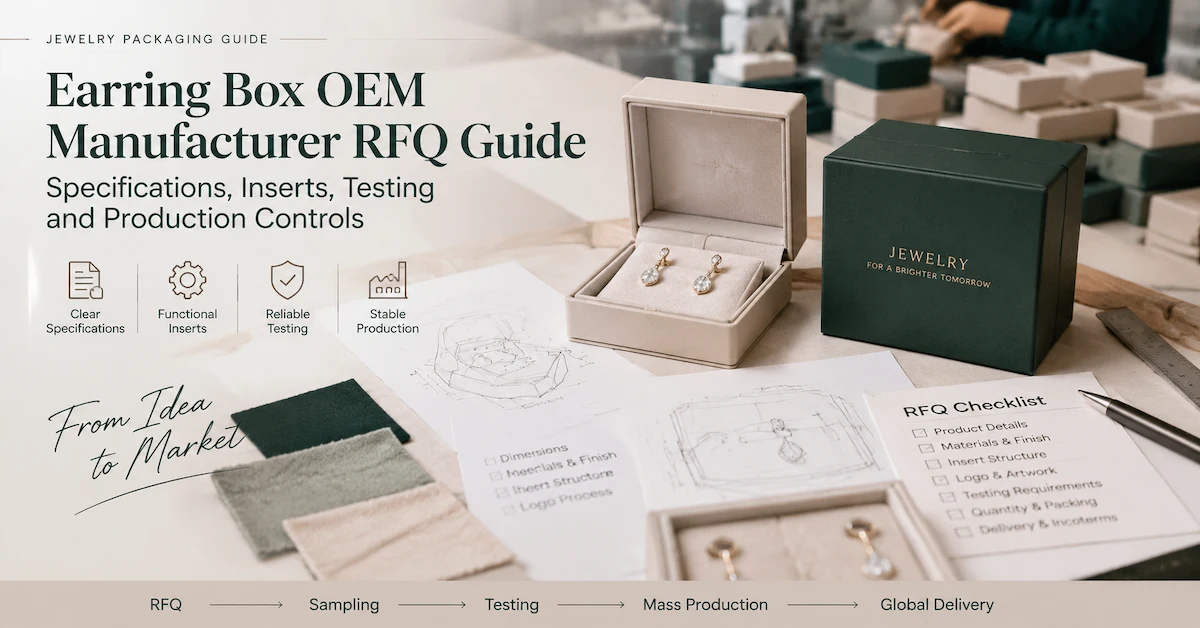
Recommended RFQ Checklist
| Information | Buyer Input |
|---|---|
| Jewelry categories | Ring, necklace, earring, bracelet, or gift boxes |
| Product dimensions | Jewelry measurements and relevant projections |
| Packaging style | Existing reference or custom concept |
| Shared branding | Color references, logo, decorative finish |
| Materials | Preferred exterior and interior construction |
| Quantity | Forecast by size, color, and SKU |
| Sample requirements | Development and approval process |
| Quality requirements | Inspection and acceptance criteria |
| Target market | Destination country and distribution channel |
| Packing requirements | Unit protection and master cartons |
| Schedule | Sample and delivery milestones |
Example RFQ
We are sourcing coordinated packaging for our ring, necklace, earring, and bracelet collections.
Our goal is to maintain a consistent exterior appearance while using appropriate inserts for each jewelry category.
Please review our product dimensions, reference designs, preferred materials, artwork, and forecast quantities.
We would appreciate information about suitable structures, MOQ by configuration, sample development, branding options, quality-control arrangements, export packing, and estimated project milestones.
Please identify opportunities for shared materials where feasible and provide an itemized quotation for each product configuration.
This type of inquiry provides a practical foundation for supplier evaluation.
Frequently Asked Questions
1. What Does a Custom Jewelry Box Supplier Do?
A supplier provides jewelry packaging products and may support design, customization, sampling, production, and export coordination. Available services depend on the supplier's actual capabilities and the agreed project scope.
2. Can Ring, Necklace, Earring, and Bracelet Boxes Be Ordered Together?
They may be ordered as part of a coordinated project, but each product can have separate MOQ and production requirements. Confirm the conditions for every configuration before placing an order.
3. Can Different Jewelry Boxes Share the Same Exterior Material?
Shared materials may be feasible where the structures and manufacturing methods allow them. The supplier should confirm suitability and provide representative samples for the finished designs.
4. How Can Jewelry Brands Reduce Packaging SKUs?
Review unnecessary variations and identify opportunities to share exterior colors, materials, or branding. Maintain product-specific dimensions and inserts where required for proper jewelry fit.
5. What Is the MOQ for Custom Jewelry Boxes?
MOQ varies by construction, material, color, decoration, and quantity. Request minimum quantities for each configuration rather than assuming one universal MOQ.
6. Is Paperboard or Wooden Packaging Better for Premium Jewelry?
Neither is universally better. Compare structural requirements, appearance, weight, finishing quality, and total cost using samples appropriate to the intended product.
7. Can Jewelry Boxes, Pouches, and Displays Be Coordinated?
They can be planned as one visual collection when the supplier supports the relevant categories. Each product still requires its own specifications and commercial confirmation.
8. How Are Repeat Orders Kept Consistent?
Use approved samples, specifications, material references, and artwork revisions. Review proposed substitutions and confirm the applicable requirements before production.
9. What Quality Documents Should Buyers Request?
Request documents relevant to the ordered product, such as specifications, approved samples, inspection records, and applicable material or certification evidence. Confirm their scope rather than relying on unrelated company-level claims.
10. How Can I Request Coordinated Jewelry Packaging From BRT PAK?
Prepare your jewelry dimensions, packaging references, artwork, preferred materials, and estimated quantities by product. Review the Jewelry Boxes collection and contact BRT PAK to discuss project-specific options and quotation requirements.
Conclusion
Choosing the right custom jewelry box supplier requires a structured approach to product compatibility, brand consistency, commercial quantities, and production quality.
For jewelry brands managing several collections, the strongest strategy is to standardize suitable exterior materials and branding while maintaining inserts and dimensions that fit each product.
A complete purchasing process should include coordinated specifications, quantity-based quotations, approved samples, documented quality criteria, and clear replenishment arrangements.
BRT PAK / Better Industrial provides jewelry packaging and related product categories, along with published design-development and international service capabilities relevant to customized packaging projects.
Explore the BRT PAK Jewelry Boxes collection and submit your packaging requirements, including your jewelry categories, artwork, materials, dimensions, and order quantities.
A well-prepared inquiry can help establish suitable packaging options, clearer commercial quotations, and a practical foundation for consistent long-term sourcing.