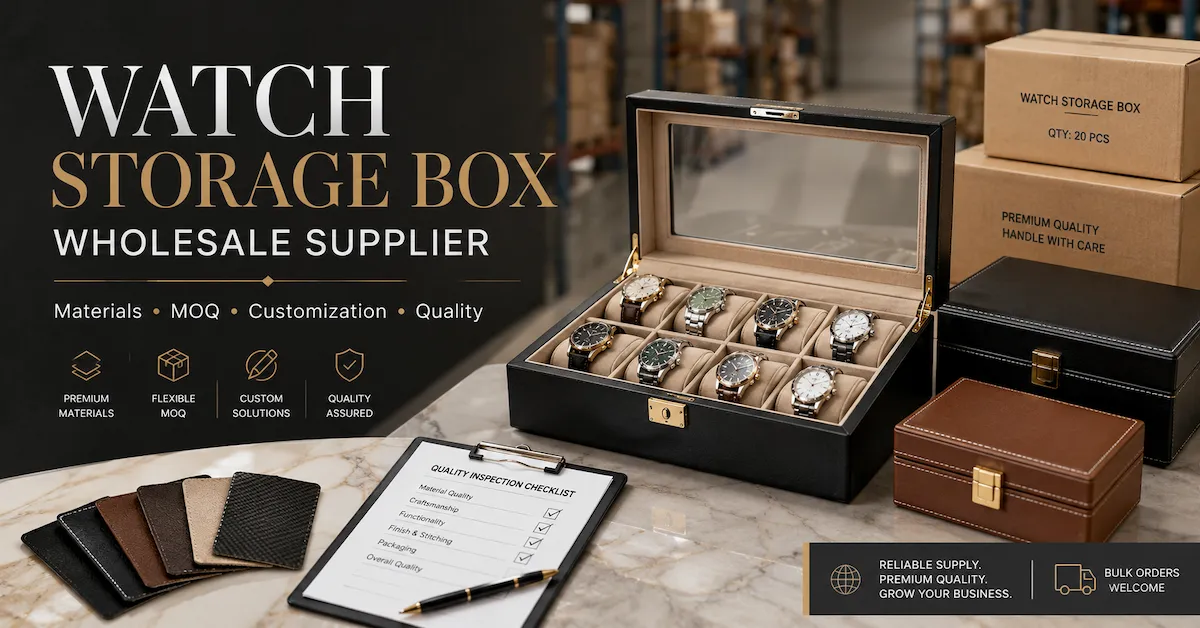

Shopping for jewelry display manufacturers is a different job from shopping for packaging. A box protects a piece and leaves with the customer. A display has to survive a shop floor. It gets handled all day, dusted weekly, re-merchandised every season, and knocked against a counter by people who are not thinking about your finish. Then a regional manager walks in and asks why the window looks different from the one across town.
So the shortlist question is not "who makes something pretty". It is: who can hold a finish, a colour and a repeatable structure across several stores and several years — and who publishes enough information that you can check the answer before you sign.
This article ranks ten companies whose own public pages describe jewellery display work — fixtures, cases, trays, busts, risers, counter systems. Why read it? Because a rollout gets expensive at the third branch, not the first. If you run a small chain, own one boutique, or sit on a brand's retail team briefing a display programme, the checks below decide whether your counters still match in year three.
If you are at an earlier stage — still deciding between a cabinet, a case and a tray — read this beside Jewelry Display Manufacturer Guide and Choosing a Display Cabinet Manufacturer for Retail Stores. Both go deep on specification. This page stays on supplier comparison.

Publisher, conflict and research disclosure — reviewed September 27, 2026: BRTPAK publishes this article, manufactures jewellery displays and boxes in Jinhua, China, and routes readers from this comparison to its own product and contact pages. That is a direct commercial conflict of interest. BRTPAK is deliberately not ranked inside the ten. The order, the weighting and every "best apparent fit" label are the publisher's editorial judgements. They are not an independent award, an audit, a certification, a customer survey or a market-share study. Each profile summarises what a supplier's own pages said on the review date. We did not verify every legal entity, factory, subcontractor, material claim, origin statement, certificate, capacity figure, minimum order or delivery schedule. Recheck everything before you shortlist.
One limitation worth stating plainly. Several sites that rank well for display-related searches are catalogues, not makers — they resell, they publish no production information, and they sometimes publish no minimum at all. We also excluded candidates whose pages we could not load on the review date rather than describe them from second-hand summaries. Where a company's pages did not state something, this article says so instead of filling the gap.
✉ Request a Custom Jewelry Display Quote
How we built this list
Three inputs, in this order. First, we looked at which display suppliers actually surface for sourcing-style queries rather than consumer queries. Second, we read each company's own product and service pages and recorded only what a buyer could verify there. Third, we weighted what we found.
Method limit: the weights below organise our desk research. No common questionnaire went to all ten companies. No blind sample test, no factory audit, no material-claim substantiation review and no identical landed-cost request for quotation was completed across the set. A rank therefore indicates our assessed fit with a retail display sourcing scenario. It is not measured product quality, not service performance, and not evidence that one supplier is better than another.
| Criterion | Weight | What we looked for |
|---|---|---|
| Route clarity | 25% | Does the company separate its own production from reselling, sourcing and stockholding? |
| Display engineering depth | 25% | Can structure, insert, lining, lighting, glazing, hinge and branding all be changed to order? |
| Store-rollout capability | 20% | Is there evidence of multi-store or multi-market project delivery rather than single-piece sales? |
| Published commercial terms | 15% | Are pack sizes, sample routes, lead times or price bands stated rather than implied? |
| Compliance evidence | 15% | Are certificates and claims tied to a named site, a scope and a date? |
Marketing adjectives earned nothing. A named production route, a real product dimension, a stated pack size and an honest limitation did. Notice how much of that a lot of display websites do not publish. That gap is the single most useful thing this article gives you.
Quick comparison: ten jewelry display manufacturers at a glance
A ranking only helps if the operating models stay visible. Two suppliers can both claim "custom displays" while one owns a factory and the other forwards your file to a plant it will not name. The table below separates the routes, then tells you what to interrogate.
| # and company | Route its pages describe | Display formats described | Published minimum or pack size | Best apparent fit | Buyer must verify |
|---|---|---|---|---|---|
| 1. DG Display Showcase | In-house design, engineering, manufacturing and overseas project delivery | Front showcases, upright cases, island cabinets, wall cases, display tables, VIP-room furniture, display props | Not published | Multi-store jewellery, watch, fragrance and museum interiors | Which entity contracts, which plant builds, who carries installation risk abroad, and what the warranty covers |
| 2. shopPOPdisplays | US display manufacturer running its own production facility | Acrylic display stands, sign holders, counter and point-of-sale units | Not published | Retail programmes that need acrylic counter units, not wooden cases | Whether your job needs custom tooling or draws on standard acrylic forms, and what the real turnaround conversation is |
| 3. Bates Display | US design-and-manufacture, production in California | Optical and jewellery display systems | Not published | Buyers who need a domestic manufacturing route and will pay for it | Whether the "made in California" claim attaches to your specific unit, and the minimum for a bespoke system |
| 4. Gems On Display | Wholesale supplier and distributor of displays and packaging | Necklace and jewellery busts, display sets, trays and liners, countertop cases, carrying cases, acrylic risers | Pack-level pricing; free shipping above a stated order value | Independent jewellers, boutiques and market traders buying standard stock displays | Whether a piece is stocked or made to order, and whether your colour can be held across a reorder |
| 5. Jewelry Display Inc | Catalogue distributor with itemised SKUs and tiered pricing | Displays, boxes, pouches, bags, rolls, tools and store supplies | Listed per each, with lower per-piece pricing at higher quantities | Small retailers and startups assembling a first counter setup | Whether your SKU is ex-stock or sourced, and what a reorder six months later will actually cost |
| 6. Montagne Pack | Custom production across boxes, soft-sewn items, displays and trays | Neck, ring, earring and bracelet displays, risers and baseboards, name plates, modular and stacking trays | Not published | Brands that want a display range and a matching box range from one source | Which parts of the range are truly custom and which are catalogue items, plus the tooling position |
| 7. Allurepack | Branded display and packaging supplier, prices quoted duty-and-tax inclusive | Suede and fabric displays, display collections, boxes, pouches, gift bags and store supplies | Not published on the review date | Brands that want presentation and packaging from one supplier and simple landed pricing | What sits behind "duty and tax included" — which markets, which carriers, which thresholds |
| 8. Richpack | China-based manufacturer with its own plants plus a partner network | Display and packaging programmes for jewellery and watch brands | Lower minimums advertised on selected styles; exact figures not published on the reviewed pages | Buyers who need a low entry quantity before committing to a collection | Which plant runs your SKU, and whether the sustainability documentation covers that exact material |
| 9. Nile Corp | Wholesale supplier of display and packaging items | Display shelves and cubbies, earring display trees, gift bags and packaging | Free shipping above a stated order value | Retailers topping up standard display stock at short notice | How much of the range is stock versus made to order, and whether a colour is repeatable |
| 10. JP Display | Online supplier with pack-based pricing on boxes and wooden trays | Wooden trays, cotton-filled boxes, presentation items | Stated pack sizes, for example packs of 25 and 100 pieces | Buyers comparing small-pack economics before placing a custom order | Whether the wooden items are imported stock, and how variation between batches is controlled |
How to use this table. Pick three or four rows. Send each one the same display brief with the same drawings, the same quantity basis and the same destination market. Then compare approved samples, compliance documents and milestone dates — not the headline price. A wooden showcase and an acrylic riser are different products, and asking both suppliers to quote "retail displays" produces a comparison that means nothing.
Comparing quotes now? Send us the same brief and put our proposal beside them. Dimensions, quantity, finish reference and destination market are enough to start.
The ten, in order
Read every entry the same way. Start with the route. Then look at what the company says about its own products, not about its values. Finish with what you still have to ask. That last column is where the real work sits.
1. DG Display Showcase
Route: design, engineering, manufacturing and project delivery under one roof.
This is the most project-shaped business on the list. Its pages say it has worked on custom showcases since 1999, and the product architecture is a store fit-out rather than a catalogue: luxury front showcases, upright display cases, island cabinets, wall-mounted cases, jewellery display tables, VIP-room furniture and display props. It also describes an integrated manufacturing facility of about 190,000 square feet and a separate retail experience centre of roughly 21,500 square feet, a design and engineering team of 180-plus, and more than 200 customised projects a year across jewellery, watch, fragrance and museum work.
Why that matters to a buyer: when a display has to fit a shop's dimensions, carry the shop's lighting and hold a brand's proportion language, the hard part is not the cabinet. It is the coordination — measurement, drawings, glazing, wiring, freight to another continent, installation, then a variation order three stores later.
- Best apparent fit: chains and brand retail teams doing new stores or refits, especially where lighting, cabinets and props must be one system.
- Verify before ordering: name the legal seller and the plant in the purchase order. Ask who holds installation responsibility in your country, how spare parts are handled after handover, and what the tolerance is on a repeat order two years later.
2. shopPOPdisplays
Route: display manufacturer with its own production facility, selling directly online.
The pages describe point-of-sale work — sign holders, acrylic display stands, brochure and counter display units — and say the production happens in the company's own facility with direct material sourcing. Its own framing is long-established: display manufacturing since 1979. That is a useful contrast to the catalogue resellers below, because a buyer who needs an acrylic counter unit with a specific footprint is dealing with someone who forms the material rather than someone who forwards a purchase order.
Acrylic is a genuinely different engineering problem from wood. Edge polishing, bend radii, chemical resistance and the way the material scratches are all decided in production. So the questions change too.
So this route suits acrylic counters and point-of-sale units, plus projects where see-through material carries the look. Three things to settle first. Is your item a standard form, or does it need new tooling? How does the finish sample read in daylight rather than under demo lighting? And what will a year of cleaning do to that surface?
3. Bates Display
Route: design and manufacture in California.
Here the origin sells as hard as the product. Bates describes American-made optical and jewellery display systems, designed and manufactured in California since 1971. Now picture a retailer whose landlord, franchise agreement or brand standard insists the fixture be domestically made. One sentence like that ends a procurement argument before it begins.
Domestic production buys speed and accountability. It costs money, and the honest comparison is never unit price against unit price. It is the total cost of the project — freight, duty, the cost of a rework, the cost of a launch slipping a fortnight.
- Best apparent fit: US optical and jewellery retailers who need a domestic route, and programmes where origin is a stated requirement.
- Verify before ordering: confirm that the domestic claim attaches to your specific unit and not only to the brand. Ask for the minimum on a bespoke system, and for the lead time on a repeat.
4. Gems On Display
Route: wholesale display and packaging supplier.
One of the widest standard ranges on this list, and one of the clearest about what it is: family owned and operated since 2002, selling wholesale. The catalogue covers necklace and jewellery busts, matching display sets, trays and liners, countertop display cases, carrying cases for shows, and acrylic risers. It also answers a question most display sites dodge — which lining colour suits which metal. Black leatherette, linen and velvet for gold, on the grounds of contrast; white leatherette, grey linen and black for silver, on the grounds of reflectivity.
That is merchandising advice rather than manufacturing information, and it is genuinely useful if you are the person deciding what the counter should look like. Be clear about what you are buying, though. This is a stock and supply route.
- Best apparent fit: independent jewellers, boutiques and market or craft traders who need displays next week, not next quarter.
- Verify before ordering: ask whether your item is stocked or made to order, whether the exact colour will still be available on the reorder, and what the minimum is for a branded run rather than a stock purchase.
5. Jewelry Display Inc
Route: catalogue distributor with itemised SKUs and quantity pricing.
The pages read like a distributor's price list, and that is the point. Items carry a number, a list price, a web price and a lower "as low as" figure at volume. Categories run from displays into boxes, pouches, bags, rolls, tools and general store supplies. There is also a published show schedule, which tells you something about how the business sells.
For a first counter setup, transparent per-each pricing is worth a lot. It lets you build a budget before you have a supplier relationship. The trade-off is that a distributor's margin sits between you and whoever actually forms the material.
- Best apparent fit: startups and small retailers assembling a complete counter from standard items and needing published prices.
- Check before ordering: who actually forms the item you are buying? Is it ex-stock? And what does the price do on the next order at the same quantity?
6. Montagne Pack
Route: custom production spanning boxes, soft-sewn items, displays and trays.
What stands out here is breadth inside one system. The display side is split properly — neck displays, ring displays, earring and pendant displays, bracelet displays, risers and baseboards, and name plates. The tray side is split the same way, into modular collections trays, stacking trays, wood-frame trays, metal-frame trays and counter presentation trays. Then the same company also makes jewellery boxes, pouches, rolls, necklace folders, polishing cloths, shopping bags and apparel packaging.
For a brand launching a collection, that matters more than it sounds. When the tray, the riser and the box come from different suppliers, the greys do not match, and the grey not matching is the first thing a customer notices.
- Best apparent fit: brands that want a coordinated display and packaging programme rather than a single fixture.
- Verify before ordering: ask which lines are genuinely made to order and which are catalogue items, who owns any tooling, and how a colour reference is held across materials — fabric, board and lacquer behave differently.
7. Allurepack
Route: branded display and packaging supplier selling on a landed-price basis.
The product story is familiar — jewellery box collections, jewellery displays including suede finishes, pouches, gift bags, wrapping and store supplies. What is unusual is on the pricing line, and it is the reason this company earns a place on the list: the site states that listed prices include import tariffs and taxes, with no extra charges added at checkout.
Almost nobody in this category publishes landed pricing. Buyers routinely compare a Chinese unit price against a European one, then discover that duty, brokerage and clearance have eaten the difference. A supplier that folds those in removes a whole category of surprise — provided you check which markets and which carriers the statement actually covers.
- Best apparent fit: brands that want presentation and packaging from one supplier and prefer to compare on a delivered basis.
- Verify before ordering: ask exactly which destination markets are covered, which carriers and thresholds apply, and who pays if a clearance charge falls outside the statement.
8. Richpack
Route: China-based manufacturer operating its own plants plus a vetted partner network, with stock held in the United States.
Richpack describes a hybrid model rather than a single factory, and its display and packaging work is aimed at jewellery and watch brands. Two published points are worth flagging because they are the two things buyers ask about first. It advertises lower minimums on selected styles for startups, seasonal launches and product testing. And it states that it offers FSC-certified paper, recycled materials and reusable structures for brands that want a lighter environmental footprint without dropping presentation quality.
Hybrid models are not a problem in themselves. They become a problem when nobody writes down which entity sells, which plant builds, and whose certificate covers the material in your order.
- Best apparent fit: brands that need a low entry quantity to test a design before committing to a collection.
- Verify before ordering: name the legal seller and the nominated plant in the purchase order, and ask whether the sustainability documentation applies to your exact material and your exact transaction. "Certified" on a website and "certified" on your paperwork are two different claims.
9. Nile Corp
Route: wholesale supplier of display and packaging items, selling online with a stated free-shipping threshold.
The reviewed pages show a practical, stock-led range: wooden shadow cubby boxes used as display shelving, leatherette earring display trees, paper gift bags, and a steady flow of new arrivals under a display category. There is little manufacturing narrative, and that is consistent with what this route is — a supply channel. For a retailer who needs to re-face a counter or repair a display without a project, that is exactly the right tool.
Buy the channel for speed and availability. Do not buy it for a bespoke fixture, and do not assume the colour you receive this quarter will match the one you receive next quarter.
- Best apparent fit: retailers replacing or topping up standard display stock quickly.
- Verify before ordering: confirm what is in stock versus made to order, photograph and keep the sample you approved, and ask how batch-to-batch variation is managed on finishes.
10. JP Display
Route: online supplier of boxes, wooden trays and presentation items, priced by pack.
The distinguishing feature here is pack economics. Items are sold in stated pack sizes — packs of 25 and 100, for example — with prices tiered against those packs, alongside promotional offers on selected boxes. There is also a range of wooden trays and presentation pieces.
Pack pricing is more useful than it looks. It tells you the smallest sensible order for a standard item, which is the number most suppliers keep off the page. Use it to size a pilot, then compare that against the minimum on a custom run. If a pack of 100 standard trays costs less than the tooling on a bespoke tray, you have learned something before you have sent a single email.
- Best apparent fit: buyers testing a counter format in small volume before commissioning anything custom.
- Verify before ordering: ask whether the wooden items are held in stock or imported to order, what the actual production origin is, and how you will inspect variation across packs.
Also worth a look, and two clarifications
The ten above are not the only credible routes. Two distinctions save buyers a week of confusion. First, jewellery retail brands that make their own displays and cases are not contract manufacturers — their production exists to serve their own catalogue, and they will not build your design. Second, a distributor with an excellent website may be further from the factory than a plain-looking manufacturer is. Origin of a website says nothing about origin of a fixture.
Building a rollout? Send the store count, the fixture list and the destination markets. We will come back with a costed proposal itemised the same way as the quotes above, so the comparison stays honest.
✉ Request a Bulk Display Quotation
Display format guide: cases, stands, trays and counter systems
Most display briefs go wrong at the format decision, before price is even discussed. Buyers ask for "a showcase" when what they need is a locking case for overnight stock. Or they buy a beautiful open tray for a shop that gets dusted daily with a wet cloth. Get the format right and three suppliers become interchangeable. Get it wrong and the cheapest quote becomes the most expensive decision in the project.
Glass display cases and cabinets
A case is a security and lighting product first, and a furniture product second. Locking, glazing, ventilation and, if you sell watches, rotation or winding provision all change the build. Ask who specifies the lighting: a case lit wrongly makes diamonds look flat and coloured stones look muddy. Glazing choice matters too — laminated glass, tempered glass and acrylic behave differently under impact and in cleaning.
Upright stands, busts and risers
This is where merchandising lives. Necklace busts, earring trees, risers and baseboards let you build height and hierarchy without adding cabinets. In this format the lining does most of the work. Velvet, suede, linen and leatherette each hold colour and wear differently, and the same nominal grey reads differently on each one.
Trays, pads and inserts
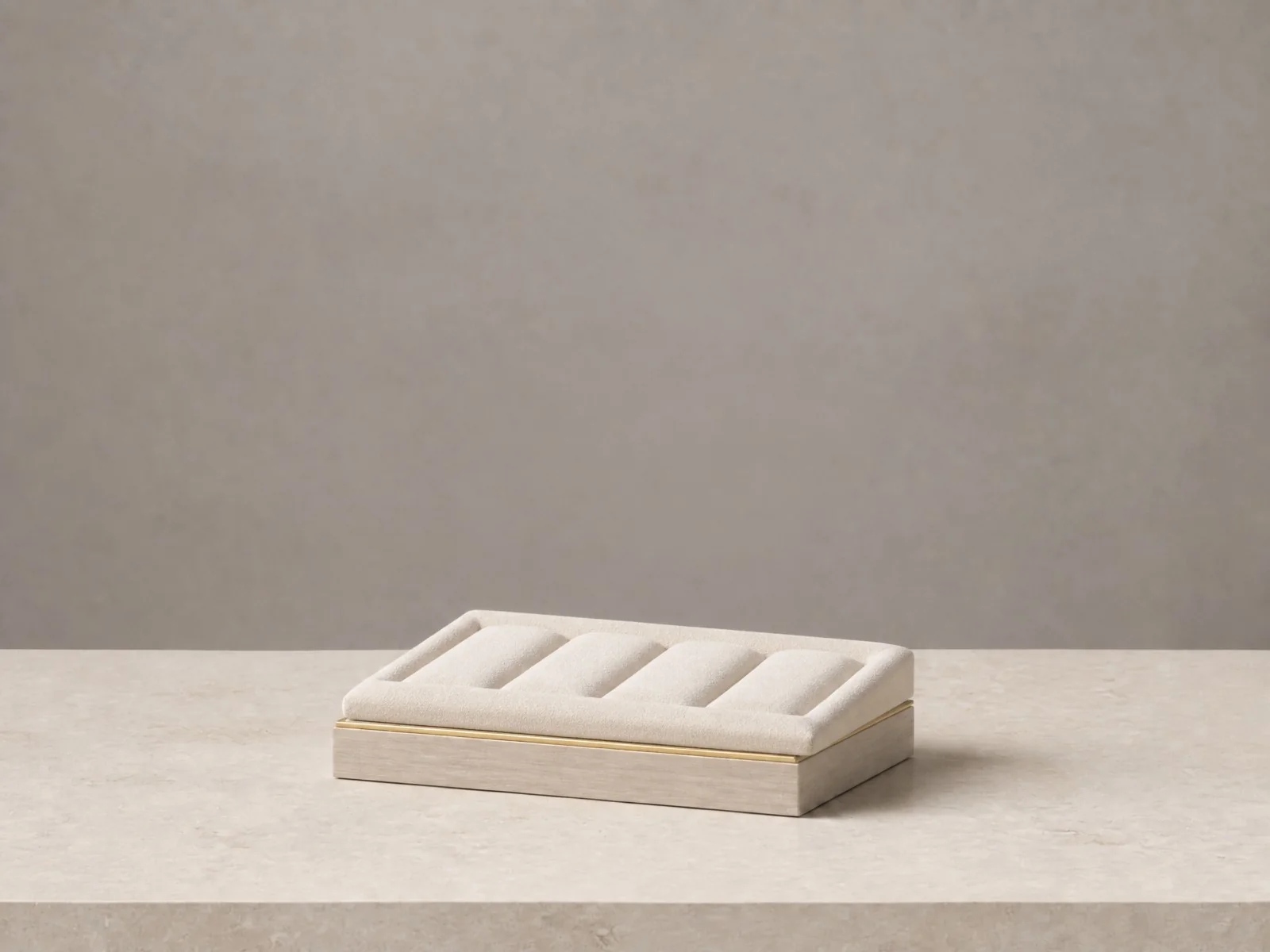
Trays are the highest-turn, highest-handling item in most shops. They get pulled out, carried to a customer, put back and re-lined. That makes insert design a durability question as much as a presentation one. Parallel slot configurations suit rings and earrings; deeper cut-outs suit bracelets; a removable pad lets one tray serve two collections. Look at multi-compartment jewelry trays if you are planning a drawer system, and at ring display tray supplier considerations if rings are the core of your counter.
Counter systems and window props
A counter system is a set of modules, not a piece of furniture. The test is whether the range can be re-cut when a collection changes size next season, and whether a module added in year three still matches the one bought in year one. Window props follow the same logic, with one extra constraint: they are usually the first thing damaged and the last thing budgeted.
| Display format | Typical retail use | Common materials | Main cost driver | Typical lead-time pattern |
|---|---|---|---|---|
| Glass case or cabinet | High-value pieces, overnight security, window display | Metal or wood frame, laminated or tempered glass, LED lighting | Glazing, locking hardware and lighting specification | Longest of all formats; drawing approval comes first |
| Upright stand or bust | Necklaces and pendants, layered counter display | Velvet or linen over board, wood base, metal trim | Lining fabric grade and hand-finishing at edges | Short for standard forms, longer if the shape is bespoke |
| Tray or pad | Ring, earring and bracelet presentation; drawer systems | Wood or board frame, velvet, suede or foam insert | Insert complexity and the number of insert variants | Short to medium; driven by insert tooling |
| Counter system | Full counter replacement or new store fit-out | Mixed — wood, metal, glass, fabric, lighting | System width, module count and site coordination | Project schedule, not a production lead time |
| Window or campaign prop | Seasonal windows, exhibitions, trade stands | Lightweight board, printed finishes, foam | Deadline pressure and one-off tooling | Very short; the calendar sets it |
The practical rule: decide the format against how the piece will be handled, then let price follow. If you are early in that decision, our own displays and trays range shows how a modular system is put together, and the jewelry display tray page shows a single module in detail.


What retail buyers must verify before shortlisting
Everything above describes what suppliers publish. This section is about what you do with it. Three checks separate a shortlist from a wish list.
Is the supplier the factory, and can it hold your capacity?
Get three names in writing: the legal entity, the production site, and the plant that will actually run your order. Then add two capacity questions. What else runs on that line in the same period? And what happens to your delivery date if a bigger order lands after yours is confirmed? Optimistic quotes tend to die quietly right there.
Does the approved sample still describe the bulk?
A sample is an argument, not a contract. It only becomes a standard if it is signed, dated, photographed in stated lighting and stored as a golden sample by both sides. Add tolerances for colour and dimension, a defect definition, an inspection level and the name of the person who decides whether a batch ships. Without those five things, "it matched the sample" is an opinion.
Can the dates be executed, not just promised?
Ask for the sequence, not the total. Drawing approval, material arrival, first-article approval, production, inspection, packing, booking, sailing. Then ask which steps sit outside the supplier's control. Freight bookings and public holidays are the two that move most often, and neither is a surprise if it is written down in advance.
| Check | Why it decides the order | Request in writing |
|---|---|---|
| Factory reality | A trading intermediary can quote anything and control nothing | Legal entity, production site address, nominated plant for your SKU |
| Capacity and calendar | Delivery promises collapse when a bigger customer arrives | Line allocation, blackout periods, holiday shutdown dates |
| Sample discipline | An unsigned sample cannot be enforced later | Signed golden sample, colour and dimension tolerances, defect definitions |
| Inspection plan | You cannot inspect a container after it sails | Inspection level, timing, who attends, report format, rework rules |
| Structural performance | Display pieces travel as freight and get handled hard | Packing specification and transit test reference |
| Documentary fit | Perfect goods can still be held at the border | Material declarations, certificate scope, origin statement |
Cost drivers and MOQ reality in 2026
Display pricing is not a single number and it is rarely a straight line. It is a stack of decisions, and every one of them is negotiable in a different way. Buyers who understand the stack negotiate the right line item. Buyers who do not negotiate the only number they can see, which is the unit price.
What actually moves the unit price
Structure beats material. Put a simple tray in a premium velvet finish beside a complex multi-tier cabinet in an ordinary one. The tray usually costs less, because the cabinet swallows labour, jigs and assembly time that the tray never asks for. Then what? Inserts come next. Finishing follows — hand-lacquering, hand-wrapping, sealed edges. After that, fabric grade, then hardware such as locks, hinges and lighting. Dimensions sit near the end, and quantity last of all.
Minimums and small-batch routes
Published minimums are scarce here, and where they do appear they often turn out to be pack sizes rather than production minimums. So stop treating one number as "the MOQ". Split it. Minimum per design, minimum per material, minimum per colour or finish — three questions, frequently three different answers. And the material or the finish usually binds first, not the design.
The sample-to-bulk price gap
Sampling is priced like prototyping, because it is. A one-off display is built with jigs made for one piece, finished by hand, and inspected individually. Bulk pricing exists because those costs get spread. When a supplier quotes a bulk price that looks dramatically lower than the sample conversation, the honest question is not "how much cheaper", it is "what changed". Tooling, insert construction, finish method and lining grade are the four usual answers.
| Cost factor | Direction of effect on unit price | Where optimisation is possible |
|---|---|---|
| Structural complexity | Largest single driver | Simplify the module count; standardise a base size across a range |
| Insert design | Rises with the number of insert variants | One tray body, interchangeable pads |
| Surface finishing | Rises sharply with hand work | Choose a finish the factory runs routinely |
| Lining fabric | Moderate, and easy to underestimate | Fix one lining reference across the whole range for colour consistency |
| Hardware and lighting | High, and it carries after-sales cost | Standardise the fitting so spares remain available |
| Dimensions | Rises with material consumption and packing volume | Fit the module to a standard carton and shipping footprint |
| Order quantity | Falls with volume, up to a point | Consolidate SKUs into one production run |
| Deadline pressure | Raises cost through air freight and overtime | Move the ship date rather than the cost, when the calendar allows |
The last row is the one buyers forget. A two-week slip on a store opening rarely costs what an air-freight upgrade costs. Write the milestone dates first, then price them.
Materials, compliance and export documentation
Compliance in this category is about chemistry and paperwork, not about how a fixture looks. Two shipments can be visually identical and only one of them clears.
Where materials meet regulation
Think about every surface a display touches: the lacquer or coating on the outside, the adhesive holding the board together, the ink on any printed element, the treatment on the lining fabric and the finish on metal hardware. That is the list a compliance question is really about.
Start with REACH, in force since 2007. Substances above one tonne per year per company have to be registered with the European Chemicals Agency. Article 33 gives consumers a right to know about substances of very high concern in articles, and companies must answer within 45 days. Building the fixture outside the EU does not move that duty off the seller's desk either.
Then there is packaging. The rules changed shape here: what was a directive is now a regulation. Go to the Commission's own pages for Regulation (EU) 2025/40. In force since 11 February 2025. Applies from 12 August 2026. Broadly replaces the 1994 Packaging Directive. And the 2030 target? Recyclable in an economically viable way, for everything placed on the EU market. On a display job that barely touches the fixture. The crate is where it bites — foam, wraps, inner cartons. Ask before that design freezes.
Now California, which stacks its own rulebook on top. Proposition 65 — formally the Safe Drinking Water and Toxic Enforcement Act of 1986 — obliges businesses to warn Californians whenever exposure to a listed chemical is possible. Do you owe that warning? Ask your own legal adviser. Can the material be swapped instead? Ask your supplier, and ask early, because that half is cheaper.
Certificates, transit testing and sourcing claims
Scope and date decide what a certificate is worth. Nothing else does. Check one today and see. ISO 9001:2015 on iso.org already reads Withdrawn. Stage 95.99. Dated 16 September 2026. The named replacement is ISO 9001:2026. Perhaps your supplier is simply carrying stale paperwork. Even so — who refreshes it, and when?
Display pieces travel as freight, so transit performance belongs in the quality plan. Open ISTA and you find the procedures laid out in bands — screening tests first, partial simulation next, then general simulation tests that reproduce the motions, forces and conditions of a distribution environment. Which band you need depends on how your goods actually move, not on what a supplier prefers.
Material sourcing claims need the same treatment. FSC operates chain-of-custody certification and three label categories — 100%, Recycled and MIX. "FSC on request" and "FSC-certified material" are not the same sentence, and neither one tells you what is inside your specific carton.
| Material | Target market | Requirement that typically applies | Effect on material choice |
|---|---|---|---|
| Lacquered wood or MDF | EU | REACH obligations on coatings, adhesives and finishes | Pushes you toward known coating systems with declarations on file |
| Wood and board | EU | Packaging regulation applying from 12 August 2026 | Favours protective packing that can be recycled |
| Printed or inked elements | US (California) | Proposition 65 warning assessment | May require a substitution or a warning decision |
| Metal hardware and trims | EU and US | Substance restrictions plus material declarations | Standardise on a supplier with documentation attached |
| Velvet, suede and leatherette linings | EU and US | Chemical treatment and declaration questions | Test the lining against your product, not just against a swatch book |
| Paper-based protective packing | EU | Recyclability expectations under PPWR timelines | Often the cheapest route to a cleaner file |
Ask for material declarations, certificate scope and the transit test position alongside the quote. Asking afterwards works too — it just costs a container to learn the answer.
How BRTPAK fits this list
Claim boundary: the section below is publisher self-description and a commercial option outside the ten-entry ranking. It does not independently prove factory ownership, in-house control of every process, material composition, origin, certification, sample or bulk quality, capacity, stock, minimum order, price, timing, delivery, or superiority over any company named above. Legal seller, nominated material supplier, production site, sample, test, quality control, packing, price and schedule all depend on the exact order, destination, contract and written confirmation.
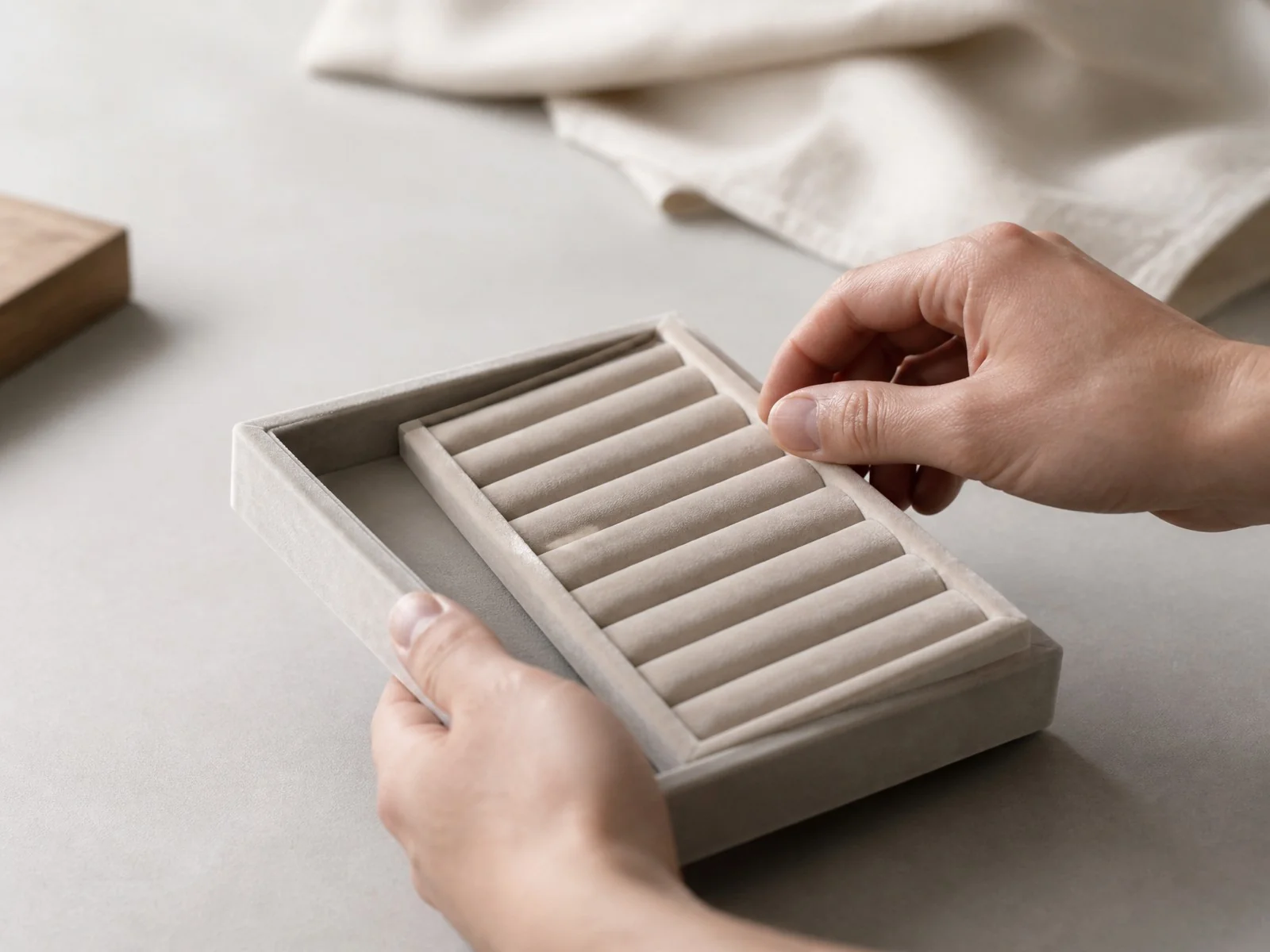
BRTPAK is Jinhua Better Industrial Co., Ltd., a manufacturer in Jinhua, Zhejiang, working across displays, trays, jewellery boxes, watch boxes, watch rolls and watch winders. Published list prices on our own product pages, as reviewed on 27 September 2026, included a velvet necklace display bust at USD 3.60 with a minimum of 100 pieces, a wooden jewellery tray at USD 6.50, and a wooden jewellery display set at USD 350.00 with a minimum of 200 sets. Logo charges are listed separately on several formats. Treat those as published anchors for standard pieces, not as quotations for your project.
Three things we do that buyers tell us are hard to find elsewhere. We produce 3D concept visualisation before physical sampling, so a shape gets rejected on a screen rather than in a sample budget. We optimise structure for carton efficiency rather than chasing the lowest possible unit price, which matters on a multi-store rollout where freight is a real line. And we prepare compliance documentation against the destination market rather than one generic pack.
You can see how the range is put together on our jewelry display tray and online custom design pages, or read the deeper spec guides: jewelry display manufacturer, custom jewelry display manufacturer, necklace display manufacturer, jewelry counter display supplier guide, LED jewelry showcase manufacturer guide, and boutique display solution supplier guide. If you also need boxes for the same rollout, start with Top 20 Jewelry Box Manufacturers in China.
Questions buyers ask us
What does a custom jewelry display actually cost?
No single figure survives a real brief, because a stock velvet bust and a bespoke lit cabinet are different products wearing the same label. Structure moves the price far more than material does. Where a manufacturer publishes list prices, treat them as an anchor for standard pieces and nothing more — a necklace bust, a wooden tray and a full wooden display set sit in three very different places. Custom work has to be quoted against your drawing, your quantity and your finish. Compare landed, conforming cost, because the unit price alone will mislead you.
So what is the minimum order quantity for display stands?
Ask it three ways, not one. Minimum per design. Minimum per material. Minimum per colour or finish. Material and finish usually bind first, and they are often higher than the design minimum. For standard stock displays the practical floor is frequently a pack size — 25 or 100 pieces — rather than a production minimum at all.
How long does a custom jewelry display order take?
Work from the sequence rather than a single number. Drawing or 3D approval first. Then material. Then first-article approval. Production, inspection, packing and booking follow. Standard forms built on an existing tool move quickly. A bespoke cabinet with lighting and glazing is a project with a schedule, not a lead time. Add the freight leg, add public holidays, and ask any supplier to break the total into stages before you accept it.
Can one manufacturer produce both displays and boxes for a store rollout?
Sometimes, and it is worth asking before you split the order. The reason is colour. When trays, risers and boxes come from three suppliers, the greys stop matching, and a customer notices that on the first visit. Ask what material the colour reference is held on, and whether fabric, board and lacquer can be driven to the same target across a range.
How do I know a display manufacturer is a real factory?
Ask for three names and one video. The legal entity, the production site address, and the plant nominated for your order — then a live walk-through of the line that will run your job. Not a showroom tour. Not a pre-recorded clip. Cross-check the entity against public business records and the address against a map. Reselling is a legitimate business model; not knowing which model you are buying from is the problem.
What materials survive a high-traffic retail counter?
Depends what you are protecting, and how often somebody picks it up. Sealed lacquered wood and MDF take daily handling well; skip the sealing and the edges go first. Acrylic wins on weight and on re-cutting, then loses on scratches and cleaning marks. Velvet and suede photograph best and soil fastest. Linen and leatherette land in the middle on both counts. One more step before you commit a counter: put your own product on the lining, not the swatch book.
Do displays have to meet compliance requirements for EU or US import?
Yes, even though a display is not a regulated product category in the way food contact material is. In the EU that means REACH-related declarations for coatings, adhesives and finishes, plus the packaging obligations now applying from 12 August 2026.In California it means a Proposition 65 assessment. Ask for declarations when you request the quote, not when the container is booked.
What protects my display design from being copied?
Paper first. An NDA signed before drawings leave your building, named to the entity that produces the goods rather than the sales office. Then four answers in writing: who owns the tooling and jigs, whether your design can be sold on to anyone else, what happens to surplus units, and how competing projects stay apart on the same floor. Ask that last one plainly. The answer tells you more about the factory than the contract does.
Can displays ship flat to cut freight cost?
Often yes, and it is one of the few cost decisions that pays twice. Knock-down construction cuts volumetric weight, which is what low-density freight is really priced on, and it reduces transit damage because the parts are not carrying their own leverage. The trade-off sits on site: assembly time, and a smaller risk of finish damage at the joints. Ask for carton dimensions and packed volume before you compare freight quotes.
Next step: send your display brief
Compare every candidate on one controlled brief. Put the format, outer dimensions, insert layout, lining reference, hardware, logo method, quantity per SKU, packing requirement and required arrival date in writing. Send the identical document to every supplier and ask each one to list any deviation as a separate alternate line rather than a silent substitution inside the base offer.
Five emails with one good brief will tell you more about these ten companies than ten brochures ever will.
Send your display brief. Include the destination market, the fixture list, the dimensions, the lining and finish references, the quantity per SKU and the date you need the goods on the floor. BRTPAK will return its own cross-border proposal, and you are free to place it beside every other quotation on this page.
✉ Send Your Display Brief to BRT Pak
Supplier identity, factory location, subcontractors, material composition, origin, environmental and certification evidence, samples, tests, inspection, capacity, stock, minimum order, price, packing, schedule and delivery terms remain subject to current source checks, destination requirements, contract, released specification and written confirmation.
Research basis: we re-read every supplier page that could be loaded on 27 September 2026, and the descriptions above stop where those pages stop. Standards and regulatory references were re-checked the same day at ISO, the European Commission's environment pages, California's OEHHA, ISTA and the FSC. One planned source, the EUR-Lex record for Regulation (EU) 2025/40, refused automated access on the review date because it wanted JavaScript, so the packaging regulation is cited from the Commission's own page instead. Where a figure or a minimum was not published, this article says so rather than guessing at one.