
What Should You Expect From a Gift Packaging Box Factory?
A gift packaging box factory should turn a product brief into packaging that can actually be manufactured, packed, shipped, displayed, and reordered consistently.
That sounds obvious. In practice, it is where many sourcing projects go wrong.
A buyer may arrive with a reference image showing a beautiful magnetic box. The factory can copy the outside appearance, but important questions remain unanswered: Is the insert suitable for the actual product? Will the lid stay aligned after repeated opening? Can the outer paper tolerate wrapping without cracking? How many finished boxes fit into one export carton? Will the approved color stay reasonably consistent during the bulk run?
These details separate a packaging manufacturer from a workshop that simply makes something similar to a photograph.
For a B2B buyer, the factory should be able to support at least five areas:
- structural development;
- material and finishing selection;
- prototype and sample approval;
- repeatable mass production;
- final packing and export preparation.
BRT Pak describes its own model as a full-process packaging service covering design, R&D, production, and global logistics, with development stages from requirement confirmation through prototype, material selection, sample confirmation, and final logistics planning.
That end-to-end approach is especially useful when the buyer is developing packaging rather than simply reordering an existing specification.
Who Usually Buys Directly From a Gift Box Factory?
The search term “gift packaging box factory” carries strong commercial intent. Most searchers are not looking for a single empty gift box.
Typical buyers include:
- brand owners launching new product collections;
- packaging and procurement managers;
- jewelry and watch companies;
- perfume and cosmetics brands;
- corporate gift suppliers;
- private-label companies;
- importers and distributors;
- lifestyle and fashion accessory brands;
- retailers developing seasonal gift sets;
- agencies managing packaging for multiple clients.
Their priorities are not identical.
A luxury brand may accept a more complex structure if the tactile experience supports a premium retail price. An importer carrying several SKUs may care more about repeatability, carton utilization, and reorder stability. A DTC brand might deliberately simplify the box to reduce shipping volume.
This is why “best gift box” is rarely the right question.
The better question is:
Which structure gives this product enough protection and the right brand experience at a cost that still works at the intended order volume?
When a Custom Factory May Not Be the Best Choice
Custom manufacturing is also not necessary for every purchase.
A stock packaging wholesaler may be more suitable when:
- you need very small quantities;
- branding is not important;
- standard dimensions already fit the product;
- delivery is required immediately;
- the packaging will be used only once for an internal event.
A factory becomes more valuable when dimensions, structure, logo, insert, surface material, color, or repeat production matter.
Start With the Product, Not the Box Style
One of the most common sourcing mistakes is choosing the structure first.
A buyer sees a drawer box on Pinterest, decides that is the target, and then tries to force a product into it.
A factory-led development process should work in the opposite direction.
Start with:
- product dimensions;
- product weight;
- fragile or polished surfaces;
- number of items per box;
- sales channel;
- target market;
- expected order quantity;
- brand positioning;
- desired opening experience;
- transport conditions.
A perfume bottle, necklace, corporate notebook set, watch, and skincare kit may all be sold as “gifts,” but they place very different loads on the box and insert.
A good structural proposal begins with those differences.
Which Gift Box Structure Should You Choose?
There is no universal structure used by every custom gift box manufacturer.
The table below gives buyers a practical starting point.
| Box Structure | Main Strength | Typical Use | Main Trade-Off |
|---|---|---|---|
| Lid-and-base rigid box | Clean, familiar presentation | Jewelry, perfume, fashion gifts | Two separate components |
| Magnetic closure box | Strong premium unboxing | Corporate gifts, beauty,luxury sets | More components and assembly |
| Drawer box | Controlled reveal experience | Jewelry, accessories, gift sets | Sleeve and drawer tolerances matter |
| Hinged presentation box | Reusable and premium | Watches, luxury accessories | Higher structural complexity |
| Folding gift box | Saves storage and freight volume | E-commerce, promotional gifting | Requires assembly |
| Wooden presentation box | High durability and perceived value | Premium watches,collectibles | Higher weight and cost |
Rigid Gift Boxes
Rigid boxes are common when visual presentation matters.
The important specification is not simply “rigid box.” Buyers should define:
- board construction;
- external dimensions;
- lid depth;
- wrapped paper;
- internal lining;
- corner requirements;
- insert;
- closure.
A small jewelry gift box and a large corporate gift set can both be rigid boxes, yet their engineering requirements are completely different.
Magnetic Gift Boxes
Magnets create a controlled opening feel and make a box more reusable.
They can work well for:
- premium corporate gifts;
- perfume sets;
- cosmetics;
- accessories;
- influencer kits.
But the extra components affect assembly, material separation, cost, and sometimes shipping weight. If the buyer's goal is simpler paper-based packaging, another closure may make more sense.
Drawer Gift Boxes
Drawer structures are effective when the reveal itself is part of the experience.
The key issue is tolerance.
Too tight, and the drawer feels difficult to open. Too loose, and it feels poorly made.
That is exactly the kind of detail that should be checked with a physical sample rather than judged from a rendering.
What Materials Should a Gift Packaging Box Factory Offer?
Material selection affects appearance, structure, production yield, shipping, and final cost.
Common options include:
Paper and Wrapped Board
Paper-based rigid boxes offer broad flexibility in:
- texture;
- color;
- printing;
- embossing;
- foil application;
- sleeves;
- branded graphics.
They work across gift, jewelry, beauty, accessory, and lifestyle categories.
Wood and MDF-Based Structures
Wood or engineered wood structures are used when long-term storage and stronger perceived value are more important than minimum shipping weight.
Typical applications include:
- watch presentation;
- collector products;
- premium corporate gifts;
- keepsake packaging.
PU and Leatherette Surfaces
Leatherette can create a soft, tailored appearance without using the visual language of printed paper.
It is often combined with:
- stitching;
- debossed logos;
- metal branding;
- microfiber or velvet interiors.
Velvet and Microfiber
These materials are often used inside packaging rather than as the structural body.
They are particularly useful when the product has:
- polished surfaces;
- metal finishes;
- jewelry stones;
- watch cases;
- delicate accessories.
The insert should be treated as part of the packaging engineering—not as decoration added at the end.
Sustainable Materials Need Specific Claims
If your brief includes FSC-certified paper, recycled fibre, or another sustainability requirement, define exactly what you require.
FSC distinguishes FSC 100%, FSC Mix, and FSC Recycled claims. FSC also states that only appropriately certified companies can apply FSC product labels, so a buyer should verify the relevant certification and material claim for the actual order instead of assuming that every paper box is covered.
BRT Pak's About page lists FSC certification among its company credentials, but buyers should still confirm the applicable material, label, and chain-of-custody requirements for each project.
This level of specificity is safer than asking for an undefined “eco-friendly gift box.”
What Should Be Customized Beyond the Logo?
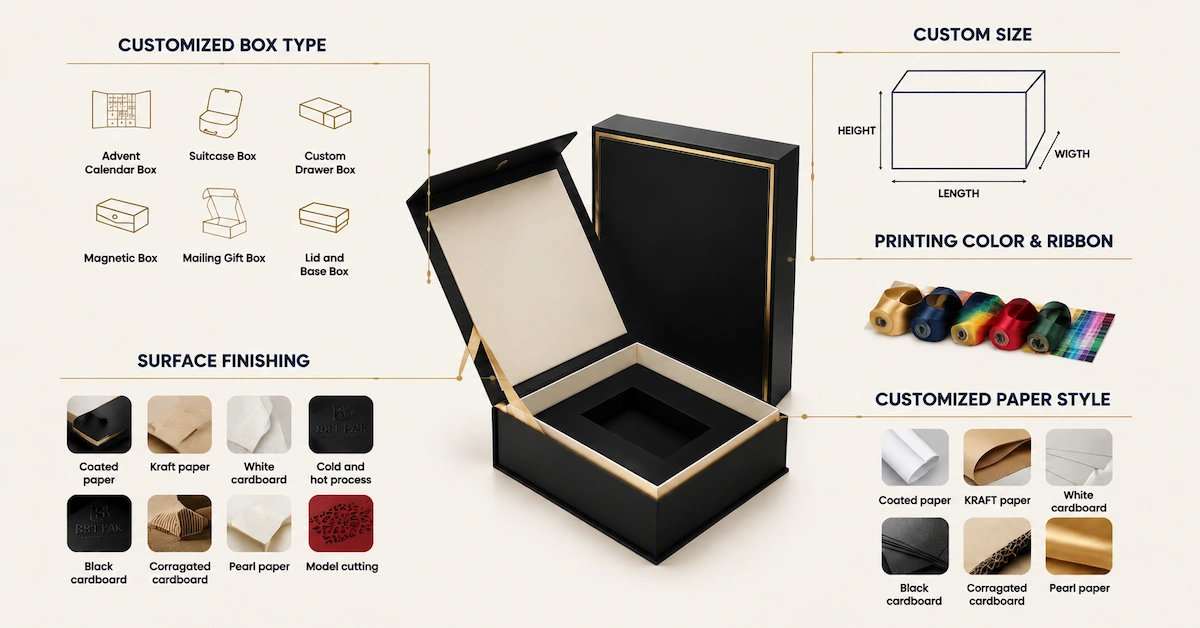
A logo is only one part of OEM gift packaging.
A genuine custom project can involve:
- overall dimensions;
- opening direction;
- lid depth;
- insert geometry;
- surface material;
- Pantone color;
- internal lining;
- ribbon;
- magnet;
- handle;
- sleeve;
- logo process;
- printing;
- export packing.
Logo and Surface Finishing
Common options include:
Embossing
Creates a raised surface detail.
Debossing
Presses the design into the surface.
Hot foil stamping
Adds metallic or colored foil details.
Screen printing
Useful on selected paper, fabric, or synthetic surfaces.
Printed graphics
Suitable when the design contains colors, patterns, illustrations, or product information.
Metal logo plates
Useful when the brand wants a physical premium accent, though they add another material to the structure.
The right finish depends on the surface.
A process that looks excellent on smooth coated paper may behave very differently on textured paper or leatherette.
Why the Insert Deserves Its Own Specification
Many packaging problems start inside the box.
A beautiful exterior cannot compensate for an insert that allows the product to move.
Before approving an insert, check:
- actual product dimensions;
- tolerance around the product;
- insertion and removal;
- pressure points;
- exposed polished surfaces;
- product orientation;
- accessory storage;
- transport movement.
For a perfume bottle, the insert needs to stabilize a relatively heavy object.
For jewelry, the priority may be surface protection and precise presentation.
For corporate gift sets, several items may need to remain aligned even if the carton is turned during transport.
These are not the same design problem.
What Should a Sample Approval Process Include?
A sample should answer questions that drawings cannot.
At minimum, buyers should check four groups of details.
1. Structure
Confirm:
- external dimensions;
- lid alignment;
- drawer movement;
- corner construction;
- opening resistance;
- closure performance.
2. Appearance
Review:
- surface color;
- wrapping quality;
- visible glue;
- edges;
- foil consistency;
- embossing depth;
- logo position.
3. Product Fit
Use the actual product whenever possible.
Check whether:
- it moves;
- it is difficult to remove;
- any surface is scratched;
- the presentation angle looks correct.
4. Packing
Do not stop at the retail box.
Ask:
- how many units go into a master carton?
- are individual boxes protected against rubbing?
- what is the carton size and gross weight?
- can carton utilization be improved?
A sample that looks perfect on a conference table can still be inefficient or vulnerable once hundreds of pieces enter an international supply chain.
BRT Pak's stated development process includes prototype creation and final sample confirmation before production.
Gift Box Factory vs Trading Company: Which Is Better?
Neither business model is automatically better.
What matters is the project.
| Requirement | Direct Factory | Trading / Sourcing Company |
|---|---|---|
| Deep box customization | Usually strong | Depends on partner factory |
| Direct production communication | Strong | Indirect |
| Multi-category sourcing | May be limited | Often strong |
| Price transparency | Usually clearer | Includes service margin |
| Complex supply consolidation | Less convenient | Can be useful |
| Repeated proprietary structure | Strong fit | Depends on supplier control |
A buyer developing a long-term custom gift box program may prefer direct manufacturing access.
A buyer sourcing boxes, bottles, textiles, and accessories in one project may value a sourcing company's consolidation service.
The useful question is not “factory or trader?”
It is:
Who controls the specification, production process, corrective action, and repeat order?
How Does a Gift Packaging Box Factory Control Quality?
Quality control should start before the finished boxes reach the inspection table.
Incoming Material Checks
A project may require checks on:
- board specification;
- wrapped paper;
- fabric;
- hardware;
- color references;
- accessory dimensions.
In-Process Checks
During manufacturing, attention usually shifts to:
- cutting;
- wrapping;
- corner formation;
- adhesive application;
- printing;
- foil registration;
- logo placement;
- insert assembly.
Final Inspection
The finished box should be checked for:
- dimensions;
- appearance;
- opening and closing;
- insert fit;
- surface marks;
- quantity;
- packing condition.
If your company uses an AQL-based inspection procedure, agree the inspection level, defect classification, and acceptance criteria before production rather than after a disagreement occurs.
Keep an Approved Reference
One simple purchasing discipline prevents many disputes:
Keep an approved physical sample and a signed specification as the production reference.
Words such as “premium,” “dark green,” or “soft velvet” are subjective.
A controlled sample is much harder to misunderstand.
Export Packaging Should Be Designed Around the Distribution Route
International packaging is exposed to stacking, vibration, drops, handling, humidity, and repeated transfers.
ISTA advises companies to understand the real distribution environment before choosing packaged-product test procedures. Its guidance specifically considers factors such as vibration, drop, compression, and atmospheric conditions when evaluating packaging performance.
For gift-box buyers, that leads to a practical rule:
Do not optimize the retail box separately from the shipping carton.
A factory should understand:
- destination;
- shipping mode;
- units per carton;
- storage conditions;
- handling route;
- acceptable cosmetic condition on arrival.
This is especially important for high-gloss surfaces, wrapped rigid boxes, wooden packaging, and boxes with delicate decorative finishes.
What Actually Determines Custom Gift Box Cost?
Searching for a universal “gift box factory price” is rarely useful.
A custom quotation changes with the specification.
| Cost Driver | Why It Changes Price |
|---|---|
| Box dimensions | Changes board, paper and shipping volume |
| Structure | Affects assembly steps and components |
| Material | Specialty papers, wood, fabric and PU vary |
| Insert | Simple paper dividers differ from complex fitted inserts |
| Printing | Coverage,colors and process matter |
| Finishing | Foil, embossing and hardware add operations |
| Quantity | Changes setup cost per piece |
| Accessories | Magnets,ribbons and metal parts add material/labor |
| Packing method | Affects protection and export volume |
| QC requirement | Additional inspection can add process cost |
Why the Lowest Quote Can Cost More
A low quotation can hide differences in:
- thinner board;
- simpler wrapping paper;
- weaker insert;
- fewer inspection steps;
- less protective export packing.
That does not mean the lowest quote is always wrong.
It means the quotes must be specification-matched before comparison.
What Should Be Included in a Gift Box RFQ?
If you want meaningful quotations from several factories, send the same brief to all of them.
A useful RFQ includes:
| RFQ Item | What to Provide |
|---|---|
| Product | Name, dimensions and weight |
| Quantity | Initial order and expected repeat volume |
| Box size | Target dimensions if known |
| Structure | Drawer, magnetic, lid/base, folding, etc. |
| Material | Preferred board/surface material |
| Insert | Product layout and material preference |
| Artwork | Logo and print files |
| Colors | Pantone or physical reference |
| Finish | Foil, emboss, print, coating, etc. |
| Market | Destination country/region |
| Packing | Individual and master carton requirements |
| Deadline | Required shipment or launch date |
| Compliance | FSC or other project-specific requirements |
Do not simply send:
“Please quote 5,000 luxury gift boxes.”
A better inquiry is:
“Please quote 5,000 rigid gift boxes for a perfume set. Finished product size is X × Y × Z. We need a wrapped paper exterior, custom fitted insert, gold foil logo, and export packing for Germany. Please quote sample cost, tooling if any, unit price, carton details, and production schedule.”
That message is far more likely to produce a usable quotation.
How Should Buyers Evaluate Production Capacity and Lead Time?
Avoid asking only:
“How many boxes can you produce per month?”
Capacity is useful, but your order depends on:
- material availability;
- current factory loading;
- number of finishing processes;
- manual assembly content;
- order quantity;
- QC requirements;
- peak-season scheduling.
Ask for a project calendar instead.
It should show:
design confirmation → sample → sample approval → material preparation → production → final inspection → shipment
BRT Pak states that its packaging development includes 3D visualization, material matching, prototyping, manufacturing, and logistics management.Its About page also describes a manufacturing team of roughly 400 specialized employees.
For your actual order, however, production timing should still be confirmed against current factory loading rather than inferred from company size.
What OEM/ODM Support Should a Good Factory Provide?
OEM means more than applying a client's logo.
For a repeatable packaging program, the factory should be able to preserve:
- structure;
- size;
- materials;
- colors;
- artwork;
- insert;
- approved finishes;
- packing specifications.
ODM capability becomes more valuable when the buyer has an idea but no finished packaging drawing.
The factory may then help translate:
“premium corporate gift box for three products”
into:
- a proposed structure;
- compartment layout;
- material combinations;
- opening sequence;
- manufacturable dimensions;
- prototype.
BRT Pak says its service model covers OEM/ODM/OBM management and development from digital validation through scaled manufacturing.
Buyers can review its broader packaging categories here: BRT Pak Products
How to Compare Two Gift Packaging Box Factories
Before choosing a supplier, score both factories using the same criteria.
| Evaluation Area | What Good Evidence Looks Like |
|---|---|
| Product fit | Relevant gift-box projects |
| Engineering | Clear structure and insert recommendations |
| Sampling | Documented prototype approval process |
| Materials | Defined material specification |
| Finishing | Samples matching required techniques |
| QC | Clear checkpoints and defect handling |
| OEM/ODM | Ability to preserve custom specifications |
| Communication | Written confirmation of revisions |
| Export packing | Carton plan and protection method |
| Certification | Documents relevant to your order |
| Commercial terms | Transparent inclusions and exclusions |
| Reorder control | Ability to reproduce approved version |
Do not select a supplier from website appearance alone.
Ask for evidence that relates to your packaging.
Common Sourcing Mistakes That Create Expensive Problems
Approving Only a Rendering
Renderings are excellent for visual discussion, but they cannot reproduce the real hand-feel, friction, wrapping quality, or insert tolerance.
Always confirm critical projects with a physical sample.
Changing Materials After Sample Approval
A cheaper substitute may affect:
- color;
- wrapping;
- foil adhesion;
- stiffness;
- appearance.
If a material changes, confirm whether a new sample is necessary.
ISTA similarly recommends retesting when changes to the product, packaging, materials, or distribution process may affect packaged-product performance.
Leaving Color Undefined
“Champagne gold” is not a controlled specification.
Use:
- Pantone references;
- approved printed samples;
- physical swatches where necessary.
Ignoring Export Carton Size
Retail packaging is only part of your landed cost.
A slightly oversized gift box multiplied by thousands of units can significantly change shipment volume.
Asking for “Best Quality”
Quality needs measurable requirements.
Define what matters:
- no visible glue;
- logo tolerance;
- color range;
- lid alignment;
- surface defect criteria;
- insert fit.
Why BRT Pak Fits Custom Gift Packaging Projects
BRT Pak's current product system includes gift boxes alongside jewelry boxes, eyewear and watch boxes, displays, bags, and watch-related packaging.
The company positions itself around full-process development rather than box production alone, including requirement analysis, design, prototype development, material selection, sample confirmation, manufacturing, and logistics.
That model is relevant to brands that need:
- a new gift-box structure;
- coordinated packaging across several SKUs;
- private-label packaging;
- custom inserts;
- premium finishes;
- repeated export production.
You can review the company's capabilities through About BRT Pak or send a project brief through Contact BRT Pak.
FAQ
What is a gift packaging box factory?
A gift packaging box factory manufactures presentation and protective boxes for commercial buyers. Depending on its capabilities, it may also provide structural design, material selection, sampling, logo customization, inserts, quality control, and export packing.
How do I choose a reliable gift packaging box factory?
Compare factories based on relevant projects, sample quality, material specification, OEM capability, production control, QC procedures, export experience, and the ability to reproduce an approved sample—not only unit price.
What types of gift boxes can a factory customize?
Common options include rigid lid-and-base boxes, drawer boxes, magnetic closure boxes, folding boxes, hinged presentation boxes, wooden boxes, and product-specific gift sets.
Can I customize the size, material, insert, and logo?
Yes. A custom gift box project can typically modify dimensions, exterior material, inner lining, insert design, colors, printing, logo finishing, closure, and export packing, subject to manufacturing feasibility.
What information does a factory need for a quotation?
Provide product dimensions, quantity, box structure, preferred materials, insert requirements, artwork, colors, finishing, destination market, required delivery timing, and reference images.
What is the MOQ for custom gift boxes?
There is no universal MOQ. It depends on material purchasing, printing, tooling, structure, finishing, assembly, and the factory's production setup. Request a project-specific MOQ rather than relying on a generic number.
How long does custom gift box production take?
Lead time depends on design confirmation, sampling, material procurement, order quantity, finishing processes, current factory loading, QC, and shipping. Ask for a complete project schedule rather than only a mass-production estimate.
How can I reduce gift box costs without making the packaging look basic?
Start by optimizing dimensions, reducing unnecessary components, simplifying hidden surfaces, standardizing some structures across SKUs, and using premium finishes selectively where customers actually see and touch them.
Can FSC-certified materials be used for gift boxes?
They can be used when an appropriate certified supply chain and material claim are available. FSC has specific rules for FSC 100%, FSC Mix, and FSC Recycled labels, so confirm the applicable claim and documentation for your project.
Should I test gift packaging before international shipment?
For products where shipping damage or cosmetic box damage is a commercial risk, transport testing or another defined packaging validation process can be valuable. ISTA recommends selecting test procedures based on the actual distribution environment.
Conclusion
The right gift packaging box factory is not simply the supplier that produces the most attractive sample or submits the lowest quotation.
For B2B buyers, the stronger partner is the one that can turn a packaging brief into a repeatable manufacturing specification.
That means understanding the product first, selecting a suitable structure, matching materials with the brand position, engineering the insert, controlling finishing, approving a physical sample, defining QC criteria, and planning the retail box together with its export packaging.
Price still matters.But price only becomes meaningful after two factories are quoting the same specification.
BRT Pak supports gift, jewelry, watch, retail, and related custom packaging projects through design development, material selection, prototyping, OEM/ODM manufacturing, and logistics support.
If you are preparing a new packaging project, send the product dimensions, expected order quantity, target market, preferred box structure, branding requirements, and reference images through BRT Pak Contact Us. A complete brief gives the factory enough information to propose a realistic structure, sample plan, and quotation instead of guessing from a reference photo.